
While I was away, I had many thoughts I could have posted in the blog. Here’s one of them:
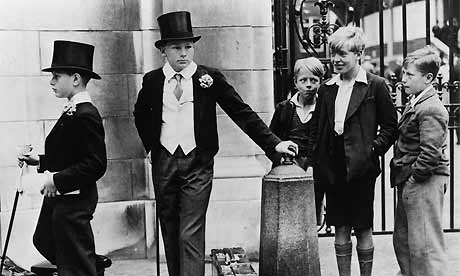
This photo was taken in 1937. It shows two boys from Eton, one of England’s leading public schools (we’d call them prep schools in the USA). They’re visiting London — not to go to the opera, or meet the king, but to attend a cricket match, with Eton’s rival, Harrow. Working-class boys are gawking at them.
The photo ran in the Guardian, the British paper, at the end of August. They used it to illustrate a piece on continuing inequality in British education. But the classical music implications are about formal dress. In 1937 — when the classical music audience was the same age as the population at large, and classical music played a much larger part in everyday life than it does now — it also made more sense for classical musicians to wear formal dress. As the photo shows, people outside classical music wore formal dress, too. It wasn’t just Eton boys. Men in the British upper class might wear tuxedos when they ate at leading restaurants, or at theater openings, or even at dinner at home. In American films from that era, we can see men wearing white tie and tails as evening dress.
So formal dress for classical musicians had some social roots. We might find those social roots too upper-class — I know I do. Men in orchestras look like old-line British aristocrats, or else like those artistocrats’ highest-ranking servants. But still there was a context, when musicians dressed that way.
There isn’t any context now. Formal dress for classical performances just looks weird, and ancient. Time to put a stop to it.
I disagree compleatly Alex. Clothing plays a role in the preformance.
If I attended a Minnesota Orchestra concert and they were not in their regular performance attire I would be disappointed. I don’t think it looks weird at all, but normal. I’ve never been distracted by their clothing, which only enhances the performance.
The jazz tradition allows for more choice in clothing. But still, early jazz musicians, who I think it’s safe to say had little British influence, wore suit coats. Even today, Ethan Iverson is almost always in a coat, and he is just one of many. In fact I can’t remember a concert where the musicians were in jeans.
In pop music clothing is arguably more important to the performer than their performance. I can see no other reason for a costume change mid-performance than to draw attention to your clothing and, necessarily, away from the music.
It’s true that many jazz musicians still wear a suit and tie when they play, especially for concert-hall gigs. But I’m not sure Ethan Iverson is the best example you could have chosen to represent this phenom. I mean, you understand that in the Bad Plus, where Ethan wears a suit and Dave and Reid wear regular street clothes, when you see them playing “Tom Sawyer” and “Life on Mars” in a rock club, the suit starts to look kind of… ironic. Or at least, a knowing exaggeration of Ethan’s role as the “straight” in that band. And you know, when I dress up in a morning coat, I am taking the piss (as the Brits say).
Maybe Anti-Social Music could get away with wearing formal wear ironically. The New York Phil, not so much. Classical instiutions are pretty much incapable of any sort of irony.
I went to the Music Builds Tour the other night, which meant a considerable drive, but a couple of favorite bands were on the bill. I was interested to note that some of the bands just dress as if they were going to, say, the grocery store, some dress in flashy versions of ordinary dress, and one band had matching tight white outfits. The dress of the band didn’t appear to influence the audience one way or another. It would be hard to say what the rationale behind the bands’ sartorial choices were, except personal preference of the person with the most influence, I suppose.
I take your point that formal dress is no longer something common in general society. The question is, what is the purpose of the dress worn by a performing group, other than the obvious one of decency? If it is to efface individual expression to the greater good of the music, then I suppose any uniform dress would do. (This is the rationale I’ve heard for matching formal outfits.) Would it actually make people in the audience more comfortable if people wore street clothes to perform? Not the usual audience – I suspect it would make them less comfortable. But would it make new attendees feel less intimidated? These are not rhetorical questions – I actually want to know if there is any data out there. In a sense, I think it actually puts more pressure on the performers to not have standardized dress, in the same way as “casual Friday” does. Instead of pulling out the uniform, they have to put together an outfit that will be comfortable and workable, as well as, hopefully, reasonably attractive. And could the putting on of formal clothing be a sign of respect from the performers for the audience? I know that I feel that way. Whether this is what the audience gets from it is another question.
When I became the director of The Pittsburgh Camerata 10 years ago, one of the few stipulations I made, other than artistic freedom, was that I would not be embroiled in any debates over the dress the women wear. So it isn’t really my decision what my group wears. But the question comes up from time to time. The debate has never, to my knowledge, been over whether to wear “formal” dresses, but which formal dresses. It would be interesting to see what came out if the debate was constructed differently. I have a considerable age range among my singers, and it might be interesting to see whether the vote split along demographic lines. One of my current singers auditioned because, as he said, he wanted an excuse to buy a tux. He is admittedly not in the demographic groups that are underrepresented in our audience. (There, wasn’t that stated with exquisite political correctness?)
I would love to hear other opinions on this question…
As someone who has been a professional orchestra musician for a number of years I can attest that wearing formal wear feels as ridiculous as it looks. We should be wearing suit and tie, like other professionals. It’s good enough for the Berlin and Vienna Philharmonics, (or office workers, basketball coaches etc etc) it should be just fine for us North Americans.
@Jeff: Vienna Philharmonic in suit and tie? Not always. Last time I saw them play (Sydney, 2006) they wore tails, and they wore them really well. It was the first time that I had seen a modern orchestra wear tails “properly”. To give an example, every man in the VPO had the appropriate patent dress shoes for this kind of suit. (I understand that the VPO is very strict and fines are involved.) Now that’s a petty example, I know, but the point is, if you’re going to adopt a uniform it should be adopted sincerely and in its details. And I think that’s where formal tails not being a common type of social attire nowadays puts a lot of male musicians at a disadvantage – the details or etiquette of its wearing have been lost. You end up with the concert equivalent of “I’m wearing the tutu, I’m sure these ballet flats from Kate Spade will do nicely.” (I even heard an orchestra manager suggest the other day that a musician could wear “any kind of white shirt” with a tail suit.)
So that’s one argument for saying that a mode of clothing that’s no longer regularly worn in even some element of society no longer has a place on the concert hall stage. Or…, perhaps it’s an argument for saying that orchestras (if they are going to put their men in tails) should be stricter with their dress codes, because the VPO looked as well as sounded fantastic.
A more general postscript. It’s likely that the VPO adopted tails as their costume (yes, I think that’s what it is) for their Sydney tour to suit the local custom and audience expectations for a gala event. Which is pretty smart.
And in the end, that’s why a “Time to put a stop to it” dismissal so annoys me. It’s an inflexible stance and doesn’t take into account the variable influences such as tradition, expectations, nature and content of the program, character of the event, and aesthetics, not to mention sheer practicality. Sure, there are times when tails are not right for the occasion – and most orchestras now have a range of dress codes from tails through tuxedos to suit-and-tie, pants-and-coloured-shirts, and even “jeans, no rips” (as in the case of one orchestra I know). Surely our key to survival is more of that kind of flexibility and adaptability, not to mention imagination, rather than more dogma? After all, for every person who sees a musician in tails and thinks of stuffy British aristocrats or butlers, there’s another who simply thinks “Don’t they all look elegant?”
Good stuff, and I agree. I wonder if an orchestra pulling itself out of this archaic habit would also cause a mind change that brought the music along with it? Imagine a whole orchestra and supporting organization that acted more relevantly, like the Kronos Quartet?
I think the focus on concert dress is exaggerated. It is true that white tie and tails is antiquated formal wear. There are virtually no occasions when even the elite have to wear tails. And the fear among classical music execs and performers, I guess, is that the dress enhances the caricature of the art form as a living fossil, frozen in amber in about 1910. The assumption appears to be that more modern dress would lower at least one of the barriers to participation in classical music that discourages young people who are part of an increasingly informal culture (I read that tie sales had fallen to the lowest level ever). Maybe that’s true, but having performers wear a distinctive form of dress sends a subliminal but direct message that the event one is attending is special. A friend of mine works in a distinguished law firm that dropped its casual Fridays because clients spending $300 an hour didn’t want their attorneys to look like the people behind the cash register at Starbucks. When I pay $60 for a concert ticket, I want to feel that I’m attending an _event_ (and I put on a coat and tie for the occasion too). I don’t think that there’s any evidence that young people are especially repelled by ties and tails, especially if they’re free to wear jeans to the concert. When concert tickets go on reduced-price sale, the audience is markedly younger. The barrier to joining a culture of attending classical concerts is much more financial than sartorial. I love classical music but can’t afford many concerts because $50 (or more) is a significant expense for me. I sympathize with musicians who find the dress uncomfortable, but it certainly doesn’t seem to prevent outstanding performances, since I’ve recently heard great work from the orchestras of Chicago, St. Louis, Cleveland, and Amsterdam, all in tails. And, personally, I don’t want the orchestra to look like a meeting at the American Bar Association. I want them to look like an _orchestra_.
Bottom line: musicians can ditch the tails, but that won’t in itself make young people think concert halls are now places for people like them. And to some degree, discarding the distinctive formal garb will dilute the brand.
We are constantly bemoaning the aging of our arts audiences. While putting the orchestra in less formal clothing may, in fact, help to ease the sense of formality that, I believe, does keep some younger audiences away. Of course, it’s not a cure all – and it, perhaps, doesn’t make sense to have the orchestra dressed less formally than the audience (like for a gala). That said, simply dressing-down the orchestra without a corresponding unbuttoning of things like ticket-prices will have little to no effect
A well-fitted tuxedo is actually wonderfully comfortable to wear. I know I play better when I look better…….as several women after performances have commented, “Why does every man looks better in a tux”? My only gripe is the cleaning bills!
there are a lot of options between dressing like a hobo and formalwear. classical musicians need to find that chic medium, which isn’t difficult. i still don’t like when musicians in any genre of music wear a raggedy t-shirt and shabby denim. it looks careless…but then again, i am a very fashion conscious and fashion-forward. but i think everyone should be, especially if they are performing in public.
Maybe not formal dress, but “symphony” implies togetherness, unity of purpose, harmony. I’d like the dress to match the intent. I don’t want to see everyone in their own version of casual Friday. It’s a show. You need costumes. Being from SoCal, I wouldn’t mind seeing my local symphonies in, say, sharp white pants and Hawaiian shirts, but everyone ought to be on the same page.
The problem isn’t formal dress per se, it’s just that it’s formal dress from another era. Yes, wear a coat and tie, that’s what people wear nowadays for formal attire, but no tuxedos – unless we’re going to do a colonial Williamsburg thing and dress to match the era of each piece performed (with powdered wigs for Mozart and Haydn), it just doesn’t make any sense.
I can see the reasons for and against, but my personal and professional preference is that the ensemble should reflect the times and the audience they want to attract.
Minnesota Orchestra plays in their civillian clothes for the annual Institute performance and I find that the audience is more comfortable and seems to relate to the orchestra and hence the music better than when the players are in formal dress. Perhaps removing of the us and them dynamic between ensemble and audience creates a more receptive environment for new music.
While there are, of course, important meanings telegraphed by what performers wear, there are also fabulous sponsorship opportunities. The Jazz at Lincoln Center Orchestra look terrific in matching suits made by their sponsor, Brooks Brothers (sometimes different sections wear distinctive ties). As an ensemble, they look like serious, confident working professionals.
Between proms and weddings, (whose average participants are a damn sight younger than we in the comboxes,) and the Oscars/Emmies/Golden Globes, (which are watched and obsessed over by a much larger, younger, less wealthy, and less educated group than classical music is,) men’s formal dress, (as well as informal dress, that is, the tuxedo,) is still widely admired, (yeah, guys, you do all look better in it,) and widely acknowledged as signaling that something SIGNIFICANT is happening.
I do not understand the impulse to try to make it appear to others that what one is doing is not very significant…
Ginny said: “…widely acknowledged as signaling that something SIGNIFICANT is happening.”
But imagine if they wore something that said something FUN is happening. Classical music might creep past 2% market share!
Two things:
Large Ensemble vs. Small Ensemble – over time, I think that the concept of identical or similar dress for large performing groups has become accepted as a way to create a sense of unity and cohesiveness (similar to the military). If everyone wears something different, it heightens the individuality of each performer (as in jazz or rock) but that may run counter to an orchestral concept (depending on the orchestra, of course). Tuxedos are still the most efficient way of getting a large number of people to purchase uniforms on their own and expect that they’ll mesh visually – unless orchestras are going to purchase uniforms for all their performers (which would be great!), then I’m afraid we’re stuck with tuxes.
Darcy mentioned jazzers performing in formal attire in concert hall performances, and I think that the concert space makes a difference here. The concert hall is in many ways like a church or government hall (in the Capitol, for instance), and while it’s not unheard of for casual dress to be found in those venues, our culture sees those places as special and therefore appropriate for a more formalized dress. Basically, if you don’t want to wear a tux, move the venue.
good point, bill. a “fun” aspect would definitely attract more people.
Ginny wrote: “I do not understand the impulse to try to make it appear to others that what one is doing is not very significant…”
The way we classical musicians seem to place the idea importance above enjoyment turns people off, thus making classical music seem stuffy. Yes, classical music is significant, but making concerts such a significant thing makes it too much of an event–and who (especially new listeners) wants to do that every week? The way we dress sends a certain message across, and the message we need to send is that classical music is not sterile. We already perform music that is hundreds of years old, so performing in [permutations of] formal wear that we’ve been wearing for a hundred years does not help us appeal to the general publisc. Also, the fact that everyone wears the same thing gives off the impression that classical musicians lack personality.
@Yvonne.
No, of course Vienna don’t always wear suit and tie, nor does Berlin, however, Vienna has worn them for every New Years concert for some time now. I just speak from personal experience that as soon as I step off the stage I can’t help but feel ridiculous dressed like Mr. Peanut.
I defy anyone to honestly say that this performance is diminished by the clothes:
http://video.google.ca/videoplay?docid=5544595658870198316&ei=62fQSNSkPIfy-wGxyOjHAg&q=boulez&vt=lf
(and yes I realize that is neither the VPO or BPO)
To Susan’s point, perhaps we take the practice of performing music that’s hundreds of years old and have the orchestra (or ensemble) costumed for the appropriate epoch?
Having the players historically dressed for a Schubertiade would throw a curve ball into the whole process and perhaps attract a completely different audience we’ve never contemplated. Rennaissance Festival-types would be in heaven! I think this would definitely add a dimension of fun for the audience and players alike (and throw in a history lesson for kicks).
Of course this could only be done for historically themed performances or chamber ensembles – I don’t think you could have the orchestra changing costumes for every piece – or could you?
Tuxedos are still the most efficient way of getting a large number of people to purchase uniforms on their own and expect that they’ll mesh visually – unless orchestras are going to purchase uniforms for all their performers (which would be great!), then I’m afraid we’re stuck with tuxes.
Seriously? More efficient than, say, a white cotton dress shirt & black pants? If visual meshing is the purpose, there’s still no reason for a tuxedo to be involved in the equation. If anything, the cost (initial + regular dry cleaning) makes them quite inefficient.
Speaking of outdated formalities, one of my CAPTCHA words below is Vicomtesse. Love the new system.
@Wendy
Why stop there? Why not retrofit all concert halls to 18th century architectural standards and seat the audience by socioeconomic class complete with a seat for the Emperor?
Just because the art in question is 200 years old, doesn’t mean everything around it must be too. It’s like saying you must eat nothing but cabbage soup and boiled potatoes for weeks before being able to appreciate Dostoyevsky.
ehehehe…maybe itll make a comeback…lol
The irony of that photograph is that one of the ‘toff’ boys died of diptheria soon afterwards, whereas the working-class lads all lived long lives.
People guess that the term paper thesis accomplishing seems to be the really time consuming issue. Nevertheless, students rely on the paper writing service assistance anytime when it is required.
” As the photo shows, people outside classical music wore formal dress, too. It wasn’t just Eton boys. ”
It really doesn’t show that…
The boys are from Harrow School not Eton. Harrow has morning stripes for Sunday dress and is located in North London, where Marylebone Cricket grounds (more commonly known as Lords) is also located, where as Eton is in Windsor in Surrey. This has been a common mistake.