
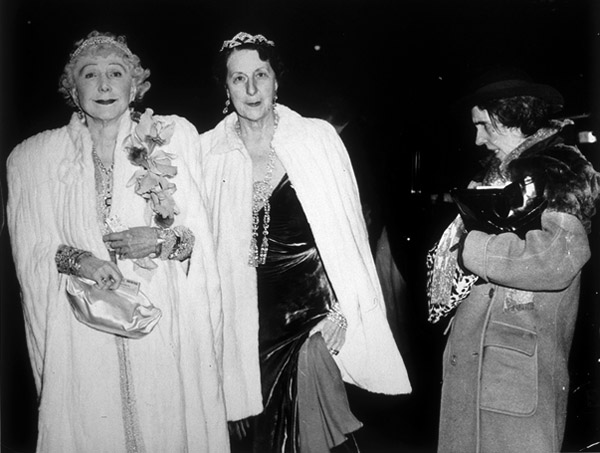
(A portion of a famous photograph by Weegee, showing society women on their way to the opening of the Metropolitan Opera season in 1943. Yet another example of formal dress of a kind we just don’t see anymore in real life.)
First, the new comment system — I love it, love it. Comments go online without waiting for my approval. So they go up fast, many of you comment on the comments, conversations start. And I don’t have to do anything at all. I don’t have to take time to approve each one, and I’m freed from the temptation of adding my own replies, nearly every time. This is good for my schedule, and good for, oh, let’s say my lightness of being.
Many thanks to the readers who suggested I adopt this system.
But, a question — would you all prefer that I commented on the comments more, as I used to? Yes? No? Tell me what you think.
And about the formal dress discussion — I loved that, too. Seems like you all covered a lot of ground, and that a lot of points of view were represented, very fairly.
One thing I noticed: some of us (me included) are very sure that our point of view is right. Or, maybe more precisely, that it’s the most important point of view. People who like formal dress think concerts would suffer without it, and think that many others in the audience agree. People who don’t like formal dress (me included) think it weakens concerts, and think it might keep (or at least help to keep) a new, young audience away.
The most fair conclusion I can come to, observing this, is that both sides are partly right. Both kinds of people really do exist, the ones who like formal dress and the ones who don’t. What we don’t know, as Rebecca wisely pointed out, whether formal dress really does keep any large number of people away.
I’d also add that we don’t have numbers — we don’t know how many people are attached to formal dress, how many people in the audience already (and among musicians) would like to see it go away, and how many people might be more likely to come to concerts if the dress was looser, less predictable, less formal, more fun.
And is either group growing? Is either group shrinking? Are there fewer people each year who demand formal dress, and more who want it over with? Is less formality the trend of the future, and formal dress a remnant of the past? I think that’s true, but I don’t have data. I can’t prove it.
Yvonne is right — we have to be adaptable. This is one of many areas in which classical music might have to play both sides of the fence, at least for a while. We might need formal concerts for the people who want them, and less formal ones for other people. And I guess there should be studies of what people in the audience — or the prospective audience — might really want. Maybe studies like that already exist! If anyone has heard of any, please let me know.
But studies might not be accurate. That is, many people may never have seen a full orchestra, for instance, dressed informally, and therefore don’t know how they’d really feel if they were hearing one. The study, in other words, might end up skewed toward favoring formality, just because too many people haven’t experienced the alternative.
And new music, as Wendy noted, doesn’t go well with formality. Bill, I think, implied something like that when he cited the Kronos Quartet as an ensemble that defines its brand — so to speak — and also supports its art by dressing in an individual way. Which reminds me that, as far as I know, very few chamber ensembles — and certainly very few made up of young musicians — dress formally for concerts. For new music, white tie and tails (and the women’s equivalent) really doesn’t seem to fit. Especially if a piece sounds and moves with echoes of pop culture, or is a happy or devastating assault of noise. What’s the meaning then of tails? Irony wouldn’t begin to be the word that might describe the disconnect.
Finally, I might note some successful ways I’ve seen ensembles dress. Way back in the 1960s I saw a performance of Stravinsky’s Les Noces at Harvard, conducted by Leon Kirschner. The chorus wore black pants or skirts, and brightly colored t-shirts. I’d guess the choral singers picked their t-shirts independently. The look was festive and alive, perfect for the festive piece. (Well, OK, the piece lives partly in the Russia of centuries ago, and the t-shirts were very up to date American, but still they worked.)
And once I saw the Brooklyn Philharmonic, in a purely orchestral concert, featuring new music, dress similarly — black below the waist, colors above. But no t-shirts (if I remember accurately), and with more muted colors.
Finally, the Northern Sinfonia, the orchestra that serves the twin cities of Newcastle and Gateshead in England, dresses in informal spiffy black, not a jacket or a tie in sight. They play in a large modern concert hall, exactly the kind of space where most of us are used to seeing tails. When the musicians walked on stage, the hall came alive. They looked relaxed and happy, with no need, apparently, to invoke an atmosphere of sanctity, or any sense of the importance of what they were about to do.
In Britain, I can imagine, orchestras are more likely to be informal, because the musicians tend to be younger. (Orchestral pay is very low, so not so many people continue playing in orchestras as they grow older.) And for the Northern Sinfonia, it’s a way of life. At the concert, I happened to be sitting next to the man who ran the arts center that includes the concert hall. He himself is informal — his trademark dress is a shirt with no jacket. He looked quite spiffy. I asked him if the orchestra always wore what they were wearing, and he said — very proudly, I thought — “Yes! They even dressed this way a month ago, when the Queen came to a concert.”
Which again shows how very differently people can react to this issue.
I’m one for both sides – a fence sitter if you must. I like the more casual styles that are starting to creep through. All black, or black below the waist can be extremely stylish, and there’s lots of fantastic fashion coming through for men that allows this to happen. Also, the difficulty in finding the more formal wear for such concerts also leans me more towards this as a future. For about a year and a half now I have been trying to put together a dinner suit. I found one in an op-shop quite cheaply that didn’t quite fit. In my initial searches a store that i get quite a lot of my clothes from had a dinner shirt, but when my parents found another dinner suit at an op-shop that fitted me (thankfully, mine fitted my dad, who was also needing one), the store no-longer stocked dinner shirts. Now obviously I’m not actively going out to find a full dinner suit, but I think this highlights the problem – these things are awfully hard to find, where as black pants are relatively easy to find.
However, there is also part of me that respects the traditions of those that have gone before me. Those that invoked the sanctity in the concert going experience, that made music other-worldly. Music – in all honesty – is the one art from that still clings to this aspect of tradition. In art and sculpture, once it’s completed there is no tradition left in its viewing – you can view it in jocks and a singlet if they’d let you in the museum. Plays are often getting a more modern reworking, as is the case with ballet and opera. Orchestral music can still have this almost religious atmosphere created by the performance, by the respect paid to the music through the traditions.
That being said, as more young people come through the ranks into orchestral careers, I feel that eventually you will see more and more orchestras going away from the tuxedos, especially seeing as I believe most youth orchestras do not use these. As these people get into the orchestras and into the orchestral management roles, then this will start to change.
Not “data”, but illuminating in the context: In a city where I worked in the past many in the audience for the symphony orchestra also subscribed to the concerts of a touring chamber orchestra. The latter, being a smaller group with younger personnel and a consciously youthful image, had adopted a designer “uniform” (possibly sponsored). The orchestra performed most evening concerts in tails.
The symphony orchestra’s audiences frequently wrote comparing their concert experiences between the two groups (and I recall these from memory, naturally). What is interesting to me is that they never commented on dress.
The comparisons they did make and which were clearly very important to them were along the lines of: the chamber orchestra comes on stage together smartly as a group, the symphony orchestra straggles on like cows and warms up on stage; the CO looks happy to be there and they smile and look at us when we applaud…; the CO strings finish the finales with all bows raised together (I think the implication here is that they looked like they were working together on a performance that acknowledged a visual element)…
In other words, what they were noticing whether the musicians were treating the performance as (pace) a “show”, a “performance” in every way beyond mere costume (since in that respect the two groups were equal although different). They were noticing whether the performers appeared to take pleasure in what they were doing or demonstrate any connection/interest in the audience. They never suggested that the SO dress like the CO or that they were turned off by the formal clothing, but they did so much want them to smile.
I’d be the last to say that clothing doesn’t make a difference. Whichever view you hold it makes an important difference. But it seems to me that that particular audience group was zeroing in on something much more fundamental to the effect a concert is going to have.
To answer your question: I enjoy your comments and responses-to-comments and would be sad to see them disappear altogether. But don’t sacrifice that lightness of being!
Once again I’ll say: there’s not one right way to do any of this. People like different things, and they respond quite differently to the same stimulus. For some people, fancy dress means “special,” but for others it means “stuffy.” For some, casual dress means “friendly,” but for others it means “not special.”
For a while I hosted an orchestra’s youth programs, presented during school hours. We wore suits and ties and colorful dresses. Some teachers said, “Why don’t you dress up more? It would make the concert more special.” Others said, “We really like the way you dress up. It makes the concert special.” Still others said, “Why do you dress up so much? It’s off-putting.”
The same clothes meant completely different things to different people. (And of course there are plenty of people for whom clothes don’t matter.) I think this is how people are. It’s part of the fun.
Music’s purpose is not to please everybody, so I think musicians should give up trying to dress in a way that pleases everyone. It’s impossible.
My guess is that formal dress persists at classical concerts not because so many people love it but because musicians are used to it and generally don’t want to hassle with finding something else. Formal dress is just a habit, like other aspects of concerts that happen without clear intent.
I suggest that we performers consider what effect or mood we want our clothes to convey, and choose clothes that, for us, convey that. That way of dressing won’t convey the same thing to every listener (and neither will anything else about the performance), but it will mean that performers will dress in keeping with their intentions. And it should result in musicians dressing in a variety of ways for different kinds of events.
While I am a staunch supporter of initiatives to make the concert experience more contemporary, I agree that there are pitfalls, as many have pointed out. As a musician and (student) conductor, I am anti-tuxedo. I suppose this reveals that my youth way have something to do with my opinion, but I think the tide must turn against this tradition (and many others, especially hero-worship) eventually if the orchestra as an institution can regain relevance in a contemporary world. I haven’t read every single comment, but I suppose I’ll repeat that at best a tux has the sartorial implication of a waiter, and at worst, the suit a redneck rents to look classy at his wedding. Indeed, the rank and file of society do not own these suits, and may only wear them twice if at all (senior prom and their wedding).
But opening up the can of worms of what to wear instead is a huge problem. The idea of a uniform is an aristocratic one, and quite possibly suggests to many a militaristic style of management of artistic production. I’ve had many an argument over the politics of the orchestra where the uninitiated, though possibly interested, are turned off by the seeming dictatorship of the conductor. Any musician would challenged this rather old-fashioned view, which hasn’t been true for years. True, there are assholes out there (I don’t believe they deserve a euphemism, they demean the art, I demean them), but most orchestras must operate more democratically in order to work. They are the result of tremendous profession cooperation, they are a monument to human achievement. Even though so may musicians are given to such unprofessional behavior – ask anyone in the Seattle Symphony.
As for the clothes, Joel Stein wrote a great piece on the LA Phil’s “Casual Friday” that is really a hoot. It is sobering to remember how fashion-unconscious and reclusive musicians tend to be. Spending so much time alone with a piece of wood can do a number on your social skills. Many musicians take pride in their “unplugged-ness” vis-a-vis contemporary culture. The result is a nightmare of clothing choices that need supervision:
http://articles.latimes.com/2007/may/25/opinion/oe-stein25
I’m not a musician, but as a working dance and theater critic I spend a lot of time in theaters from the Metropolitan Opera to church basements. If I dress as a “member of the audience,” meaning something fancy for Saturday night at the Met, I find that I’m distracted from my job, which is attending to and thinking about what’s on the stage.
Back in the mid ’60s, when I was a student at Bennington, the joint ran a chamber music series—Bach cello suites, if memory serves. Admission to the concerts, in a studio in a carriage barn, was free, but audience members had to dress with a sense of occasion.
Just reporting, here. Getting the young to go anyplace that’s not about them, when they can have the music on their iPod and/or their couch, is a challenge. As more of us are under-employed and over-extended financially, and our fancy duds get threadbare and no longer fit, it’ll be interesting to see who can afford to buy tickets, let alone worry about what they or the performers are wearing.
Choirs wrestle with the same question. Robe? Big advantage is that we HAVE robes, they were paid for long ago and they look good when the choir is up front against the backdrop of Victorian Gothic architecture. In the white top, black pants (or skirts) alternative “uniform”? Individual choice? Co-ordinated colors? The Sunday School drama director and the liturgical dance choreographer love to choose the choir’s costume to serve them as backup chorus for their performances- but then what if some soprano doesn’t get the message and, expecting to be robed, shows up in tennis shorts or hospital scrubs? A change of regime in last few years in my congregation has added pop and gospel music to the hymns and classical anthems and cantata/oratorio repertoire, and encouraged volunteer instrumentalists to join or replace the organ and piano accompanist. Much of this music involves mingling with the congregation and encouraging them to sing harmony or counterpoint or clap or play rhythm instruments: what garb best facilitates this? It is confusing, and consumes time that might be better spent on rehearsal, but so far more members embrace it than are annoyed by it……
My very favorite concert dress was a young, upstart, hip symphony orchestra where everybody chose their own combination of black and white attire. Thus they looked cohesive and gave a nod to traditional concert dress, but displayed their own personalities and style. As an orchestra conductor myself who works with great commitment to opening up the orchestral world to the great world I find conventional formal attire, along with the strict adherence to rules of demeanor by the audience, to be quite off-putting and worth disregarding.
From a performer’s perspective (I’m a trombonist), playing classical music in a stiff, restrictive tailcoat, cuff-linked shirt, over-priced half vest, and throat-wrenching white bow tie is an incredibly uncomfortable and inhibiting task to accomplish. I emphasize the word “task.” Performing in this garb indeed–at least for me–creates more distraction, gets in the way of the music I’m seeking to play, makes me feel like the Jeeves to the audience’s Wooster, and turns an otherwise enjoyable experience into what is nothing more than work, a job, a task.
We never practice in these outfits–why expect us to perform in them to the same level? I concur with going for dress that’s comfortable, stylish, and indeed still “dress;” that is to say: mostly uniform, and different from what you wear to Starbucks on a Saturday morning.
Let us wear clothes that allow us to connect better with the audience simply because we’re not trying to overcome the handicap of three layers of cotton, one of wool, and a breath-choking noose affixed to our necks.
In American films from that era, we can see men wearing white tie and tails as evening dress.So formal dress for classical musicians had some social roots. We might find those social roots too upper-classi know i do. Men in orchestras look like old-line British aristocrats, or else like those artistocrats’ highest-ranking servants. But still there was a context, when musicians dressed that way.
——————————
Hazel
Guaranteed ROI
wearing formal attire long before, be it performance attire or performance wear brings something about in a person, as we can observed, fashion long before is more like a lifestyle, everyone seems so desperate to look good and elegant, that is actually a good thing,since from there, fashion evolves