
I was queasy when I first heard that the New York Philharmonic might go to North Korea. This is the sickest country on earth, the place with the most repressive, most deranged, and most cynical government. If you offend the regime, and get sent to a labor camp, they’ll send your entire family, including little kids. There’s brutality in these camps, of course, and not enough food. And in the midst of all that, the kids are forced to go to schools — or, rather, sick parodies of schools — where they do nothing but recite praise of the country’s “dear leader,” Kim Jong-il.
Sick. But I know a leading expert on North Korea, and, to ease my mind, I asked for his opinion. He thinks the Philharmonic should go, because — no matter how sick the regime might be — any contact with the outside world can be helpful. That reassured me. I hope the Philharmonic’s trip happens, and that it does some good.
But still it’s best to be cautious. I wish, for instance, that the Philharmonic’s director of communications, Eric Latzky, hadn’t been quoted in a New York Times article, saying this about North Korea’s capitol:
We went to Pyongyang and discovered a city that was clean and orderly and not without beauty, and had a kind of high level of culture and intelligence.
I’m friendly with Eric, and I like him. Maybe he was misquoted, or only partially quoted. But I think there’s no reason to flatter this regime. Of course Pyongyang is nice. It’s maintained as a showcase, and also as a home for the North Korean elite, while the rest of the country often starves. In no sense is it a normal city, the kind of bustling metropolis — with an independent life of its own — that Beijing was even in the worst days of Mao’s rule, or as Moscow was under Stalin.
By all accounts, it’s an artificial place. No one can live or travel there without official permission. I don’t know what the Philharmonic delegation saw, but visitors often report that the streets are almost empty. Certainly the view from Google Earth shows wide boulevards with almost no traffic:
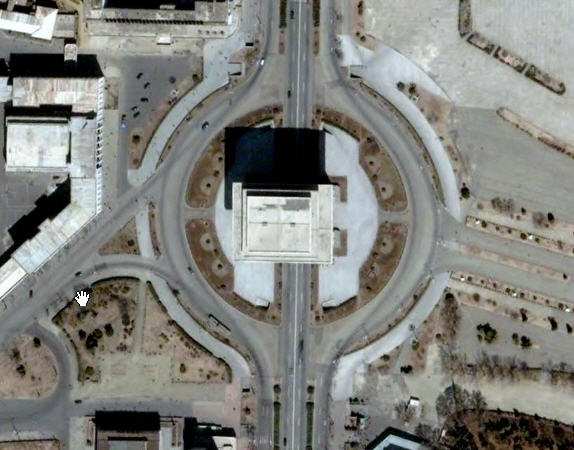
Some experts think that the subway in Pyongyang doesn’t really run, that just a single train shuttles back and forth, to deceive visitors. As for culture, everything I’ve read suggests that there isn’t any, except what the regime fosters, always in praise of itself.
And the sickest thing about North Korea is the cult of its leaders — Kim Jong-il, the “dear leader,” and his late father, Kim Il-sung, the “great leader,” founder of the country. Note that they might as well be monarchs, with the son succeeding the father. The cult goes beyond the cult of personality that surrounded Stalin and Mao. This is a cult of divinity. Foreign visitors are, by many accounts, asked to visit shrines to the leaders, and are asked to bow to their images. North Koreans emerge from these shrines weeping.
In a striking documentary I’ve seen on PBS, North Korean citizens were treated by a visiting French eye surgeon. (An amazing exception to the usual practice of not allowing foreigners to take any significant part in the life of the country.) These people had been blind for years, and the surgeon restored their sight. When their bandages were taken off, they fell on the floor before portraits of the two Kims, weeping and giving thanks, as if the leaders themselves had cured them, which, most likely, is quite literally what they believed.
Kim and his family, meanwhile, live like Eurotrash, enjoying all the vices the West can provide. Surrounding them is an inner Communist elite, who most likely are cynical. There’s a documentary available on DVD, called A State of Mind, which shows young North Korean girls taking part in the “mass games,” gigantic ceremonies in which dancers and gymnasts give praise to the leaders. At one point we see high-ranking officials in the audience, obviously bored, checking their watches, as if to see how much more of this nonsense they’ll have to endure.
Surrounding the inner party (to use Orwell’s terminology from 1984), is an “outer party” of elites who don’t get inside information. These people appear to be utter believers. Some of them are in A State of Mind, looking normal enough in their Pyongyang apartment, with state radio broadcasts always in the background (they can be turned down, but can’t be turned off). But, normal as they seem, they’re also brainwashed. They’re asked what would happen if the U.S. and North Korea fought a war, and with perfect crazy confidence they explain why North Korea would win.
Then there’s the rest of the country, the mass of North Koreans, who often starve. I’m sure my portrait here is too simple — surely North Korea has some kind of social and political life, apart from the rule of the Kims — but as a broad outline, I think it’s accurate.
For more information:
A State of Mind, the documentary film about preparations for the mass games.
Under the Loving Care of the Fatherly Leader: North Korea and the Kim Dynasty, by Bradley K. Martin. A thorough, lively history, which also gives a clear picture of how things are now.
The Aquariums of Pyongyang: Ten Years in the North Korean Gulag, by Kang Chol-Hwan and Pierre Rigoulot. A sober, important memoir by a labor camp survivor who managed to flee the country.
Pyongyang: A Journey in North Korea, by Guy Delisle. The non-fiction equivalent of a graphic novel, very funny and sad, by a Frenchman who produced animated films in North Korea. Shows, with great empathy, how regimented North Korean life can be.
Eurotrash Greg?#
Another good source of information is the documentary “Children of the Secret State.” Made me cry… Very good information.