
I didn’t write my “Capitano Sangue” post as well as I might have, and maybe some things weren’t clear. I especially should stress that I’m not objecting to art from the past, including classical music from the past. This year I think I’ve read six Trollope novels, just for instance (the first four from the Barchester series, and the first two Pallisers.) And I’ve listened with pure happiness to two Verdi reissues from the LambertoGardelli series that came out on Philips in the ’70s , I masnadieri (Carlo Bergonzi is such a joy to hear) and La battaglia di Legnano. Plus I’ve been listening intensely to Toscanini recordings of standard classical repertoire; more on that in another post.
But you couldn’t possibly miss that Trollope lived long ago. All the particulars of 19th century courtship and marriage, one of his big subjects — it’s very far from how things are now. But of course that’s one of the reasons I read him. It’s intriguing to go to a different place, especially one with enough connections to our time that we can savor the differences. (His prose is one of those differences; nobody writes like that now, and nobody should.)
With Verdi, I know I’m in the past, too, but that might be for personal reasons. If you see Rigoletto at the Met, I don’t think that feels like the past, or at least it doesn’t to me. It feels like going to the opera, as we know that activity today. But to me., Verdi comes from another era in part because I’ve studied him so much, and also studied the history and culture of 19th century Italian opera. Among much else, I love the musical forms that opera composers used back then, and especially the sweeping cabalettas that end almost every scene.
For those who don’t know this music, almost every scene comes to rest in the middle with a slow piece of music, and then ends with something that’s usually fast, with a simple melody and propulsive rhythm, which is supposed to end the scene in a burst of excitement. This has to be one of the most commercial musical forms ever devised. The idea is to leave the audience cheering. And the simple melody is always repeated, which serves many purposes. The repeat could make the audience happy. If they like the tune, they get to hear it twice. And, since the operas tended to be written and rehearsed in a hurry, repeats made everybody’s work easier. If a lot of music was repeated, the composer could write less, and the singers and orchestra had less to learn. Between the two statements of the melody, and after the second one, you’d typically hear noisy music.
That helped keep the excitement going, and helped bring it to some wild height of madness after the second statement of the melody had finished. But all this isn’t as simple as it sounds. Simple music is in some ways harder to write than complicated music. If you write a fugue in 19 voices, everybody knows you’re very serious, and often people (especially connoisseurs) will nod their heads in solemn approval, even if the results aren’t all that interesting. But if you write a tune designed to knock an audience absolutely dead, everybody knows pretty quickly whether you’ve succeeded or failed, and if you’ve failed, they just won’t cheer.
So here’s something I really love about this cabaletta form. (The fast piece at the end of each scene is called a “cabaletta,” except in the case of large ensembles, typically found at the end of the first or second act, when the cabaletta is called a “stretta.” See how intense a classical music nerd I can be?) As the 19th century winds on, the form starts to degenerate.
Early on, in Bellini’s operas, cabalettas seem to make sense. The repeats seem motivated. Between the verses, the singers keep singing, often with the help of a chorus. They keep saying whatever got them excited enough to sing the cabaletta in the first place, which then makes us in the audience feel there’s a reason to sing the whole thing again. But in Verdi’s time, cabalettas started to seem a bit old. Eventually Verdi just about stopped writing them. They’d passed their use-by date. When they do crop up, as they do all through the two operas I’ve been listening to, they sound a little pro forma, put into the opera because they’re supposed to be there, but not necessarily because anyone (Verdi included) really believed in them. The tunes aren’t so good; that’s one giveaway. But an even stronger giveaway is what happens between the verses. You start getting music written only for the orchestra, which leaves the singer stamping around all alone on stage, then turning once more to the audience to sing the melody a second time, for no apparent reason.
So here’s why I’m a real 19th century opera junkie. In some ways, I love the unmotivated cabaletta repeats better than the ones that make sense. This is what happens when you fall in love with a genre, quite apart from the pieces that comprise it. I feel that way about other things — ’50s science fiction films, for instance, and doowop songs. Somebody might say, “That’s the stupidest monster I’ve ever seen.” (Talking, maybe about the giant locusts that climb up Chicago buildings in The Beginning of the End. They filmed the scene by putting real locusts down on a photo of a Chicago building. Sometimes the locusts walk right off the building into the air around it.) I say, “I love the stupidity.” Or else someone complains that doowop ballads almost all have the same chord progression, the immortal I – VI — IV ( or II) – V. I say, “I love that chord progression,” and it gives me a tingle even in a really bad song. (I think it tells a little story: Comfort gives way to risk and excitement, with a knot in the pit of your stomach; then there’s reassurance, and finally resolution.) So in bel canto opera, and the Verdi operas that followed, I love the cabalettas. Which also help me remember that the operas were written a long time ago.
But now let’s get away from my obsessions, and rejoin the classical music mainstream. There, music from the past is the norm, and it tends to lose its pastness. Which in one way makes sense, because the music still is with us, right here in the present. But in another way it makes no sense, because the style and content of the music comes from the past. I think we should notice that, just as we notice that Trollope’s marriages come from the past (not to mention the style of his writing). But I think we don’t, often enough, because we’re not conditioned to question classical masterworks. We tend to accept them unquestioningly, and when we talk about their history, we do it in scholarly terms, so the history becomes a distant object of contemplation, and not a reality that might hit us square in the face during a performance.
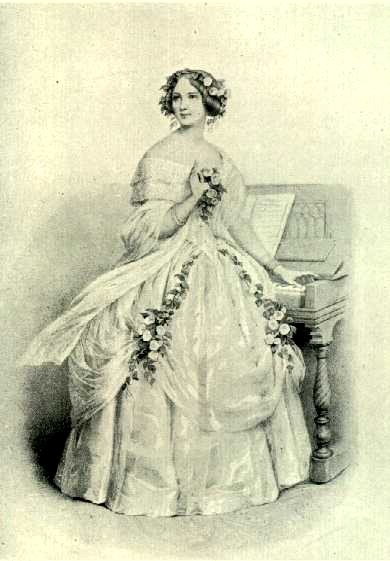
Footnote to this: the most fully 19th century trait (for me, anyway) in I masnadieri is the soprano role, which was written for Jenny Lind (pictured above), a soprano generally thought to have more pipes than guts (or, more sympathetically, an incomparable technique, but not much sense of theater). Verdi liked her, apparently, but wrote her a remarkably empty part, full of embellishments. The music, JulienBudden says in his three-volume study of Verdi, is “tinsel-like”; I’d call it the frilliest soprano role Verdi ever wrote, and to me it’s really almost a shock after Verdi’s other sopranos, who tend to be women with guts, and sometimes even outright demons like Lady Macbeth, Abigaille in Nabucco, or Odabella in Attila.
The frills end up making a kind of sense, because this piece has a climax that’s over the top even for Italian opera. The tenor, who’s an outlaw, kills the soprano (his beloved), to save her from sharing his immoral life. How appropriate, then, for the soprano to be all frilly (and how even more fitting it would have been if Verdi had written music for the tenor that suggested his unease, as he did with the distantly similar title role in Ernani; I masnadieri isn’t one of Verdi’s more convincing operas). But the frills also place the piece squarely in the 19th century. I don’t think I’ve ever met, in my 20th and 21st century life, a woman as frilly as this one, and I’m not sure I could have, unless I visited the deep South during the ’50s. Trollope might have recognized her, though. And to judge from that picture of Jenny Lind, she must have fit the singer perfectly.
I like, very much, the idea that in listening to common practice period classical music, we ought to be struck by its pastness, but are not. We are, for instance, I think, generally when listening to “early music,” at least in part because it often has a frame around it that suggests anachronism. What I don’t really know yet is why we don’t hear 18th and 19th c. music as “past” nor how we might go about doing so. Is it really just that we are taught not to question it? We are not taught to question Dufay, but there’s no hearing that as contemporary, right? Something like this has happened with jazz, too, I think: we tend to hear pre-bop forms as anachronistic, but not bop/post bop; though certain items from the 70s certainly sound dated, like the Mahavishnu Ork, for instance. How does this relate?
Actually, though, I also wonder if all those people out there who love rock/pop/hip hop/country don’t hear classical (and jazz?) as anachronistic.
There is certainly a lot of mumbo -jumbo going on which adds up to nothing .
Pointless little mental
exercises on what was,what could be and on and on while missing the most signficent aspect of this
topic .
First throw out the terms ie. classical romantic etc.
and use only “music”.No one alive has any idea how music sounded to Bach ,Mozart etc. and their audiences ,reading of it means very little except
how the audience reacted to
the sounds of the time.
Pitch varied greatly and
has a profound effect on
what one hears ,espeially
clarity of notes .From
338 to 440 is a world of difference ,especially in opera ,when some ditzy
soprano is aiming for the high “e” Gould grunting at the piano is just that
it may be brilliant to some but it ain’t Bach
as Bach wrote it.Dinnertein may play her Bach until doomsday
but it will never be Bach
it will be Dinnerstein
playing her rendition of Bach .Whatever goes on in the concert hall to-day
is in a sense bogus unles
we play contemporary music at our pitch and
our understanding of tempo,and nuance of sound.This is where painting as an art has us beat -we must come to art on its terms not ours.
You are discerning ,but I believe you write at times just to provoke .May I suggest that we learn from the past in what they didn’t do.Pitch i believe
is very important ,just go to the cookie cutter string department at Julliard (by that I mean they all sound alike and vibrate until your back teeth get on edge ,and they bore equally ) have a violin player do a mozart work at a pitch of 338 440 444 and notice the difference in the sound and how the approach to playing changes. ad inferior
gut strings ,minimum vibrato as taught by papa
Mozart and you have a totally different world
of violin playing and sound
production .I have heard
most from Parlow (?!) to the latest hotshot and the
difference is quite astonishing as to sound
and approach to the art .
What we have gained in speed we have lost in artistry .You cannot reproduce the sounds of the past nor the temperment for we all belong to our own times .and must ,if only to be true to ourselves -but we can steal a little
bit here and there from the past if it works to-day . You know fiddle players to-day play Kreisler a lot to show their “human” side but if
Kreisler showed up to-day unknown and playing as he did
every critic would bring him down as second rate .
As for Versailles what went on back stairs was no different than what goes on stage at some of opera houses I have attended .You didn’t really go to hear Lucia
did you ? tell me it ain’t so .