
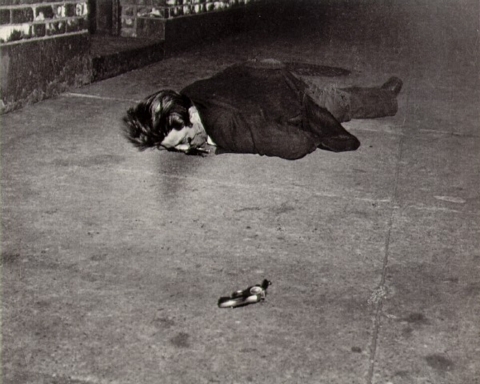
I have some big posts coming, about the dramatic turnaround plans at the Metropolitan Opera, and (as promised) about the British research on a young audience. But no time for anything big today, so here’s something smaller.
In my Cleveland hotel room, I worked for a while on some piano pieces I’m writing, little musical embodiments of Weegee photos (Weegee being the now-famous New York tabloid photographer from the ‘40s). I’ve finished the first of these pieces, a musical setting, if that’s the word, of the Weegee photo I’ve uploaded here, called “Gunman Killed By Off-Duty Cop at 344 Broome Street.” (Which would have been the caption printed with the photo when it appeared in a newspaper.) It’s an odd, abrupt little piece; I’ve been drawn to miniatures lately. It ends quite suddenly, with a shock, if I did my work right, creating surprise that it ends so suddenly, and then (again if I got this right) a realization that, yes, this really had to be the end. Like the gunman’s life…
You can see a score of the piece http://www.gregsandow.com/gunman_killed.pdf here, as a PDF file. And here’s a rough computer demo of the music.
Weegee’s photos are of course a lot like film noir, and for both reference and inspiration I recorded (from DVDs) some excerpts from film noir scores — from Out of the Past and Too Late for Tears — and saved them on my hard drive. In my hotel, I was listening to them and doing a little editing; I’d recorded them quickly, without bothering to give the excerpts beginnings or ends. So I was fixing that, and something started to dawn on me. The studio orchestras play these scores vividly. In fact, they do everything I complained a while ago that serious classical orchestras don’t do enough, which here I’d summarize as making all the effects the score calls for. If the film scores are supposed to be menacing, they sound menacing; if they slide into love music, it’s drenched with ambiguous romance. So bravo to these long-ago studio musicians…and why can’t we play Mahler like that?
***
Roy Webb wrote the score for Out of the Past, with a terrific tune as the main theme. R. Dale Butts wrote the score for Too Late for Tears, full of menace and atmosphere. Here’s a sample of his work, and of the vivid, even slinky musical performance. This little excerpt from the film’s soundtrack, with music, dialogue, footsteps, and the creak of a rowboat, makes a fine little piece of sound art. The people you hear talking have just killed the woman’s husband…