
Here’s a tale you won’t find in “Students for a Democratic Society, A Graphic History,” a new book due out soon. I always meant to write it down but never did. I’m telling it now before I forget all the details, because I don’t think it’s been recorded anywhere.
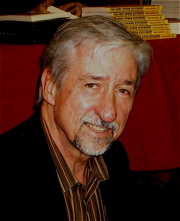 It was the winter of 1970, probably in February. I’m not sure of the exact date. It must have been around the time that Tom Hayden and four others of the Chicago Seven were convicted of inciting a riot in Chicago at the 1968 Democratic Convention.
The place was Jessica Mitford’s house in Berkeley, California, where a crowd of Bay Area radicals, politicos, artists, poets, journalists, professors and other high-minded riffraff had gathered. We were there to hear the latest news and to rally the troops, raise money, and generally show our solidarity with the leaders of the antiwar movement.
The house was packed. Rumor had it that Jean Genet would be there, along with the Black Panthers. They were squiring him around the country as part of their campaign to free Bobby Seale, who had been on trial with the Chicago Seven until his case was separated from theirs. (You may recall that he’d been bound, gagged and chained to a chair in the courtroom).
 A painter’s ladder was set in the middle of the living room as a sort of platform for the speakers. Several speeches had already been made when a huge red convertible with the top down roared up to the front of the house. Genet jumped out, surrounded by Black Panthers with weapons bulging under their leather jackets. Among them was David Hilliard, who had taken over running the party in Seale’s absence.
I no longer recall the speakers or their speeches. But I do remember Hayden, clearly the main speaker, being very low-key and looking like a Berkeley grad student in jeans and sneakers. His modesty and reasonableness were apparent. I was impressed. Hilliard was not. As soon as Hayden finished speaking, he challenged him. He wanted to know: Why was Hayden out on the street while Bobby Seale was in a jail cell? (Two of the Chicago Seven had been found innocent of all charges. Hayden must have been out on bail, while his conviction, like that of the others, was being appealed.)
Hilliard’s question was an accusation. Calmly and with what seemed to me a sadness in his reply, Hayden refuted the implication that he had betrayed Seale in any way. There was only one reason he was free and Seale was not. It could be summed up in the word racism. “Bobby is black,” he said. “I am white.” Those words I do recall, perhaps because they were so simple. The reply did not satisfy Hilliard. His aggressiveness seemed menacing.
At this point a friend of Hayden’s — I think it was a UC Berkeley student president or former president who had come with him — stepped in front of Hayden, as if to protect him. He shouldn’t have. Hilliard hadn’t done anything physically threatening, and Hayden was as composed as a turtle. Now, however, incited by the sudden move of the self-appointed bodyguard, Hilliard picked up an empty beer pitcher and swung it. It was a roundhouse swing that couldn’t miss. He and Hayden were standing no more than an arm’s length apart.
Incredibly, Hilliard did miss. Instead of hitting Hayden, who somehow hadn’t budged or even flinched, the blow struck a young girl (the poet Michael McClure’s daughter) who was sitting on the floor at their feet. Two sounds — a hollow, leaden bonk! followed by a high-pitched cry of pain — went off like a siren. This sent the crowd into a panic. People dove out of the way.
Genet went into a boxer’s crouch, evidently believing he had to defend himself. He was wearing an army fatigue jacket, his head had white stubble and so did his face, like he hadn’t shaved. Ready to take on all comers, he planted his front foot on a coffee table. Pugnacious. I remember thinking he couldn’t have understood much of what was said. From the few words he’d spoken, you could tell his English wasn’t very good.
Somebody shouted that the police had been called and were on their way. The crowd spilled out the front door onto the street and scattered. The last thing I remember of the pandemonium that day was how blue the sky looked and how puzzled Hayden appeared to be as he walked away unhurried, and it seemed to me, forlorn.
Postscript: Well, it looks like the incident took place sometime in mid- to late March. Here’s an excerpt from an inelegant letter I wrote on March 27, 1970, to Carl Weissner, which a librarian at Northwestern University Library, Sigrid Perry, found for me:
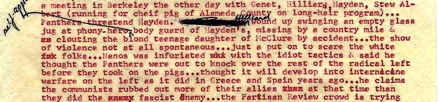
The mention of Stew Albert, whom I’d forgotten about, makes me wonder now whether he was the “self-appointed bodyguard” who stepped in front of Hayden. Nanos is Nanos Valaoritis, the noted Greek poet. He had fled from Greece after it was taken over in a 1967 coup by a rightwing military junta known as “the colonels.” Nanos was a good friend at the time (a warmer human being is hard to imagine) and was teaching at San Francisco State. We went together to Mitford’s house.