AJ Logo an ARTSJOURNAL weblog | ArtsJournal Home | AJ Blog Central

« March 2011 | Main | May 2011 »

April 29, 2011

APRIL IS THE CRUELEST MONTH

"High-culture unions that fight to hang on to an untenable status quo are shooting themselves in the head. Labor leaders invariably respond to managerial cries of disaster-around-the-corner by arguing that their members should not be made to suffer today for the managerial mistakes of the past. But in the end, it doesn't matter who made the first blunder..."

Posted April 29, 9:24 AM

TT: The most beautiful sound in the world
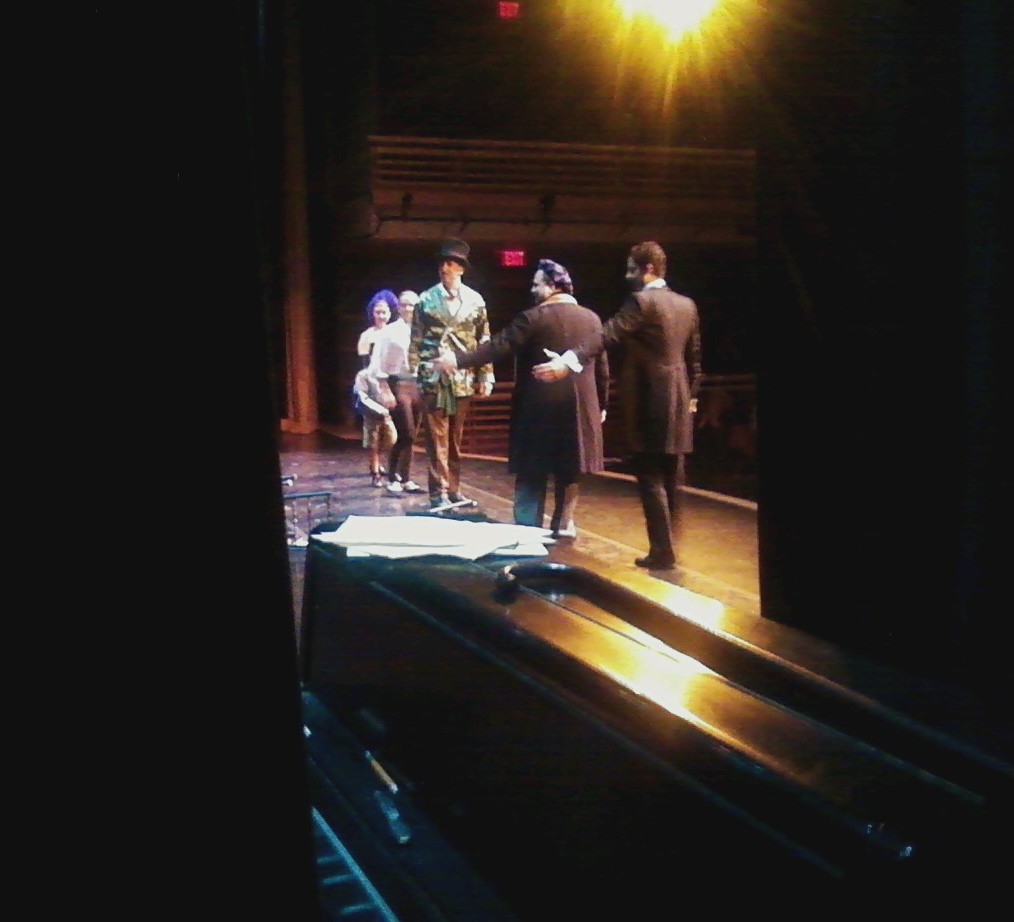
0428112153_0001.jpgI snapped this picture from the wings of the theater where Danse Russe was premiered last night by Philadelphia's Center City Opera Theater. Paul Moravec and I were waiting for the cue to take our curtain call. By then we were tired, sweaty, and immensely gratified, for it was surpassingly clear that we had a hit on our hands. Truth to tell, we knew it a few minutes after Andrew Kurtz gave the downbeat. The opening-night audience was excited and responsive right from the start--we got laughs in places where we weren't expecting them, and dead silence everywhere we wanted it--and the applause at the end of the show merely set a seal on what the laughter had already told us.

I'm too tired to write much more, having just returned to my hotel from a riotous cast party. Come back on Monday and I'll tell you all about it.

Posted April 29, 12:40 AM

TT: The invisible girls

In the last of three drama columns for this week's Wall Street Journal, I wrap up the current Broadway season with reviews of Baby It's You! and The People in the Picture. Here's an excerpt.

* * *

Every jukebox musical rises or falls on the mass appeal of the songs out of which its score is stitched. If you don't care for '60s girl-group pop, then you're likely to find "Baby It's You!" tedious--but you'll be more exasperated by the book, which takes a real-life story that even a Stephen Sondheim buff could love and turns it into a live-action comic strip so relentlessly simple-minded as to make "Anything Goes" look like a differential equation set to music.

"Baby It's You!" is mostly about Florence Greenberg (Beth Leavel, who is terrific), a nice Jewish housewife from New Jersey who got tired of doing dishes and started her own record label. One day Mrs. Greenberg's daughter (Kelli Barrett) told her about four black girls who sang together for fun at the neighborhood high school, and presto! The Shirelles were born. Likewise Scepter Records, which Ms. Greenberg turned into one of the great money-making music machines of the '60s, thanks to her knack for knowing a hit when she heard one. Along the way she fell in love with Luther Dixon (Allan Louis), who wrote and produced most of the Shirelles' records, and their scandalous love affair (Dixon was black) broke up Ms. Greenberg's marriage....

Here comes the catch: Floyd Mutrux and Colin Escott, who wrote the vapid book for "Million Dollar Quartet," have done even worse by "Baby It's You!" Every line is as predictable as tepid canned soup. (How do we know that Mr. Greenberg is a Jew? Because he says "Oy!" a lot.) As if that weren't bad enough, Messrs. Mutrux and Escott neglected to characterize the four Shirelles, instead turning them into a squealing quartet of interchangeable parts who exist only to sing songs, change costumes, smile and shake their collective booty....

Donna Murphy is one of the best musical-comedy actresses who ever sang a showstopper, and anything she does is worth seeing, at least while she's onstage. That said, "The People in the Picture" is yet another addition to the seemingly endless list of Lousy Musicals of 2011, an exercise in button-pushing that takes a pair of serious subjects--Alzheimer's disease and the Holocaust--and uses them to prove the well-known fact that even on Broadway, two wrongs don't make a right.

The recipe for "The People in the Picture"? iTake Bubbie (Ms. Murphy), a Jewish grandmother who doesn't get along with her divorced daughter (Nicole Parker). Add Jenny (Rachel Resheff), the perky little granddaughter to whom Bubbie is telling the story of how she once led the Warsaw Gang, a touring troupe of Polish actors who ran afoul of the Nazis. Hint at a Terrible Secret that explains why Bubbie and her daughter don't get along. Then give Bubbie a conveniently timed case of Alzheimer's, thus forcing her to spill the beans before it's too late. What do you get? Two and a half hours' worth of retchworthy glop, set to the greeting-card lyrics of Iris Rainer Dart ("It's never been easy/It's always been rough/I give her my life/But it's never enough") and the perfectly serviceable music of Mike Stoller (who is better known as the other half of Leiber & Stoller) and Artie Butler. Ms. Dart also wrote the book, about which I need say only that it actually contains the phrase "Doctor schmoctor" and a joke about Josef Mengele....

* * *

Read the whole thing here.

Donna Murphy sings "Loving You" in the original production of Stephen Sondheim's Passion:

Posted April 29, 12:00 AM

TT: High culture goes bankrupt

If you're following ArtsJournal, you know all about the bankruptcy of the Philadelphia Orchestra, the apparent demise of the Syracuse Symphony and Seattle's Intiman Theater, and all the other horror stories that have made April the cruelest month in recent memory for art in America. In my "Sightings" column for today's Wall Street Journal, I take a look at the current situation. Here's an excerpt.

* * *

What's the problem? In the immortal (if apocryphal) words of Sam Goldwyn, "If nobody wants to see your picture, there's nothing you can do to stop them." Corollary: If nobody can afford a ticket to your show, there's nothing you can do to make them buy one. When money is tight and ticket prices keep climbing, playgoers and opera buffs will respond by staying home. Moreover, the high-culture business models of the past don't work anymore. In particular, the subscription-based models that kept opera and theater companies and symphony orchestras afloat throughout the 20th century are no longer viable now that younger Americans are unwilling to commit in advance to attending future performances, and most of these groups are still trying to find consistently effective new ways to balance the books.

And what's the moral of the story? Here's part of it: High-culture unions that fight to hang on to an untenable status quo are shooting themselves in the head. Labor leaders invariably respond to managerial cries of disaster-around-the-corner by arguing that their members should not be made to suffer today for the managerial mistakes of the past. But in the end, it doesn't matter who made the first blunder. Everybody in the culture business, union leaders included, has been guilty of chronic myopia when it comes to outmoded business models. The point is that there is no longer any alternative to root-and-branch fiscal reform. What's more, managers and board members now know this. Increasingly, they're willing to shut up shop altogether--or, like the Philadelphia Orchestra, declare bankruptcy--rather than purchase short-term labor peace, as they did in the past, by agreeing to contracts that they can no longer afford....

* * *

Read the whole thing here.

Posted April 29, 12:00 AM

TT: Apropos of Danse Russe (V)

The opening of the Joffrey Ballet's reconstruction of the original 1913 Ballets Russes production of The Rite of Spring, with music by Igor Stravinsky, décor by Nicholas Roerich, and choreography by Vaslav Nijinsky. The choreography was reconstructed and staged by Millicent Hodson:

Posted April 29, 12:00 AM

TT: Almanac

"The over-publicized bit about expression (or non-expression) was simply a way of saying that music is supra-personal and super-real and as such beyond verbal meanings and verbal descriptions. It was aimed against the notion that a piece of music is in reality a transcendental idea 'expressed in terms of' music, with the reductio ad absurdum implication that exact sets of correlatives must exist between a composer's feelings and his notation. It was offhand and annoyingly incomplete, but even the stupider critics could have seen that it did not deny musical expressivity, but only the validity of a type of verbal statement about musical expressivity. I stand by the remark, incidentally, though today I would put it the other way around: music expresses itself."

Igor Stravinsky and Robert Craft, Expositions and Developments

Posted April 29, 12:00 AM

April 28, 2011

TT: Song of himself

In the second of three drama columns for this week's Wall Street Journal, I review the Broadway revival of The Normal Heart. Here's an excerpt.

* * *

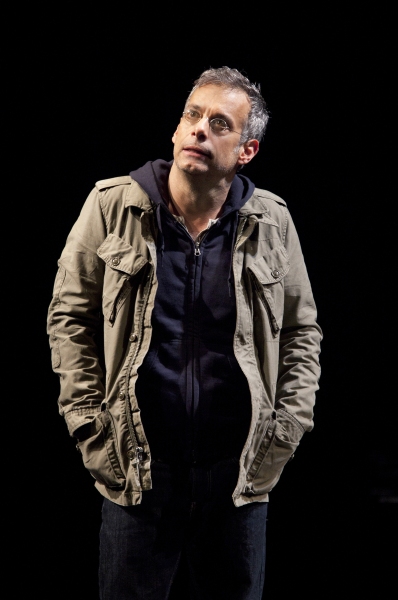
tn-500_the_normal_heart_joe_mantello_158_photo_credit_joan_marcus.jpgThe way in which you respond to the Broadway revival of "The Normal Heart," Larry Kramer's play about the early years of the AIDS epidemic, may depend on how old you were in 1985, when it was first seen Off Broadway. Those who are too young to remember when AIDS was laying waste to a generation of gay men could well be stunned into submission by the unremitting ferocity of "The Normal Heart." But now that AIDS has become a chronic condition rather than a death sentence, Mr. Kramer's play must stand on its artistic merits, not its impassioned sincerity. How does it hold up? Better than I expected, but not as well as I'd hoped.

"The Normal Heart" is an autobiographical play whose hero, Ned Weeks (Joe Mantello), is Mr. Kramer's fictional stand-in. Like the real Larry Kramer, Ned is a furiously angry gay writer who likes nothing better than an argument, and when his friends start to sicken and die from a mysterious ailment, he starts an organization (Gay Men's Health Crisis, though it is never named in the play) whose purpose is to help them cope and draw attention to their plight. But Ned is so abrasive that he alienates most of his friends and colleagues, and when his lover (John Benjamin Hickey) becomes infected with the AIDS virus, the combined stress pushes him over the edge....

Too much of "The Normal Heart," alas, is given over to speech-making, and the intimate scenes in which we see the characters living their lives rather than talking about them are so involving and persuasive that the table-pounding becomes all the more regrettable by contrast. An even bigger problem with "The Normal Heart" is that it is self-aggrandizing to an astonishing degree: Mr. Kramer portrays himself as a flawed but ultimately heroic figure, a kind of secular Moses, and the fact that he really did make a historic contribution to the fight against AIDS doesn't make the portrayal any easier to swallow without gagging....

It helps greatly that Mr. Mantello, who is vastly better known these days as a director but who starred in the original Broadway production of "Angels in America," is giving one of the best performances of the season, on or Off Broadway. He doesn't do anything fancy, nor does he hungrily solicit the audience's sympathy: Instead he plays Ned with a simplicity and straightforwardness that makes him fully understandable....

* * *

Read the whole thing here.

Posted April 28, 12:00 AM

TT: So you want to see a show?

Here's my list of recommended Broadway, off-Broadway, and out-of-town shows, updated weekly. In all cases, I gave these shows favorable reviews (if sometimes qualifiedly so) in The Wall Street Journal when they opened. For more information, click on the title.

BROADWAY:
Anything Goes (musical, G/PG-13, mildly adult subject matter that will be unintelligible to children, closes Jan. 8, reviewed here)
Born Yesterday (comedy, G/PG-13, closes July 31, reviewed here)
The House of Blue Leaves (serious comedy, PG-13, closes July 23, reviewed here)
How to Succeed in Business Without Really Trying (musical, G/PG-13, perfectly fine for children whose parents aren't actively prudish, reviewed here)
The Importance of Being Earnest (high comedy, G, just possible for very smart children, closes July 3, reviewed here)
Lombardi (drama, G/PG-13, a modest amount of adult subject matter, reviewed here)
Million Dollar Quartet (jukebox musical, G, reviewed here)
The Motherf**ker with the Hat (serious comedy, R, adult subject matter, closes June 26, reviewed here)

OFF BROADWAY:
Avenue Q (musical, R, adult subject matter and one show-stopping scene of puppet-on-puppet sex, reviewed here)
The Fantasticks (musical, G, suitable for children capable of enjoying a love story, reviewed here)
Play Dead (theatrical spook show, PG-13, utterly unsuitable for easily frightened children or adults, reviewed here)

CLOSING SOON IN LOS ANGELES:
God of Carnage (serious comedy, PG-13, Los Angeles remounting of Broadway production with original cast, adult subject matter, closes May 15, Broadway run reviewed here)

CLOSING SUNDAY ON BROADWAY:
La Cage aux Folles (musical, PG-13, adult subject matter, reviewed here)

Posted April 28, 12:00 AM

TT: Once more unto the breach

diaghilev.jpgTonight Philadelphia's Center City Opera Theater presents the world premiere of Danse Russe, my second operatic collaboration with Paul Moravec. The final dress rehearsal went incredibly well. Paul and I are feeling very good about everybody and everything.

You might enjoy reading this synopsis of the opera that I wrote for the program:

In old age, Igor Stravinsky, the greatest composer of the twentieth century, revisits the stage of the Paris theater where The Rite of Spring, the ballet score that was his youthful masterpiece, was first performed a half-century earlier, causing a riot. His memories take him back to 1913, the year when he wrote the piece. In his mind, he becomes young again and is joined on stage by Sergei Diaghilev, the ballet impresario who commissioned The Rite of Spring; Vaslav Nijinsky, who choreographed it; and Pierre Monteux, who conducted the first performance. The four men act out the events, some comical and others serious, leading up to the opening-night riot. Then Stravinsky awakes from his reverie. An old man once again, he reflects on how much the world has changed since 1913, and as the opera ends he sings with love of the "holy Russian spring" of his childhood.

That's about the size of it.

What follows is a miniature essay about Danse Russe that Paul and I wrote yesterday. It, too, will be in the program. If you're coming, we look forward to seeing you there. If you'd like to come but haven't bought tickets, go here for more information.

And now...away I go!

* * *

Igor Stravinsky's The Rite of Spring was the most important piece of music written in the twentieth century, but it was also a work for the stage, and anyone who has written such a work knows that the process of moving it from the page to the stage is of necessity mad and unpredictable. That's why Danse Russe is a comedy--what we call a "vaudeville." It occurred to us at the outset that what Stravinsky and his collaborators went through in order to bring The Rite of Spring to fruition must have been funny, at least at times. Thus we decided to tell the story of its creation as a backstage comedy, one that makes use of the contemporary conventions of vaudeville: the dances, the jokes, the straw hats, even the pretty girl who brings in the easel cards that announce each change of scene. What we've written is a cross between an opera and an old-fashioned musical, and that, too, is deliberate. This is an American take on a Russian masterpiece.

But if Danse Russe is a comedy, it is, ultimately, a serious comedy, one that seeks to offer the audience a fractured glimpse into the mysteries of the creative process. Yes, it's a comic-book version of a celebrated moment in cultural history, but much of what you'll be seeing is deeply informed by the historical record of the events leading up to the riotous 1913 premiere of The Rite of Spring. The words that are sung and spoken by Stravinsky, Sergei Diaghilev, Vaslav Nijinsky and Pierre Monteux in Danse Russe are in many cases based on things that they actually said or wrote in real life. Only the tone has been changed.

Howard Hawks, the director of such classic screwball comedies as Bringing Up Baby and His Girl Friday, liked to say that "the only difference between comedy and tragedy is point of view." Though our point of view on the making of The Rite of Spring is comic, we know that it was very serious business indeed, and so we've sought to portray it with love and understanding--and a smile.

Posted April 28, 12:00 AM

TT: Apropos of Danse Russe (IV)

Igor Stravinsky talks about his collaboration with Sergei Diaghilev and Vaslav Nijinsky and the first performance of The Rite of Spring. Also seen is Robert Craft, Stravinsky's assistant and amanuensis. Toward the end of this clip from Stravinsky, a 1965 TV documentary, we see the composer in the Paris theater where The Rite of Spring was premiered.

In this clip, Stravinsky revisits the studio where he composed The Rite of Spring and is briefly seen conducting the score:

Stravinsky, Diaghilev, and Nijinsky are characters in Danse Russe. I used these two clips as source material for the libretto.

Posted April 28, 12:00 AM

TT: Almanac

"For I consider that music is, by its very nature, essentially powerless to express anything at all, whether a feeling, an attitude of mind, a psychological mood, a phenomenon of nature, etc. Expression has never been an inherent property of music. That is by no means the purpose of its existence. If, as is nearly always the case, music appears to express something, this is only an illusion and not a reality. It is simply an additional attribute which, by tacit and inveterate agreement, we have lent it, thrust upon it, as a label, a convention-in short, an aspect which, unconsciously or by force of habit, we have come to confuse with its essential being."

Igor Stravinsky, An Autobiography

Posted April 28, 12:00 AM

April 27, 2011

TT: And one to go

A little later today I'll be heading down to Philadelphia for the final dress rehearsal of Danse Russe. Things have been going very well all week long, and Paul Moravec and I expect Thursday's premiere to go at least as well, if not better. That's a wonderful feeling--and a reassuring one. Anybody who tells you that a bad dress rehearsal means a good opening night knows nothing about theater.

The experience of bringing my second opera to the stage has been quite different from that of rehearsing The Letter in Santa Fe two years ago. The Letter opened in July, and I took a full month off from my day job at The Wall Street Journal to attend rehearsals (though I only skipped a single drama column--I saw several long-running summer festival shows before flying out to Santa Fe and reviewed them while I was there).

Danse Russe, by contrast, went into rehearsal at the height of the busiest Broadway season in years, and there was no way that I could escape to Philadelphia until I'd seen all the shows I had to see. I went to five previews in a row last week, two of them on Saturday. (Seeing two musicals in one day is not a good idea, Mrs. Worthington.) Then, on Monday, I got up at seven in the morning and spent nine hours writing three Wall Street Journal drama columns, after which I took the next train to Philadelphia, arriving just in time for the piano dress of Danse Russe. It was the first time that I'd seen the entire piece performed on stage from start to finish, and I was so busy scrawling down notes for the singers that I barely had time to register the impact of seeing it.

220px-Sergej_Diaghilev_%281872-1929%29_ritratto_da_Valentin_Aleksandrovich_Serov.jpgOnly once was I fully present in the emotional moment, and that was when I heard the new aria for Sergei Diaghilev that Paul and I wrote a couple of months ago after seeing a workshop performance of the next-to-last draft of Danse Russe. Paul had called me from Philadelphia on Saturday to tell me that the aria really worked, but I had to take his word for it: I'd never heard it sung, only "played" in a synthesized version on my laptop. Hearing and seeing my words sung from the stage bowled me over--though not for long. The rehearsal continued, and in mere seconds I was caught up once more in the controlled frenzy that is a dress rehearsal.

On the train to New York that night, I thought of the scene from Bull Durham in which Tim Robbins, the hot young rookie pitcher, trots proudly into the dugout after pitching a fantastic inning. He says, "I was great, huh?" But Kevin Costner, the veteran catcher who's trying to prepare him for the big leagues, isn't having any of it. He says, "Your fastball was up and your curveball was hanging. In the show they would've ripped you." Robbins asks, "Can't you let me enjoy the moment?" And Costner replies, "The moment's over."

That's the way it goes, at least in my experience. Not until Thursday's premiere will I be able to savor Danse Russe, and even then I'll probably be so preoccupied with the nuts and bolts of the performance that I won't really experience it. If I'm lucky, I'll be able to relax on Friday and Saturday and see the show the way the audience sees it. Or not. After all, it isn't my job to enjoy Danse Russe. That's your job, should you feel so moved. My job is to help make it all happen. Pleasure is optional--for now.

* * *

Danse Russe opens on Thursday at Philadelphia's Kimmel Center for the Performing Arts. For more information, go here.

Posted April 27, 12:00 AM

TT: Apropos of Danse Russe (III)

Igor Stravinsky conducts the Toronto Symphony in a 1967 rehearsal for a performance of his Pulcinella Suite. Stravinsky composed the score for The Rite of Spring in 1913 and is a character in Danse Russe:

Posted April 27, 12:00 AM

TT: Almanac

"My music is best understood by children and animals."

Igor Stravinsky (quoted in The Observer, Oct. 8, 1961)

Posted April 27, 12:00 AM

April 26, 2011

TT: Present laughter

215524_197436793624767_100000753440240_435977_2867412_n.jpgAdam Feldman, the drama critic of Time Out New York, sent me this snapshot taken on the set of CUNY-TV's Theater Talk, where I taped an episode last week that will air later this month. In addition to Adam and me, the panel included Jacques le Sourd and Elisabeth Vincentelli. As you can see, we had a lot of fun talking about the Broadway season just past.

Critics can, needless to say, be sour souls--especially when they see a bunch of bad shows in a row--but I thought it might possibly amuse you to see how amused the two of us look. I only wish I knew what I was laughing at!

Posted April 26, 9:54 AM

TT: A blacker shade of blue

In today's Wall Street Journal I review two major revivals, The House of Blue Leaves and Born Yesterday. Here's an excerpt.

* * *

blueleavesopen460.jpgIt's dauntingly difficult to bring off John Guare's "The House of Blue Leaves," which may explain why this modern masterpiece, first performed in 1966, hasn't been seen on Broadway since 1987. The trick is in the tone. "The House of Blue Leaves" is a comedy about hopelessness, and it plays like "You Can't Take It With You" rewritten by Eugène Ionesco: It won't work if it isn't zany, and it won't work if it isn't horrifically disturbing. Fortunately, David Cromer has cracked Mr. Guare's complex code with the effortless understanding that he brings to every show he stages. The result is a production in which three big names--Ben Stiller, Edie Falco and Jennifer Jason Leigh--are presented not as flop insurance but as artists, and in which full justice is done to one of the best American plays of the 20th century.

If you leave out the loony parts, "The House of Blue Leaves" sounds like a kitchen-sink tragedy, the story of a frustrated songwriter (Mr. Stiller) who is married to a schizophrenic (Ms. Falco) and who falls in love with his downstairs neighbor (Ms. Leigh). But Mr. Guare confounds all expectations by making Artie Shaughnessy a bad songwriter (he pays the rent by working in a zoo) and superimposing atop his painful plight a high-speed screwball-comedy plot involving three nuns and a deaf starlet (Alison Pill). Yet you are always aware of the excruciating agony of Artie and his demented wife, and though much of "The House of Blue Leaves" is wildly funny, there is no forgetting that it is a "farce" in which innocent people die.

Mr. Cromer, as is his wont, has directed "The House of Blue Leaves" for truth, not comedy, letting the humor come of its own accord (and come it does, especially in the second act) rather than forcing it off the page. As a result, much of the laughter is audibly uncomfortable, and when the terrible last scene has played itself out to the bitter end, you go home feeling stunned and drained...

tn-500_12.jpgThe sound that you're hearing at the Cort Theatre these days is one of the rarest in the world: It's the collective purr of an audience falling in love with a brand-new face. Nina Arianda made a huge impression on everyone who saw her make her professional stage debut last year in the Off-Broadway premiere of David Ives' "Venus in Fur." Now she's playing the not-so-dumb-blonde in a Broadway revival of Garson Kanin's "Born Yesterday," the play that put Judy Holliday on the map in 1946 and is going to do the same thing for Ms. Arianda. Ms. Arianda is a charismatic comedienne who is as funny as she is sexy, and anyone capable of resisting her charms is both blind and deaf....

* * *

Read the whole thing here.

Nina Arianda appears in a trailer for the premiere of David Ives' Venus in Fur:

Posted April 26, 12:00 AM

TT: Apropos of Danse Russe (II)

From Fantasia, the opening of Walt Disney's animated interpretation of The Rite of Spring, with the music performed by Leopold Stokowski and the Philadelphia Orchestra:

Posted April 26, 12:00 AM

TT: Almanac

"The trouble with music appreciation in general is that people are taught to have too much respect for music; they should be taught to love it instead."

Igor Stravinsky, "Subject: Music," (New York Times Magazine, Sept. 27, 1964)

Posted April 26, 12:00 AM

April 25, 2011

TT: Just about there

picasso25.JPGDress rehearsals for Danse Russe, my new operatic collaboration with Paul Moravec, start today. If you're only just joining us, Danse Russe is a backstage comedy--yes, a comedy--about the creation of Igor Stravinsky's The Rite of Spring. It opens in Philadelphia on Thursday night.

I don't know whether I'll have time to do any more blogging prior to the first performance. In case I'm too busy or preoccupied, I've already posted, in addition to a week's worth of Stravinsky-related almanac entries, a series of relevant daily videos that I hope will divert you.

Now, if you'll excuse me, I've got work to do....

* * *

For more information about Danse Russe, or to order tickets, go here.

To listen to an episode of WNYC's Soundcheck in which Paul Moravec and I talk about Danse Russe, go here.

Posted April 25, 12:00 AM

TT: Apropos of Danse Russe (I)

Pierre Monteux conducts the London Symphony Orchestra in a 1961 performance of Paul Dukas' The Sorcerer's Apprentice. Monteux conducted the first performance of The Rite of Spring in 1913 and is a character in Danse Russe:

Posted April 25, 12:00 AM

TT: Almanac

"My freedom will be so much the greater and more meaningful the more narrowly I limit my field of action and the more I surround myself with obstacles. Whatever diminishes constraint diminishes strength. The more constraints one imposes, the more one frees one's self of the chains that shackle the spirit."

Igor Stravinsky, Poetics of Music

Posted April 25, 12:00 AM

April 22, 2011

TT: Down and out in London and New York

Let the bad times roll: I review two more Broadway stinkers, Jez Butterworth's Jerusalem and the stage version of Sister Act, in today's Wall Street Journal. Here's an excerpt.

* * *

"Jerusalem" is pretentious almost without limit, a three-hour save-our-England tract in which the uplift is slathered with a thick brown sauce composed of two parts coarse humor and one part pseudo-poetry. In addition, "Jerusalem" features a performance by Mark Rylance ("La Bête," "Boeing-Boeing") that is every bit as good as the critical buzz that accompanied it to Broadway from London's West End. Connoisseurs of great acting won't want to miss him--but those with normal attention spans will be hard pressed to make it all the way to the finish line.

Mark-Rylance-in-Jerusalem-001.jpgMr. Rylance plays Johnny "Rooster" Byron, a booze-sodden drug dealer and teller of tall tales who would be known in England as "Falstaffian" or "Rabelaisian" and in America as "trailer trash." He lives in a moldering Airstream parked in a forest on the edge of a real-estate development whose occupants, not at all surprisingly, are trying to have him evicted. Rooster is the unofficial godfather of a merry band of working-class louts whom he lovingly describes, in one of his more printable turns of phrase, as "educationally subnormal outcasts." They flock to the enchanted forest to drink his drink, snort his coke, have casual sex and forget their Lives of Loud Desperation, about which they are inclined to give lengthy speeches when sober.

What we have here is, in short, the theatrical counterpart of what is known to literary scholars as a "condition-of-England novel," a genre long beloved of those who prefer politics to art. Mr. Butterworth has upped the ante still further by adding a stiff dose of middle-class self-loathing à la George Orwell, who famously declared in "Nineteen Eighty-Four" that "if there is hope, it lies in the proles!" That deluded sentence could well stand as the epigraph of "Jerusalem." Like Orwell's "proles," Rooster Byron (get it?) is in touch with the instinctual life of sex, drugs and rock 'n' roll. This, of course, makes him infinitely more authentic than the prim homeowners who want to give him the push....

The season isn't over yet, but I'm already guessing that "Sister Act" will walk away with the Bottom of the Barrel Prize for 2011. While the original 1992 screen version of "Sister Act" wasn't the worst movie ever made, the musical-comedy version that arrived on Broadway after successful runs in Pasadena and London is a wretched piece of rhinestone-spangled junk....

* * *

Read the whole thing here.

Posted April 22, 12:00 AM

TT: Just because (I)

Pierre Boulez conducts Stravinsky's Rite of Spring:

Posted April 22, 12:00 AM

TT: Just because (II)

Michael Colgrass talks about recording The Rite of Spring with Igor Stravinsky on the podium:

Posted April 22, 12:00 AM

TT: Almanac

"Laughter is the climax in the tragedy of seeing, hearing and smelling self-consciously."

Wyndham Lewis, "Inferior Religions"

Posted April 22, 12:00 AM

April 21, 2011

TT: So you want to see a show?

Here's my list of recommended Broadway, off-Broadway, and out-of-town shows, updated weekly. In all cases, I gave these shows favorable reviews (if sometimes qualifiedly so) in The Wall Street Journal when they opened. For more information, click on the title.

BROADWAY:
Anything Goes (musical, G/PG-13, mildly adult subject matter that will be unintelligible to children, closes Jan. 8, reviewed here)
How to Succeed in Business Without Really Trying (musical, G/PG-13, perfectly fine for children whose parents aren't actively prudish, reviewed here)
The Importance of Being Earnest (high comedy, G, just possible for very smart children, closes July 3, reviewed here)
Lombardi (drama, G/PG-13, a modest amount of adult subject matter, reviewed here)
Million Dollar Quartet (jukebox musical, G, reviewed here)
The Motherf**ker with the Hat (serious comedy, R, adult subject matter, closes June 26, reviewed here)

OFF BROADWAY:
Avenue Q (musical, R, adult subject matter and one show-stopping scene of puppet-on-puppet sex, reviewed here)
The Fantasticks (musical, G, suitable for children capable of enjoying a love story, reviewed here)
Play Dead (theatrical spook show, PG-13, utterly unsuitable for easily frightened children or adults, reviewed here)

CLOSING SOON IN LOS ANGELES:
God of Carnage (serious comedy, PG-13, Los Angeles remounting of Broadway production with original cast, adult subject matter, closes May 15, Broadway run reviewed here)

CLOSING NEXT WEEK ON BROADWAY:
La Cage aux Folles (musical, PG-13, adult subject matter, closes May 1, reviewed here)

CLOSING SUNDAY OFF BROADWAY:
Angels in America (drama, PG-13/R, adult subject matter, reviewed here)

Posted April 21, 12:00 AM

TT: Almanac

"Nothing is more curious than the almost savage hostility that Humour excites in those who lack it."

George Saintsbury, A Last Vintage

Posted April 21, 12:00 AM

April 20, 2011

TT: Is it real, or is it Kathleen Turner?

I've hit a bad patch on Broadway. In today's Wall Street Journal I pan High and Wonderland. Here's an excerpt.

* * *

Was Kathleen Turner ever an actor? Maybe, but she's not one anymore. All she does nowadays is waddle onstage and hawk the self-parody that long ago became her stock in trade. To say that Ms. Turner plays an alcoholic nun in Matthew Lombardo's "High" comes close to giving away the whole game. Yes, Sister Jamison Connelly is a foul-mouthed, tough-talking dame with a heart of brass-plated gold, and yes, Ms. Turner's Janie-One-Note performance is so thickly mannered as to suggest that the producers of "High" have engaged a Kathleen Turner robot instead of the real thing. She rattles off her lines in a hoarse, staccato baritone voice that sounds as if it had been brought into being through daily doses of Drano administered by mouth, and she never does anything that you can't see coming several hundred miles away.

High460a.jpgNeither does Mr. Lombardo, a specialist in coarsely wrought small-cast vehicles for Hollywood refugees of a certain age. Last year it was "Looped," in which Valerie Harper played Tallulah Bankhead. This year it's "High," a three-hander in which Ms. Turner attempts to save the body and soul of Cody (Evan Jonigkeit), a dope-addled street hustler whose self-destructive behavior is enabled by the solicitude of a well-meaning but foolish priest (Stephen Kunken). "High" is the sort of play in which a character (Ms. Turner, naturally) utters sentences like "Okay, God, here's the deal," then expects the audience not to giggle contemptuously in response....

The problem with Frank Wildhorn musicals is that they contain Frank Wildhorn songs. "Wonderland," an updated stage version of Lewis Carroll's "Alice's Adventures in Wonderland," is stuffed full of easy-listening pop ditties written in the out-the-other-ear style to which Mr. Wildhorn long ago accustomed his fans. As for Jack Murphy's lyrics, suffice it to say that he lays his creative cards on the table in the very first number: "Larger smaller--keep it real/Change just happens, learn to deal."

If you've spent any time at all watching the dreck dished up on contemporary children's TV, you'll have a pretty good idea of what Mr. Wildhorn and his collaborators have done to "Alice's Adventures in Wonderland." The time is right this second and the place is Queens. Alice (Janet Dacal) is a well-dressed, temporarily single working mom whose unemployed, temporarily unenlightened husband (Darren Ritchie) has left her because he's embarrassed not to be the family breadwinner. Chloe (Carly Rose Sonenclar), their daughter, is an unnaturally mature-sounding 11-year-old Broadway diva who is incapable of uttering an unsarcastic word. Alice bumps her head in the elevator, lies down to take a nap and finds herself in Wonderland, a country whose inhabitants all speak the same tired argot, half smart-assery and half meta-humor...

* * *

Read the whole thing here.

Posted April 20, 12:00 AM

TT: Snapshot

Paul Lynde, June Carroll, and Alice Ghostley in a very rare kinescope of excerpts from New Faces of 1952, originally telecast in 1960. The songs are "Guess Who I Saw Today" and "Boston Beguine":

(This is the latest in a weekly series of arts-related videos that appear in this space each Wednesday.)

Posted April 20, 12:00 AM

TT: Almanac

"Civilization advances by extending the number of important operations which we can perform without thinking of them."

Alfred North Whitehead, An Introduction to Mathematics

Posted April 20, 12:00 AM

April 19, 2011

TT: Double-header

117478844_e4f850728f.jpgDanse Russe will be premiered in Philadelphia next Thursday, and Paul Moravec and I are beating the bushes to spread the word about opening night. This afternoon we'll be talking about our second opera with John Schaefer on my favorite radio show, WNYC's Soundcheck. By a strange and wonderful coincidence, the first half of the program will be devoted to a debate about the merits of Steely Dan's Aja, one of the few pop albums of my college days to which I still listen regularly and with the utmost pleasure. Afterward, Paul and I will talk about and play excerpts from Danse Russe.

Soundcheck airs between two and three p.m. ET. To listen live via terrestrial radio, tune to 93.9 on your FM dial (no static at all!). To listen via streaming audio, go here.

Posted April 19, 12:00 AM

TT: Just because

Steely Dan plays "Peg" live in 2003:

Posted April 19, 12:00 AM

TT: Almanac

"Technology never changed anything except to make us more efficient at being who we were all along."

Dorothy Gambrell, Cat and Girl (Mar. 29, 2011)

Posted April 19, 12:00 AM

April 18, 2011

TT: Why doesn't my heart go dancing?

Time was when I prided myself on ignoring the weather. Rain or shine, cold or hot, I rose above it, paying no psychic attention to the outside world. Or at least I pretended to pay no attention--and very often I even fooled myself.

0414111223.jpgIn recent years, however, I've discovered, somewhat to my embarrassment, that the weather matters to me, and having spent good-sized chunks of the past two winters in Florida, I now find that it matters a lot. Fall remains my favorite season, but I like sunshine, and when I returned to New York from Winter Park last month, the near-complete absence of it sent my general frame of mind into a low-grade tailspin. So when the sun came briefly out last week and spring declared itself to be here de facto, I rejoiced.

Given the fact that I've just finished writing a libretto for an opera about the making of The Rite of Spring, this would seem to be a perfectly logical thing to have done. But for the moment, Danse Russe is going on without me. Yes, it's being rehearsed in Philadelphia, but I'm completely tied up with Broadway press previews, and it won't be until next Monday's piano dress rehearsal that I'll finally be able to get out of town and see what Andrew Kurtz and Center City Opera Theater have wrought.

Don't take this as indifference. I'm enormously eager to see what Danse Russe looks like on stage--but for the moment there's absolutely nothing I can do about it. I can't get out of New York for anything short of a life-or-death crisis, and the opening of my second opera, sad (or not) to say, doesn't qualify. So far as I know, everything is going just fine down in Philadelphia, and my presence isn't required. Paul Moravec and I put the opera through an elaborate workshop process, and we hope we fumigated it enough to kill all the bugs. No doubt we'll need to make some last-minute fixes, just as we did for the premiere of The Letter in 2009, but my guess is that if we do, they'll be small.

So here I sit, thankful that spring has made its belated appearance and wishing that I were at today's rehearsal. Instead I'm writing about a Broadway show that I didn't much like and keeping one eye on the clock, since I have to go down to Paul's Upper West Side Apartment and tape a radio interview about Danse Russe later today. Life is what it is, and it rarely works out precisely as we'd like--which is no reason not to be basically happy with most of it, and wildly happy with some of it. Just because I wish I were somewhere else doesn't mean I'm not glad to be here.

* * *

Tom Lehrer sings about the coming of spring:

Posted April 18, 12:00 AM

TT: The sound of spring

The Bill Evans Trio plays "Spring Is Here":

Posted April 18, 12:00 AM

TT: Almanac

"You're only as good as your last compliment."

Chelsea G. Summers (posted on Twitter, Apr. 4, 2011)

Posted April 18, 12:00 AM

April 15, 2011

TT: The fine art of tearjerking

Once again, I'm climbing out on a limb and panning--kind of, sort of--what I suspect is going to be the popular favorite of the current Broadway season, Lincoln Center Theater's transfer of the London production of War Horse. Here's an excerpt.

* * *

Horse1190.jpg"War Horse" was a big hit in London, and it will be a big hit at New York's Lincoln Center Theater. It can't fail, and it shouldn't. Never again will you see such visually poetic, technically self-assured craftsmanship as is on near-continuous display in this large-cast stage version of Michael Morpurgo's 1982 children's novel about the adventures of a horse called Joey--played onstage by a life-sized puppet--who is sold to the British cavalry in 1914 and shipped to France, where he is ridden into battle and lost behind enemy lines. Anyone who fails to respond to "War Horse" on the level of pure spectacle simply doesn't like theater.

Unfortunately, there's a catch, and it, too, is big: "War Horse" is the most shameless piece of tearjerking to hit Broadway since "The Sound of Music." If that doesn't stop you in your tracks, buy your tickets now. Otherwise, read on and be forewarned.

The synopsis of "War Horse" with which this review began is all you need to know about the events of the play, which is a straight-off-the-rack pageant of sibling rivalry, youthful rebellion, crazy courage and folk songs. Since critical etiquette forbids the revelation of surprises, even when they're not surprising, suffice it to say that what happens thereafter is a cross between "Black Beauty" and "Saving Private Ryan." Small wonder that Steven Spielberg is turning "War Horse" into a movie--only without the puppetry. That, however, will be like performing "La Bohème" without the music, since the puppetry is the point of the show. All of the animals in "War Horse" are "played" by puppets whose operators are visible to the audience, and it is this deliberate renunciation of conventional theatrical illusion that enables the poetry. You know that Joey and his fellow horses are mechanical dummies, but they are manipulated with such uncanny sensitivity that words like "realism" and "naturalism" quickly fade into irrelevance....

So...what's not to like? The fundamental flaw of "War Horse" is that Nick Stafford, who wrote the script "in association" (that's how the credit reads) with South Africa's Handspring Puppet Company, has taken a book that was written for children and tried to give it the expressive weight of a play for adults. Not surprisingly, Mr. Morpurgo's plot can't stand the strain. Dramatic situations that work perfectly well in the context of the book play like Hollywood clichés onstage....

* * *

Read the whole thing here.

Posted April 15, 12:00 AM

TT: The case of the disappearing duo

2255817074_6c2ef90951.jpgThe Criterion Collection has just put out superbly produced home-video versions of Topsy-Turvy, Mike Leigh's wonderful 1999 movie about the making of The Mikado, and Victor Schertzinger's fascinating 1939 film version of The Mikado as performed by members of the D'Oyly Carte Opera Company, for whom the operetta was originally written in 1885. These releases are the subject of my "Sightings" column in today's Wall Street Journal. Here's an excerpt.

* * *

Why are the comic operettas of W.S. Gilbert and Arthur Sullivan so rarely seen in fully professional productions nowadays? "H.M.S. Pinafore," "The Gondoliers," "The Mikado" and "The Pirates of Penzance" are immortal masterpieces whose musicality and stageworthiness have been proven time and again. Opera companies mount them from time to time, most recently when Chicago's Lyric Opera gave the deluxe treatment to "The Mikado" in December. Yet their popularity has diminished sharply in this country, so much so that I've had only one occasion to review a Gilbert and Sullivan revival by an important American theater company, when the Utah Shakespearean Festival did "Pinafore" in 2006.

I can't tell you why G & S (as they're known to their fans) have fallen on such hard times, but I'm delighted to report that you can now relish them in your living room....

"Topsy-Turvy" is the smartest backstage movie ever made, a deeply knowing fictional study of how a theatrical production takes shape. The acting, especially that of Jim Broadbent as the irascible, anxiety-ridden Gilbert, is as convincing as it is possible to be....

The 1939 film version of "The Mikado" is noteworthy in part because it, too, is so well sung and played. (The conductor, Geoffrey Toye, had extensive experience performing the G & S operettas in the theater.) But the most remarkable thing about the film is that it preserves a now-dead theatrical tradition. The D'Oyly Carte Opera Company, which closed its doors in 1982 after a century of continuous activity, prided itself on performing the operettas of Gilbert and Sullivan in a manner consistent with the intentions of Gilbert himself, who staged all of their premieres. Though the "Mikado" film is not a literal record of a stage performance, much of it is closely based on the way that the company had been doing "The Mikado" ever since it opened more than a half-century earlier....

* * *

Read the whole thing here.

"Three Little Maids from School Are We," as performed in the 1939 film of The Mikado:

Posted April 15, 12:00 AM

TT: Almanac

"When I'm in a room where nobody knows me I know I'm in the real world."

Virgil Thomson (quoted in Anthony Tommasini, Virgil Thomson: Composer on the Aisle)

Posted April 15, 12:00 AM

April 14, 2011

TT: So you want to see a show?

Here's my list of recommended Broadway, off-Broadway, and out-of-town shows, updated weekly. In all cases, I gave these shows favorable reviews (if sometimes qualifiedly so) in The Wall Street Journal when they opened. For more information, click on the title.

BROADWAY:
Anything Goes (musical, G/PG-13, mildly adult subject matter that will be unintelligible to children, closes Jan. 8, reviewed here)
How to Succeed in Business Without Really Trying (musical, G/PG-13, perfectly fine for children whose parents aren't actively prudish, reviewed here)
The Importance of Being Earnest (high comedy, G, just possible for very smart children, closes July 3, reviewed here)
Lombardi (drama, G/PG-13, a modest amount of adult subject matter, reviewed here)
Million Dollar Quartet (jukebox musical, G, reviewed here)
The Motherf**ker with the Hat (serious comedy, R, adult subject matter, closes June 26, reviewed here)

OFF BROADWAY:
Avenue Q (musical, R, adult subject matter and one show-stopping scene of puppet-on-puppet sex, reviewed here)
The Fantasticks (musical, G, suitable for children capable of enjoying a love story, reviewed here)
Play Dead (theatrical spook show, PG-13, utterly unsuitable for easily frightened children or adults, reviewed here)

IN LOS ANGELES:
God of Carnage (serious comedy, PG-13, Los Angeles remounting of Broadway production with original cast, adult subject matter, closes May 15, Broadway run reviewed here)

CLOSING SOON ON BROADWAY:
La Cage aux Folles (musical, PG-13, adult subject matter, closes May 1, reviewed here)

CLOSING NEXT WEEK OFF BROADWAY:
Angels in America (drama, PG-13/R, adult subject matter, closes Apr. 24, reviewed here)

Posted April 14, 12:00 AM

TT: Almanac

"Nouns are names and can be libelous; the verbs, though sometimes picturesque, are few in number and tend toward alleging motivations. It is the specific adjectives that really describe and that do so neither in sorrow nor in anger. And to describe what one has heard is the whole art of reviewing."

Virgil Thomson, Virgil Thomson

Posted April 14, 12:00 AM

April 13, 2011

DVD

Support Your Local Sheriff. A wide-gauge western spoof written and directed by William Bowers and Burt Kennedy, who between them made more than their share of dead-serious horse operas. All but forgotten today, Support Your Local Sheriff was one of the sleeper hits of 1969, partly because of the irresistible charm of James Garner as the Maverick-like sort-of-anti-hero and partly because of the perfect supporting cast (Walter Brennan, Bruce Dern, Joan Hackett, Harry Morgan). And guess what? It's as funny today as it was when I saw it in the theater as a boy (TT).

Posted April 13, 7:58 PM

TT: Finally!

At last, there's some new stuff in the Top Five and "Out of the Past" modules of the right-hand column. Take a peek.

Posted April 13, 1:40 PM

BOOK

Peter Guralnick, Last Train to Memphis: The Rise of Elvis Presley. This is the first installment of a two-volume biography originally published in 1995. In it, Guralnick follows Presley through the death of his mother in 1958. Last Train to Memphis might just be the best book ever written about an American musician, and it definitely belongs at the top of the short list of first-rate rock biographies, not just because Guralnick's research is impeccable but because his gifts as a storyteller are extraordinary. I reread it before starting work on Pops: A Life of Louis Armstrong in order to remind myself of how good a musical biography can be (TT).

Posted April 13, 1:39 PM

CD

Jazz: The Smithsonian Anthology (Smithsonian Folkways, six CDs). No "canonical" collection of important jazz recordings can hope to be definitive, but this one, which contains 111 tracks and is accompanied by a two-hundred-page book, comes as close as you're likely to get, certain startling omissions notwithstanding (mostly, I regret to say, of such important white instrumentalists as Bobby Hackett, Red Nichols, Pee Wee Russell, Red Norvo, and Dave Tough). The accompanying notes are by a cross-section of well-known jazz scholars and commentators, myself among them. Several distressing flaws notwithstanding, this is a serious and largely admirable piece of work (TT).

Posted April 13, 1:33 PM

PLAY

The Motherf**ker with the Hat (Gerald Schoenfeld Theatre, 236 W. 45, closes June 26). Don't be put off by the dumb title--Stephen Adly Guirgis' new play is a smart, tightly written comedy of working-class manners, crisply staged by Anna D. Shapiro (August: Osage County) and performed by a superlative ensemble cast led by Bobby Cannavale (Win Win). Chris Rock, who is making his stage debut, is the draw, and he's pretty good, too, for the most part. The play's the thing, though, and it won't let you down, not even for a split-second (TT).

Posted April 13, 1:33 PM

DVD

Car 54 Where Are You?: Complete First Season (Shanachie, four DVDs). All thirty episodes of the 1961-62 season of one of the most clever and well-made situation comedies ever to appear on American television. Nat Hiken, who made Phil Silvers a TV star, did the same for Fred Gwynne and Joe E. Ross in this zany portrait of a squad-car team who troll the Bronx in search of trouble--all of which happens to them. An absolute must for golden-age TV buffs (TT).

Posted April 13, 1:32 PM

GALLERY

Romare Bearden Collage: A Centennial Celebration (Michael Rosenfeld, 24 W. 57, up through May 21). Twenty-one richly colored, rewardingly complex, and beautifully hung collages made between 1964 and 1983 by one of the great American modernists. Essential viewing (TT).

Posted April 13, 1:32 PM

TT: Snapshot

Zero Mostel sings Stephen Sondheim's "Comedy Tonight" (from A Funny Thing Happened on the Way to the Forum) at the 1971 Tony Awards:

(This is the latest in a weekly series of arts-related videos that appear in this space each Wednesday.)

Posted April 13, 12:00 AM

TT: Almanac

"Teachers tend to form opinions about music, and these are always getting in the way of creation. The teacher, like the parent, must always have an answer for everything. If he doesn't he loses prestige. He must make up a story about music and stick to it. Nothing is more sterilizing."

Virgil Thomson, The State of Music

Posted April 13, 12:00 AM

April 12, 2011

TT: Lose the title, see the show

Broadway is jumping, and for the rest of the month I'll be filing two or three drama columns each week for The Wall Street Journal. In today's paper I review The Motherf**ker With the Hat and Catch Me if You Can. The first--very much to my surprise, by the way--is a knockout, the second a dud. Here's an excerpt.

* * *

Theatergoers familiar with the work of Stephen Adly Guirgis know that the gigawatt expletive embedded in the title of his latest play is one of his favorite words--on stage, anyway. Whether the public at large will feel comfortable seeing it on a marquee is an open question. Broadway is a scary place to open a straight play, especially one whose name can't be said out loud on network TV. It stands to reason that "The Motherf**ker With the Hat" (to give the play its official, double-asterisked title) should have done poorly in previews, the buzz-inducing presence of Chris Rock notwithstanding. But even though the title is too clever by half, Mr. Guirgis' play is buzzworthy in its own right. It's tight, smart and splendidly well-made, a tough-minded, unromantically romantic comedy that keeps you laughing, then sends you home thinking.

mofo11.jpg"Hat" (let's leave it at that) is about two working-class couples who are too close for comfort. Jackie (Bobby Cannavale), a violent hothead who just got out of jail and is now trying to get clean and sober, is crazy about Veronica (Elizabeth Rodriguez), who has an equally short fuse but has yet to discover the joys of sobriety. Ralph D. (Mr. Rock), Jackie's sponsor in Alcoholics Anonymous, is a fast-talking scamster whose long-suffering wife (Annabella Sciorra) knows what he's up to and has had it up to here. When Jackie finds a strange man's hat in the grungy apartment that he shares with Veronica, all hell breaks loose. To say more would be to give the game away, but rest assured that you won't get even a half-step ahead of Mr. Guirgis, who deals a steady stream of surprising cards all evening long....

Time was when musicals got made into movies. Now it's the other way around. A successful Hollywood film is now seen as one of the safest possible sources for a big-budget Broadway musical, since it brings to the stage--at least in theory--its own built-in audience of fans. Not that that stopped the producers of "9 to 5" from losing their shirts, but generally speaking, the theory is sound. Would that it made for better shows. "Catch Me if You Can" is a case in point, a glossy stage version of Steven Spielberg's 2002 movie that is musically unmemorable and emotionally dead....

* * *

Read the whole thing here.

Posted April 12, 12:00 AM

TT: Just because

Exposé of Sleight of Hand, a rare short film featuring card-trick expert John Scarne:

Posted April 12, 12:00 AM

TT: Almanac

"If you have to worry about originality or think about it, you're not original."

William Schuman, unpublished autobiographical manuscript

Posted April 12, 12:00 AM

April 11, 2011

TT: Tick-tock, tick-tock

topsy-turvy_02.jpgWhat with the steady stream of Broadway and off-Broadway openings and the fast-approaching world premiere of Danse Russe in Philadelphia on April 28, I'm too distracted to do any blogging beyond the usual almanac entries and theater-related posts. So in lieu of holding forth at endless length on whatever, I'm posting a link to a transcript of a recent interview about Danse Russe. (In case you're wondering, this really is the way that Paul Moravec and I talk when we're in the same room.)

To read the interview, go here.

Posted April 11, 12:00 AM

TT: Almanac

"Americans are generous but not magnanimous, because the grand gesture is too aristocratic for comfort."

Florence King, "Florence King Opens Her Diary" (The Spectator, Mar. 12, 2011)

Posted April 11, 12:00 AM

April 8, 2011

TT: She's got the zowie

In today's Wall Street Journal I have pretty good things to say about the Roundabout Theatre Company's revival of Anything Goes and great things to say about Sutton Foster, its star. Here's an excerpt.

* * *

Sutton Foster is a star without a sky. Like Kristin Chenoweth, she is a natural-born performer of good old-fashioned musical comedy who lives in an age when good old-fashioned musical comedies are no longer being written. A wholesome beauty with a voice as warm as summer sunshine, Ms. Foster has to date starred in only one first-rate show, "The Drowsy Chaperone," and until now she'd never appeared in a Broadway revival of a classic musical. The Roundabout Theatre Company's production of Cole Porter's "Anything Goes," directed and choreographed by Kathleen Marshall, isn't exactly that, nor is the show quite right for Ms. Foster, but her performance is so full of zowie as to overcome all possible objections. If she weren't already a star, this "Anything Goes" would make her one with room to spare.

Sutton.jpg"Anything Goes" is a fluffy-headed farce about amorous shenanigans on a cruise ship in which Ms. Foster plays a hardboiled nightclub singer named Reno Sweeney who falls for the wrong guy (Colin Donnell) before finding the right one (Adam Godley). The role was written in 1934 for Ethel Merman, and Patti LuPone, a performer of like inclination, took it over in the 1987 Broadway revival. Unlike those famously tough gals, Ms. Foster isn't a naturally brassy dame, and there are times when it feels as though she's playing dress-up. Yet her singing is so lustrous and vibrant that you'll be glad to go along with the gag. She nails every syllable of Porter's tricky lyrics to the back wall of the theater--in "You're the Top" she even gives the uncanny impression that she's making them up on the spot--and when she uncoils her mile-long legs and flicks a forward pass at Mr. Donnell in the first scene, you'll whoop with delight....

The original "Anything Goes" featured three of Porter's best-known songs, "You're the Top," "I Get a Kick out of You" and the title number, and a book that was written by P.G. Wodehouse and Guy Bolton, then rewritten by Howard Lindsay and Russel Crouse (Wodehouse claimed that only two of his lines made it to Broadway). It is now, like most pre-"Oklahoma!" musicals, a bit on the quaint side, and so it's no surprise that the Roundabout is performing the much-altered version created for Lincoln Center Theater in 1987, an updated, commoditized "Anything Goes" into which three more Porter hits, "Easy to Love," "Friendship" and "It's De-Lovely," were shoehorned. Though its period feel was synthetic, the Lincoln Center version was still a huge success (it ran for 784 performances) and has since become the "standard" version of "Anything Goes." Alas, it's crammed full of rusty wisecracks that lost their crackle long ago, and since nobody seems inclined to dust off the original, one wonders why the Roundabout didn't call in David Ives to give the script a good going-over.

Ms. Marshall, who did so well by "The Pajama Game" and "Wonderful Town," takes a while to get going this time around, perhaps because the book is stale. Not until the title song, which wraps up the first act, do her dances catch fire. From that moment on, "Anything Goes" flies through the air with absolute assurance....

* * *

Read the whole thing here.

Ethel Merman and Bert Lahr sing "Friendship," originally telecast on a 1954 Colgate Comedy Hour production of Anything Goes:

Posted April 08, 12:00 AM

TT: Almanac

"Now he discovered that secret from which one never quite recovers, that even in the most perfect love one person loves less profoundly than the other."

Thornton Wilder, The Bridge of San Luis Rey

Posted April 08, 12:00 AM

April 7, 2011

TT: So you want to see a show?

Here's my list of recommended Broadway, off-Broadway, and out-of-town shows, updated weekly. In all cases, I gave these shows favorable reviews (if sometimes qualifiedly so) in The Wall Street Journal when they opened. For more information, click on the title.

BROADWAY:
How to Succeed in Business Without Really Trying (musical, G/PG-13, perfectly fine for children whose parents aren't actively prudish, reviewed here)
The Importance of Being Earnest (high comedy, G, just possible for very smart children, closes July 3, reviewed here)
Lombardi (drama, G/PG-13, a modest amount of adult subject matter, reviewed here)
Million Dollar Quartet (jukebox musical, G, reviewed here)

OFF BROADWAY:
Avenue Q (musical, R, adult subject matter and one show-stopping scene of puppet-on-puppet sex, reviewed here)
The Fantasticks (musical, G, suitable for children capable of enjoying a love story, reviewed here)
Play Dead (theatrical spook show, PG-13, utterly unsuitable for easily frightened children or adults, reviewed here)

CLOSING SOON ON BROADWAY:
La Cage aux Folles (musical, PG-13, adult subject matter, closes May 1, reviewed here)

CLOSING SOON OFF BROADWAY:
Angels in America (drama, PG-13/R, adult subject matter, closes Apr. 24, reviewed here)

CLOSING SATURDAY ON BROADWAY:
Driving Miss Daisy (drama, G, possible for smart children, reviewed here)

CLOSING SUNDAY OFF BROADWAY:
Molly Sweeney (drama, G, too serious for children, reviewed here)

CLOSING SUNDAY IN WASHINGTON, D.C.:
Who's Afraid of Virginia Woolf? (drama, PG-13/R, Washington remounting of Chicago production, adult subject matter, Chicago run reviewed here)

Posted April 07, 12:00 AM

TT: Almanac

"In uncertainty I am certain that underneath their topmost layers of frailty men want to be good and want to be loved. Indeed most of their vices are attempted short cuts to love."

John Steinbeck, East of Eden

Posted April 07, 12:00 AM

April 6, 2011

TT: Too much information

flasher.jpgA friend of mine recently had to write a piece called "Twenty-five Interesting Things About You" for her workplace newsletter, and asked me to look it over prior to publication. As I did so, it occurred to me that such pieces are growing increasingly difficult for the blogger-tweeters among us to write. Living in public as we do, we have far fewer secrets, even the innocuous kind. All is grist for the latest posting, and we turn our own stones.

Are there twenty-five passably interesting things about me that aren't generally known to those who know me at all well, either in person or via the social media? Let's see. Here goes nothing, or at least not much:

• I was twenty-one when I learned how to swim.

• I hate two foods, liver and blue cheese. I'll only eat the former in spreadable form, and I won't eat the latter under any circumstances.

• Leonard Bernstein's "Some Other Time" is my favorite song.

• I'm painfully shy, and have spent my whole life overcompensating for it.

molly_crabapple_portrait_reasonably_small.jpg• One of my best friends is a sexblogger who used to be a professional stripper.

• I talk to myself when I'm alone, most often when I'm driving a car.

• When I get sleepy while driving, I make up filthy lyrics to well-known songs and sing them as loudly as possible.

• I used to have perfect pitch, but lost it many years ago.

• I've always wished that I had a deeper voice.

• Most of my major dreams have either come true or appear to be in the process of doing so, but here's an unrealized fantasy: I want to be one of the speakers in a performance of William Walton's Façade.

• I've never gotten falling-down drunk. Genteel tipsiness is my limit.

• Mrs. T says I'm "old-fashioned." She doesn't mean it as a compliment, either.

• I always choose the typefaces in which my books are set.

Nanny_Fran_Drescher.jpg• I had a mild crush on Fran Drescher early in the run of The Nanny. It lasted for about three months.

• I can't dance. Don't ask me.

• The last time I read any novel by Charles Dickens from cover to cover was when I was in high school.

• I wrote and published a review of a biography of a well-known writer without having read any of her books. That was more than a quarter-century ago, and I still haven't read any of them.

• I've been in love (romantically, that is) seven times.

• I stole an elaborately inscribed copy of a book by a legendary classical pianist from a college library (not my alma mater). Years later, I sent it back--anonymously.

• A dog attacked me when I was a little boy. This caused me to be afraid of dogs throughout the rest of my childhood. The phobia eventually subsided, but even now I only pretend to like them when in the company of passionate dog lovers.

• Conversely--sort of--I find women with cat-like faces to be irresistible.

78967f.jpg• Not counting fine art, the only physical object owned by a friend that I have ever actively coveted was a flawlessly preserved set of the New York edition of the works of Henry James.

• I never wanted children of my own, though I (usually) enjoy their company and seem to be reasonably good with them.

• I know who Tina Fey is, but I've never seen her, either on TV or at the movies.

• I wore a bright pink caftan once and was photographed in it.

Kind of wussy, huh? At least I didn't make any of it up.

P.S. I answered the Proust Questionnaire in this space six years ago, if you're curious. Most of my answers would be the same today.

P.P.S. I forgot that I played this same game in 2009. The two postings contain six identical or similar items, but are otherwise different. Go figure.

Posted April 06, 12:00 AM

TT: Snapshot

Jimmy Rushing and the Count Basie All-Stars perform "I Left My Baby" on The Sound of Jazz, originally telecast in 1957:

(This is the latest in a weekly series of arts-related videos that appear in this space each Wednesday.)

Posted April 06, 12:00 AM

TT: Almanac

"Life is a game and true love is a trophy."

Rufus Wainwright, "Poses"

Posted April 06, 12:00 AM

April 5, 2011

TT: In the beginning

22173_298078517192_652497192_4483101_7170084_n.jpgYesterday's reminiscence of the first movie I ever saw in a theater has put me in a nostalgic mood, so with the help of Wikipedia, I've compiled a list of interesting things that happened in 1956, the year in which Mrs. T and I were born.

So far as I know, nothing of any particular interest took place on February 6, my birthday, but the rest of the year was reasonably eventful, especially as regards art and culture. Among other noteworthy occurrences:

• Elvis Presley made his network TV debut and released his first movie, Love Me Tender.

My Fair Lady, Leonard Bernstein's Candide, Eugene O'Neill's Long Day's Journey into Night, and Samuel Beckett's Waiting for Godot opened on Broadway.

• John Osborne's Look Back in Anger opened in London.

Huntleybrinkley060668.jpgThe Huntley-Brinkley Report, the first big-name nightly TV newscast, was launched.

The Price Is Right made its TV debut.

The Milton Berle Show was canceled.

• Videotape was publicly demonstrated for the first time.

• William Shawn became the editor of The New Yorker.

• Marilyn Monroe married Arthur Miller.

• Grace Kelly married Prince Rainier.

Marty.jpegMarty won the Best Picture Oscar.

• Dean Martin and Jerry Lewis dissolved their partnership.

The Wizard of Oz was shown on TV for the first time.

• Humphrey Bogart made his last movie, The Harder They Fall.

• Books published in 1956 included James Baldwin's Giovanni's Room, Saul Bellow's Seize the Day, Albert Camus' The Fall, Ian Fleming's Diamonds Are Forever, Allen Ginsberg's Howl, L. Ron Hubbard's Scientology, Billie Holiday's Lady Sings the Blues, Robert Lowell's Life Studies, Grace Metalious' Peyton Place, Edwin O'Connor's The Last Hurrah, William H. Whyte's The Organization Man, and Angus Wilson's Anglo-Saxon Attitudes.

• Films released in 1956 include Around the World in 80 Days, Bigger Than Life, Giant, Lust for Life, The Man Who Knew Too Much, The Searchers, and The Ten Commandments.

• Records released in 1956 include Chet Baker Sings, Chuck Berry's "Roll Over Beethoven," Johnny Cash's "I Walk the Line," Ray Charles' "Hallelujah I Love Her So," Miles Davis' Round About Midnight, Ellington at Newport, Ella and Louis, Peggy Lee's Black Coffee, the Louvin Brothers' Tragic Songs of Life, Charles Mingus' Pithecanthropus Erectus, Elvis Presley's "Hound Dog," Sonny Rollins' Saxophone Colossus, and Frank Sinatra's Songs for Swingin' Lovers.

1101560423_400.jpg• Among those who made the cover of Time: Jacques Barzun (who is 103 years old and still kicking!), Maria Callas, Duke Ellington, Sigmund Freud (painted by Ben Shahn), Rex Harrison, William Holden, Edward Hopper, Marilyn Monroe, and Eero Saarinen.

• Fred Allen, Max Beerbohm, Clifford Brown, Tommy Dorsey, Lyonel Feininger, Alfred Kinsey, H.L. Mencken, A.A. Milne, Jackson Pollock, and Art Tatum died.

• Geena Davis, Bo Derek, Kenny G, Carrie Fisher, Mel Gibson, Tom Hanks, Tony Kushner, Nathan Lane, Bill Maher, Mark Morris, Johnny Rotten, David Sedaris, and Dwight Yoakam were born.

All these things happened in my lifetime, more or less, though I wasn't paying attention yet. I didn't become aware of the larger world around me until November 22, 1963. I vaguely recall the death of my maternal grandfather the year before, but the assassination of John Kennedy is the first public event that I can now remember with any distinctness. After that, the lights went up and the show began.

Posted April 05, 12:00 AM

TT: Just because

Diana Krall sings "Love Letters":

Posted April 05, 12:00 AM

TT: Almanac

"Accepting life whole and keeping one's love of art from idolatry means remembering that nonliving things must be loved soberly. The living have first claim, and fellow feeling for them should stir not only at the sight of sorrow and pain, but at the call of the imagination."

Jacques Barzun, "Towards a Fateful Serenity" (courtesy of Anecdotal Evidence)

Posted April 05, 12:00 AM

April 4, 2011

TT: The first picture show

d-dondi01.jpgI first saw a movie in a theater in 1961. It was Dondi, a now-forgotten screen version of a now-forgotten comic strip about an adorable little war orphan who makes his circuitous way from Italy to the United States, there to have all manner of adventures and live happily ever after.

The film, which starred David Janssen, Arnold Stang, Patti Page, and Walter Winchell, appears to have sunk without trace. So did the strip, which ran from 1955 to 1986, at which time it was carried by a mere thirty-five newspapers. The only reason why I remember either one is because according to family legend, I was asked to leave the theater midway through the show. It seems that I was so excited by Dondi that I insisted on running up and down the aisle, which in 1961 was universally regarded as conduct unbecoming a filmgoer, even one who was, like me, just five years old.

Most films, however musty, surface on Turner Classic Movies sooner or later. When Dondi popped up there the other day, I made a point of recording it for future viewing, and last night I took an amused peek at my very first movie. Somewhat surprisingly, the first reel, in which poor little Dondi finds refuge from a snowstorm in a shabby-looking Army barracks, had a vaguely familiar look to me. Was it possible that the first few minutes of Dondi had impressed themselves on my memory? Surely not--and yet it's true that I've retained a handful of other visual fragments of my pre-school days. Among other things, I clearly remember seeing Edward R. Murrow on Person to Person, a show that Murrow stopped hosting in 1959. If I can remember that, it's well within the realm of possibility that I can also recall a snippet or two of Dondi, at least up to the point when Hodge Decker, the dapper manager of the Malone Theater, gave me the boot.

S_MaloneTheater1940s-full.jpgThe Malone, the movie house in Smalltown, U.S.A., where I saw Dondi, no longer exists. It was closed and torn down in 1985, a year before the comic strip bit the dust and eleven years after I moved away from the Missouri town where I grew up. I must have attended a fair number of Saturday matinees there, but the names of the other films that I saw have all faded from my memory. Nor do I have any sexy memories to share with you, for I was a pitifully slow learner when it came to women, and I don't think I worked up the nerve to fondle anyone at the Malone other than tentatively.

As for Dondi, it's not the worst picture I've ever seen, though only sentiment can explain why I watched the whole thing last night. As longtime readers of this blog know, I am one of those blessed creatures who had a largely happy childhood and who moved away from home not out of discontent but to seek out opportunities that were unavailable in a small Midwestern town. Had I taken my father's advice and become a lawyer, I probably would have come back to Smalltown, settled down, made something of myself, and--like little Dondi--lived happily ever after.

Or not: the small towns of America, it's said, used to be full of unhappy misfits who frittered away their lives longing for that which they could never hope to have. This may well be true, but most everybody who lived in Smalltown when I was a boy seems to have managed to do so with a minimum of fuss, and those who couldn't usually packed up and left.

tracy02a.jpgNowadays, of course, the word "provincial" has lost most of its meaning and much of its sting, since we all live in the same electronic echo chamber. It's as easy to watch Treme or download "Born This Way" in Smalltown as it is in Manhattan. But I can remember when it took at least a month for the movies I read about in Time to get to the Malone, and many of the ones that sounded most interesting never got there at all. Though network television had started to shrink the world in 1961, its effects were gradual and fitful. In those days placing a long-distance telephone call was still a big deal, and the only person in America who carried his own phone around with him was Dick Tracy.

1961-Zenith-Ad.JPGWas the world of my childhood better, worse, or just different? All of the above, I should think. Sometimes I wish I still lived there, but it goes without saying that I would have had to live in a place not unlike New York in order to do the things that I'd want to be doing now. I was, however, content to live in Smalltown in 1961, and almost as content in 1971. My mother and brother still live there, and I've yet to hear either one of them complain about it.

All in all, I think I was lucky to live there when I did, just as I was lucky to move to New York when I did. In fact, I think I'm a pretty lucky guy all around--even if I did get thrown out of the Malone Theater fifty years ago for running up and down the aisle.

* * *

Patti Page sings the theme from Dondi:

Posted April 04, 12:00 AM

TT: See me, hear me

pointing-finger.jpgFrom time to time I get spotted in public, occasionally with unpredictable results. I've relieved to say that I've never gotten a right to the jaw or a pie in the face, but last Friday I was standing in front of the Stephen Sondheim Theatre, waiting to see Anything Goes, when an older fellow with a perfect Mittel-European accent walked right up to me, peered in my face, and said, "You're the guy who wrote the book about Louis Armstrong? I read it. I recognized your face! Nice to see you!" He then vanished into the crowd, leaving me...well, bemused, I guess. I hope he liked it.

I'm always happy to accept compliments (if that's what this was) from strangers on the sidewalk, but if you'd like to have a more extended face-to-face encounter with me this week, here are two opportunities:

• On Tuesday in Manhattan I'll be presenting excerpts from Danse Russe, my new operatic collaboration with Paul Moravec, as part of a midday program at the Jewish Community Center, which is located at 334 Amsterdam. The show starts at 12:30 p.m.

For more information, go here.

To read more about the arts festival of which Danse Russe (which opens in Philadelphia on April 28) is a part, go here.

• On Sunday I'll be in Malvern, Pennsylvania, taking part in a public conversation with Abigail Adams, the artistic director of People's Light & Theatre, one of my favorite regional theater companies. Our subject is Horton Foote, whose Dividing the Estate is about to be staged by PL&T (the production opens on May 11). The event starts at six o'clock.

For more information, go here.

Posted April 04, 12:00 AM

TT: Almanac

"There could be no honor in a sure success, but much might be wrested from a sure defeat."

T.E. Lawrence, Revolt in the Desert

Posted April 04, 12:00 AM

April 1, 2011

TT: Toothless Tiger

It's back to business as usual on Broadway: I do the job on Bengal Tiger at the Baghdad Zoo in today's Wall Street Journal. Here's an excerpt.

* * *

If you're a movie star, you can do pretty much anything you want on Broadway. You can make your stage debut there, regardless of whether you've ever performed in front of an audience. You can be the leading man in a musical, despite the pesky fact that you've never sung anywhere but in your shower. You can even finagle a bunch of producers into putting up the cash to mount an ostensibly serious new play, the kind that normally wouldn't have a chance of opening anywhere near Times Square. Which explains the unlikely presence on Broadway of Rajiv Joseph's "Bengal Tiger at the Baghdad Zoo," a symbolic drama about the horrors of the war in Iraq that has just transferred to New York from the Kirk Douglas Theatre in Los Angeles with a single cast change: Robin Williams is making his Broadway debut in the title role....

Robin-Williams-Bengal-Tiger-Baghdad-Zoo-300x228.jpgMr. Williams' tiger is a foul-mouthed comedian-predator who is shot to death by Kev (Brad Fleischer), a loutishly stupid American soldier, when he bites off the hand of Tom (Glenn Davis), Kev's corrupt buddy. The tiger's ghost then wanders the streets of Baghdad circa 2003, in the process rubbing shoulders with other ghosts, among them that of Uday Hussein, Saddam's son (Hrach Titizian). In between these spectral encounters, we meet various other Iraqi citizens, all of whom are compromised to the degree that they have been forced to do business either with the Hussein family or the U.S. armed forces. We are, in short, in the shadowy land of moral equivalence, that mysterious domain where God is dead, life is absurd and everyone is no damn good.

Might it be possible to write a first-rate play about the war in Iraq that proceeds from these assumptions? Absolutely. The animating premise of "Bengal Tiger in the Baghdad Zoo" is clever enough, and the script is structured skillfully. The trouble is that the play so rarely says anything unpredictable. It is, to be sure, a trifle unexpected that Uday should be unapologetically portrayed as a slick, Westernized monster of the will who tortures and kills because he feels like it. But to make both soldiers cartoonish Ugly Americans is too easy by half...

Mr. Williams' performance is equally predictable, but it's not his fault, for he's playing the tiger as written: The script calls for a superficial Hollywood-style performance, and he obliges...

* * *

Read the whole thing here.

Posted April 01, 12:00 AM

TT: The other centenarian

In my "Sightings" column for today's Wall Street Journal I pay tribute to Terence Rattigan, a major twentieth-century playwright whose work is now virtually unknown in the United States. Here's an excerpt.

* * *

Tennessee Williams was born a hundred years ago last week, and if there haven't been many celebrations, it's because they aren't necessary. His best plays are performed regularly throughout America, and he is universally regarded as one of our greatest writers. But 2011 is also the centenary of Terence Rattigan's birth, yet you'd be hard pressed to find anyone on this side of the Atlantic who is aware of the fact. Indeed, few American theatergoers are likely even to recognize Rattigan's name, much less to know that the author of "Separate Tables" and "The Winslow Boy" was one of the 20th century's most popular and successful playwrights. I've written scarcely a word about him in this paper's drama column. Why? Because none of his two dozen plays, so far as I know, has received a major professional production in the U.S. since I became the Journal's theater critic in 2003....

rattigan-PA_388921t.jpgWhy did Rattigan drop off the scope? Because he specialized in stylish, "well-made" plays about the English middle class and its deceptively genteel discontents. "I believe that the best plays are about people and not about things." Rattigan wrote in 1950, and back then most people agreed with him. Starting in the late '50s and early '60s, a new generation of politically conscious playwrights like John Osborne and Shelagh Delaney started writing harsh portrayals of life on the wrong side of the tracks, and within a matter of years the determinedly apolitical Rattigan had become a period piece. But now that the "swinging '60s" have themselves passed into history, it's possible once again for English playgoers to unapologetically savor his sharp wit and elegant craftsmanship.

What is harder to say is whether Rattigan's plays have any chance of finding an audience in the U.S. The problem is that virtually all of his best work is permeated with two quintessentially English themes that are unusually difficult for American actors and directors to understand: class differences and emotional inhibition. In a Rattigan play, you never have to ask where a character went to school or what he does for a living. You can tell by his accent--or his tie....

* * *

Read the whole thing here.

A scene from the 1951 film version of Rattigan's The Browning Version, starring Michael Redgrave:

Posted April 01, 12:00 AM

TT: Almanac

"Do you know what 'le vice Anglais'--the English vice--really is? Not flagellation, not pederasty--whatever the French believe it to be. It's our refusal to admit our emotions. We think they demean us, I suppose."

Terence Rattigan, In Praise of Love

Posted April 01, 12:00 AM

e="application/atom+xml" title="Atom" href="http://www.artsjournal.com/aboutlastnight/atom.xml" /> About Last Night: April 2011 Archives

« March 2011 | Main | May 2011 »

April 2011 Archives

April 1, 2011

TT: Almanac

"Do you know what 'le vice Anglais'--the English vice--really is? Not flagellation, not pederasty--whatever the French believe it to be. It's our refusal to admit our emotions. We think they demean us, I suppose."

Terence Rattigan, In Praise of Love

TT: The other centenarian

In my "Sightings" column for today's Wall Street Journal I pay tribute to Terence Rattigan, a major twentieth-century playwright whose work is now virtually unknown in the United States. Here's an excerpt.

* * *

Tennessee Williams was born a hundred years ago last week, and if there haven't been many celebrations, it's because they aren't necessary. His best plays are performed regularly throughout America, and he is universally regarded as one of our greatest writers. But 2011 is also the centenary of Terence Rattigan's birth, yet you'd be hard pressed to find anyone on this side of the Atlantic who is aware of the fact. Indeed, few American theatergoers are likely even to recognize Rattigan's name, much less to know that the author of "Separate Tables" and "The Winslow Boy" was one of the 20th century's most popular and successful playwrights. I've written scarcely a word about him in this paper's drama column. Why? Because none of his two dozen plays, so far as I know, has received a major professional production in the U.S. since I became the Journal's theater critic in 2003....

rattigan-PA_388921t.jpgWhy did Rattigan drop off the scope? Because he specialized in stylish, "well-made" plays about the English middle class and its deceptively genteel discontents. "I believe that the best plays are about people and not about things." Rattigan wrote in 1950, and back then most people agreed with him. Starting in the late '50s and early '60s, a new generation of politically conscious playwrights like John Osborne and Shelagh Delaney started writing harsh portrayals of life on the wrong side of the tracks, and within a matter of years the determinedly apolitical Rattigan had become a period piece. But now that the "swinging '60s" have themselves passed into history, it's possible once again for English playgoers to unapologetically savor his sharp wit and elegant craftsmanship.

What is harder to say is whether Rattigan's plays have any chance of finding an audience in the U.S. The problem is that virtually all of his best work is permeated with two quintessentially English themes that are unusually difficult for American actors and directors to understand: class differences and emotional inhibition. In a Rattigan play, you never have to ask where a character went to school or what he does for a living. You can tell by his accent--or his tie....

* * *

Read the whole thing here.

A scene from the 1951 film version of Rattigan's The Browning Version, starring Michael Redgrave:

TT: Toothless Tiger

It's back to business as usual on Broadway: I do the job on Bengal Tiger at the Baghdad Zoo in today's Wall Street Journal. Here's an excerpt.

* * *

If you're a movie star, you can do pretty much anything you want on Broadway. You can make your stage debut there, regardless of whether you've ever performed in front of an audience. You can be the leading man in a musical, despite the pesky fact that you've never sung anywhere but in your shower. You can even finagle a bunch of producers into putting up the cash to mount an ostensibly serious new play, the kind that normally wouldn't have a chance of opening anywhere near Times Square. Which explains the unlikely presence on Broadway of Rajiv Joseph's "Bengal Tiger at the Baghdad Zoo," a symbolic drama about the horrors of the war in Iraq that has just transferred to New York from the Kirk Douglas Theatre in Los Angeles with a single cast change: Robin Williams is making his Broadway debut in the title role....

Robin-Williams-Bengal-Tiger-Baghdad-Zoo-300x228.jpgMr. Williams' tiger is a foul-mouthed comedian-predator who is shot to death by Kev (Brad Fleischer), a loutishly stupid American soldier, when he bites off the hand of Tom (Glenn Davis), Kev's corrupt buddy. The tiger's ghost then wanders the streets of Baghdad circa 2003, in the process rubbing shoulders with other ghosts, among them that of Uday Hussein, Saddam's son (Hrach Titizian). In between these spectral encounters, we meet various other Iraqi citizens, all of whom are compromised to the degree that they have been forced to do business either with the Hussein family or the U.S. armed forces. We are, in short, in the shadowy land of moral equivalence, that mysterious domain where God is dead, life is absurd and everyone is no damn good.

Might it be possible to write a first-rate play about the war in Iraq that proceeds from these assumptions? Absolutely. The animating premise of "Bengal Tiger in the Baghdad Zoo" is clever enough, and the script is structured skillfully. The trouble is that the play so rarely says anything unpredictable. It is, to be sure, a trifle unexpected that Uday should be unapologetically portrayed as a slick, Westernized monster of the will who tortures and kills because he feels like it. But to make both soldiers cartoonish Ugly Americans is too easy by half...

Mr. Williams' performance is equally predictable, but it's not his fault, for he's playing the tiger as written: The script calls for a superficial Hollywood-style performance, and he obliges...

* * *

Read the whole thing here.

April 4, 2011

TT: Almanac

"There could be no honor in a sure success, but much might be wrested from a sure defeat."

T.E. Lawrence, Revolt in the Desert

TT: See me, hear me

pointing-finger.jpgFrom time to time I get spotted in public, occasionally with unpredictable results. I've relieved to say that I've never gotten a right to the jaw or a pie in the face, but last Friday I was standing in front of the Stephen Sondheim Theatre, waiting to see Anything Goes, when an older fellow with a perfect Mittel-European accent walked right up to me, peered in my face, and said, "You're the guy who wrote the book about Louis Armstrong? I read it. I recognized your face! Nice to see you!" He then vanished into the crowd, leaving me...well, bemused, I guess. I hope he liked it.

I'm always happy to accept compliments (if that's what this was) from strangers on the sidewalk, but if you'd like to have a more extended face-to-face encounter with me this week, here are two opportunities:

• On Tuesday in Manhattan I'll be presenting excerpts from Danse Russe, my new operatic collaboration with Paul Moravec, as part of a midday program at the Jewish Community Center, which is located at 334 Amsterdam. The show starts at 12:30 p.m.

For more information, go here.

To read more about the arts festival of which Danse Russe (which opens in Philadelphia on April 28) is a part, go here.

• On Sunday I'll be in Malvern, Pennsylvania, taking part in a public conversation with Abigail Adams, the artistic director of People's Light & Theatre, one of my favorite regional theater companies. Our subject is Horton Foote, whose Dividing the Estate is about to be staged by PL&T (the production opens on May 11). The event starts at six o'clock.

For more information, go here.

TT: The first picture show

d-dondi01.jpgI first saw a movie in a theater in 1961. It was Dondi, a now-forgotten screen version of a now-forgotten comic strip about an adorable little war orphan who makes his circuitous way from Italy to the United States, there to have all manner of adventures and live happily ever after.

The film, which starred David Janssen, Arnold Stang, Patti Page, and Walter Winchell, appears to have sunk without trace. So did the strip, which ran from 1955 to 1986, at which time it was carried by a mere thirty-five newspapers. The only reason why I remember either one is because according to family legend, I was asked to leave the theater midway through the show. It seems that I was so excited by Dondi that I insisted on running up and down the aisle, which in 1961 was universally regarded as conduct unbecoming a filmgoer, even one who was, like me, just five years old.

Most films, however musty, surface on Turner Classic Movies sooner or later. When Dondi popped up there the other day, I made a point of recording it for future viewing, and last night I took an amused peek at my very first movie. Somewhat surprisingly, the first reel, in which poor little Dondi finds refuge from a snowstorm in a shabby-looking Army barracks, had a vaguely familiar look to me. Was it possible that the first few minutes of Dondi had impressed themselves on my memory? Surely not--and yet it's true that I've retained a handful of other visual fragments of my pre-school days. Among other things, I clearly remember seeing Edward R. Murrow on Person to Person, a show that Murrow stopped hosting in 1959. If I can remember that, it's well within the realm of possibility that I can also recall a snippet or two of Dondi, at least up to the point when Hodge Decker, the dapper manager of the Malone Theater, gave me the boot.

S_MaloneTheater1940s-full.jpgThe Malone, the movie house in Smalltown, U.S.A., where I saw Dondi, no longer exists. It was closed and torn down in 1985, a year before the comic strip bit the dust and eleven years after I moved away from the Missouri town where I grew up. I must have attended a fair number of Saturday matinees there, but the names of the other films that I saw have all faded from my memory. Nor do I have any sexy memories to share with you, for I was a pitifully slow learner when it came to women, and I don't think I worked up the nerve to fondle anyone at the Malone other than tentatively.

As for Dondi, it's not the worst picture I've ever seen, though only sentiment can explain why I watched the whole thing last night. As longtime readers of this blog know, I am one of those blessed creatures who had a largely happy childhood and who moved away from home not out of discontent but to seek out opportunities that were unavailable in a small Midwestern town. Had I taken my father's advice and become a lawyer, I probably would have come back to Smalltown, settled down, made something of myself, and--like little Dondi--lived happily ever after.

Or not: the small towns of America, it's said, used to be full of unhappy misfits who frittered away their lives longing for that which they could never hope to have. This may well be true, but most everybody who lived in Smalltown when I was a boy seems to have managed to do so with a minimum of fuss, and those who couldn't usually packed up and left.

tracy02a.jpgNowadays, of course, the word "provincial" has lost most of its meaning and much of its sting, since we all live in the same electronic echo chamber. It's as easy to watch Treme or download "Born This Way" in Smalltown as it is in Manhattan. But I can remember when it took at least a month for the movies I read about in Time to get to the Malone, and many of the ones that sounded most interesting never got there at all. Though network television had started to shrink the world in 1961, its effects were gradual and fitful. In those days placing a long-distance telephone call was still a big deal, and the only person in America who carried his own phone around with him was Dick Tracy.

1961-Zenith-Ad.JPGWas the world of my childhood better, worse, or just different? All of the above, I should think. Sometimes I wish I still lived there, but it goes without saying that I would have had to live in a place not unlike New York in order to do the things that I'd want to be doing now. I was, however, content to live in Smalltown in 1961, and almost as content in 1971. My mother and brother still live there, and I've yet to hear either one of them complain about it.

All in all, I think I was lucky to live there when I did, just as I was lucky to move to New York when I did. In fact, I think I'm a pretty lucky guy all around--even if I did get thrown out of the Malone Theater fifty years ago for running up and down the aisle.

* * *

Patti Page sings the theme from Dondi:

April 5, 2011

TT: Almanac

"Accepting life whole and keeping one's love of art from idolatry means remembering that nonliving things must be loved soberly. The living have first claim, and fellow feeling for them should stir not only at the sight of sorrow and pain, but at the call of the imagination."

Jacques Barzun, "Towards a Fateful Serenity" (courtesy of Anecdotal Evidence)

TT: Just because

Diana Krall sings "Love Letters":

TT: In the beginning

22173_298078517192_652497192_4483101_7170084_n.jpgYesterday's reminiscence of the first movie I ever saw in a theater has put me in a nostalgic mood, so with the help of Wikipedia, I've compiled a list of interesting things that happened in 1956, the year in which Mrs. T and I were born.

So far as I know, nothing of any particular interest took place on February 6, my birthday, but the rest of the year was reasonably eventful, especially as regards art and culture. Among other noteworthy occurrences:

• Elvis Presley made his network TV debut and released his first movie, Love Me Tender.

My Fair Lady, Leonard Bernstein's Candide, Eugene O'Neill's Long Day's Journey into Night, and Samuel Beckett's Waiting for Godot opened on Broadway.

• John Osborne's Look Back in Anger opened in London.

Huntleybrinkley060668.jpgThe Huntley-Brinkley Report, the first big-name nightly TV newscast, was launched.

The Price Is Right made its TV debut.

The Milton Berle Show was canceled.

• Videotape was publicly demonstrated for the first time.

• William Shawn became the editor of The New Yorker.

• Marilyn Monroe married Arthur Miller.

• Grace Kelly married Prince Rainier.

Marty.jpegMarty won the Best Picture Oscar.

• Dean Martin and Jerry Lewis dissolved their partnership.

The Wizard of Oz was shown on TV for the first time.

• Humphrey Bogart made his last movie, The Harder They Fall.

• Books published in 1956 included James Baldwin's Giovanni's Room, Saul Bellow's Seize the Day, Albert Camus' The Fall, Ian Fleming's Diamonds Are Forever, Allen Ginsberg's Howl, L. Ron Hubbard's Scientology, Billie Holiday's Lady Sings the Blues, Robert Lowell's Life Studies, Grace Metalious' Peyton Place, Edwin O'Connor's The Last Hurrah, William H. Whyte's The Organization Man, and Angus Wilson's Anglo-Saxon Attitudes.

• Films released in 1956 include Around the World in 80 Days, Bigger Than Life, Giant, Lust for Life, The Man Who Knew Too Much, The Searchers, and The Ten Commandments.

• Records released in 1956 include Chet Baker Sings, Chuck Berry's "Roll Over Beethoven," Johnny Cash's "I Walk the Line," Ray Charles' "Hallelujah I Love Her So," Miles Davis' Round About Midnight, Ellington at Newport, Ella and Louis, Peggy Lee's Black Coffee, the Louvin Brothers' Tragic Songs of Life, Charles Mingus' Pithecanthropus Erectus, Elvis Presley's "Hound Dog," Sonny Rollins' Saxophone Colossus, and Frank Sinatra's Songs for Swingin' Lovers.

1101560423_400.jpg• Among those who made the cover of Time: Jacques Barzun (who is 103 years old and still kicking!), Maria Callas, Duke Ellington, Sigmund Freud (painted by Ben Shahn), Rex Harrison, William Holden, Edward Hopper, Marilyn Monroe, and Eero Saarinen.

• Fred Allen, Max Beerbohm, Clifford Brown, Tommy Dorsey, Lyonel Feininger, Alfred Kinsey, H.L. Mencken, A.A. Milne, Jackson Pollock, and Art Tatum died.

• Geena Davis, Bo Derek, Kenny G, Carrie Fisher, Mel Gibson, Tom Hanks, Tony Kushner, Nathan Lane, Bill Maher, Mark Morris, Johnny Rotten, David Sedaris, and Dwight Yoakam were born.

All these things happened in my lifetime, more or less, though I wasn't paying attention yet. I didn't become aware of the larger world around me until November 22, 1963. I vaguely recall the death of my maternal grandfather the year before, but the assassination of John Kennedy is the first public event that I can now remember with any distinctness. After that, the lights went up and the show began.

April 6, 2011

TT: Almanac

"Life is a game and true love is a trophy."

Rufus Wainwright, "Poses"

TT: Snapshot

Jimmy Rushing and the Count Basie All-Stars perform "I Left My Baby" on The Sound of Jazz, originally telecast in 1957:

(This is the latest in a weekly series of arts-related videos that appear in this space each Wednesday.)

TT: Too much information

flasher.jpgA friend of mine recently had to write a piece called "Twenty-five Interesting Things About You" for her workplace newsletter, and asked me to look it over prior to publication. As I did so, it occurred to me that such pieces are growing increasingly difficult for the blogger-tweeters among us to write. Living in public as we do, we have far fewer secrets, even the innocuous kind. All is grist for the latest posting, and we turn our own stones.

Are there twenty-five passably interesting things about me that aren't generally known to those who know me at all well, either in person or via the social media? Let's see. Here goes nothing, or at least not much:

• I was twenty-one when I learned how to swim.

• I hate two foods, liver and blue cheese. I'll only eat the former in spreadable form, and I won't eat the latter under any circumstances.

• Leonard Bernstein's "Some Other Time" is my favorite song.

• I'm painfully shy, and have spent my whole life overcompensating for it.

molly_crabapple_portrait_reasonably_small.jpg• One of my best friends is a sexblogger who used to be a professional stripper.

• I talk to myself when I'm alone, most often when I'm driving a car.

• When I get sleepy while driving, I make up filthy lyrics to well-known songs and sing them as loudly as possible.

• I used to have perfect pitch, but lost it many years ago.

• I've always wished that I had a deeper voice.

• Most of my major dreams have either come true or appear to be in the process of doing so, but here's an unrealized fantasy: I want to be one of the speakers in a performance of William Walton's Façade.

• I've never gotten falling-down drunk. Genteel tipsiness is my limit.

• Mrs. T says I'm "old-fashioned." She doesn't mean it as a compliment, either.

• I always choose the typefaces in which my books are set.

Nanny_Fran_Drescher.jpg• I had a mild crush on Fran Drescher early in the run of The Nanny. It lasted for about three months.

• I can't dance. Don't ask me.

• The last time I read any novel by Charles Dickens from cover to cover was when I was in high school.

• I wrote and published a review of a biography of a well-known writer without having read any of her books. That was more than a quarter-century ago, and I still haven't read any of them.

• I've been in love (romantically, that is) seven times.

• I stole an elaborately inscribed copy of a book by a legendary classical pianist from a college library (not my alma mater). Years later, I sent it back--anonymously.

• A dog attacked me when I was a little boy. This caused me to be afraid of dogs throughout the rest of my childhood. The phobia eventually subsided, but even now I only pretend to like them when in the company of passionate dog lovers.

• Conversely--sort of--I find women with cat-like faces to be irresistible.

78967f.jpg• Not counting fine art, the only physical object owned by a friend that I have ever actively coveted was a flawlessly preserved set of the New York edition of the works of Henry James.

• I never wanted children of my own, though I (usually) enjoy their company and seem to be reasonably good with them.

• I know who Tina Fey is, but I've never seen her, either on TV or at the movies.

• I wore a bright pink caftan once and was photographed in it.

Kind of wussy, huh? At least I didn't make any of it up.

P.S. I answered the Proust Questionnaire in this space six years ago, if you're curious. Most of my answers would be the same today.

P.P.S. I forgot that I played this same game in 2009. The two postings contain six identical or similar items, but are otherwise different. Go figure.

April 7, 2011

TT: Almanac

"In uncertainty I am certain that underneath their topmost layers of frailty men want to be good and want to be loved. Indeed most of their vices are attempted short cuts to love."

John Steinbeck, East of Eden

TT: So you want to see a show?

Here's my list of recommended Broadway, off-Broadway, and out-of-town shows, updated weekly. In all cases, I gave these shows favorable reviews (if sometimes qualifiedly so) in The Wall Street Journal when they opened. For more information, click on the title.

BROADWAY:
How to Succeed in Business Without Really Trying (musical, G/PG-13, perfectly fine for children whose parents aren't actively prudish, reviewed here)
The Importance of Being Earnest (high comedy, G, just possible for very smart children, closes July 3, reviewed here)
Lombardi (drama, G/PG-13, a modest amount of adult subject matter, reviewed here)
Million Dollar Quartet (jukebox musical, G, reviewed here)

OFF BROADWAY:
Avenue Q (musical, R, adult subject matter and one show-stopping scene of puppet-on-puppet sex, reviewed here)
The Fantasticks (musical, G, suitable for children capable of enjoying a love story, reviewed here)
Play Dead (theatrical spook show, PG-13, utterly unsuitable for easily frightened children or adults, reviewed here)

CLOSING SOON ON BROADWAY:
La Cage aux Folles (musical, PG-13, adult subject matter, closes May 1, reviewed here)

CLOSING SOON OFF BROADWAY:
Angels in America (drama, PG-13/R, adult subject matter, closes Apr. 24, reviewed here)

CLOSING SATURDAY ON BROADWAY:
Driving Miss Daisy (drama, G, possible for smart children, reviewed here)

CLOSING SUNDAY OFF BROADWAY:
Molly Sweeney (drama, G, too serious for children, reviewed here)

CLOSING SUNDAY IN WASHINGTON, D.C.:
Who's Afraid of Virginia Woolf? (drama, PG-13/R, Washington remounting of Chicago production, adult subject matter, Chicago run reviewed here)

April 8, 2011

TT: Almanac

"Now he discovered that secret from which one never quite recovers, that even in the most perfect love one person loves less profoundly than the other."

Thornton Wilder, The Bridge of San Luis Rey

TT: She's got the zowie

In today's Wall Street Journal I have pretty good things to say about the Roundabout Theatre Company's revival of Anything Goes and great things to say about Sutton Foster, its star. Here's an excerpt.

* * *

Sutton Foster is a star without a sky. Like Kristin Chenoweth, she is a natural-born performer of good old-fashioned musical comedy who lives in an age when good old-fashioned musical comedies are no longer being written. A wholesome beauty with a voice as warm as summer sunshine, Ms. Foster has to date starred in only one first-rate show, "The Drowsy Chaperone," and until now she'd never appeared in a Broadway revival of a classic musical. The Roundabout Theatre Company's production of Cole Porter's "Anything Goes," directed and choreographed by Kathleen Marshall, isn't exactly that, nor is the show quite right for Ms. Foster, but her performance is so full of zowie as to overcome all possible objections. If she weren't already a star, this "Anything Goes" would make her one with room to spare.

Sutton.jpg"Anything Goes" is a fluffy-headed farce about amorous shenanigans on a cruise ship in which Ms. Foster plays a hardboiled nightclub singer named Reno Sweeney who falls for the wrong guy (Colin Donnell) before finding the right one (Adam Godley). The role was written in 1934 for Ethel Merman, and Patti LuPone, a performer of like inclination, took it over in the 1987 Broadway revival. Unlike those famously tough gals, Ms. Foster isn't a naturally brassy dame, and there are times when it feels as though she's playing dress-up. Yet her singing is so lustrous and vibrant that you'll be glad to go along with the gag. She nails every syllable of Porter's tricky lyrics to the back wall of the theater--in "You're the Top" she even gives the uncanny impression that she's making them up on the spot--and when she uncoils her mile-long legs and flicks a forward pass at Mr. Donnell in the first scene, you'll whoop with delight....

The original "Anything Goes" featured three of Porter's best-known songs, "You're the Top," "I Get a Kick out of You" and the title number, and a book that was written by P.G. Wodehouse and Guy Bolton, then rewritten by Howard Lindsay and Russel Crouse (Wodehouse claimed that only two of his lines made it to Broadway). It is now, like most pre-"Oklahoma!" musicals, a bit on the quaint side, and so it's no surprise that the Roundabout is performing the much-altered version created for Lincoln Center Theater in 1987, an updated, commoditized "Anything Goes" into which three more Porter hits, "Easy to Love," "Friendship" and "It's De-Lovely," were shoehorned. Though its period feel was synthetic, the Lincoln Center version was still a huge success (it ran for 784 performances) and has since become the "standard" version of "Anything Goes." Alas, it's crammed full of rusty wisecracks that lost their crackle long ago, and since nobody seems inclined to dust off the original, one wonders why the Roundabout didn't call in David Ives to give the script a good going-over.

Ms. Marshall, who did so well by "The Pajama Game" and "Wonderful Town," takes a while to get going this time around, perhaps because the book is stale. Not until the title song, which wraps up the first act, do her dances catch fire. From that moment on, "Anything Goes" flies through the air with absolute assurance....

* * *

Read the whole thing here.

Ethel Merman and Bert Lahr sing "Friendship," originally telecast on a 1954 Colgate Comedy Hour production of Anything Goes:

April 11, 2011

TT: Almanac

"Americans are generous but not magnanimous, because the grand gesture is too aristocratic for comfort."

Florence King, "Florence King Opens Her Diary" (The Spectator, Mar. 12, 2011)

TT: Tick-tock, tick-tock

topsy-turvy_02.jpgWhat with the steady stream of Broadway and off-Broadway openings and the fast-approaching world premiere of Danse Russe in Philadelphia on April 28, I'm too distracted to do any blogging beyond the usual almanac entries and theater-related posts. So in lieu of holding forth at endless length on whatever, I'm posting a link to a transcript of a recent interview about Danse Russe. (In case you're wondering, this really is the way that Paul Moravec and I talk when we're in the same room.)

To read the interview, go here.

April 12, 2011

TT: Almanac

"If you have to worry about originality or think about it, you're not original."

William Schuman, unpublished autobiographical manuscript

TT: Just because

Exposé of Sleight of Hand, a rare short film featuring card-trick expert John Scarne:

TT: Lose the title, see the show

Broadway is jumping, and for the rest of the month I'll be filing two or three drama columns each week for The Wall Street Journal. In today's paper I review The Motherf**ker With the Hat and Catch Me if You Can. The first--very much to my surprise, by the way--is a knockout, the second a dud. Here's an excerpt.

* * *

Theatergoers familiar with the work of Stephen Adly Guirgis know that the gigawatt expletive embedded in the title of his latest play is one of his favorite words--on stage, anyway. Whether the public at large will feel comfortable seeing it on a marquee is an open question. Broadway is a scary place to open a straight play, especially one whose name can't be said out loud on network TV. It stands to reason that "The Motherf**ker With the Hat" (to give the play its official, double-asterisked title) should have done poorly in previews, the buzz-inducing presence of Chris Rock notwithstanding. But even though the title is too clever by half, Mr. Guirgis' play is buzzworthy in its own right. It's tight, smart and splendidly well-made, a tough-minded, unromantically romantic comedy that keeps you laughing, then sends you home thinking.

mofo11.jpg"Hat" (let's leave it at that) is about two working-class couples who are too close for comfort. Jackie (Bobby Cannavale), a violent hothead who just got out of jail and is now trying to get clean and sober, is crazy about Veronica (Elizabeth Rodriguez), who has an equally short fuse but has yet to discover the joys of sobriety. Ralph D. (Mr. Rock), Jackie's sponsor in Alcoholics Anonymous, is a fast-talking scamster whose long-suffering wife (Annabella Sciorra) knows what he's up to and has had it up to here. When Jackie finds a strange man's hat in the grungy apartment that he shares with Veronica, all hell breaks loose. To say more would be to give the game away, but rest assured that you won't get even a half-step ahead of Mr. Guirgis, who deals a steady stream of surprising cards all evening long....

Time was when musicals got made into movies. Now it's the other way around. A successful Hollywood film is now seen as one of the safest possible sources for a big-budget Broadway musical, since it brings to the stage--at least in theory--its own built-in audience of fans. Not that that stopped the producers of "9 to 5" from losing their shirts, but generally speaking, the theory is sound. Would that it made for better shows. "Catch Me if You Can" is a case in point, a glossy stage version of Steven Spielberg's 2002 movie that is musically unmemorable and emotionally dead....

* * *

Read the whole thing here.

April 13, 2011

TT: Almanac

"Teachers tend to form opinions about music, and these are always getting in the way of creation. The teacher, like the parent, must always have an answer for everything. If he doesn't he loses prestige. He must make up a story about music and stick to it. Nothing is more sterilizing."

Virgil Thomson, The State of Music

TT: Snapshot

Zero Mostel sings Stephen Sondheim's "Comedy Tonight" (from A Funny Thing Happened on the Way to the Forum) at the 1971 Tony Awards:

(This is the latest in a weekly series of arts-related videos that appear in this space each Wednesday.)

GALLERY

Romare Bearden Collage: A Centennial Celebration (Michael Rosenfeld, 24 W. 57, up through May 21). Twenty-one richly colored, rewardingly complex, and beautifully hung collages made between 1964 and 1983 by one of the great American modernists. Essential viewing (TT).

DVD

Car 54 Where Are You?: Complete First Season (Shanachie, four DVDs). All thirty episodes of the 1961-62 season of one of the most clever and well-made situation comedies ever to appear on American television. Nat Hiken, who made Phil Silvers a TV star, did the same for Fred Gwynne and Joe E. Ross in this zany portrait of a squad-car team who troll the Bronx in search of trouble--all of which happens to them. An absolute must for golden-age TV buffs (TT).

PLAY

The Motherf**ker with the Hat (Gerald Schoenfeld Theatre, 236 W. 45, closes June 26). Don't be put off by the dumb title--Stephen Adly Guirgis' new play is a smart, tightly written comedy of working-class manners, crisply staged by Anna D. Shapiro (August: Osage County) and performed by a superlative ensemble cast led by Bobby Cannavale (Win Win). Chris Rock, who is making his stage debut, is the draw, and he's pretty good, too, for the most part. The play's the thing, though, and it won't let you down, not even for a split-second (TT).

CD

Jazz: The Smithsonian Anthology (Smithsonian Folkways, six CDs). No "canonical" collection of important jazz recordings can hope to be definitive, but this one, which contains 111 tracks and is accompanied by a two-hundred-page book, comes as close as you're likely to get, certain startling omissions notwithstanding (mostly, I regret to say, of such important white instrumentalists as Bobby Hackett, Red Nichols, Pee Wee Russell, Red Norvo, and Dave Tough). The accompanying notes are by a cross-section of well-known jazz scholars and commentators, myself among them. Several distressing flaws notwithstanding, this is a serious and largely admirable piece of work (TT).

BOOK

Peter Guralnick, Last Train to Memphis: The Rise of Elvis Presley. This is the first installment of a two-volume biography originally published in 1995. In it, Guralnick follows Presley through the death of his mother in 1958. Last Train to Memphis might just be the best book ever written about an American musician, and it definitely belongs at the top of the short list of first-rate rock biographies, not just because Guralnick's research is impeccable but because his gifts as a storyteller are extraordinary. I reread it before starting work on Pops: A Life of Louis Armstrong in order to remind myself of how good a musical biography can be (TT).

TT: Finally!

At last, there's some new stuff in the Top Five and "Out of the Past" modules of the right-hand column. Take a peek.

DVD

Support Your Local Sheriff. A wide-gauge western spoof written and directed by William Bowers and Burt Kennedy, who between them made more than their share of dead-serious horse operas. All but forgotten today, Support Your Local Sheriff was one of the sleeper hits of 1969, partly because of the irresistible charm of James Garner as the Maverick-like sort-of-anti-hero and partly because of the perfect supporting cast (Walter Brennan, Bruce Dern, Joan Hackett, Harry Morgan). And guess what? It's as funny today as it was when I saw it in the theater as a boy (TT).

April 14, 2011

TT: Almanac

"Nouns are names and can be libelous; the verbs, though sometimes picturesque, are few in number and tend toward alleging motivations. It is the specific adjectives that really describe and that do so neither in sorrow nor in anger. And to describe what one has heard is the whole art of reviewing."

Virgil Thomson, Virgil Thomson

TT: So you want to see a show?

Here's my list of recommended Broadway, off-Broadway, and out-of-town shows, updated weekly. In all cases, I gave these shows favorable reviews (if sometimes qualifiedly so) in The Wall Street Journal when they opened. For more information, click on the title.

BROADWAY:
Anything Goes (musical, G/PG-13, mildly adult subject matter that will be unintelligible to children, closes Jan. 8, reviewed here)
How to Succeed in Business Without Really Trying (musical, G/PG-13, perfectly fine for children whose parents aren't actively prudish, reviewed here)
The Importance of Being Earnest (high comedy, G, just possible for very smart children, closes July 3, reviewed here)
Lombardi (drama, G/PG-13, a modest amount of adult subject matter, reviewed here)
Million Dollar Quartet (jukebox musical, G, reviewed here)
The Motherf**ker with the Hat (serious comedy, R, adult subject matter, closes June 26, reviewed here)

OFF BROADWAY:
Avenue Q (musical, R, adult subject matter and one show-stopping scene of puppet-on-puppet sex, reviewed here)
The Fantasticks (musical, G, suitable for children capable of enjoying a love story, reviewed here)
Play Dead (theatrical spook show, PG-13, utterly unsuitable for easily frightened children or adults, reviewed here)

IN LOS ANGELES:
God of Carnage (serious comedy, PG-13, Los Angeles remounting of Broadway production with original cast, adult subject matter, closes May 15, Broadway run reviewed here)

CLOSING SOON ON BROADWAY:
La Cage aux Folles (musical, PG-13, adult subject matter, closes May 1, reviewed here)

CLOSING NEXT WEEK OFF BROADWAY:
Angels in America (drama, PG-13/R, adult subject matter, closes Apr. 24, reviewed here)

April 15, 2011

TT: Almanac

"When I'm in a room where nobody knows me I know I'm in the real world."

Virgil Thomson (quoted in Anthony Tommasini, Virgil Thomson: Composer on the Aisle)

TT: The case of the disappearing duo

2255817074_6c2ef90951.jpgThe Criterion Collection has just put out superbly produced home-video versions of Topsy-Turvy, Mike Leigh's wonderful 1999 movie about the making of The Mikado, and Victor Schertzinger's fascinating 1939 film version of The Mikado as performed by members of the D'Oyly Carte Opera Company, for whom the operetta was originally written in 1885. These releases are the subject of my "Sightings" column in today's Wall Street Journal. Here's an excerpt.

* * *

Why are the comic operettas of W.S. Gilbert and Arthur Sullivan so rarely seen in fully professional productions nowadays? "H.M.S. Pinafore," "The Gondoliers," "The Mikado" and "The Pirates of Penzance" are immortal masterpieces whose musicality and stageworthiness have been proven time and again. Opera companies mount them from time to time, most recently when Chicago's Lyric Opera gave the deluxe treatment to "The Mikado" in December. Yet their popularity has diminished sharply in this country, so much so that I've had only one occasion to review a Gilbert and Sullivan revival by an important American theater company, when the Utah Shakespearean Festival did "Pinafore" in 2006.

I can't tell you why G & S (as they're known to their fans) have fallen on such hard times, but I'm delighted to report that you can now relish them in your living room....

"Topsy-Turvy" is the smartest backstage movie ever made, a deeply knowing fictional study of how a theatrical production takes shape. The acting, especially that of Jim Broadbent as the irascible, anxiety-ridden Gilbert, is as convincing as it is possible to be....

The 1939 film version of "The Mikado" is noteworthy in part because it, too, is so well sung and played. (The conductor, Geoffrey Toye, had extensive experience performing the G & S operettas in the theater.) But the most remarkable thing about the film is that it preserves a now-dead theatrical tradition. The D'Oyly Carte Opera Company, which closed its doors in 1982 after a century of continuous activity, prided itself on performing the operettas of Gilbert and Sullivan in a manner consistent with the intentions of Gilbert himself, who staged all of their premieres. Though the "Mikado" film is not a literal record of a stage performance, much of it is closely based on the way that the company had been doing "The Mikado" ever since it opened more than a half-century earlier....

* * *

Read the whole thing here.

"Three Little Maids from School Are We," as performed in the 1939 film of The Mikado:

TT: The fine art of tearjerking

Once again, I'm climbing out on a limb and panning--kind of, sort of--what I suspect is going to be the popular favorite of the current Broadway season, Lincoln Center Theater's transfer of the London production of War Horse. Here's an excerpt.

* * *

Horse1190.jpg"War Horse" was a big hit in London, and it will be a big hit at New York's Lincoln Center Theater. It can't fail, and it shouldn't. Never again will you see such visually poetic, technically self-assured craftsmanship as is on near-continuous display in this large-cast stage version of Michael Morpurgo's 1982 children's novel about the adventures of a horse called Joey--played onstage by a life-sized puppet--who is sold to the British cavalry in 1914 and shipped to France, where he is ridden into battle and lost behind enemy lines. Anyone who fails to respond to "War Horse" on the level of pure spectacle simply doesn't like theater.

Unfortunately, there's a catch, and it, too, is big: "War Horse" is the most shameless piece of tearjerking to hit Broadway since "The Sound of Music." If that doesn't stop you in your tracks, buy your tickets now. Otherwise, read on and be forewarned.

The synopsis of "War Horse" with which this review began is all you need to know about the events of the play, which is a straight-off-the-rack pageant of sibling rivalry, youthful rebellion, crazy courage and folk songs. Since critical etiquette forbids the revelation of surprises, even when they're not surprising, suffice it to say that what happens thereafter is a cross between "Black Beauty" and "Saving Private Ryan." Small wonder that Steven Spielberg is turning "War Horse" into a movie--only without the puppetry. That, however, will be like performing "La Bohème" without the music, since the puppetry is the point of the show. All of the animals in "War Horse" are "played" by puppets whose operators are visible to the audience, and it is this deliberate renunciation of conventional theatrical illusion that enables the poetry. You know that Joey and his fellow horses are mechanical dummies, but they are manipulated with such uncanny sensitivity that words like "realism" and "naturalism" quickly fade into irrelevance....

So...what's not to like? The fundamental flaw of "War Horse" is that Nick Stafford, who wrote the script "in association" (that's how the credit reads) with South Africa's Handspring Puppet Company, has taken a book that was written for children and tried to give it the expressive weight of a play for adults. Not surprisingly, Mr. Morpurgo's plot can't stand the strain. Dramatic situations that work perfectly well in the context of the book play like Hollywood clichés onstage....

* * *

Read the whole thing here.

April 18, 2011

TT: Almanac

"You're only as good as your last compliment."

Chelsea G. Summers (posted on Twitter, Apr. 4, 2011)

TT: The sound of spring

The Bill Evans Trio plays "Spring Is Here":

TT: Why doesn't my heart go dancing?

Time was when I prided myself on ignoring the weather. Rain or shine, cold or hot, I rose above it, paying no psychic attention to the outside world. Or at least I pretended to pay no attention--and very often I even fooled myself.

0414111223.jpgIn recent years, however, I've discovered, somewhat to my embarrassment, that the weather matters to me, and having spent good-sized chunks of the past two winters in Florida, I now find that it matters a lot. Fall remains my favorite season, but I like sunshine, and when I returned to New York from Winter Park last month, the near-complete absence of it sent my general frame of mind into a low-grade tailspin. So when the sun came briefly out last week and spring declared itself to be here de facto, I rejoiced.

Given the fact that I've just finished writing a libretto for an opera about the making of The Rite of Spring, this would seem to be a perfectly logical thing to have done. But for the moment, Danse Russe is going on without me. Yes, it's being rehearsed in Philadelphia, but I'm completely tied up with Broadway press previews, and it won't be until next Monday's piano dress rehearsal that I'll finally be able to get out of town and see what Andrew Kurtz and Center City Opera Theater have wrought.

Don't take this as indifference. I'm enormously eager to see what Danse Russe looks like on stage--but for the moment there's absolutely nothing I can do about it. I can't get out of New York for anything short of a life-or-death crisis, and the opening of my second opera, sad (or not) to say, doesn't qualify. So far as I know, everything is going just fine down in Philadelphia, and my presence isn't required. Paul Moravec and I put the opera through an elaborate workshop process, and we hope we fumigated it enough to kill all the bugs. No doubt we'll need to make some last-minute fixes, just as we did for the premiere of The Letter in 2009, but my guess is that if we do, they'll be small.

So here I sit, thankful that spring has made its belated appearance and wishing that I were at today's rehearsal. Instead I'm writing about a Broadway show that I didn't much like and keeping one eye on the clock, since I have to go down to Paul's Upper West Side Apartment and tape a radio interview about Danse Russe later today. Life is what it is, and it rarely works out precisely as we'd like--which is no reason not to be basically happy with most of it, and wildly happy with some of it. Just because I wish I were somewhere else doesn't mean I'm not glad to be here.

* * *

Tom Lehrer sings about the coming of spring:

April 19, 2011

TT: Almanac

"Technology never changed anything except to make us more efficient at being who we were all along."

Dorothy Gambrell, Cat and Girl (Mar. 29, 2011)

TT: Just because

Steely Dan plays "Peg" live in 2003:

TT: Double-header

117478844_e4f850728f.jpgDanse Russe will be premiered in Philadelphia next Thursday, and Paul Moravec and I are beating the bushes to spread the word about opening night. This afternoon we'll be talking about our second opera with John Schaefer on my favorite radio show, WNYC's Soundcheck. By a strange and wonderful coincidence, the first half of the program will be devoted to a debate about the merits of Steely Dan's Aja, one of the few pop albums of my college days to which I still listen regularly and with the utmost pleasure. Afterward, Paul and I will talk about and play excerpts from Danse Russe.

Soundcheck airs between two and three p.m. ET. To listen live via terrestrial radio, tune to 93.9 on your FM dial (no static at all!). To listen via streaming audio, go here.

April 20, 2011

TT: Almanac

"Civilization advances by extending the number of important operations which we can perform without thinking of them."

Alfred North Whitehead, An Introduction to Mathematics

TT: Snapshot

Paul Lynde, June Carroll, and Alice Ghostley in a very rare kinescope of excerpts from New Faces of 1952, originally telecast in 1960. The songs are "Guess Who I Saw Today" and "Boston Beguine":

(This is the latest in a weekly series of arts-related videos that appear in this space each Wednesday.)

TT: Is it real, or is it Kathleen Turner?

I've hit a bad patch on Broadway. In today's Wall Street Journal I pan High and Wonderland. Here's an excerpt.

* * *

Was Kathleen Turner ever an actor? Maybe, but she's not one anymore. All she does nowadays is waddle onstage and hawk the self-parody that long ago became her stock in trade. To say that Ms. Turner plays an alcoholic nun in Matthew Lombardo's "High" comes close to giving away the whole game. Yes, Sister Jamison Connelly is a foul-mouthed, tough-talking dame with a heart of brass-plated gold, and yes, Ms. Turner's Janie-One-Note performance is so thickly mannered as to suggest that the producers of "High" have engaged a Kathleen Turner robot instead of the real thing. She rattles off her lines in a hoarse, staccato baritone voice that sounds as if it had been brought into being through daily doses of Drano administered by mouth, and she never does anything that you can't see coming several hundred miles away.

High460a.jpgNeither does Mr. Lombardo, a specialist in coarsely wrought small-cast vehicles for Hollywood refugees of a certain age. Last year it was "Looped," in which Valerie Harper played Tallulah Bankhead. This year it's "High," a three-hander in which Ms. Turner attempts to save the body and soul of Cody (Evan Jonigkeit), a dope-addled street hustler whose self-destructive behavior is enabled by the solicitude of a well-meaning but foolish priest (Stephen Kunken). "High" is the sort of play in which a character (Ms. Turner, naturally) utters sentences like "Okay, God, here's the deal," then expects the audience not to giggle contemptuously in response....

The problem with Frank Wildhorn musicals is that they contain Frank Wildhorn songs. "Wonderland," an updated stage version of Lewis Carroll's "Alice's Adventures in Wonderland," is stuffed full of easy-listening pop ditties written in the out-the-other-ear style to which Mr. Wildhorn long ago accustomed his fans. As for Jack Murphy's lyrics, suffice it to say that he lays his creative cards on the table in the very first number: "Larger smaller--keep it real/Change just happens, learn to deal."

If you've spent any time at all watching the dreck dished up on contemporary children's TV, you'll have a pretty good idea of what Mr. Wildhorn and his collaborators have done to "Alice's Adventures in Wonderland." The time is right this second and the place is Queens. Alice (Janet Dacal) is a well-dressed, temporarily single working mom whose unemployed, temporarily unenlightened husband (Darren Ritchie) has left her because he's embarrassed not to be the family breadwinner. Chloe (Carly Rose Sonenclar), their daughter, is an unnaturally mature-sounding 11-year-old Broadway diva who is incapable of uttering an unsarcastic word. Alice bumps her head in the elevator, lies down to take a nap and finds herself in Wonderland, a country whose inhabitants all speak the same tired argot, half smart-assery and half meta-humor...

* * *

Read the whole thing here.

April 21, 2011

TT: Almanac

"Nothing is more curious than the almost savage hostility that Humour excites in those who lack it."

George Saintsbury, A Last Vintage

TT: So you want to see a show?

Here's my list of recommended Broadway, off-Broadway, and out-of-town shows, updated weekly. In all cases, I gave these shows favorable reviews (if sometimes qualifiedly so) in The Wall Street Journal when they opened. For more information, click on the title.

BROADWAY:
Anything Goes (musical, G/PG-13, mildly adult subject matter that will be unintelligible to children, closes Jan. 8, reviewed here)
How to Succeed in Business Without Really Trying (musical, G/PG-13, perfectly fine for children whose parents aren't actively prudish, reviewed here)
The Importance of Being Earnest (high comedy, G, just possible for very smart children, closes July 3, reviewed here)
Lombardi (drama, G/PG-13, a modest amount of adult subject matter, reviewed here)
Million Dollar Quartet (jukebox musical, G, reviewed here)
The Motherf**ker with the Hat (serious comedy, R, adult subject matter, closes June 26, reviewed here)

OFF BROADWAY:
Avenue Q (musical, R, adult subject matter and one show-stopping scene of puppet-on-puppet sex, reviewed here)
The Fantasticks (musical, G, suitable for children capable of enjoying a love story, reviewed here)
Play Dead (theatrical spook show, PG-13, utterly unsuitable for easily frightened children or adults, reviewed here)

CLOSING SOON IN LOS ANGELES:
God of Carnage (serious comedy, PG-13, Los Angeles remounting of Broadway production with original cast, adult subject matter, closes May 15, Broadway run reviewed here)

CLOSING NEXT WEEK ON BROADWAY:
La Cage aux Folles (musical, PG-13, adult subject matter, closes May 1, reviewed here)

CLOSING SUNDAY OFF BROADWAY:
Angels in America (drama, PG-13/R, adult subject matter, reviewed here)

April 22, 2011

TT: Almanac

"Laughter is the climax in the tragedy of seeing, hearing and smelling self-consciously."

Wyndham Lewis, "Inferior Religions"

TT: Just because (II)

Michael Colgrass talks about recording The Rite of Spring with Igor Stravinsky on the podium:

TT: Just because (I)

Pierre Boulez conducts Stravinsky's Rite of Spring:

TT: Down and out in London and New York

Let the bad times roll: I review two more Broadway stinkers, Jez Butterworth's Jerusalem and the stage version of Sister Act, in today's Wall Street Journal. Here's an excerpt.

* * *

"Jerusalem" is pretentious almost without limit, a three-hour save-our-England tract in which the uplift is slathered with a thick brown sauce composed of two parts coarse humor and one part pseudo-poetry. In addition, "Jerusalem" features a performance by Mark Rylance ("La Bête," "Boeing-Boeing") that is every bit as good as the critical buzz that accompanied it to Broadway from London's West End. Connoisseurs of great acting won't want to miss him--but those with normal attention spans will be hard pressed to make it all the way to the finish line.

Mark-Rylance-in-Jerusalem-001.jpgMr. Rylance plays Johnny "Rooster" Byron, a booze-sodden drug dealer and teller of tall tales who would be known in England as "Falstaffian" or "Rabelaisian" and in America as "trailer trash." He lives in a moldering Airstream parked in a forest on the edge of a real-estate development whose occupants, not at all surprisingly, are trying to have him evicted. Rooster is the unofficial godfather of a merry band of working-class louts whom he lovingly describes, in one of his more printable turns of phrase, as "educationally subnormal outcasts." They flock to the enchanted forest to drink his drink, snort his coke, have casual sex and forget their Lives of Loud Desperation, about which they are inclined to give lengthy speeches when sober.

What we have here is, in short, the theatrical counterpart of what is known to literary scholars as a "condition-of-England novel," a genre long beloved of those who prefer politics to art. Mr. Butterworth has upped the ante still further by adding a stiff dose of middle-class self-loathing à la George Orwell, who famously declared in "Nineteen Eighty-Four" that "if there is hope, it lies in the proles!" That deluded sentence could well stand as the epigraph of "Jerusalem." Like Orwell's "proles," Rooster Byron (get it?) is in touch with the instinctual life of sex, drugs and rock 'n' roll. This, of course, makes him infinitely more authentic than the prim homeowners who want to give him the push....

The season isn't over yet, but I'm already guessing that "Sister Act" will walk away with the Bottom of the Barrel Prize for 2011. While the original 1992 screen version of "Sister Act" wasn't the worst movie ever made, the musical-comedy version that arrived on Broadway after successful runs in Pasadena and London is a wretched piece of rhinestone-spangled junk....

* * *

Read the whole thing here.

April 25, 2011

TT: Almanac

"My freedom will be so much the greater and more meaningful the more narrowly I limit my field of action and the more I surround myself with obstacles. Whatever diminishes constraint diminishes strength. The more constraints one imposes, the more one frees one's self of the chains that shackle the spirit."

Igor Stravinsky, Poetics of Music

TT: Apropos of Danse Russe (I)

Pierre Monteux conducts the London Symphony Orchestra in a 1961 performance of Paul Dukas' The Sorcerer's Apprentice. Monteux conducted the first performance of The Rite of Spring in 1913 and is a character in Danse Russe:

TT: Just about there

picasso25.JPGDress rehearsals for Danse Russe, my new operatic collaboration with Paul Moravec, start today. If you're only just joining us, Danse Russe is a backstage comedy--yes, a comedy--about the creation of Igor Stravinsky's The Rite of Spring. It opens in Philadelphia on Thursday night.

I don't know whether I'll have time to do any more blogging prior to the first performance. In case I'm too busy or preoccupied, I've already posted, in addition to a week's worth of Stravinsky-related almanac entries, a series of relevant daily videos that I hope will divert you.

Now, if you'll excuse me, I've got work to do....

* * *

For more information about Danse Russe, or to order tickets, go here.

To listen to an episode of WNYC's Soundcheck in which Paul Moravec and I talk about Danse Russe, go here.

April 26, 2011

TT: Almanac

"The trouble with music appreciation in general is that people are taught to have too much respect for music; they should be taught to love it instead."

Igor Stravinsky, "Subject: Music," (New York Times Magazine, Sept. 27, 1964)

TT: Apropos of Danse Russe (II)

From Fantasia, the opening of Walt Disney's animated interpretation of The Rite of Spring, with the music performed by Leopold Stokowski and the Philadelphia Orchestra:

TT: A blacker shade of blue

In today's Wall Street Journal I review two major revivals, The House of Blue Leaves and Born Yesterday. Here's an excerpt.

* * *

blueleavesopen460.jpgIt's dauntingly difficult to bring off John Guare's "The House of Blue Leaves," which may explain why this modern masterpiece, first performed in 1966, hasn't been seen on Broadway since 1987. The trick is in the tone. "The House of Blue Leaves" is a comedy about hopelessness, and it plays like "You Can't Take It With You" rewritten by Eugène Ionesco: It won't work if it isn't zany, and it won't work if it isn't horrifically disturbing. Fortunately, David Cromer has cracked Mr. Guare's complex code with the effortless understanding that he brings to every show he stages. The result is a production in which three big names--Ben Stiller, Edie Falco and Jennifer Jason Leigh--are presented not as flop insurance but as artists, and in which full justice is done to one of the best American plays of the 20th century.

If you leave out the loony parts, "The House of Blue Leaves" sounds like a kitchen-sink tragedy, the story of a frustrated songwriter (Mr. Stiller) who is married to a schizophrenic (Ms. Falco) and who falls in love with his downstairs neighbor (Ms. Leigh). But Mr. Guare confounds all expectations by making Artie Shaughnessy a bad songwriter (he pays the rent by working in a zoo) and superimposing atop his painful plight a high-speed screwball-comedy plot involving three nuns and a deaf starlet (Alison Pill). Yet you are always aware of the excruciating agony of Artie and his demented wife, and though much of "The House of Blue Leaves" is wildly funny, there is no forgetting that it is a "farce" in which innocent people die.

Mr. Cromer, as is his wont, has directed "The House of Blue Leaves" for truth, not comedy, letting the humor come of its own accord (and come it does, especially in the second act) rather than forcing it off the page. As a result, much of the laughter is audibly uncomfortable, and when the terrible last scene has played itself out to the bitter end, you go home feeling stunned and drained...

tn-500_12.jpgThe sound that you're hearing at the Cort Theatre these days is one of the rarest in the world: It's the collective purr of an audience falling in love with a brand-new face. Nina Arianda made a huge impression on everyone who saw her make her professional stage debut last year in the Off-Broadway premiere of David Ives' "Venus in Fur." Now she's playing the not-so-dumb-blonde in a Broadway revival of Garson Kanin's "Born Yesterday," the play that put Judy Holliday on the map in 1946 and is going to do the same thing for Ms. Arianda. Ms. Arianda is a charismatic comedienne who is as funny as she is sexy, and anyone capable of resisting her charms is both blind and deaf....

* * *

Read the whole thing here.

Nina Arianda appears in a trailer for the premiere of David Ives' Venus in Fur:

TT: Present laughter

215524_197436793624767_100000753440240_435977_2867412_n.jpgAdam Feldman, the drama critic of Time Out New York, sent me this snapshot taken on the set of CUNY-TV's Theater Talk, where I taped an episode last week that will air later this month. In addition to Adam and me, the panel included Jacques le Sourd and Elisabeth Vincentelli. As you can see, we had a lot of fun talking about the Broadway season just past.

Critics can, needless to say, be sour souls--especially when they see a bunch of bad shows in a row--but I thought it might possibly amuse you to see how amused the two of us look. I only wish I knew what I was laughing at!

April 27, 2011

TT: Almanac

"My music is best understood by children and animals."

Igor Stravinsky (quoted in The Observer, Oct. 8, 1961)

TT: Apropos of Danse Russe (III)

Igor Stravinsky conducts the Toronto Symphony in a 1967 rehearsal for a performance of his Pulcinella Suite. Stravinsky composed the score for The Rite of Spring in 1913 and is a character in Danse Russe:

TT: And one to go

A little later today I'll be heading down to Philadelphia for the final dress rehearsal of Danse Russe. Things have been going very well all week long, and Paul Moravec and I expect Thursday's premiere to go at least as well, if not better. That's a wonderful feeling--and a reassuring one. Anybody who tells you that a bad dress rehearsal means a good opening night knows nothing about theater.

The experience of bringing my second opera to the stage has been quite different from that of rehearsing The Letter in Santa Fe two years ago. The Letter opened in July, and I took a full month off from my day job at The Wall Street Journal to attend rehearsals (though I only skipped a single drama column--I saw several long-running summer festival shows before flying out to Santa Fe and reviewed them while I was there).

Danse Russe, by contrast, went into rehearsal at the height of the busiest Broadway season in years, and there was no way that I could escape to Philadelphia until I'd seen all the shows I had to see. I went to five previews in a row last week, two of them on Saturday. (Seeing two musicals in one day is not a good idea, Mrs. Worthington.) Then, on Monday, I got up at seven in the morning and spent nine hours writing three Wall Street Journal drama columns, after which I took the next train to Philadelphia, arriving just in time for the piano dress of Danse Russe. It was the first time that I'd seen the entire piece performed on stage from start to finish, and I was so busy scrawling down notes for the singers that I barely had time to register the impact of seeing it.

220px-Sergej_Diaghilev_%281872-1929%29_ritratto_da_Valentin_Aleksandrovich_Serov.jpgOnly once was I fully present in the emotional moment, and that was when I heard the new aria for Sergei Diaghilev that Paul and I wrote a couple of months ago after seeing a workshop performance of the next-to-last draft of Danse Russe. Paul had called me from Philadelphia on Saturday to tell me that the aria really worked, but I had to take his word for it: I'd never heard it sung, only "played" in a synthesized version on my laptop. Hearing and seeing my words sung from the stage bowled me over--though not for long. The rehearsal continued, and in mere seconds I was caught up once more in the controlled frenzy that is a dress rehearsal.

On the train to New York that night, I thought of the scene from Bull Durham in which Tim Robbins, the hot young rookie pitcher, trots proudly into the dugout after pitching a fantastic inning. He says, "I was great, huh?" But Kevin Costner, the veteran catcher who's trying to prepare him for the big leagues, isn't having any of it. He says, "Your fastball was up and your curveball was hanging. In the show they would've ripped you." Robbins asks, "Can't you let me enjoy the moment?" And Costner replies, "The moment's over."

That's the way it goes, at least in my experience. Not until Thursday's premiere will I be able to savor Danse Russe, and even then I'll probably be so preoccupied with the nuts and bolts of the performance that I won't really experience it. If I'm lucky, I'll be able to relax on Friday and Saturday and see the show the way the audience sees it. Or not. After all, it isn't my job to enjoy Danse Russe. That's your job, should you feel so moved. My job is to help make it all happen. Pleasure is optional--for now.

* * *

Danse Russe opens on Thursday at Philadelphia's Kimmel Center for the Performing Arts. For more information, go here.

April 28, 2011

TT: Almanac

"For I consider that music is, by its very nature, essentially powerless to express anything at all, whether a feeling, an attitude of mind, a psychological mood, a phenomenon of nature, etc. Expression has never been an inherent property of music. That is by no means the purpose of its existence. If, as is nearly always the case, music appears to express something, this is only an illusion and not a reality. It is simply an additional attribute which, by tacit and inveterate agreement, we have lent it, thrust upon it, as a label, a convention-in short, an aspect which, unconsciously or by force of habit, we have come to confuse with its essential being."

Igor Stravinsky, An Autobiography

TT: Apropos of Danse Russe (IV)

Igor Stravinsky talks about his collaboration with Sergei Diaghilev and Vaslav Nijinsky and the first performance of The Rite of Spring. Also seen is Robert Craft, Stravinsky's assistant and amanuensis. Toward the end of this clip from Stravinsky, a 1965 TV documentary, we see the composer in the Paris theater where The Rite of Spring was premiered.

In this clip, Stravinsky revisits the studio where he composed The Rite of Spring and is briefly seen conducting the score:

Stravinsky, Diaghilev, and Nijinsky are characters in Danse Russe. I used these two clips as source material for the libretto.

TT: Once more unto the breach

diaghilev.jpgTonight Philadelphia's Center City Opera Theater presents the world premiere of Danse Russe, my second operatic collaboration with Paul Moravec. The final dress rehearsal went incredibly well. Paul and I are feeling very good about everybody and everything.

You might enjoy reading this synopsis of the opera that I wrote for the program:

In old age, Igor Stravinsky, the greatest composer of the twentieth century, revisits the stage of the Paris theater where The Rite of Spring, the ballet score that was his youthful masterpiece, was first performed a half-century earlier, causing a riot. His memories take him back to 1913, the year when he wrote the piece. In his mind, he becomes young again and is joined on stage by Sergei Diaghilev, the ballet impresario who commissioned The Rite of Spring; Vaslav Nijinsky, who choreographed it; and Pierre Monteux, who conducted the first performance. The four men act out the events, some comical and others serious, leading up to the opening-night riot. Then Stravinsky awakes from his reverie. An old man once again, he reflects on how much the world has changed since 1913, and as the opera ends he sings with love of the "holy Russian spring" of his childhood.

That's about the size of it.

What follows is a miniature essay about Danse Russe that Paul and I wrote yesterday. It, too, will be in the program. If you're coming, we look forward to seeing you there. If you'd like to come but haven't bought tickets, go here for more information.

And now...away I go!

* * *

Igor Stravinsky's The Rite of Spring was the most important piece of music written in the twentieth century, but it was also a work for the stage, and anyone who has written such a work knows that the process of moving it from the page to the stage is of necessity mad and unpredictable. That's why Danse Russe is a comedy--what we call a "vaudeville." It occurred to us at the outset that what Stravinsky and his collaborators went through in order to bring The Rite of Spring to fruition must have been funny, at least at times. Thus we decided to tell the story of its creation as a backstage comedy, one that makes use of the contemporary conventions of vaudeville: the dances, the jokes, the straw hats, even the pretty girl who brings in the easel cards that announce each change of scene. What we've written is a cross between an opera and an old-fashioned musical, and that, too, is deliberate. This is an American take on a Russian masterpiece.

But if Danse Russe is a comedy, it is, ultimately, a serious comedy, one that seeks to offer the audience a fractured glimpse into the mysteries of the creative process. Yes, it's a comic-book version of a celebrated moment in cultural history, but much of what you'll be seeing is deeply informed by the historical record of the events leading up to the riotous 1913 premiere of The Rite of Spring. The words that are sung and spoken by Stravinsky, Sergei Diaghilev, Vaslav Nijinsky and Pierre Monteux in Danse Russe are in many cases based on things that they actually said or wrote in real life. Only the tone has been changed.

Howard Hawks, the director of such classic screwball comedies as Bringing Up Baby and His Girl Friday, liked to say that "the only difference between comedy and tragedy is point of view." Though our point of view on the making of The Rite of Spring is comic, we know that it was very serious business indeed, and so we've sought to portray it with love and understanding--and a smile.

TT: So you want to see a show?

Here's my list of recommended Broadway, off-Broadway, and out-of-town shows, updated weekly. In all cases, I gave these shows favorable reviews (if sometimes qualifiedly so) in The Wall Street Journal when they opened. For more information, click on the title.

BROADWAY:
Anything Goes (musical, G/PG-13, mildly adult subject matter that will be unintelligible to children, closes Jan. 8, reviewed here)
Born Yesterday (comedy, G/PG-13, closes July 31, reviewed here)
The House of Blue Leaves (serious comedy, PG-13, closes July 23, reviewed here)
How to Succeed in Business Without Really Trying (musical, G/PG-13, perfectly fine for children whose parents aren't actively prudish, reviewed here)
The Importance of Being Earnest (high comedy, G, just possible for very smart children, closes July 3, reviewed here)
Lombardi (drama, G/PG-13, a modest amount of adult subject matter, reviewed here)
Million Dollar Quartet (jukebox musical, G, reviewed here)
The Motherf**ker with the Hat (serious comedy, R, adult subject matter, closes June 26, reviewed here)

OFF BROADWAY:
Avenue Q (musical, R, adult subject matter and one show-stopping scene of puppet-on-puppet sex, reviewed here)
The Fantasticks (musical, G, suitable for children capable of enjoying a love story, reviewed here)
Play Dead (theatrical spook show, PG-13, utterly unsuitable for easily frightened children or adults, reviewed here)

CLOSING SOON IN LOS ANGELES:
God of Carnage (serious comedy, PG-13, Los Angeles remounting of Broadway production with original cast, adult subject matter, closes May 15, Broadway run reviewed here)

CLOSING SUNDAY ON BROADWAY:
La Cage aux Folles (musical, PG-13, adult subject matter, reviewed here)

TT: Song of himself

In the second of three drama columns for this week's Wall Street Journal, I review the Broadway revival of The Normal Heart. Here's an excerpt.

* * *

tn-500_the_normal_heart_joe_mantello_158_photo_credit_joan_marcus.jpgThe way in which you respond to the Broadway revival of "The Normal Heart," Larry Kramer's play about the early years of the AIDS epidemic, may depend on how old you were in 1985, when it was first seen Off Broadway. Those who are too young to remember when AIDS was laying waste to a generation of gay men could well be stunned into submission by the unremitting ferocity of "The Normal Heart." But now that AIDS has become a chronic condition rather than a death sentence, Mr. Kramer's play must stand on its artistic merits, not its impassioned sincerity. How does it hold up? Better than I expected, but not as well as I'd hoped.

"The Normal Heart" is an autobiographical play whose hero, Ned Weeks (Joe Mantello), is Mr. Kramer's fictional stand-in. Like the real Larry Kramer, Ned is a furiously angry gay writer who likes nothing better than an argument, and when his friends start to sicken and die from a mysterious ailment, he starts an organization (Gay Men's Health Crisis, though it is never named in the play) whose purpose is to help them cope and draw attention to their plight. But Ned is so abrasive that he alienates most of his friends and colleagues, and when his lover (John Benjamin Hickey) becomes infected with the AIDS virus, the combined stress pushes him over the edge....

Too much of "The Normal Heart," alas, is given over to speech-making, and the intimate scenes in which we see the characters living their lives rather than talking about them are so involving and persuasive that the table-pounding becomes all the more regrettable by contrast. An even bigger problem with "The Normal Heart" is that it is self-aggrandizing to an astonishing degree: Mr. Kramer portrays himself as a flawed but ultimately heroic figure, a kind of secular Moses, and the fact that he really did make a historic contribution to the fight against AIDS doesn't make the portrayal any easier to swallow without gagging....

It helps greatly that Mr. Mantello, who is vastly better known these days as a director but who starred in the original Broadway production of "Angels in America," is giving one of the best performances of the season, on or Off Broadway. He doesn't do anything fancy, nor does he hungrily solicit the audience's sympathy: Instead he plays Ned with a simplicity and straightforwardness that makes him fully understandable....

* * *

Read the whole thing here.

April 29, 2011

TT: Almanac

"The over-publicized bit about expression (or non-expression) was simply a way of saying that music is supra-personal and super-real and as such beyond verbal meanings and verbal descriptions. It was aimed against the notion that a piece of music is in reality a transcendental idea 'expressed in terms of' music, with the reductio ad absurdum implication that exact sets of correlatives must exist between a composer's feelings and his notation. It was offhand and annoyingly incomplete, but even the stupider critics could have seen that it did not deny musical expressivity, but only the validity of a type of verbal statement about musical expressivity. I stand by the remark, incidentally, though today I would put it the other way around: music expresses itself."

Igor Stravinsky and Robert Craft, Expositions and Developments

TT: Apropos of Danse Russe (V)

The opening of the Joffrey Ballet's reconstruction of the original 1913 Ballets Russes production of The Rite of Spring, with music by Igor Stravinsky, décor by Nicholas Roerich, and choreography by Vaslav Nijinsky. The choreography was reconstructed and staged by Millicent Hodson:

TT: High culture goes bankrupt

If you're following ArtsJournal, you know all about the bankruptcy of the Philadelphia Orchestra, the apparent demise of the Syracuse Symphony and Seattle's Intiman Theater, and all the other horror stories that have made April the cruelest month in recent memory for art in America. In my "Sightings" column for today's Wall Street Journal, I take a look at the current situation. Here's an excerpt.

* * *

What's the problem? In the immortal (if apocryphal) words of Sam Goldwyn, "If nobody wants to see your picture, there's nothing you can do to stop them." Corollary: If nobody can afford a ticket to your show, there's nothing you can do to make them buy one. When money is tight and ticket prices keep climbing, playgoers and opera buffs will respond by staying home. Moreover, the high-culture business models of the past don't work anymore. In particular, the subscription-based models that kept opera and theater companies and symphony orchestras afloat throughout the 20th century are no longer viable now that younger Americans are unwilling to commit in advance to attending future performances, and most of these groups are still trying to find consistently effective new ways to balance the books.

And what's the moral of the story? Here's part of it: High-culture unions that fight to hang on to an untenable status quo are shooting themselves in the head. Labor leaders invariably respond to managerial cries of disaster-around-the-corner by arguing that their members should not be made to suffer today for the managerial mistakes of the past. But in the end, it doesn't matter who made the first blunder. Everybody in the culture business, union leaders included, has been guilty of chronic myopia when it comes to outmoded business models. The point is that there is no longer any alternative to root-and-branch fiscal reform. What's more, managers and board members now know this. Increasingly, they're willing to shut up shop altogether--or, like the Philadelphia Orchestra, declare bankruptcy--rather than purchase short-term labor peace, as they did in the past, by agreeing to contracts that they can no longer afford....

* * *

Read the whole thing here.

TT: The invisible girls

In the last of three drama columns for this week's Wall Street Journal, I wrap up the current Broadway season with reviews of Baby It's You! and The People in the Picture. Here's an excerpt.

* * *

Every jukebox musical rises or falls on the mass appeal of the songs out of which its score is stitched. If you don't care for '60s girl-group pop, then you're likely to find "Baby It's You!" tedious--but you'll be more exasperated by the book, which takes a real-life story that even a Stephen Sondheim buff could love and turns it into a live-action comic strip so relentlessly simple-minded as to make "Anything Goes" look like a differential equation set to music.

"Baby It's You!" is mostly about Florence Greenberg (Beth Leavel, who is terrific), a nice Jewish housewife from New Jersey who got tired of doing dishes and started her own record label. One day Mrs. Greenberg's daughter (Kelli Barrett) told her about four black girls who sang together for fun at the neighborhood high school, and presto! The Shirelles were born. Likewise Scepter Records, which Ms. Greenberg turned into one of the great money-making music machines of the '60s, thanks to her knack for knowing a hit when she heard one. Along the way she fell in love with Luther Dixon (Allan Louis), who wrote and produced most of the Shirelles' records, and their scandalous love affair (Dixon was black) broke up Ms. Greenberg's marriage....

Here comes the catch: Floyd Mutrux and Colin Escott, who wrote the vapid book for "Million Dollar Quartet," have done even worse by "Baby It's You!" Every line is as predictable as tepid canned soup. (How do we know that Mr. Greenberg is a Jew? Because he says "Oy!" a lot.) As if that weren't bad enough, Messrs. Mutrux and Escott neglected to characterize the four Shirelles, instead turning them into a squealing quartet of interchangeable parts who exist only to sing songs, change costumes, smile and shake their collective booty....

Donna Murphy is one of the best musical-comedy actresses who ever sang a showstopper, and anything she does is worth seeing, at least while she's onstage. That said, "The People in the Picture" is yet another addition to the seemingly endless list of Lousy Musicals of 2011, an exercise in button-pushing that takes a pair of serious subjects--Alzheimer's disease and the Holocaust--and uses them to prove the well-known fact that even on Broadway, two wrongs don't make a right.

The recipe for "The People in the Picture"? iTake Bubbie (Ms. Murphy), a Jewish grandmother who doesn't get along with her divorced daughter (Nicole Parker). Add Jenny (Rachel Resheff), the perky little granddaughter to whom Bubbie is telling the story of how she once led the Warsaw Gang, a touring troupe of Polish actors who ran afoul of the Nazis. Hint at a Terrible Secret that explains why Bubbie and her daughter don't get along. Then give Bubbie a conveniently timed case of Alzheimer's, thus forcing her to spill the beans before it's too late. What do you get? Two and a half hours' worth of retchworthy glop, set to the greeting-card lyrics of Iris Rainer Dart ("It's never been easy/It's always been rough/I give her my life/But it's never enough") and the perfectly serviceable music of Mike Stoller (who is better known as the other half of Leiber & Stoller) and Artie Butler. Ms. Dart also wrote the book, about which I need say only that it actually contains the phrase "Doctor schmoctor" and a joke about Josef Mengele....

* * *

Read the whole thing here.

Donna Murphy sings "Loving You" in the original production of Stephen Sondheim's Passion:

TT: The most beautiful sound in the world

0428112153_0001.jpgI snapped this picture from the wings of the theater where Danse Russe was premiered last night by Philadelphia's Center City Opera Theater. Paul Moravec and I were waiting for the cue to take our curtain call. By then we were tired, sweaty, and immensely gratified, for it was surpassingly clear that we had a hit on our hands. Truth to tell, we knew it a few minutes after Andrew Kurtz gave the downbeat. The opening-night audience was excited and responsive right from the start--we got laughs in places where we weren't expecting them, and dead silence everywhere we wanted it--and the applause at the end of the show merely set a seal on what the laughter had already told us.

I'm too tired to write much more, having just returned to my hotel from a riotous cast party. Come back on Monday and I'll tell you all about it.

APRIL IS THE CRUELEST MONTH

"High-culture unions that fight to hang on to an untenable status quo are shooting themselves in the head. Labor leaders invariably respond to managerial cries of disaster-around-the-corner by arguing that their members should not be made to suffer today for the managerial mistakes of the past. But in the end, it doesn't matter who made the first blunder..."

About April 2011

This page contains all entries posted to About Last Night in April 2011. They are listed from oldest to newest.

March 2011 is the previous archive.

May 2011 is the next archive.

Many more can be found on the main index page or by looking through the archives.

Powered by
Movable Type 3.33