« March 2010 | Main | May 2010 »
April 30, 2010
TT: And the winners are...
I had to go straight from a meeting of the New York Drama Critics' Circle to an off-Broadway show, so I didn't have a chance to post the winners of our annual awards, on which we voted this afternoon. To find out who won what, go here.
Posted April 30, 11:18 PM
TT: Sorry about that, folks
Some anonymous scoundrel for whom hell isn't nearly hot enough hacked ArtsJournal on Monday night, thereby bringing down the whole site and all of its associated blogs, this one included. Our Girl, CAAF, and I haven't able to post anything since Tuesday morning, and though the malicious malware that shut us down is long gone, the lights didn't go back on for many readers until just a few minutes ago.
Doug McLennan, who runs ArtsJournal, explains what happened--and why Google has wrongly kept you from reading this blog for the past couple of days--in this posting.
As of this hour, all of our accumulated postings are now published and we're back in business again. Profuse apologies if you've been trying in vain to pay us a visit. Believe me, we're glad to be back!
Posted April 30, 10:03 AM
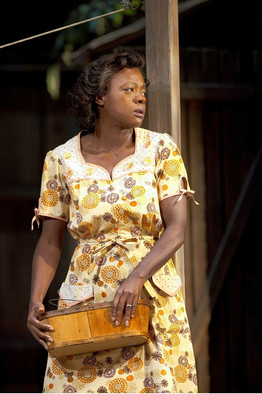
TT: Cheers for Viola Davis (and August Wilson)
In today's Wall Street Journal drama column, I cover the opening of the Broadway revival of August Wilson's Fences, a great American play in which Viola Davis is giving the performance of a lifetime. I also have a few things to say about Enron. Here's an excerpt.
* * *
Denzel Washington is by far the biggest name associated with the first Broadway revival of August Wilson's "Fences," but my guess is that it's Viola Davis whose performance is going to stick with you. Not that Mr Washington is anything less than solid, but Ms. Davis is something else again. I knew she was a remarkable artist--anyone who saw her in the Off-Broadway premiere of Lynn Nottage's "Intimate Apparel" or the film version of John Patrick Shanley's "Doubt" knows that--but what she's doing this time around goes straight into my scrapbook of stage performances from which you learn how brutally true to life great acting can be....
It was Wilson's special achievement to forge the everyday speech of working-class blacks into a language poetic enough to encompass tragedy. Time and again in "Fences" the actors utter sentences so pointed that they make you want to laugh out loud with delight: "I told him if he wasn't the marrying kind, then move out the way so the marrying kind could find me." "The only thing I knew was the time had come for me to leave my daddy's house. And right there the world suddenly got big."
Ms. Davis speaks her share of these sentences with relish, but she also makes us see their meaning. When Mr. Washington confesses that he has betrayed her, she appears to shrink before your eyes. "You telling your wife this?" she cries. "I have to wait 18 years to hear something like this?" Then her arms flail at random, as if she were a puppet whose strings had been clipped by despair....
Can good topical theater be spun out of nine-year-old news? Maybe, but you won't prove it by Lucy Prebble's "Enron," a ripped-from-the-headlines black comedy about the rise and fall of the corporation whose 2001 collapse sent shivers through the world of finance that are felt to this day. Rupert Goold's ultra-flashy production abounds with high-tech stage trickery, none of which manages to conceal the thinness and triviality of Ms. Prebble's surprisingly unamusing script....
* * *
Read the whole thing here.
Posted April 30, 12:00 AM
TT: A kind of poet
In Saturday's "Sightings" column for The Wall Street Journal, I pay tribute to Gene Lees, the song lyricist and music journalist whose passing I noted last week. Gene, whom I had the honor to know for the last twenty-odd years of his life, was a greatly gifted writer and a lovable--if difficult--man, and I did my best to convey something of his complex essence in this piece.
If you're curious, pick up a copy of tomorrow's Journal and see what I have to say.
UPDATE: Read the whole thing here.
Posted April 30, 12:00 AM
TT: Almanac
"Passion persuades me one way, reason another. I see the better and approve it, but I follow the worse."
Ovid, Metamorphoses
Posted April 30, 12:00 AM
April 29, 2010
TT: So you want to see a show?
Here's my list of recommended Broadway, off-Broadway, and out-of-town shows, updated weekly. In all cases, I gave these shows favorable reviews (if sometimes qualifiedly so) in The Wall Street Journal when they opened. For more information, click on the title.
Warning: Broadway shows marked with an asterisk were sold out, or nearly so, last week.
BROADWAY:
• A Behanding in Spokane (black comedy, PG-13, violence and adult subject matter, closes June 6, reviewed here)
• La Cage aux Folles * (musical, PG-13, adult subject matter, reviewed here)
• Fela! (musical, PG-13, adult subject matter, reviewed here)
• God of Carnage (serious comedy, PG-13, adult subject matter, closes June 27, reviewed here)
• Million Dollar Quartet (jukebox musical, G, reviewed here)
• South Pacific (musical, G/PG-13, some sexual content, brilliantly staged but unsuitable for viewers acutely allergic to preachiness, closes Aug. 22, reviewed here)
OFF BROADWAY:
• Alfred Hitchcock's The 39 Steps (comedy, G, suitable for bright children, original Broadway production reviewed here)
• Avenue Q (musical, R, adult subject matter and one show-stopping scene of puppet-on-puppet sex, reviewed here)
• The Fantasticks (musical, G, suitable for children capable of enjoying a love story, reviewed here)
• The Glass Menagerie (drama, G, too dark for children, closes June 13, reviewed here)
• Our Town (drama, G, suitable for mature children, reviewed here)
• The Temperamentals (drama, PG-13, adult subject matter, reviewed here)
CLOSING NEXT WEEK OFF BROADWAY:
• The Orphans' Home Cycle, Parts 1, 2, and 3 (drama, G/PG-13, too complicated for children, now being performed in rotating repertory, closes May 8, reviewed here, here, and here)
CLOSING SATURDAY OFF BROADWAY:
• I Never Sang for My Father (drama, G/PG-13, too dark for children, closes May 1, reviewed here)
Posted April 29, 12:00 AM
TT: Almanac
"I'm acting for the audience, not for myself, and I do it as directly as I can."
James Cagney, Cagney by Cagney
Posted April 29, 12:00 AM
April 28, 2010
TT: Snapshot
Bill Monroe and His Blue Grass Boys play "Roanoke" in 1955:
(This is the latest in a weekly series of arts-related videos that appear in this space each Wednesday.)
Posted April 28, 12:00 AM
TT: Almanac
"Struggling young repertory actors believe too fervently in themselves and their prospects ever to entertain the conscious thought that their backers can suffer--or, at any rate, the thought that their backers can suffer in anything but a noble cause."
Patrick Hamilton, Mr. Stimpson and Mr. Gorse
Posted April 28, 12:00 AM
April 27, 2010
TT: Food for thought
Who painted this unsigned watercolor?

If you need a hint--and you almost certainly will--the painter once made the following remark:
We should never judge artists by their political views. The imagination they need for their work deprives them of the ability to think in realistic terms.
Care to venture a guess? If not, search for the quote and you'll find out the answer....
Posted April 27, 12:00 AM
TT: Almanac
"But a long time ago I made me a rule: I let people do what they want to do."
Louis L'Amour, Hondo
Posted April 27, 12:00 AM
April 26, 2010
TT: Low-rent Apartment
The Wall Street Journal's much-discussed New York section was rolled out this morning. As part of the general ballyhoo, I've been asked to write a second weekly drama column for the Journal, this one specifically for the new section. The new column won't run on a specific day, but will be published on the morning after the opening of whatever show I happen to be reviewing. Subscribers to the national edition won't see it, alas, but anybody can read it on line.
My inaugural column is about the Broadway revival of Promises, Promises, which I regret to say is a major disappointment. Here's an excerpt.
* * *
When a hit musical drops out of sight for nearly four decades, there's usually a reason. In the case of "Promises, Promises," which is being revived for the first time on Broadway since the original production closed there after a 1,281-performance run, the reason is obvious: It's no good. Nor is Rob Ashford's big-budget mounting likely to win many new friends for the 1968 Burt Bacharach-Hal David-Neil Simon adaptation of Billy Wilder's "The Apartment." Not only is it dully staged, but it's so miscast that even Kristin Chenoweth, normally one of Broadway's hottest commodities, looks like she showed up at the wrong theater.
To be sure, it's easy to see why Messrs. Bacharach, David and Simon thought it a good idea to turn "The Apartment" into a musical. Wilder's 1960 movie is one of the sharpest-witted romantic comedies ever filmed, a sweet-and-sour tale of workplace fornication in which every laugh has a sting in the tail. It was also perfectly cast, with Jack Lemmon playing the role of C.C. Baxter, a corporate hireling who makes his apartment available to Fred MacMurray, his married boss, for after-hours trysts with Shirley MacLaine, the delectable elevator operator whom both men crave.
That's where the trouble starts with "Promises, Promises." Problem No. 1: Ms. Chenoweth plays Fran Kubelik, the shopworn waif who is so devastated by her lover's faithlessness that she takes an overdose of sleeping pills. I'm one of Ms. Chenoweth's staunchest admirers, but her gifts do not include the ability to suggest vulnerability, and it is impossible to imagine that so self-assured a woman would even contemplate suicide, much less attempt it. As a result, her performance is dramatically unbelievable...
This brings us to the deficiencies of the show proper. In the film, Baxter supplies an introductory narration that sets up the plot, then lets the viewer figure the rest out for himself. In the musical, he narrates from start to finish, a bad idea that kills the momentum stone dead and is made worse by Mr. Simon's habit of stuffing his speeches full of jokes that might been funny in 1968 but are now about as stylish as a Buick with fins.
As for the score, it consists of a string of chirpy soft-rock ballads like the title tune and "I'll Never Fall in Love Again" that were heard around the clock on AM radio back in the days of Herb Alpert and the Tijuana Brass (which doubtless explains why the original production of "Promises, Promises" was so huge a hit). One of them, "A House Is Not a Home," is a beautifully turned piece of work that has since been taken up by such jazz greats as Sarah Vaughan and Bill Evans. The others are so similar-sounding as to approach indistinguishability....
* * *
Read the whole thing here.
UPDATE: A reader advised me this morning that the original online version of this column was behind the Journal's paywall. I now have a link in place that should be accessible to everyone.
Posted April 26, 12:00 AM
TT: Mamet's top ten
I expect that David Mamet's Theatre, which was published last week, is going to stir up a stink, and I plan to write about it at length at some point in the future. For now, though, I want to pass on the following paragraphs:
Here are my choices for Great American Plays: First, Our Town, then The Front Page, Who's Afraid of Virginia Woolf?, A Streetcar Named Desire, All My Sons, and Doubt. One might also mention The Time of Your Life, The Boys in the Band, The Best Man, and The Women.What do these plays have in common? They are intensely American. That is, they both treat American issues and are written in an American idiom closer to real poetry than to prose.
That is a damned interesting list, and an equally interesting explanation. My own list, needless to say, would look different--but the overlap would be considerable.
Posted April 26, 12:00 AM
TT: Almanac
"The very object of an art, the principle of its artifice, is precisely to impart the impression of an ideal state in which the man who reaches it will be capable of spontaneously producing, with no effort of hesitation, a magnificent and wonderfully ordered expression of his nature and our destinies."
Paul Valéry, "Remarks on Poetry"
Posted April 26, 12:00 AM
April 25, 2010
BOOK
David Mamet, Theatre (Faber & Faber, $22). In this hard-nosed little book, the author of American Buffalo and Glengarry Glen Ross concisely sets forth his explanations of what theater is, how it works, why most directors and all critics are idiots, and why people who don't write plays like David Mamet are basically wasting their time. He also finishes the job of outing himself as a libertarian-flavored not-quite-conservative. Since Mamet is also one of the major American playwrights of the twentieth century, all this is of obvious interest to anyone who cares about theater, and it's expressed so compellingly (if repetitiously) that you can't help but get swept up in the current of the author's absolute self-assurance. You may not like Theatre, but you'll learn from it (TT).Posted April 25, 2:25 PM
CD
Pat Metheny, Orchestrion (Nonesuch). The most influential jazz guitarist of his generation hooks up a roomful of solenoid-controlled acoustic musical instruments to his electric guitar, turns them into the world's biggest one-man band, and causes them to play an albumful of ear-ticklingly lovely original compositions. Go here to see Metheny talk about the technology behind this fascinating project--but by all means listen first (TT).Posted April 25, 2:24 PM
MUSICAL
La Cage aux Folles (Longacre, 220 W. 48). The Jerry Herman-Harvey Fierstein musical-comedy version of the 1978 film is still as tawdry and tinselly as ever, but this small-scale revival, which stars Kelsey Grammer and Douglas Hodge, is so unfancy and heartfelt that it miraculously contrives to turn a show I've never liked into one that touched me to the heart. As of now, La Cage is the show to see if you're looking for a Big Broadway Tourist Trap that's worth the price of the ticket (TT).Posted April 25, 2:22 PM
April 23, 2010
TT: Gene Lees, R.I.P.
Gene Lees, who published the Jazzletter and wrote the lyrics for such standards as Antonio Carlos Jobim's "This Happy Madness" and Bill Evans' "Waltz for Debby," was so much a part of my life that I can't take in the fact of his death. I knew him for years and wrote a preface for Waiting for Dizzy, one of the many books in which he collected his Jazzletter essays and profiles. He was a vain, difficult, endlessly crotchety man, and like many such men, he was surprisingly easy to love.
Most people know Gene's lyrics, but comparatively few non-musicians are familiar with the Jazzletter, though it was one of the first and most influential privately published newsletters of its kind. Here's how I described it in my preface to Waiting for Dizzy:
In order to preserve some of the rich oral tradition of jazz and, in his words, "satisfy my own curiosity" about the lives and personalities of the great jazz musicians, Gene Lees started the Jazzletter, a monthly journal about jazz and American popular music, in 1981. Most of the Jazzletter is written by Lees himself, though he also publishes essays and memoirs by working musicians. Waiting for Dizzy, the third book quarried out of his Jazzletter essays, portrays in unprecedented and knowing detail the world of jazz as it really is. The musicians profiled in Waiting for Dizzy are not inarticulate sociopaths wandering from fix to fix. They are intelligent, well-spoken craftsmen who take a commercial commodity and turn it into an art form, the only wholly original one this country has produced. They live the shadowy lives of night people, working their mysterious musical alchemy in bars and country clubs and recording studios. Theirs is a world of friendship and mutual admiration, of unexpected kindness and extraordinary generosity, of hard times and empty pockets and four-in-the-morning courage....Composer Johnny Mandel--one of the many major jazz musicians who subscribe to the Jazzletter and eagerly await its arrival each month--has said of Lees' work: "Most writing about jazz seems like somebody looking through glass into a fish tank. Gene's sounds like he's in the tank, swimming with the rest of us."
I wrote a couple of pieces that appeared in the Jazzletter, and was immensely proud to have been asked to do so by a writer whom I admired so greatly.
I'd say more, or at least try, but Doug Ramsey has already said it all here.
UPDATE: I ran across this quote from Gene on Facebook this morning: "I have always been more interested in music itself than in my own opinion about it." Well said.
The Washington Post obituary is here.
The Los Angeles Times obituary is here.
Posted April 23, 8:51 AM
TT: Size matters
This week's Wall Street Journal drama column, in which I review three new Broadway musicals, is a mixed bag. I very much liked the revival of La Cage aux Folles, a musical of which I'm not greatly fond, but I had no use whatsoever for American Idiot and was unable to shake off strong doubts about Sondheim on Sondheim. Here's an excerpt.
* * *
Now that money is tight in the world of theater, small-scale productions of large-scale Broadway musicals are popping up everywhere. Some are illuminating, others constrictingly ill-conceived. The Menier Chocolate Factory's revival of "La Cage aux Folles," which has transferred to Broadway after a hugely successful London run, belongs in the first category--and then some. I've never cared for "La Cage," but I loved this modest staging, which is so good that it makes the show seem better than it really is.
The trouble with the musical version of "La Cage" is that it's loud, crass and overblown. Not so the 1978 film on which it is based, in which the story of two middle-aged gay men who run a transvestite nightclub (one is the manager, the other the drag-queen star) is told with such sweet simplicity that you can't help but be touched. In the process of turning this charming little tale into a big-budget Broadway show, Jerry Herman and Harvey Fierstein smothered it in brassy one-liners and knock-'em-dead production numbers, and somewhere along the way the sweetness turned sour.
By stuffing their staging into a shabby-looking set roughly comparable in size to a second-rate nightclub, Terry Johnson and Tim Shortall, the director and set designer, have clipped away the tinsel and made it possible for the audience to focus on the relationship of Georges (Kelsey Grammer, lately of "Frasier") and Albin (Douglas Hodge). To be sure, the score is still banal and the jokes still grate, but at least you can believe in what you're seeing, and Messrs. Grammer and Hodge are so engaging that the show's shortcomings recede into the distance....
Whatever else it is, Green Day's "American Idiot" isn't an opera, just as the stage show that has now been made out of it isn't a musical. The original album, released in 2004, consists of 13 sketchily related punk-rock songs that purport to tell the story of a trio of disaffected teenage slackers, and the show consists of the same songs, with a few others thrown in to bring the running time up to 90 minutes. The onstage version of "American Idiot" contains no dialogue, only intermittent snippets of first-person narration, and Michael Mayer's image-driven video-style staging is discontinuous to the point of plotlessness.
All this being the case, "American Idiot" rises or falls almost entirely on the strength of the songs themselves, and I regret to say that I found them to be brain-numbingly dull. Perhaps I might feel differently if I were 14, but I was all but incapable of attending to the puerile maunderings of Billie Joe Armstrong, Green Day's lyricist...
In addition to being a great songwriter, Stephen Sondheim is the object of a cult, the members of which are gathering nightly at Studio 54 to take part in a religious ceremony disguised as a revue. "Sondheim on Sondheim," devised and directed by James Lapine, Mr. Sondheim's longtime theatrical collaborator, consists of lively performances by eight singers of three dozen Sondheim songs, all of them introduced by the man himself, who appears not in person but via the wonders of digital projection. The handsomely mounted results suggest a cross between a PBS documentary and a lecture-recital and at times are almost as interesting...
* * *
Read the whole thing here.
Posted April 23, 12:00 AM
TT: Almanac
"The lot of critics is to be remembered by what they failed to understand."
George Moore, Impressions and Opinions
Posted April 23, 12:00 AM
April 22, 2010
TT: So you want to see a show?
Here's my list of recommended Broadway, off-Broadway, and out-of-town shows, updated weekly. In all cases, I gave these shows favorable reviews (if sometimes qualifiedly so) in The Wall Street Journal when they opened. For more information, click on the title.
Warning: Broadway shows marked with an asterisk were sold out, or nearly so, last week.
BROADWAY:
• A Behanding in Spokane (black comedy, PG-13, violence and adult subject matter, closes June 6, reviewed here)
• Fela! (musical, PG-13, adult subject matter, reviewed here)
• God of Carnage (serious comedy, PG-13, adult subject matter, reviewed here)
• Million Dollar Quartet (jukebox musical, G, reviewed here)
• South Pacific (musical, G/PG-13, some sexual content, brilliantly staged but unsuitable for viewers acutely allergic to preachiness, closes Aug. 22, reviewed here)
OFF BROADWAY:
• Alfred Hitchcock's The 39 Steps (comedy, G, suitable for bright children, original Broadway production reviewed here)
• Avenue Q (musical, R, adult subject matter and one show-stopping scene of puppet-on-puppet sex, reviewed here)
• The Fantasticks (musical, G, suitable for children capable of enjoying a love story, reviewed here)
• The Glass Menagerie (drama, G, too dark for children, closes June 13, reviewed here)
• Our Town (drama, G, suitable for mature children, reviewed here)
• The Temperamentals (drama, PG-13, adult subject matter, reviewed here)
CLOSING SOON OFF BROADWAY:
• I Never Sang for My Father (drama, G/PG-13, too dark for children, closes May 1, reviewed here)
• The Orphans' Home Cycle, Parts 1, 2, and 3 (drama, G/PG-13, too complicated for children, now being performed in rotating repertory, closes May 8, reviewed here, here, and here)
Posted April 22, 12:00 AM
TT: Almanac
"The chief knowledge that a man gets from reading books is the knowledge that very few of them are worth reading."
H.L. Mencken, A Little Book in C Major
Posted April 22, 12:00 AM
April 21, 2010
TT: Snapshot
The opening of Terence Rattigan's 1955 screen adaptation of The Deep Blue Sea, starring Vivien Leigh and directed by Anatole Litvak, with a score by Malcolm Arnold:
(This is the latest in a weekly series of arts-related videos that appear in this space each Wednesday.)
Posted April 21, 12:00 AM
TT: Almanac
"Biographer: an unjust god."
H.L. Mencken, A Little Book in C Major
Posted April 21, 12:00 AM
April 20, 2010
TT: Third time's a charm
I've never won a prize in my life--none of any consequence, at least--but Pops: A Life of Louis Armstrong, which was nominated earlier this year for an NAACP Image Award and a Pulitzer, is now up for an award from the Jazz Journalists Association. It's one of five books published in 2009 that have been nominated in the Best Book About Jazz category. The competition is stiff, and I don't expect to bring home the bacon, but it's always nice to be asked.
Alas, I won't be able to come to the ceremony on June 14. Mrs. T and I will be flying out to the Oregon Shakespeare Festival that morning. I'll be there in spirit, though!
Posted April 20, 12:00 AM
TT: Almanac
"Great art is the contempt of a great man for small art."
F. Scott Fitzgerald, notebook entry, 1945
Posted April 20, 12:00 AM
April 19, 2010
TT: Ties that bind
I'll be speaking about Pops: A Life of Louis Armstrong at the Kansas City Public Library on May 6, then flying from there to Chicago to see plays with Mrs. T and Our Girl. First, though, I'm going to spend a few days in Smalltown, U.S.A., at the end of which I'll rent a car and drive north to St. Louis and west to Kansas City. That's a long haul, but there's no good way to get from Smalltown to Kansas City other than by car--the only way you can fly there is if you happen to own a plane--and I need to see my family and walk the streets of the place I know best.
Between Pops and The Letter, I was so busy last year that I didn't get to visit Smalltown as often as usual. I have a sneaking feeling that I'm not going to have a whole lot of time on my hands in the next few years to come, so I figure I'd better grab any reasonable opportunity to go there that presents itself. This'll do.
The strength of my home ties is one of the many things that sets me apart from most of the people among whom I live and work. I must be the least alienated intellectual (if that's what I am--it's not a word I care to use to describe myself) ever to set up shop in New York City. I don't think I have any particular illusions about Smalltown, and I wouldn't want to try to live there anymore--you have to drive too far to see a play--but every once in a while I find myself all but overwhelmed by the desire to be there. While I'm sure this is mostly because my mother and brother and sister-in-law still live in Smalltown, that's not the only reason, not by a long shot. Even though I've lived in Manhattan and its environs for a quarter-century now, I've never quite managed to persuade myself that I truly belong here, that I am of the city, citified.
I once wrote a book in which I tried to put this feeling into words:
I am glad to have two homes, glad to be able to catch a cab outside Grand Central Station and, six hours later, step out of a rented car and stroll up the driveway to the back door of my parents' house and sleep in the bedroom where I slept as a child. Once I thought I would spend the rest of my life in a place like that. I did not know when I went off to college that I would someday stand at both ends of the long road that stretched invisibly before me, beckoning vainly across the continent to myself. I am like a million other Americans who grew up and moved away from the small towns of their childhood. We cannot go back; we are not at home where we are. We are exiles from the lost heart of the land we love.
I wrote that paragraph in 1991. I still feel that way, pretty much.
* * *
Pat Metheny, a fellow Missourian, plays "Letter from Home":
Posted April 19, 12:00 AM
TT: Almanac
"The way to determine whether you have talent is to rummage through your files and see if you have written anything; if you have, and quite a lot, then the chances are you have the talent to write more. If you haven't written anything, you do not have the talent because you don't want to write. Those who do can't help themselves."
George V. Higgins, On Writing
Posted April 19, 12:00 AM
April 18, 2010
DENYING SHAKESPEARE
"I am, as should be apparent, poking fun at those benighted souls who believe that someone other than William Shakespeare--the most prominent candidates being Francis Bacon and the Earl of Oxford--wrote Hamlet, Macbeth and Romeo and Juliet. In a saner world, nobody would need to poke fun at them, for nobody would give them the time of day, there being no credible evidence whatsoever to support their claims..."Posted April 18, 11:48 PM
April 16, 2010
TT: Good rockin' tonight
I report on two satisfying shows in this week's Wall Street Journal drama column, Million Dollar Quartet and Keen Company's off-Broadway revival of I Never Sang for My Father. Here's an excerpt.
* * *
Good clean rockabilly fun has come to Broadway in the form of "Million Dollar Quartet," an unpretentious, engagingly energetic staged concert with just enough story to qualify it as a jukebox musical. The subject is the celebrated evening in 1956 when Johnny Cash, Jerry Lee Lewis, Carl Perkins and Elvis Presley got together at Sam Phillips' recording studio in Memphis for an informal pre-Christmas jam session. These pop-music giants are respectively portrayed by Lance Guest, Levi Kreis, Robert Britton Lyons and Eddie Clendening, four accomplished musicians who evoke their legendary models without stooping to literal imitation. Put them together and you get a hell of a band....
Don't go to "Million Dollar Quartet" looking for great acting. Three members of the front line are not professional actors (Mr. Guest is the ringer) and the book, by Colin Escott and Floyd Mutrux, is tissue-thin. This is the kind of show that goes flat whenever the characters stop singing and start talking. Fortunately, they do plenty of the former and not too terribly much of the latter....
How good must a play be to make it worth seeing? It certainly needn't be a masterpiece. Robert Anderson's "I Never Sang for My Father," which had a modest but respectable run on Broadway in 1968 and was then turned into a modestly successful film, is a post-"Glass Menagerie" kitchen-sink drama about an aging father (Keir Dullea) and his angry, alienated son (Matt Servitto). Though devoid of poetry, it's so true to life that you'll wince at every other line, and Keen Company's revival is as satisfying as a meat-and-potatoes dinner whipped up by a five-star chef....
* * *
Read the whole thing here.
Posted April 16, 12:00 AM
TT: Shakespeare denial
I'm one of many people who's read and been impressed by James Shapiro's Contested Will: Who Wrote Shakespeare? In tomorrow's Wall Street Journal "Sightings" column I talk about the book, and the phenomenon that inspired it. I was inspired in turn by something that struck me while reading Contested Will, though Shapiro himself didn't get around to mentioning it: Shakespeare is, so far as I know, the only major artist since Homer whose authorship of the works for which he is remembered has been systematically questioned. Why? Why the Bard and not, say, Bach?
If that question piques your curiosity, pick up a copy of Saturday's Journal and see what I have to say.
UPDATE: Read the whole thing here.
Posted April 16, 12:00 AM
TT: Almanac
"Selfishness must always be forgiven, you know, because there is no hope of a cure."
Jane Austen, Mansfield Park
Posted April 16, 12:00 AM
April 15, 2010
TT: Just because
Vladimir Horowitz plays the slow movement of Mozart's A Major Piano Concerto, K. 488:
Is there a more beautiful piece of music in all the world?
Posted April 15, 12:40 AM
TT: Pick-me-up
A reader writes:
I've been reading Pops with tremendous pleasure--it was the ideal book to take with me on a recent trip to New Orleans for the French Quarter Festival. A parking attendant saw me there carrying it one day and shouted out, "Good book!"
That might just be the best review I've ever gotten.
Posted April 15, 12:00 AM
TT: So you want to see a show?
Here's my list of recommended Broadway, off-Broadway, and out-of-town shows, updated weekly. In all cases, I gave these shows favorable reviews (if sometimes qualifiedly so) in The Wall Street Journal when they opened. For more information, click on the title.
Warning: Broadway shows marked with an asterisk were sold out, or nearly so, last week.
BROADWAY:
• A Behanding in Spokane (black comedy, PG-13, violence and adult subject matter, closes June 6, reviewed here)
• Fela! (musical, PG-13, adult subject matter, reviewed here)
• God of Carnage (serious comedy, PG-13, adult subject matter, reviewed here)
• South Pacific (musical, G/PG-13, some sexual content, brilliantly staged but unsuitable for viewers acutely allergic to preachiness, closes Aug. 22, reviewed here)
OFF BROADWAY:
• Alfred Hitchcock's The 39 Steps (comedy, G, suitable for bright children, original Broadway production reviewed here)
• Avenue Q (musical, R, adult subject matter and one show-stopping scene of puppet-on-puppet sex, reviewed here)
• The Fantasticks (musical, G, suitable for children capable of enjoying a love story, reviewed here)
• The Glass Menagerie (drama, G, too dark for children, extended through June 13, reviewed here)
• Our Town (drama, G, suitable for mature children, reviewed here)
• The Temperamentals (drama, PG-13, adult subject matter, reviewed here)
CLOSING SOON OFF BROADWAY:
• The Orphans' Home Cycle, Parts 1, 2, and 3 (drama, G/PG-13, too complicated for children, now being performed in rotating repertory, closes May 8, reviewed here, here, and here)
CLOSING SATURDAY OFF BROADWAY:
• The Cocktail Party (drama, PG-13, adult subject matter, reviewed here)
Posted April 15, 12:00 AM
TT: Almanac
"Be sure to read no mean books. Shun the spawn of the press on the gossip of the hour. Do not read what you shall learn, without asking, in the street and the train."
Ralph Waldo Emerson, "Books"
Posted April 15, 12:00 AM
April 14, 2010
TT: Justified
Howard Kurtz, who covers the media for the Washington Post, quoted me on Monday in a column about the changing role of newspaper critics in the age of online opinion, professional and otherwise. Since what I said to Kurtz got noticed here and there, it occurred to me that it might be worth reprinting part of a column I wrote for The Wall Street Journal in 2007 in which I addressed the same topic at greater length.
* * *
I now spend more time reading art-related blog postings than print-media reviews. Increasingly, they're sharper, livelier and timelier than their old-media competition.
This is why I have mixed feelings about the decline of regional newspaper criticism, much of which is uneven in quality and not a little of which is pointless. Why, for instance, should a medium-sized newspaper run locally written reviews of blockbuster movies or beach-blanket novels? That's like assigning a restaurant critic to discuss the difference between Big Macs and Whoppers. To the limited extent that such commodity art requires "serious" criticism, wire-service copy will do the job perfectly well.
The fine arts, however, are a different story. One of the most important civic duties that a newspaper performs is to cover the activities of local arts groups--but it can't do that effectively without also employing knowledgeable critics who are competent to evaluate the work of those groups. Mere reportage, while essential, is only the first step. It's not enough to announce that the Hooterville Art Museum finally bought itself a Picasso. You also need a staffer who can tell you whether it's worth hanging, just as you need someone who knows whether the Hooterville Repertory Company's production of Private Lives was funny for the right reasons.
Can bloggers do that? Of course--and some of them do it better than their print-media counterparts....
But blogging, valuable though it can be, is no substitute for the day-to-day attention of a newspaper whose editors seek out experts, hire them on a full-time basis, and give them enough space to cover their beats adequately. The problem is that fewer and fewer newspapers seem willing to do that in any consistent way. I don't care for the word "provincial," but I can't think of a more accurate way to describe a city whose local paper is unwilling to make that kind of commitment to the fine arts.
To be sure, it's hard for medium-sized regional newspapers to attract serious critics, but it can be done. Indeed, a well-edited regional paper is often the best possible place for an up-and-coming young critic to learn his trade. I got my start reviewing second-string classical concerts for the Kansas City Star thirty years ago. Now that such entry-level work is drying up, I fear for the future of arts journalism in America.
Any artist who's been side-swiped by a lame-brained critic will doubtless be tempted to cheer this news. Before such aggrieved folk break out the Dom Perignon, though, they should pay heed to the warning of Virgil Thomson, who dominated American music criticism in the Forties and Fifties: "Perhaps criticism is useless. Certainly it is often inefficient. But it is the only antidote we have to paid publicity."
If you think you can do without that antidote, more power to you--but you'd better be prepared to buy a lot of ads.
Posted April 14, 12:00 AM
TT: Snapshot
A film version of a 1942 radio broadcast of The Jack Benny Program:
(This is the latest in a weekly series of arts-related videos that appear in this space each Wednesday.)
Posted April 14, 12:00 AM
TT: Almanac
"There are people who read too much: the bibliobibuli. I know some who are constantly drunk on books, as other men are drunk on whiskey or religion. They wander through this most diverting and stimulating of worlds in a haze, seeing nothing and hearing nothing."
Minority Report: H.L. Mencken's Notebooks
Posted April 14, 12:00 AM
April 13, 2010
TT: Empty closet
Our Girl has invited me to play this game, the rules of which were passed along by the proprietor of one of our favorite blogs:
Reading skeletons...are those books and writers that make you ashamed of yourself. Like Even Cowgirls Get the Blues, which I read one hot and beach-blanketed summer to impress a California girl. Or Zen and the Art of Motorcycle Maintenance, the philosophical pretensions of which amazed me when I was a pretentious college senior. All of us have skeletons in our reading closets. We do not confess to them, because we do not want to be arrested. We want to move on with our reading lives.
It happens that I never got around to reading either of the aforementioned books. For my generation, I suspect that Catch-22 may well be the ultimate reading skeleton. I thought it profound in high school and now wince at the thought of ever having to crack it again. Nor do I plan to revisit The Catcher in the Rye, Good Times/Bad Times, or A Separate Peace in my middle age, any more than I'd care to repeat my freshman year in high school, though it doesn't embarrass me to admit to having read and liked those books in my adolescence--or, for that matter, to having listened with pleasure to, say, Crosby, Stills & Nash. To be young is to be...well, young.
As far as my adult reading goes, I incline to agree with Our Girl, who says that "I feel as though I can justify reading any book that keeps my attention." This includes, needless to say, such noted purveyors of what H.L. Mencken called "homicidal fiction" as Elmore Leonard, Rex Stout, and Donald Westlake, all of whose novels are variously pleasing to readers with well-tuned ears.
On the other hand, I've never been one to bother with contemporary commercial fiction, no doubt because I find it all but impossible to read a book that isn't stylishly written. To be specific, I've yet to read a single word by any of the novelists whose works appear on the latest New York Times list of paperback mass-market fiction best sellers (except for John Grisham, whose The Firm I read in a weak moment a number of years ago). This incapacity has been known to work to my disadvantage--it's the reason why I've never been able to get anywhere with Theodore Dreiser, or with the vast majority of academic biographies--but I'm mostly grateful for it.
Your turn, CAAF.
Posted April 13, 5:23 PM
TT: Mortification, anyone?
The Pulitzer Prizes were announced yesterday. Needless to say, I didn't win one, nor was I a finalist, though I was nominated three times, for Pops, my contribution to The Letter, and in my capacity as The Wall Street Journal's drama critic.
As if that weren't a sufficiently direct lesson in humility, I received in the mail my latest royalty check from Borealis Press. This one (pause for drumroll) was for...$4.06.
Vanity, thy name is someone else. At least until tomorrow. Or maybe next week.
Posted April 13, 12:00 AM
TT: Almanac
"I need not tell you what it is to be knocking about in an open boat. I remember nights and days of calm when we pulled, we pulled, and the boat seemed to stand still, as if bewitched within the circle of the sea horizon. I remember the heat, the deluge of rain-squalls that kept us baling for dear life (but filled our water-cask), and I remember sixteen hours on end with a mouth dry as a cinder and a steering-oar over the stern to keep my first command head on to a breaking sea. I did not know how good a man I was till then. I remember the drawn faces, the dejected figures of my two men, and I remember my youth and the feeling that will never come back any more--the feeling that I could last for ever, outlast the sea, the earth, and all men; the deceitful feeling that lures us on to joys, to perils, to love, to vain effort--to death; the triumphant conviction of strength, the heat of life in the handful of dust, the glow in the heart that with every year grows dim, grows cold, grows small, and expires--and expires, too soon--before life itself."
Joseph Conrad, "Youth" (courtesy of The Rat)
Posted April 13, 12:00 AM
April 12, 2010
TT: Lucky man
I'm up my ears in work in New York, Mrs. T is up in Connecticut taking care of various chores, and neither of these things will be changing until Sunday. As a result, I was feeling more than a little bit grumpy when I sat down in front of the TV on Friday night, surfed the channels, and settled on Groundhog Day, a movie that I love but hadn't seen in several years.
Later that same evening, I emitted a burst of tweets which, stitched together, read as follows:
I'm in the middle of a major writing project (not the Ellington biography) that's giving me a bad case of the ups-and-downs. What I'd like to do is leave my computer behind and hole up on Isle au Haut for a couple of work-free weeks. Alas, this is not an option. I'll have to settle for a nice long walk in Central Park, which is far from the worst of a bad bargain.If you need to adjust your attitude--and I did--a repeat viewing of Groundhog Day will likely do the trick. I laughed and laughed, then found myself overcome with gratitude at film's end. I'm the luckiest person I know, and sometimes I forget it. Not tonight, though.
To which Lileks responded as follows: "Gratitude! That's precisely the reaction I have to cheer-inducing, optimistic art. It's a profound and underrated emotion." And so it is, especially the latter. Among other things, that's why Mozart has always been more widely celebrated than Haydn, an equally great composer whose music, though anything but ignorant of the world's sorrows, is nonetheless fundamentally optimistic and hopeful. Under the aspect of modernity, we prefer our geniuses to be bleak, believing as we do that life is real, earnest, and not infrequently grim. Except that it isn't, at least not always, and to forget that fact is to commit the soul-shriveling sin of ingratitude.
In a piece I wrote about Haydn for Commentary back in 2005, I quoted the following statement that has been attributed to the composer:
Often when contending with obstacles of every sort that interfered with my work... a secret feeling within me whispered: "There are but few contented and happy men here below; grief and care prevail everywhere; perhaps your labors may one day be the source from which the weary and worn, or the man burdened with affairs, may derive a few moments' rest and refreshment." What a powerful motive for pressing onward!
And what an equally powerful motive for seeking to make optimistic art.
The truest and best sentence in Pops: A Life of Louis Armstrong, if I do say so myself, is the one in which I described Armstrong as "a major-key artist who would always be disinclined to lament the woes of the world, aware of them though he was." I coined the phrase "major-key artist" long ago to describe my old friend Nancy LaMott, who contended with the brutal and debilitating frustration of chronic illness, yet somehow contrived to fill her voice with the sunny warmth of hope each time she raised it in song.
Would that I could do that, or something like it! Alas, I'm merely a craftsman, not a great artist, but at least I can do my best to remind my readers of the life-enhancing virtues of such other joy-inspiring masters as (to name a few off the top of my head) Sir Thomas Beecham, Pierre Bonnard, Emmanuel Chabrier, Noël Coward, Erroll Garner, Howard Hawks, Henri Matisse, Fairfield Porter, and Frank Lloyd Wright. And--lest we forget--Harold Ramis, the director of Groundhog Day, who may not be a master but who has certainly helped make the world a happier and more grateful place.
As for my own fluctuating gratitude, it ran high all weekend long, fed by Saturday's glorious sunshine and my first long walk through Central Park in far longer than I care to admit. I am, I know, absurdly lucky, lucky in love and friendship and, perhaps rarest of all, in work. No doubt I spend too much time at the grindstone, but how many people get to earn their living writing books about men like Louis Armstrong and reviews of shows like, say, Gordon Edelstein's current off-Broadway revival of The Glass Menagerie? And how many working journalists get to change hats in the middle of life and collaborate with a great composer on an opera, then see it produced to perfection and cheered to the echo?
I haven't mentioned her lately in this space, so perhaps it's worth saying that my mother did everything right (other than failing to teach me how to cook). Evelyn Teachout, who turns eighty-one in June, mysteriously neglected to make any of the all-too-familiar mistakes that blight the lives of so many of the people I know. She showed me how to laugh, admired my achievements, brushed off my failures, assured me whenever necessary that pretty much anything I wanted to do in life would be fine with her, and never left me in the slightest doubt of her love. She embedded in me what Freud called "that confidence of success that often induces real success." You can't get much luckier than that.
Each day is, of course, its own challenge, and I'm sure that I'll forget to be grateful for all my good fortune at some particularly exasperating point in the week to come. But this posting, along with others like it that I've written in the seven years since this blog opened for business, is meant to serve as a marker, a permanent reminder of my obligation to appreciate all that is good, both in my own life and in the world around me.
Vladimir Nabokov said it: "The cradle rocks above an abyss, and common sense tells us that our existence is but a brief crack of light between two eternities of darkness." Perhaps--but oh, how lovely a light!
* * *
Just in case you need a lift this morning, here's the Erroll Garner Trio playing "Where or When":
Posted April 12, 12:00 AM
TT: Almanac
"It was as though being in tune with life was an accident that might sometimes befall the fortunate young but was otherwise something for which human beings lacked any real affinity. How odd. And how odd it made him seem to himself to think that he who had always felt blessed to be numbered among the countless unembattled normal ones might, in fact, be the abnormality, a stranger from real life because of his being so sturdily rooted."
Philip Roth, American Pastoral (courtesy of The Rat)
Posted April 12, 12:00 AM
April 9, 2010
TT: I've seen that show before
I have lukewarm feelings about both of the Broadway shows I reviewed in today's Wall Street Journal drama column, The Addams Family and Lend Me a Tenor. Here's an excerpt.
* * *
If you're a New Yorker with children, or if you're bringing the family to Manhattan this summer, you'll have to go to "The Addams Family." It won't kill you. You'll laugh a lot, though never during the unmemorable songs, which are supposed to be funny but aren't. You're more than likely to spend a considerable part of the evening wondering how much the set cost. And as you depart the theater, you'll probably catch yourself wondering whether it was really, truly worth it to take your kids to a goodish musical whose tickets are so expensive that you can buy an iPad for less than the price of four orchestra seats....
If you liked the sitcom and/or the movies, you'll know just what you're going to get, right down to the ba-da-da-DUMP (snap, snap) TV-show themelet with which Mr. Lippa's otherwise anonymous-sounding score begins. The plot, in which young Wednesday Addams (Krysta Rodriguez) falls for a non-creepy boy from Ohio (Wesley Taylor), is as bland as canned tomato soup, and Nathan Lane and Bebe Neuwirth play Gomez and Morticia Addams right down the center (he's zany, she's haughty)....
Ken Ludwig writes comfy, low-stakes farces in which no one is embarrassed--at least not for long--and all of the characters live happily ever after. "Lend Me a Tenor," last seen on Broadway in 1990, is the quintessential example of Mr. Ludwig's easygoing comic approach, a farce about a production of Verdi's "Otello" whose star (here played by Anthony LaPaglia) fails to show up for opening night. The plot is properly labyrinthine, the jokes reasonably clever, but never once do you you thrill with sadistic glee as a pompous twit strolls heedlessly toward his well-deserved rendezvous with humiliation. If that's what you expect from a farce--and I do--you'll find "Lend Me a Tenor" to be amiable but more then a few teeth short. If not, you'll like it just fine.
Stanley Tucci is making his Broadway debut as a stage director with this revival. His inexperience shows: The staging, for all its coarsely slapsticky liveliness, isn't as taut as it ought to be...
* * *
Read the whole thing here.
Posted April 09, 12:00 AM
TT: Almanac
"Two paradoxes are better than one; they may even suggest a solution."
Edward Teller, Conversations on the Dark Secrets of Physics
Posted April 09, 12:00 AM
April 8, 2010
TT: So you want to see a show?
Here's my list of recommended Broadway, off-Broadway, and out-of-town shows, updated weekly. In all cases, I gave these shows favorable reviews (if sometimes qualifiedly so) in The Wall Street Journal when they opened. For more information, click on the title.
Warning: Broadway shows marked with an asterisk were sold out, or nearly so, last week.
BROADWAY:
• A Behanding in Spokane (black comedy, PG-13, violence and adult subject matter, closes June 6, reviewed here)
• Fela! * (musical, PG-13, adult subject matter, reviewed here)
• God of Carnage (serious comedy, PG-13, adult subject matter, reviewed here)
• South Pacific (musical, G/PG-13, some sexual content, brilliantly staged but unsuitable for viewers acutely allergic to preachiness, closes Aug. 22, reviewed here)
OFF BROADWAY:
• Avenue Q (musical, R, adult subject matter and one show-stopping scene of puppet-on-puppet sex, reviewed here)
• The Fantasticks (musical, G, suitable for children capable of enjoying a love story, reviewed here)
• The Glass Menagerie (drama, G, too dark for children, closes June 13, reviewed here)
• Our Town (drama, G, suitable for mature children, reviewed here)
• The Temperamentals (drama, PG-13, adult subject matter, reviewed here)
CLOSING SOON OFF BROADWAY:
• The Orphans' Home Cycle, Parts 1, 2, and 3 (drama, G/PG-13, too complicated for children, now being performed in rotating repertory, closes May 8, reviewed here, here, and here)
CLOSING NEXT WEEK OFF BROADWAY:
• The Cocktail Party (drama, PG-13, adult subject matter, closes Apr. 17, reviewed here)
Posted April 08, 12:00 AM
TT: Almanac
"There is a God. There is no God. Where is the problem? I am quite sure that there is a God in the sense that I am sure my love is no illusion. I am quite sure there is no God, in the sense that I am sure there is nothing which resembles what I can conceive when I say that word."
Simone Weil, Waiting for God (courtesy of Laura Good)
Posted April 08, 12:00 AM
April 7, 2010
OGIC: Words to the wise
A few literary timbits, er, tidbits. My mind is in the bakery.
• Cheeni Rao, a hugely talented young writer, published his first book last year. The book, In Hanuman's Hands, is a painfully honest, gorgeously written memoir of addiction and recovery, but not like any you've ever read. Rao's spiraling and redemption are intertwined with family mythology about his Hindu ancestors and tales from the Indian epic poem The Ramayana. The book was well received and marked Rao as a writer to watch.
Earlier this year, Rao contributed to the undergraduate alumni magazine I edit at the University of Chicago (his alma mater). His essay, "Stern Lessons," is about going back to college after the events of In Hanuman's Hands, finding his path as a writer, and losing a lot more. It's a wonderful piece of writing, honest and incisive. Read "Stern Lessons" here.
• Here's an idea I can get behind: for National Poetry Month, why not memorize a poem? I wrote previously about the rewards of learning poems by heart here. I'll let you know mine as soon as I choose it.
• What are your reading skeletons--as distinguished from your guilty pleasures? I devoured everything written by Lee Child during the second half of last year though, honestly, I'm not sure how ashamed I am or should be. Unlike, say, some of the television I watch, I feel as though I can justify reading any book that keeps my attention. What about you, esteemed co-bloggers?
Posted April 07, 10:37 AM
TT: Snapshot
Flanders and Swann sing "A Song of Patriotic Prejudice," from At the Drop of Another Hat:
(This is the latest in a weekly series of arts-related videos that appear in this space each Wednesday.)
Posted April 07, 12:00 AM
TT: Almanac
"Politics, when it is an art and a service, not an exploitation, is about acting for an ideal through realities."
Charles de Gaulle, press conference, June 30, 1955
Posted April 07, 12:00 AM
April 6, 2010
TT: Almanac
"They showed utter contempt of the law but expected the system to be fair, which to them meant lenient."
Elmore Leonard, Maximum Bob
Posted April 06, 12:00 AM
April 5, 2010
TT: Standing mute
I have nothing to say today. I may not have anything to say for the rest of the week. Instead of pretending otherwise, I'll leave things to Our Girl, CAAF, and the authors of the daily almanac entries.
See you somewhat later.
Posted April 05, 12:00 AM
TT: Almanac
"Humility is not a virtue propitious to the artist. It is often pride, emulation, avarice, malice--all the odious qualities--which drive a man to complete, elaborate, refine, destroy, renew, his work until he has made something that gratifies his pride and envy and greed. And in doing so he enriches the world more than the generous and good, though he may lose his own soul in the process. That is the paradox of artistic achievement."
Evelyn Waugh, "Chesterton"
Posted April 05, 12:00 AM
April 2, 2010
BOOK
James Shapiro, Contested Will: Who Wrote Shakespeare? (Simon & Schuster, $25). This crisp study of the history of what is euphemistically known in literary circles as "the authorship question" is, or should be, the last word on a bizarre notion that somehow managed to sway such heavy hitters as Mark Twain, Henry James, and Sigmund Freud. If you really, truly think that somebody else wrote Shakespeare's plays, you probably won't be persuaded by Shapiro's closing chapter, a brilliantly pithy summary of the unanswerable evidence that he really, truly did. Otherwise, Contested Will is essential reading for anyone who cares to know how silly smart people can be (TT).Posted April 02, 8:37 PM
BOOK
Richard Stark, The Black Ice Score/The Green Eagle Score/The Sour Lemon Score (University of Chicago, $14 each). Volumes ten through twelve in the University of Chicago Press' uniform paperback edition of the complete Parker novels of the late, lamented Donald E. Westlake, each with a preface by Dennis Lehane. If you haven't gotten the message yet, get it now: Parker is the ultimate anti-hero, and these lean, stone-hard novels are as good as noir fiction gets (TT).Posted April 02, 8:21 PM
TT: Marvelous Party
I have nothing but good things to say in today's Wall Street Journal drama column about the off-Broadway revival of The Cocktail Party, and next to nothing but bad things to say about the Broadway transfer of Red, the new play about Mark Rothko. Here's an excerpt.
* * *
Here's a statistic that will make you jump: The original Broadway production of T.S. Eliot's "The Cocktail Party" was a commercial hit that played for 409 performances. It also won its author a Tony Award. Of course that was in 1950, back in the days when it was taken for granted that anyone with a college degree in anything wouldn't need to be told who wrote "The Love Song of J. Alfred Prufrock," and could probably even quote the first three lines from memory. Eliot actually turned up on the cover of Time, though not until two months after "The Cocktail Party" opened, which says much about how central the play once was to his reputation.
Times have changed, and so has Eliot's reputation. Just as his Christian conservatism is now viewed with bristling suspicion by academics whose benighted parents and grandparents thought him a genius, so have "The Cocktail Party" and his other postwar verse dramas vanished from the stage. The Actors Company Theatre's Off-Broadway revival of "The Cocktail Party" marks the first time in four decades that the play has been performed in New York....
If you're willing to suspend religious disbelief and give Old Possum a chance to do his stuff, then I suspect you'll be transfixed by the stealthy skill with which he goes about the challenging task of making sainthood comprehensible to a secular audience. It helps that this production, transparently directed by Scott Alan Evans and simply but elegantly designed by Andrew Lieberman and Laura Jellinek, is being performed with élan by a high-class ensemble cast....
I've never reviewed a play about a great artist that was remotely true to life. It isn't just the facts that playwrights get wrong: it's the feel of the day-to-day existence of the kind of person who is prepared to subordinate all else to the quest for beauty. While this may sound dramatic, the drama mostly takes place inside the artist's head, and unless he beats his wife in between making masterpieces, there tends not to be a whole lot to see. That leaves us with conversation, and the chit-chat of artists usually alternates between shoptalk and gossip, which is interesting if you're in the business but otherwise pretty dull.
Mark Rothko, the subject of John Logan's "Red," was a different breed of cat, one who liked to talk--a lot--about his theories of art. These, however, were fairly windy, and so is Mr. Logan's play, in which Rothko is portrayed as a Borscht Belt blowhard ("Nature doesn't work for me--the light's no good") whose bullying conceals the proverbial and all-too-predictable heart of gold. Alfred Molina, under normal circumstances a consummately fine actor, is here inexplicably reminiscent of Sgt. Bilko...
* * *
Read the whole thing here.
Posted April 02, 12:00 AM
TT: Meet me at the Sondheim
Henry Miller's Theatre is being renamed after Stephen Sondheim in honor of the great songwriter's eightieth birthday. I'm all for that, but the hoopla surrounding the announcement of the coming dedication of the Stephen Sondheim Theatre inspired me to ask two questions: (1) Which other Broadway theaters are named after real-life people? (2) Who else deserves to be similarly honored?
I spent a couple of hours this week doing my homework, and the result is my "Sightings" column for Saturday's Wall Street Journal, in which I offer a few suggestions for renaming various piles of brick and plaster on the Great White Way. If you'd like to know who's on my little list, pick up a copy of tomorrow's Journal and see what I have to say.
UPDATE: Read the whole thing here.
Posted April 02, 12:00 AM
TT: Almanac
Disillusion can become itself an illusion
If we rest in it.
T.S. Eliot, The Cocktail Party
Posted April 02, 12:00 AM
April 1, 2010
THE DECLINE OF THE AUDIENCE
"Anyone who goes to the theater or to classical-music performances has long been accustomed to sitting among a sea of bald and gray heads. Even such technologically up-to-date enterprises as the closed-circuit opera telecasts transmitted from New York's Metropolitan Opera House to movie theaters across America draw crowds consisting mainly of senior citizens. A sobering report issued in November has put statistical flesh on the bones of the anecdotal evidence of a looming disaster for the arts in the United States..."Posted April 01, 9:03 AM
TT: So you want to see a show?
Here's my list of recommended Broadway, off-Broadway, and out-of-town shows, updated weekly. In all cases, I gave these shows favorable reviews (if sometimes qualifiedly so) in The Wall Street Journal when they opened. For more information, click on the title.
Warning: Broadway shows marked with an asterisk were sold out, or nearly so, last week.
BROADWAY:
• A Behanding in Spokane (black comedy, PG-13, violence and adult subject matter, closes June 6, reviewed here)
• Fela! * (musical, PG-13, adult subject matter, reviewed here)
• God of Carnage (serious comedy, PG-13, adult subject matter, reviewed here)
• South Pacific (musical, G/PG-13, some sexual content, brilliantly staged but unsuitable for viewers acutely allergic to preachiness, closes Aug. 22, reviewed here)
OFF BROADWAY:
• Avenue Q (musical, R, adult subject matter and one show-stopping scene of puppet-on-puppet sex, reviewed here)
• The Fantasticks (musical, G, suitable for children capable of enjoying a love story, reviewed here)
• The Glass Menagerie (drama, G, too dark for children, extended through June 13, reviewed here)
• The Orphans' Home Cycle, Parts 1, 2, and 3 (drama, G/PG-13, too complicated for children, now being performed in rotating repertory, closes May 8, reviewed here, here, and here)
• Our Town (drama, G, suitable for mature children, reviewed here)
• The Temperamentals (drama, PG-13, adult subject matter, reviewed here)
CLOSING SUNDAY ON BROADWAY:
• A View from the Bridge * (drama, PG-13, violence and some sexual content, reviewed here)
• The Miracle Worker (drama, G, too intense for small children, reviewed here)
Posted April 01, 12:00 AM
TT: Almanac
"If you cannot enjoy reading a book over and over again, there is no use reading it at all."
Oscar Wilde, "The Decay of Lying"
Posted April 01, 12:00 AM