
Today’s crisis in humanities education takes many forms, and many are the proposed remedies.
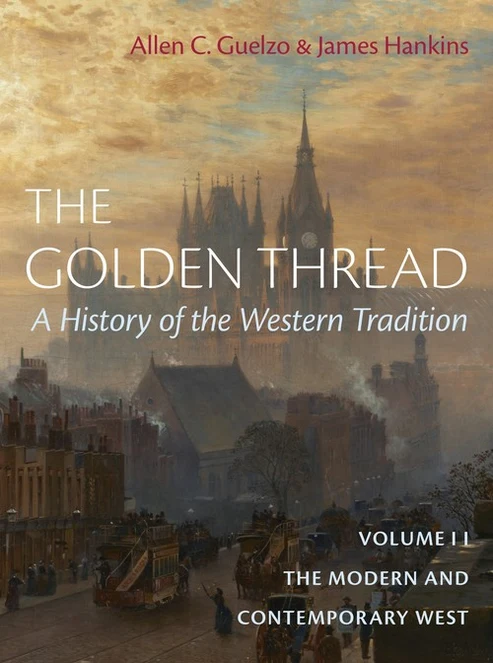
One such is a brave new two-volume, 1,700-page textbook, The Golden Thread: A History of the Western Tradition. Its authors, Allen Guelzo and James Hankins, are historians who insist on the continued importance of knowing “the civilization of the West,” specifically including its basis in “language and literature.” They privilege the arts.
This unfashionable emphasis on Western music, literature, and visual art will doubtless pigeon-hole their efforts. The publisher is Encounter Books, which politically nestles on the right. The teachers and students likely to use these volumes will be located at religiously affiliated high schools and colleges.
Guelzo, who authored volume two (The Modern and Contemporary West), is an eminent specialist in the Civil War with a marked interest in religion and in intellectual history – and also in classical music. A sampling:
“Brahms could be ponderous and at times even tragic. But his second symphony shines serenely with a balance and ease worthy of a Mozart or a Haydn, and he could sometimes show a puckish sense of humor.” Of Tchaikovsky: “His long suit remained always the ballet. Even in his operas, it is the dances that stand out (especially the waltz and polonaise in Eugene Onegin and the Russian hopak from Mazeppa).” The pertinent three-page spread, titled “Wagner, Brahms, and Tchaikovsky,” includes a cameo appearance of Dvorak as a “Romantic nationalist” composer provocatively (and knowingly) placed alongside America’s Charles Ives.
Guelzo, as it happens, is no friend of Wagner. The composer who galvanizes his sustained attention is Johann Sebastian Bach, to whom he dedicates eleven pages. A web of secular and religious currents produce in Bach heightened forms of secular and religious music. Cross-referencing Italy’s Antonio Vivaldi (himself allotted three pages), Guelzo briefly traces the emergence of Bach’s concertos and of his sonatas and partitas for solo violin – concert music that still astonishes today. But the religious Bach is Guelzo’s passion. In Bach’s cantatas Guelzo extrapolates “two unmistakable Pietest characteristics” – “a deep awareness of sin” and “a desire for deep personal intimacy with Jesus Christ.” Guelzo’s own intimacy with the cantata “Ich habe genug” yields this endorsement: “In the cantata he wrote for February 2, 1727 . . . Bach set a text of exquisite bliss and resignation, echoing Simeon’s ‘Lord, now let our servant depart in peace.’’’ And he highlights “one of the most beautiful vocal lines Bach ever wrote, of surpassing tenderness, on the words “Schlummert ein, ihr matten Augen (‘Fall asleep, weary eyes’).”
Ultimately, Guelzo volunteers this summation: “If Monteverdi and Vivaldi transformed Western music from an amateurish performance of servants, Bach transposed it into an art capable of carrying the highest emotional and spiritual messages and vaulted it over painting, sculpture, and architecture as the most potent and portable vehicle for Western personal expression.”
That Guelzo’s treatment of the arts is itself highly personal — and hence prejudiced — is a strength, not a weakness. Still, this is a book that necessarily covers a lot of ground at great velocity: it will be up to teachers to make portions of it stick. Can they do it? Can today’s high school and collegiate History students, coping with ever shorter attention spans, manage to slow down enough to absorb a Bach cantata?
Even if Allen Guelzo has merely created an opportunity to find out, he will have enhanced the prospects for sustaining Western cultural memory – a source of ballast as we hurtle ever onward toward a weightless future.
Leave a Reply