
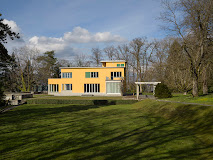
Switzerland’s idyllic Lake Lucerne, bounded by majestic mountains, was famously the site of two composer’s homes. Sergei Rachmaninoff built Senar (an acronym for SErgei and NAtalia Rachmaninoff) on land purchased in 1930. From 1932 until 1939, it was his annual residence from May to August. Richard Wagner rented Tribschen, a short boat ride from Lucerne, from 1866 to 1872.
Both homes proved ideal retreats. Senar hosted the happiest years of Rachmaninoff’s exile in the West. Wagner, in Swiss exile, enjoyed his happiest years anywhere. Both accommodated large and close-knit households, including children and dogs. Both hosted distinguished visitors. Each furnished a sanctum without becoming cut off from the world.
Senar, built to Rachmaninoff’s specifications, was notably progressive for its time. Its clean lines, its eschewal of clutter and adornment document a Bauhaus influence. Both the house and grounds are spacious. This is where Rachmaninoff envisioned being buried — but his death occurred in wartime and the grave, incongruously, is situated in a cemetery north of New York City. Thanks to the Rachmaninoff Foundation, the house remains largely as Rachmaninoff left it. To the original furnishings, the foundation has added a deft assortment of photographs and memorabilia. The music room includes Rachmaninoff’s piano and his composer’s desk with its pencils, pens, and cigarettes. Visitors stroll the house and grounds as they wish. There is no gift shop. His friends Alexander and Katherine Swann, in a much-quoted reminiscence, perceived Rachmaninoff as “alone in spirit and everlastingly homesick for Russia. The Russian spirit and habits were all-powerful in him.” They also reported that they “practically never saw him annoyed, displeased, fussing, or excited.” And that “he did everything quietly and firmly; hesitation was alien to his nature.” Today, Senar palpitates with the composer’s unseen presence. It evokes his implacable poise and sovereign humanity.
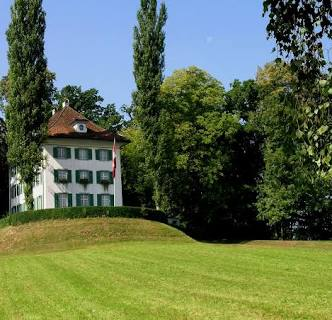
Tribschen, centuries old, is a handsome three-story manor house on a hill. As with Senar, the site is close to the water. Though the original furnishings are not preserved, the downstairs rooms are decorated with appropriate paintings and furnishings. The wide staircase is where Wagner’s Siegfried Idyll was first performed – as a surprise birthday gift to his wife Cosima, in bed upstairs with their newborn son Siegfried. This legendary vignette is revived with each performance of the work, in which the slumbering child is sublimely evoked amid whimsical allusions to the heroic exploits of his operatic namesake.
Wagner’s remarkable Tribschen output additionally included parts of Die Meistersinger, Siegfried, and Gotterdammerung. At Senar, Rachmaninoff’s dormant creative gift revived. He there composed his Third Symphony and – a masterpiece in which the rhythms of American jazz infiltrate a succession of pungent mood pictures — the Rhapsody on a Theme by Paganini (facsimiles of both manuscripts sit on his composer’s table, inviting inspection).
Tribschen is administered by the city of Lucerne, which also oversees an adjoining swimming facility. Leaving the small wooden dock and climbing the path to the house, I was surrounded by sun-bathing youngsters. Inside, I discovered the third floor closed. The entire second floor was devoted to an exhibit titled “Wagner Taboo? Jewish Perspectives.” To be sure, Wagner’s anti-Semitism is an inescapable fact and – alas – newly pertinent in today’s Europe. It is also an inexhaustible focus of scholarship and debate. Any exhibit attempting to frame it will itself be incomplete and controversial.
“Wagner Taboo?” comprises a series of installations featuring notable Jews, not always musicians, who condoned or condemned Richard Wagner. Additional attention is devoted to Wagner’s notorious 1850 essay “Jews in Music” – a pamphlet both egregious and harmful. The conductor Hermann Levi, the pianist Carl Tausig, and the soprano Lilli Lehmann, among the most prominent Jews who effusively admired Wagner the man, are all represented. Among the naysayers the curators have chosen Albert Einstein, who hated Wagner’s music, and the tenor Heinrich Sondheim, who refused to sing Wagner and once engaged in a public altercation with him. Though the precise circumstances of this shouting match will never be known, the exhibit implies that Wagner’s antagonism was aroused by Sondheim’s religion. But this cannot be the whole story. For – as the exhibit, so far as I could tell, never acknowledges – Wagner’s wide circle of friends and acquaintances was at all time packed with Jews with whom he maintained warm relationships. This was as much a signature of “Wagner and the Jews” as his anti-Semitic rants.
“Wagner Taboo?” omits, for instance, the impresario Angelo Neumann, who toured the Ring throughout Europe and wrote an affectionate book-length memoir, Recollections of Wagner, in which he describes himself reeling at the news of Wagner’s death (“I felt within my soul that a god had left this earth”). Is Albert Einstein, who never met Wagner, a more credible authority? From the panel featuring Leopold Sachse we learn that he directed Ring performances at the Met in the 1930s. Far more prominent, in those same performances, were the conductor Artur Bodanzky and the singers Friedrich Schorr and Emanuel List – all Jews (with Schorr a cantor’s son). The panel for Gustav Mahler cites Mahler’s well-known description of Mime, in the opera Siegfried, as a neurotic “Jewish type.“ Does this mean that Mahler condemned Wagner? The rest of that Mahler quote, uncited, reads: “I know only one Mime, and that is me. You wouldn’t believe what there is in that part, or what I could make of it.” Notwithstanding the historic premises, notwithstanding the photographs and paintings, Wagner’s own presence at Tribschen is today extinguished except as a fiendish specter requiring urgent remedial attention.
Rachmaninoff, too, is a permanent topic of controversy. I’ve never heard anyone accuse him of anti-Semitism. But he has long been reviled in some quarters as a recidivist merchandiser of kitsch. More substantively, his relationship to the contemporary world is complex and elusive. Rachmaninoff was no revanchist snob, only in love with the past. He adored piloting his motorboat. Driving a motor-car, he testified, evinced an “inner clam” resembling the satisfactions of conducting an orchestra. He spoke up for Gershwin, relished Art Tatum, and once wrote that “the seed of the future music of American lies in a true Negro music.” His transcription of Tchaikovsky’s “Lullaby” – the last music he wrote – ends with a bluesy nightclub progression.
At home, Rachmaninoff spoke Russian and maintained Russian customs. He took American citizenship belatedly, in 1943. He considered it “disgraceful” that he never fully mastered English. He courteously adapted yet stayed an interior course anchored by a loving family and loving friends, by servants, a chef, and a chauffeur all of whom were Russian.
On rare occasions, American journalists were privileged to glimpse the magnitude of Rachmaninoff’s displacement. In 1926, a New Yorker reporter visited his five-story Riverside Drive home and left a description that Senar recapitulates: “While waiting for the appearance of one of his daughters, who were always his emissaries, the caller became conscious of a suzerainty of order; of punctilious nobility of a fair, natural elegance.” A year earlier, the Musical Observer witnessed an encounter in Rachmaninoff’s Carnegie Hall dressing room. Konstantin Stanislavsky’s Moscow Art Theatre was performing in New York:
“The actors and actresses . . . almost surrounded him. Some of the men kissed him and he them in real Russian stye. They exchanged a few words in the tempo of a chant before an altar. Then for a minute or two they spoke not a word. The Moscow players simply looked at the great Moscow musician in reverent silence. Such devotion, such poise, such childlike sincerity, I never saw before . . . Then [the actors] walked away one by one, like so many children . . . The master’s gaze was fixed on them, and he waved at the last actor who looked back as he went out of the door. . . I am not ashamed to admit that the sanctity of this scene moved me to tears. And from the quick movement of his eyelids I could notice that the master’s eyes were not altogether dry either. . . . It was a sacrament.”
Spurning the modernist thicket, Rachmaninoff the composer was to some cowardly. He could equally be understood as defiant. All this, and more, could generate a timely Rachmaninoff exhibit. It’s the kind of thing the Rachmaninoff Foundation does. Its current projects include a commissioned orchestration of the Corelli Variations and a Zurich Opera “Rachmaninoff Tryptic” comprising the composer’s three one-act operas . At Senar, the foundation presents concerts and lectures (including the talk with music on “Rachmaninoff and Nostalgia” that I delivered last Friday). But Senar would not be an appropriate location for an exhibit of any kind – it would impinge.
And Tribschen is not the place to inquire whether Richard Wagner’s operas should be taboo.
To read a pertinent blog post arguing that Wagner was “not a monster,” and exploring his personal relationships with Jewish colleagues and friends, click here.
Dear Mr. Horowitz,
I read with great interest your writings on Sergei Rachmaninoff on your ArtsJournal blog. Your judgments and generalizations are enormously valuable for understanding Rachmaninoff’s influence on American cultural life in the first half of the twentieth century.
I am currently writing a short essay on the Art Deco era, in which I touch on the American music of the period. It is hard to miss that this era coincides almost exactly with Rachmaninoff’s years in the United States. This inevitably raises the question of whether he influenced the American musical scene, and the work of American composers and performers. Conversely, how did the American music of his day affect his own work and his art as a pianist of genius, especially the newest music, into which melodies rooted in African American musical traditions had flowed so widely?
Of course, the music that Rachmaninoff and other leading figures of the classical tradition composed and performed was of an entirely different origin. But it sounded in the same years, often in the same halls, and often before the same audiences.
I realize that my presentation is somewhat muddled, but the essence of my question is quite simple. Can we say that music of African American origin, jazz above all, which resounded so abundantly across America in the 1920s and 1930s, was an integral part of Art Deco musical culture and one of its important facets? May Rachmaninoff and other “classical” figures be included, to a certain extent, among the figures of American Art Deco musical culture? And finally, would it be right to describe the musical culture of the United States in the Art Deco period as “mosaic”?
With deep respect,
Michael Tubli, Ph.D.
September 18, 2026