
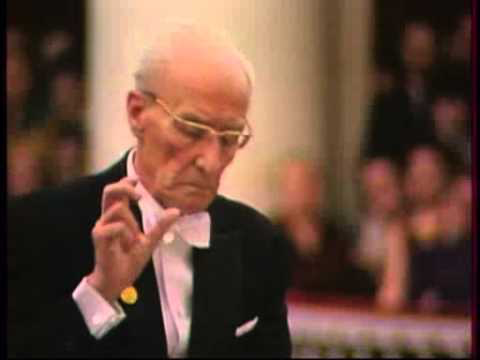
The decline in orchestral performance continues apace.
A specimen: The main theme of the sublime pas de deux from Tchaikovsky’s The Nutcracker is a descending G major scale introduced by the cellos, then repeated in response by the first violins. I recently heard a performance by an American orchestra whose principal cellist is venerable. His section took ownership of Tchaikovsky’s melody. But the violins – predominantly young — weren’t listening, and played the same scale mechanically.
My memory is long.
I was fourteen years old when I encountered the world’s greatest orchestra. It was the Leningrad Philharmonic, on tour in White Plains, New York, in 1962. As I much later wrote in The Propaganda of Freedom:
“I heard a program comprising Mozart’s Violin Concerto No. 5 with [David] Oistrakh, a Myaskovsky symphony, and Tchaikovsky’s Fifth. ‘The Death of Tybalt’ from Prokofiev’s Romeo and Juliet was an encore. I listened in a state of shock. The entire ensemble vibrated with color. The horn vibratos and tight, bright trumpet timbres were new to me. The orchestra’s glory was its string choir. The violins played with a wealth of nuance I had not imagined possible. The dynamic range of the whole group, from threaded wisps to sonic avalanches, was unique in my experience. In Prokofiev the palette of the Leningrad Philharmonic, in its myriad dimensions, was more “Romantic,” less “modern,” than the Western norm. In Mozart its espressivo grew exquisitely refined. In Tchaikovsky the Leningrad sound was, as I instantly and unforgettably realized, Tchaikovsky’s sound, revealed to my ears for the first time.”
The conductor was the young Genadi Rozhdestvensky, but it was Yevgeny Mravinsky’s orchestra. He had led it since 1938. He did not conduct elsewhere. He shared the 1962 tour with Rozhdestvensky. He had never before appeared in the United States and was little known here. With few exceptions, his recordings were not readily available. His name did not come up in High Fidelity Magazine, which I read religiously. Conventional New World wisdom held that the greatest orchestras were American – George Szell’s in Cleveland, Fritz Reiner’s in Chicago.
Such opinions mattered because this was the era of the cultural Cold War, in which the Soviets gained a head start by flooding American concert halls with musicians of genius. It’s a story, drenched in ironies, that I tell in The Propaganda of Freedom, the propaganda in question being a risible American assertion that only “free artists” in “free societies” produced great art. Symptomatic of the rivalries in play were the reviews posted in the New York Times by Harold Schonberg. Schonberg patronized Mravinsky, lecturing him on up-to-date Mozart interpretation. (Schonberg’s response to the “old-fashioned” Bolshoi Opera, thirteen years later, was the same. It would be a mistake to imagine that American critics of Soviet artists were more generous or less threatened than Soviet critics in their assessment of visiting Americans.)
In the seventies, the Leningrad Philharmonic lost key members to defection, including any number of Jewish string players. I got to know Lazar Gosman, who wound up in the St. Louis Symphony. He told me that when Mravinsky read Schonberg’s reviews, he announced he would never return to the United States—and he never did. Gosman also told me that in St. Louis he was amazed to discover the musicians heading for their cars after concerts. In Leningrad the orchestra members would congregate post-concert to drink and decompress. The Leningrad concertmaster, Viktor Liberman, in 1979 became concertmaster of the Rotterdam Philharmonic, then of Amsterdam’s Concertgebouw Orchestra six years later. He told Russian acquaintances that he did not fully appreciate the quasi-religious solemnity of Mravinsky’s rehearsals and concerts until he left. In Leningrad, rehearsals and concerts were never casual occasions.
Liberman’s first violins were the orchestra’s pride and glory. The young fiddlers I encounter in our top American orchestras are a different species. So far as I am aware, comparably robust string sonorities can nowadays only be found abroad, in the ranks of the Berlin Philharmonic. (One could also here cite Serge Koussevitzky’s Boston Symphony violins, also Russian – e.g, in their scorching 1943 live broadcast of Tchaikovsky’s Francesca da Rimini.) Mravinsky’s violins were more sensuous, more aromatic, more Romantically “Russian” in phrasing and nuance than Berlin’s, then or now. Thanks to the internet, you can see him drill his string choir in Brahms’ Fourth Symphony, asking for even more sustained weight and rhythmic precision – and getting it (go to 39:38). You can also access a live performance evoking what I heard 64 years ago in White Plains: a 1960 recording (from the Edinburgh Festival) of Rozhdestvensky conducting the Leningrad Philharmonic in Tchaikovsky. The music (again) is Francesca da Rimini and it’s the most titanic Tchaikovsky performance I know. You can hear it for yourself right here.
Mravinsky will always be mainly associated with the symphonies of Dmitri Shostakovich. He premiered six of them. Before his recordings began circulating in the US, the ending of Shostakovich’s Fifth was ecstatically swift, infectiously purveyed by Leonard Bernstein. Mravinsky was oppressively slow: a revelation supported by Shostakovich’s eventual testimony that he had here subversively depicted “forced rejoicing.” According to Dave Hurwitz of Classics Today, who knows such things, the supreme Mravinsky Shostakovich recording is a 1982 version of the Eighth.
Ever since that 1962 epiphany, Mravinsky will for me always signify Tchaikovsky. In a gripping video of a 1982 Leningrad Philharmonic version of the Fifth Symphony – regarded by Mravinsky as Tchaikovsky’s peak achievement. The cameras remain transfixed by the conductor’s severe countenance. But listen to the violins gradually lean into the first movement’s rhapsodic second subject at 5:13. To hear the orchestra in peak form, beautifully recorded, there’s a famous 1960 Deutsche Gramophone LP of Tchaikovsky’s Fifth recorded on tour (but not in live performance) in Vienna.
It goes without saying that any orchestra and any conductor with so pronounced an identity will not serve all seasons. And yet I find the breadth of affinity surprising. Of the supreme Bruckner conductors of the twentieth century, Mravinsky is surely the least acknowledged. The sheer weight of utterance, anchored by guttural double basses, is overwhelming. Here, for instance, is a revelatory Bruckner Seventh, from 1967. In the first two movements, the string choir is gesangvoll to a degree new to me. Every line is shaped. The pacing is surprisingly plastic. At the tidal climax of the Adagio, in place of the usual rallentando, Mravinsky just piles it on. The coda in the brass – the music memorializing Wagner – surges to a searing triple-forte climax. Just when you think this live performance can only begin to tire, the players deliver a scherzo of incredible swagger and panache in which the recapitulation actually gathers strength, striking an even deeper groove. But the biggest surprise is the finale, which had always seemed to me an inadequate capstone. It is torrid. There is a famous story about Mravinsky rehearsing Bruckner 7 for weeks or maybe it was months, then cancelling the public performance. In some versions, Mravinsky felt he never got it right. But in the British documentary I reference below, the story ends differently – that Mravinsky’s final dress rehearsal was a performance he felt he could never equal, so he eschewed a public concert. I believe that version.
In Beethoven, Mravinsky’s austerities are humbling – as in a 1964 version of the Seventh Symphony, massive yet quick. His Stravinsky repertoire included the later Stravinsky – Apollo, The Fairy’s Kiss, and – amazingly – Agon, a non-tonal score only played in the US in the pit of the New York City Ballet. Another surprise is Mravinsky’s Debussy: a vivid La Mer from 1962 in which the orchestra’s lyric brass vibratos and penetrating winds – resistant to homogenizing blends — sound serendipitously “French” (that is: they recall what French orchestras used to sound like).
What to make of it today? The Iron Curtain was an evil imprisonment – yet paradoxically preserved certain artistic traditions rapidly fading in the West. However throttled by the state bureaucracy, Soviet classical music retained an integrated community of performers, pedagogues, and – most remarkably – contemporary composers, including a pair of popular geniuses: Shostakovich and Serge Prokofiev. In this context, Mravinsky was an inspired throwback to a lineage of podium tyrants, a towering martinet who in bearing and gesture evoked the impersonal severity of a Byzantine gargoyle. He drilled the players unstintingly. His authority and rehearsal prerogatives were absolute. The late Byron Janis – the American pianist who triumphed in the Soviet Union two years after Van Cliburn won the1958 Tchaikovsky Competition – once told me that in Russia he made one musical request: could he possibly perform with Yevgeny Mravinsky and the Leningrad Philharmonic? We’re very sorry, he was informed, but no one tells Mravinsky what to do.
A British documentary film, “Yevgeny Mravinsky: Soviet Conductor, Russian Aristocrat,” discloses the man. Privately, he loathed the Soviet regime. He was also privately religious. His apartment displayed many Christian icons. He was ruthlessly self-critical. Born to an aristocratic family, he profoundly identified with what Russia was before Lenin and Stalin. He mourned the past.
A second documentary film incorporates long stretches of Mravinsky speaking. It’s in Russian – which my wife translated for me. Here are some of the things Mravinsky says:
On interpretation: “You have to feel it’s the only way even though you can’t prove it.” (Claudio Arrau, in my Conversations with Arrau, says the same thing and adds: “Thinking about the audience, that’s one thing that can kill an interpretation.”)
On preparing a score at home: “A torture. Terrifying.”
On Shostakovich: “He was the greatest composer of our time. . . . I lived in the same reality that he did.” Subsequent to the Fifth Symphony, they never discussed the interpretation of his music. “I could read it in his face.”
On Shostakovich’s impulsive decision, in rehearsal, to dedicate his Eighth Symphony to Mravinsky: “The greatest happiness of my life.”
The commanding austerity of Mravinsky’s presence is occasionally relieved by an ironic smile or a softening of his gaunt features. Agnes told me that the self-evident integrity of his severe discourse made “a beautiful impression: generous, kind.”
***
Here’s another extract from The Propaganda of Freedom, recalling my discovery of Cold War musical visitors:
“Mainly, . . . my experience of Soviet classical music was an experience of pianists, arriving in droves. [Emil] Gilels, more than [Sviatoslav] Richter, was for me. He commanded the biggest, most colorful of all keyboard signatures. He was at all times larger than life, heedlessly expressive. But he suffered greatly as a Soviet artist. Other pianists, fed up with being told what, when, and where they could perform, fled to the West with stories of unimaginable indignities and insanities. Two whom I came to know were Vladimir Feltsman and the late Alexander Toradze. They resented being trained as Soviet musical athletes, groomed to win the international piano competitions in which the Russian excelled. But their musical preparation, at the Moscow Conservatory, was more personal and comprehensive than in any Western music school; from an early age they were accepted into a ripe community of musicians. They also attained a higher level of cultural and intellectual awareness than was (or is) the Western norm. And they benefited from a native repertoire including important twentieth-century and contemporary composers. Toradze specialized in Prokofiev, Shostakovich, and Stravinsky; he was also closely associated with the late Georgian composer Giya Kancheli. Feltsman, whose affinities are Germanic, forged a close personal and professional relationship with Alfred Schnittke, for many the leading Soviet composer of the post-Shostakovich generation. The late American pianist John Browning, who well knew the competition circuit, once summarized: ‘If the Russians don’t come, the general standards are not nearly as good. . . . You know, they’re ready to give concerts at the age of fifteen—they’re truly ready.’
“In one obvious respect, cultural exchange was a Russian failure: the departures of Toradze (1983) and Feltsman (1987); of Rudolf Nureyev (1961); of Vladimir Ashkenazy (1963); of Rostropovich and his wife, the soprano Galina Vishnevskaya (1974); and of Mikhail Baryshnikov (1974) were world news. But these artists, and others who remained Soviet, conveyed a caliber of cultural life surpassing in many respects an American classical music culture that had (and has) never outgrown a Eurocentric bias. . . . “
Mravinsky’s Leningrad Philharmonic, the crown jewel of Soviet classical music, was already a time capsule. With colonnades, hanging chandeliers, and temporary chairs, its Philharmonic Hall, built in 1839, more resembled a palatial ballroom than a concert auditorium. The current occupant, the St. Petersburg Philharmonic, is a world-class ensemble without a striking sonic signature. No less than today’s Boston Symphony or Philadelphia Orchestra, it more partakes of generic contemporary norms than of specific musical identities once enforced by a Koussevitzky or Leopold Stokowski.
There will be no rebirth of the Leningrad Philharmonic or of other singular ensembles from another era. But orchestras can at least aspire to attain a singular sense of purpose – something I sense in Delta David Gier’s mission-driven South Dakota Symphony, and in Ivan Fischer’s Budapest Festival Orchestra.
As for Viktor Liberman’s Leningrad violins – they weren’t just a product of Mravinsky’s tyranny. The music was in their blood, in centuries of culture building upon itself. Today we have social media and artificial intelligence. It is a challenge we are summoned to ponder and confront.
To read a pertinent blog on the decline of orchestral performance (“Why Riccardo Muti is Wrong”), click here.
Mravinsky is a conductor I’ve come to re-embrace after finding his musicmaking too cold and grim for a while. But he’s one of the titanic ‘dark’ maestros: like Klemperer, Horenstein, Ancerl, E. Kleiber in a bad mood…
Interestingly, I always thought he was a great conductor of German music, it was in the Russians he was famous for that I started having doubts. I forget where I saw it, but there’s a fascinating interview with Gergiev where he said that Russians are generally surprised by the demand in the West for Mravinsky’s Tchaikovsky, because in the USSR he was known as the ultimate authority over the German masters.
Who then was the Russian authority? Kondrashin? Golovanov? Svetlanov? GR?