
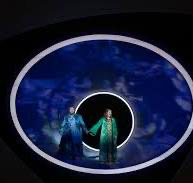
Conrad L. Osborne’s detailed assessment of the new Met “Tristan und Isolde,” a definitive critique of Yuvan Sharon’s obtrusive production, is compulsive reading for all remaining Wagnerites. Even more distressing than this version’s shortcomings is the acclaim it has received and the influence it may exert on opinion and practice. Osborne writes:
“The [production’s] Tristan installation is an apt symbolic representation of humanity’s present predicament—a technologically determined world in constant motion for its own sake, broken free of focus or continuity, therefore of history and memory, circling about, often feverishly, without getting anywhere except to an unearned pretense of renewal.”
He also has some kind things to say about my new novel, “The Disciple,” which among other things recalls how “Tristan” was played and sung when first given at the Met in 1886 – a landmark performance at which some in audience “stood on their seats and screamed” when the curtain fell on the Liebestod.
“In 1994, . . . Joseph Horowitz published his fascinating Wagner Nights, an account of the life and times of the conductor Anton Seidl, who introduced Tristan und Isolde to America . . . ,led the extraordinary series of popular summer concerts (heavy on Wagner) at Brighton Beach, and inspired the foundation of the Seidl Society, a largely female organization of cult intensity in support of Seidl’s work and of Wagnerism in the U.S. It was Horowitz’s research in the Seidl Society archives at the Brooklyn Historical Society that restored this artistically vital but forgotten history, with its enticing Gilded Age background and cast of larger-than-life characters, to our cultural memory.
“Now, Horowitz has fictionalized the story in the form of a novel, The Disciple, bringing the era and its people, from great artists, iconic critics, and society stars to the black children sponsored by the Society, to vivid life. . . . Chapter One tells the tale of that Tristan premiere, starring the veteran Wagner tenor Albert Niemann and the great Lilli Lehmann, seen through the eyes of one of the most authoritative of those critics, Henry Krehbiel, while Chapter Ten takes us briefly into a coaching session with Seidl and Jean de Reszke, as the latter prepared for the crowning challenge of his legendary career.”
Here’s a snippet of that coaching of act three, as I envisioned it. Seidl instructs:
“ . . . The beauty is not self-sufficient. You must also convey the most extreme fatigue. You are emerging from a period of complete derangement. You have hallucinated the appearance of Isolde’s ship. You have collapsed into a coma. You have now awakened. Your mind begins to clear. You begin to remember and understand. You are regaining sanity and even a sense of responsibility for your lover’s madness. And yet you cannot possibly rejoin the world. Your fatal glimpse of another realm — of pure being, pure desire — is beyond remedy. And now you re-envision Isolde, your balm, your release, your salvation, sailing toward you across the watery void. And you are also summoning your death.”
De Reszke shut his eyes.
“We have already been rehearsing for too long a time, we are growing drunk,” Seidl continued. “But once more, please — for me. From ‘Wie sie selig.’”
He recommenced conjuring an orchestra’s murmuring strings and solo horn, transcendental water-music intimating cosmic mystery and oceanic repose. De Rezske glimpsed all he could of Tristan’s longing and Isolde’s mirage of healing loveliness; of Tristan’s life abandonment and Isolde’s complicit love pledge. The intimacy of their dialogue, in a room with drawn curtains and attentive memorabilia, was intoxicating; unwittingly, inadvertently, they themselves became the lovers. The piano’s throbbing hypnotic pulsations caressed the singer’s song. The love vision mounted toward an expostulation at once ecstatic and forelorn. Seidl interpolated a cadence, stopped, and shut the piano lid. De Reszke retrieved his jacket, hat, and walking stick. He bowed once and departed. . . .
For more on the Met’s current “Tristan,” click here.
For more on today’s Metropolitan Opera, click here.
Wonderful!