
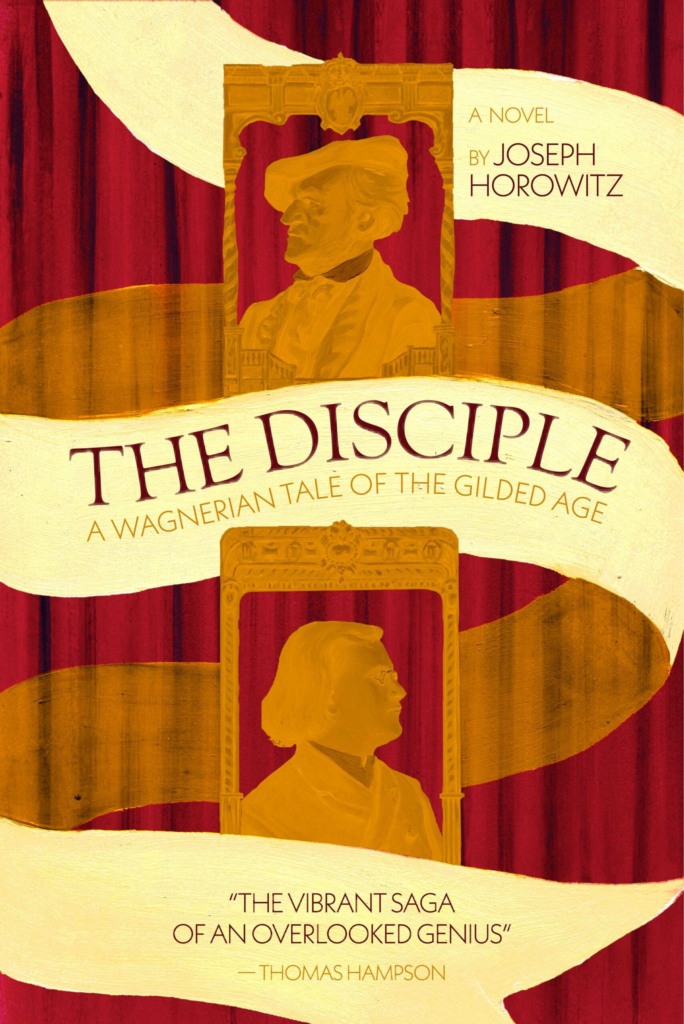
Reviewing my new novel “The Disciple: A Wagnerian Tale of the Gilded Age,” the British critic Clive Paget writes in “Musical America” that it’s “a richly detailed depiction of [New York] at the apogee of the Gilded Age and its embrace of all things Wagnerian.” His review reads in part:
Horowitz sees Seidl’s sudden death at the age of 47 as a national and cultural calamity. “Bigger than the Toscanini story to come, bigger than the Bernstein story,” he writes, “Seidl’s New World sojourn is, finally, intensified by the pathos of unconsummated promise. Its magnitude and implications challenge understanding.” . . .
A scrupulous researcher and, most importantly, a gifted storyteller, Horowitz’ s lively prose, ready wit, and persuasive dialogue blow the dust of history off of his deftly assembled characters. And what a cast list it is. There’s the tireless Laura Langford, proto-feminist, social progressive, clairvoyant and ardent theosophist, who, as founder of the Seidl Society, became the leading impresario in Brooklyn . . . Then there’s the dean of New York music critics Henry Krehbiel, a heavy-set intellectual wending his solitary way to his desk at the New York Tribune every evening to craft his ponderous pronouncements . . . Antonin Dvorak is another fine vignette. . .
The legendary European singers that Seidl brought to America are captured in all their gossipy self-absorption and . . . There’s a refreshingly even-handed treatment of Cosima Wagner, the black widow of Bayreuth. . . . Horowitz’s Richard Wagner, narcissistic, twinkly eyed, and fiendish by turns, is one of the more persuasive character sketches I’ve come across. . . .
Above all, The Disciple conjures the sense of an America rich with potential, a nation crackllng with energy, its buildings, transportation, and industry exploding with unbridled ambition. From Chicago to Manhattan, the author seems familiar with every borough and street . . . And yet there’s an inscrutable sadness about his central protagonist, an unfathomable melancholy . . . There ‘s a personal tragedy at play , one that Horowitz teases out over the course of the novel, keeping us in suspense until Seidl’s ‘Rosebud’ moment.
For another recent Wagner post (“Not a Monster”), click here.
Congratulations, Joe, on your latest publication. May the many fans of The Gilded Age TV series find it and savor it.