
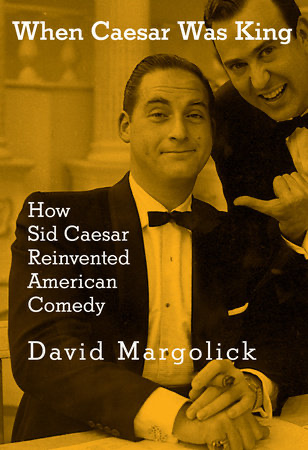
It must mean a lot that I can remember watching Sid Caesar’s “Show of Shows” on TV with my parents as a young child. For one thing, I don’t recall watching anything else as a family. For another, Caesar’s “Show of Shows” went off the air in 1954 and I was born in 1948. So I was all of six years old. The memory stuck.
Caesar virtually disappeared from television when “Caesar’s Hour” – his sequel show — was cancelled by NBC in 1957. But Caesar’s reputation as a comic genius, a talent to set beside Chaplin and Keaton, more than lingered. Then in 1973 “Ten from ‘Your Show of Shows’” – grainy kinescopes – turned up in movie theaters. To this day, no other comedian makes me laugh myself prostrate to the floor.
The Caesar career was famously short-lived; he was all of 35 when he lost his weekly TV berth. It was always my understanding that he simply burned out, that doing live TV full tilt every week — the ruthless schedule, the manic energy – was just too much. And Caesar was visibly high-strung: he stammered, he coughed, he frayed. The desperation he enacted was both funny and real.
From David Margolick’s new biography When Caesar Was King I now learn, however, that the king was partly dethroned by Lawrence Welk, who showed up nationally on ABC in 1955 and slaughtered Caesar’s ratings. Consciously and strategically, Welk embodied the bland. His band’s “bubble music” was engineered to smooth and soothe. Sampling Welk on youtube, I discovered a single Black guest artist – a smiling tap dancer who made the show seem even whiter.
That Welk’s own delivery was blank was his very signature. His instrument was the accordion. His core audience included elderly ladies for whom Caesar was a neurotic anomaly. One Iowa dentist claimed that NBC was trying to “ram” Caesar “down our vision.” “In some magazine I noted that Sid Caesar was rated the wit of the year,” she told the Chicago Tribune. “Should that be so, I’m Samuel L. Clemens’s twin sister.” The Nashville Banner invited readers to chime in. “I don’t like ‘Your Show or Shows’ either and don’t know anyone who does,” wrote Mrs. Gladys Miller. “If all of TV was like ‘Your Show of Shows,’ there would be no market for TV sets,” testified Mrs. R. E. Farris.
At the same moment, NBC’s press department boasted: “The small town this generation has known has ceased to exist. Television has created similar tastes in all sizes of communities. Sectionalism and regionalism are vanishing as people sit in their living rooms, looking into the magic window of television.” Margolick comments that it proved hard to abandon the “starry-eyed notion that folks outside big eastern cities would be thrilled to have sophisticated entertainment dumped on their doorstep. But in what one advertising derisively called ‘East Cupcake, Iowa,’ this wasn’t necessarily so. Far from binding together two different Americas, television only heightened – and, maybe, even widened – the chasm.”
Was Sid Caesar’s cancellation by NBC some kind of parable? Is it pertinent to Donald Trump’s America? To the impending cancellation of Stephen Colbert by Paramount? To the ongoing conglomeration of big media?
Newton Minow, as JFK’s chairman of the Federal Communications Commission, in 1961 famously called TV “a vast wasteland.” That was half a century before Trump’s FCC chairman, Brendon Carr, threatened to revoke the licenses of ABC affiliates who carried Jimmy Kimmel. As I happen to know a thing or two about cultural programming during the early decades of commercial television, I can put Minow’s complaint in another context: the wasteland was not uniform. Caesar actually fit into a corner of creativity.
When we think of television heroes from the 1950s, the marquee name is CBS’s Edward R. Murrow, who stood up to McCarthy and in 1958 warned that commercial TV, driven by profit, was insulating Americans. Six years before that, “Omnibus” debuted on CBS. It was an arts showcase urbanely hosted by Alistair Cook. Leonard Bernstein’s TV career – a landmark in musical pedagogy — began on “Omnibus” with an exploration of Beethoven’s Fifth Symphony in which he pondered the composer’s discarded sketches.
But what first bears mentioning is that Bernstein was blacklisted when in 1954 Robert Saudek invited him onto “Omnibus.” More than an enlightened arts initiative, his engagement was an act of defiance that effectively reactivated Bernstein’s American career, and not only on TV. Bernstein’s “Young People’s Concerts,” also on CBS, began in 1958 and ran until 1972 – 53 programs in all. Bernstein’s YPC producer was Roger Englander. When President Kennedy was shot, Englander was instantly on the phone. CBS scheduled Bernstein and the New York Philharmonic in a memorial concert — a performance of Mahler’s Resurrection Symphony, with soloists and chorus – that was aired live just two days later.
The most prominent commercial sponsor of Bernstein’s early TV work was the Ford Motor Company. At one point in the relationship, Charles Moore, a Ford vice president, visited West Berlin, then a West German island surrounded by Communist East Germany. Moore decided that the United States would be inadequately represented at a forthcoming festival. Ford put up $150,000 to send Bernstein and the Philharmonic to the West Berlin Music, Drama, and Arts Festival – and turned it into a 1960 “Ford Presents” special on CBS.
Over at NBC television, David Sarnoff’s prime cultural initiative was a series of live concerts, including complete operas, featuring Arturo Toscanini and the NBC Symphony (1948 to 1952). Sarnoff also created an English-language NBC Opera stressing contemporary and American repertoire. Born in a Russian shtetl, Sarnoff was a driven, self-made tastemaker without formal education. In his youth, he acquired a reverence for symphony and opera. But for Sarnoff Sid Caesar must have seemed a mere comedian.
As Margolick makes clear, Caesar on NBC was pegged by many Americans as “elitist,” even “intellectual.” He was also (like Leonard Bernstein) self-evidently Jewish. His producer was Max Liebman. His writers included Mel Brooks and Woody Allen. His fans included Bernstein, who would re-enact Caesar’s parody of insomniacs for his children. Though it would not have occurred to me to group Caesar and Bernstein together, on second thought many Caesar skits parodied high culture. For instance: they assumed audiences knew the fashionable Japanese art films that inspired “U-Bet-U,” in which Caesar plays a clumsy samurai warrior.
Most notably, Caesar – himself a trained musician who once played his saxophone professionally — took on classical music and opera, a specialty that peaked during his last seasons as a TV regular. I am thinking, for instance, of “Gallipacci,” the Pagliacci spoof that opens with a mercilessly banal production number: “Santa Claus Is Coming to Town” rendered in Italian double talk.
But the coup de grace was Caesar performing Grieg’s Piano Concerto. Though I adore Victor Borge, Caesar’s parody is supreme. Working with his in-house pianist, the formidable Earl Wild, Caesar sits on a piano bench facing the audience, playing an invisible keyboard on an otherwise vacant stage. The manic hilarity of this act was predicated on a labor of love: split second coordination of Caesar’s hands and fingers with Wild’s off-stage manipulations of virtuoso passagework, including planned wrong notes and tasteless sentimental rubatos. It was all choreographed in a matter of days, then flawlessly executed on live TV. There exist several versions; the one to watch is here.
Caesar’s comedy was never political. It was never explicitly Jewish. But it was fundamentally disruptive, with everything else fair game: Hollywood films, Broadway plays, health food restaurants, rock ‘n roll, progressive jazz, corporate boardrooms, and popular TV shows not excluding Lawrence Welk. A spirit of demolition reigned unchecked. Many sensed this and objected. For others, Caesar’s humor was as cathartic as any other form of sublime artistic expression.
I assume that Sid Caesar would not appeal to today’s emerging national culture tsar. Caesar was too fundamentally irreverent and hence dangerous. Scanning the more than 250 names proposed for Donald Trump’s impending National Garden of Heroes, I find a single comedian: Bob Hope. In fact, Caesar is not even among the comedians awarded Kennedy Center [sic] Honors, a long list including Danny Kaye, Bill Cosby, Steve Martin, Mel Brooks, Billy Crystal, and Lily Tomlin. Perhaps that’s incidental. Or perhaps it registers the “chasm” dividing two Americas that David Margolick links to television in his biography of TV’s most original star.
For a related blog on Trump, JFK, Bernstein, and the arts, click here.
Joe: Let’s not criticize someone because his “signature” was the accordion!
Do you know this this brilliant skit with Nanette Fabray ?
https://youtu.be/U-1SBZJIrgg?si=YdVnCY62wjFQXRQx
Sid Caesar is forgotten today in the same way that the brilliant Ernie Kovacs is forgotten today, along with hundreds of other pioneers of early television. (I just recently watched the complete season 1 of “Gunsmoke,” from 1955, Great fun.) Do Generation Z people know who Jackie Gleason is, or Milton Berle?
I find the comment about the “small town” ceasing to exist odd. TV brought us “Green Acres,” “Petticoat Junction,” “Bonanza,” etc., etc. It seems to me that the “low brow” and “high brow” have pretty much always co-existed on television. Maybe I’m wrong.
And, yes, it is true that Arthur Duncan was the only Black performer on the Welk Show. However, he was one of the very few tap dancers who kept that art form alive, week after week, at a time when tap was not featured anywhere else.
I saw the revue “Sid Caesar and Company” at the (late lamented) Village Gate in the late 1980s. Caesar performed the Grieg Piano Concerto bit pretty much as he had in the 1950s. It was still just as funny. He looked at least 30 pounds lighter in his later years, and somehow to me he was more comical looking at the heavier weight,
Imogene Coca was not part of the cast of that production. Coca was the perfect comedic partner for Caesar in the 50s TV shows. The contrast in their respective sizes even made them look funny as a couple in sketches. One day in 1998 when I was visiting someone at the Actors Fund Home in Englewood, New Jersey, I was walking down a corridor and spotted Imogene Coca several yards ahead of me. She was at that time a resident there and appeared disoriented. As I neared her, I called out, loudly, “Hello Ms. Coca, it’s nice to see you.” In an instant she snapped to full alertness, turned in my direction, and, looking right at me, pirouetted into the most charming, piquant, hilarious curtsy you could possibly imagine. In that instant she traveled back in time and turned into the Coca of “Your Show of Shows.” She didn’t know who I was, but didn’t have to: I was “the public.” That memory has stayed fresh with me all these years.
Of course caesar’s cancellation is somehow a “parable'” connected to the. Trump era. And yeah, the fact that Lawrence Welk had a black cast member made the show seem oh-so0-white. (Sic Caesar didn’t have any black folk on his show, which is somehow remembered as cool, hip, and multi-raciaal.) Whatever.