• Home
  • About
    • Chloe Veltman
    • lies like truth
    • Contact
  • AJBlogs
  • ArtsJournal

lies like truth

Chloe Veltman: how culture will save the world

Archives for June 2013

Dancing Textiles, Hidden Drama

photoArt museums generally go two ways with their textile-oriented exhibitions, neither of which are particularly satisfactory.

Either they stage the big, flashy haute couture shows of clothing by A-list fashion designers, or they mount folksy displays of appliqué and macramé created by unheralded craftspeople from downtrodden communities. The former draw huge crowds but are essentially all glitz and no soul, and the latter shine a light on often fascinating “outsider” art but are usually over-earnest and unimaginatively presented.

Contrastingly, The Denver Art Museum’s fabric-focused effort, Spun: Adventures in Textiles, manages to make apparel dance. Literally.

I attended the museum’s monthly late night event on Friday and left feeling utterly inspired by the way in which the institution makes textile art seem exciting and relevant without resorting to the vacuous world of catwalks or the overly-sincere one of patchwork quilts.

A cornerstone of Spun is a show devoted to the work of Nick Cave, an awe-inspiring American artist who works at the intersection of costume, sculpture, performance art and video montage. Cave is most famous for creating a series of massive, colorful “Sound Suits” out of thin strands of stringy fabric which transform the human body into a being that’s part Wookie, part shaman and part toilet brush.

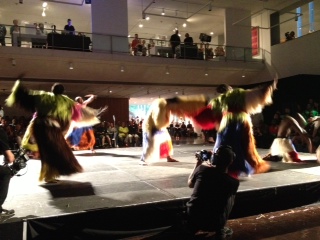
Cave’s work is on display in several rooms in the museum as video installations and a gallery full of his most mind boggling costume creations. On Friday night in front of a packed auditorium, Cave engaged three professional dance companies from Colorado and a number of auditioned community members (including a museum security guard) to perform dances wearing  Sound Suits or interacting with other large-scale fabric props. A live band provided a brazen, heavily improvised soundtrack for the dancers. Videographers weaved in and out of the choreography, creating a version of the event, screened on one of the walls on a large-scale as well as projected via live web-stream on the Internet, that allowed audiences to examine what was going on from several different angles.

It was a euphoric hour and a half that engaged all of the senses – I was sitting in the front row and was able to smell the dancers’ sweat and touch the soft, woolly strands of a horse-like Sound Suit that two dancers wore towards the end of the show.

The Suits are so vibrant, funny and full of life that it’s hard to believe that Cave first started experimenting with the idea in reaction to the violent, racial hatred-inspired beating of Rodney King in 1991. The Suits have evolved since then, becoming more extravagant. But even as the dancers involved in the live presentation burst and shimmied around the stage in an avalanche of carnivalesque color and movement, the primal, crazed energy at times took a sinister and exhausting turn. There is undoubtedly a violent streak in this work, as gorgeous and hilarious as it seems on the surface.


Digging Deep

UnknownMark Adamo’s new work currently receiving its world premiere run at The San Francisco Opera, The Gospel of Mary Magdalene, is all about excavation. The metaphor of digging runs throughout the musically fecund work both explicitly and implicitly, reminding us in our age so obsessed with shiny surfaces, to look below for meaning.

The story, which seeks to reinstate the controversial and oft-derided Biblical figure of Mary Magdalene as a key player rather than marginal nobody in the life of Jesus, is framed by an archaeological dig.

As a group of archaeologists at the site sing about their desire to discover deeper truths about the Biblical past through finding evidence that supports new truths that lie embedded in the earth, so Adamo’s powerful musical score, coupled by nuanced and moving performances from the cast — the American mezzo soprano Sasha Cooke is particularly mesmerizing in the title role — serve to take us beyond the merely shallow.

If Adamo’s extensive scholarship on Mary Magdalene makes the narrative feel a little bloated and over-mined (scholarly footnotes even appear in the libretto), the composer’s straight-to-the-heart use of language and engulfing musical sonoroties force the listener to become deeply involved in the characters’ stories.

The fact that some of the arias feel like show tunes, complete with soaring melodies and lots of sentiment, easily draws listeners in. But there’s nothing easy or superficial about Adamo’s writing. The use of instrumentation creates constantly surprising timbres and the restless harmonic landscape undercuts the fluidity of the lines to make us understand that there’s more going on in each scene than surface texture.


Kids Focus at the National Portrait Gallery

UnknownI’m very impressed with the way in which the National Portrait Gallery in London is engaging children and teenagers in the art of portraiture.

I was in the museum, one of my favorite London haunts, a couple of days ago and was struck by the volume and inventiveness of the kids’ outreach programs at the institution.

For example, the National’s high-profile BP Portrait Award features a “Next Generation” initiative which organizes a bunch of special programming for young people aged between 14 and 19. Kids enrolled in the program get private viewings of the works presented in the annual award exhibition,  portrait drawing and painting workshops with BP Portrait Award artists, the opportunity to attend a special summer school and drop-in art sessions.

Also connected with the BP Award is a lovely “kids guide” that youngsters can pick up when they enter the exhibition space. The guide, which takes the simple but effective form of  a colorful, high-quality paper handout produced by artist Anna Hymas, takes children on a special tour, asking playful questions about some of the works on display and providing space for kids to draw their responses to some of the paintings that catch their eye. There’s even a section for a prize draw. Kids are encouraged to draw thumbnail portraits on the entry form of their friends and family. Winning entries get goody bags with signed books by Hymas.

Then there’s the “Creative Connections” program, a four-year project which connects young people with contemporary artists to create artistic responses inspired by works in the gallery’s collection. The present incarnation of the project (which is in its first year) involves students from a London school working with artist Lucy Steggals to seek inspiration from eight portraits that have some kind of historical link to their neighborhood of Bow. The portraits include those of Gandhi and Sylvia Pankhurst. The initiative is accompanied by a slew of lectures, walking tours and family art workshops.

I saw lots of children and teens at the Gallery when I was there. Many of them were browsing independently. Some of them were drawing in front of canvases. The institution makes engagement look easy. But clearly a lot of time, creativity and effort has gone into engaging the young.

Rocky Mountain High

UnknownIt’s official: I’m moving to Denver to launch and head up Colorado Public Radio’s brand new arts desk. First day on the job — July 17th. Exciting times. Here and below is the press release issued by the station, which came out today:

Colorado Public Radio Hires Award-Winning Arts Reporter to Lead New Arts Bureau

CENTENNIAL, Colo. – June 18, 2013 – Colorado Public Radio (CPR) announced that award-winning arts reporter Chloe Veltman will be the new editor for CPR’s forthcoming arts bureau and online arts hub.

Veltman brings more than a decade of experience to her new role, including working for The New York Times as the weekly Bay Area arts correspondent and for the SF Weekly as its chief theater critic. Veltman is also the creator, host and producer of VoiceBox, a weekly, syndicated public radio and podcast series about the human voice and the best of the vocal music scene, based out of KALW in San Francisco. Her work has also been published in The Los Angeles Times, The Wall Street Journal, The Economist, The Financial Times and American Theatre Magazine among others.

“Chloe’s wealth of knowledge and passion for the arts will be paramount as we build out the arts bureau and expand coverage,” said Kelley Griffin, CPR’s vice president of news.  “We’re thrilled to welcome her and can’t wait to harness her creativity and leadership as we chart the next chapter of CPR’s future by launching our first comprehensive multi-media news bureau.”

Veltman will be responsible for hiring and managing the new arts bureau’s two-full time reporters, supervising the bureau’s team of contributors and working with CPR Classical and OpenAir to ensure that arts-related coverage is distributed across all three of CPR’s services.

“I was drawn to Colorado Public Radio not only because of the organization’s existing commitment to supporting the arts, but also for its leadership and vision for how that commitment can expand to serve a larger and more diverse audience,” said Veltman. “Listeners depend on CPR to provide coverage that can’t be found anywhere else, and I’m looking forward to building on that mission by bringing Colorado’s cultural community to the forefront.”

In addition to writing about the arts, Veltman is also an active arts practitioner. She is a trained dramaturg, and has sung and played the oboe in many chamber ensembles and orchestras in the Bay Area including The International Orange Chorale of San Francisco, Convivium, Symphony Parnassus and The Mill Valley Philharmonic. She has a Bachelor of Arts Degree in English Literature from King’s College, Cambridge and a Masters of Fine Arts Degree in Dramaturgy from the Central School of Speech and Drama in London.

The arts bureau and online arts hub was made possible by a three-year, $900,000 grant from The Bonfils-Stanton Foundation, with the goal of significantly increasing arts coverage of the Denver/Boulder metro area and across the state.

For more information about Colorado Public Radio, visit www.cpr.org or find us on Facebook and Twitter.

Colorado Public Radio is a non-profit 501(c)(3) organization that provides 24-hour, in-depth news and music to about 429,000 listeners each week (Source: Arbitron, Fall 2011/Spring 2012). More than 90 percent of CPR’s funds come from the private support of listeners, businesses and foundations.

News: Denver 90.1 FM, Boulder 1490 AM, Pueblo 1230 AM, Vail 89.9 FM, Grand Junction 89.5 FM, Montrose / Craig / Parachute 88.3 FM, Gunnison 88.5 FM, Ouray 91.5 FM, Meeker / Rangely 91.1 FM, and online at www.cpr.org.

Classical: Denver 88.1 FM, Boulder 99.9 FM, Pueblo 91.9 FM, Colorado Springs 94.7 FM, Glenwood Springs 90.5 FM, Aspen 101.5 FM, Western Slope 103.3 FM, Dove Creek 88.7 FM, Gunnison 89.1 FM, Cortez 102.5 FM, Crystal River Valley / Old Snowmass 93.9 FM, Thomasville 93.7 FM, and online at www.cpr.org.

OpenAir: Denver 1340 AM. Online at www.openaircpr.org.

Monday Music

UnknownI am in England, having a bit of family time before life, as I know it, does a total summersault in July. This morning, I found myself sitting with around 50 people, most of them retired and female, in Canterbury’s Salvation Army headquarters, singing old-fashioned pop hits and folk songs.

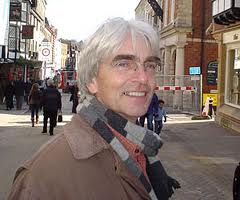
My mum sings with this “Monday Music” group. She invited me to join her for this morning’s session. The choir is led by an amazing and dynamic conductor, Grenville Hancox (pictured). Grenville, whom I have known since I was a kid, is a retired music professor at Canterbury Christ Church University, a fine clarinetist and a passionate believer in music-making for all. He leads several vocal ensembles around town.  The Monday Music group, which meets every Monday at 11am, is mostly aimed at older people who love to sing for fun but may not have any musical background at all.

Singing as part of this group was such a pleasure this morning. We started off with warm up exercises which ranged from clapping games and singing the letters of the alphabet, to doing rounds in as many as six parts. Then we made a joyful noise in four parts, accompanied by Grenville on guitar, in oldies like The Crystals’ “Da Do Ron Ron” and George Harrison’s “By Bye Love.”

The singers clearly love Grenville. He has a light touch and makes it fun, while at the same time conveying enough about the importance of good diaphragm support and clear diction to make people pay close attention and sit up straight.

One of the unexpected delights of the morning was ending the session by walking en masse over to a nearby health food store where we sang a few songs, flash-mob style, before unsuspecting shoppers. Everyone was smiling among the shelves of gluten-free granola and vegan cheese. The group’s energy was high. I think we could have stood there singing for hours.

I left feeling very happy to have been part of the ensemble for the morning. For my mum’s sake, I wish Monday music could also happen on the other six days of the week.


PS July 14: Someone posted a 2.5 minute video of our escapade in the health food store. Check it out here.

Hair and Bones

imagesIt was surreal going from fawning over a lock of Beethoven’s hair yesterday afternoon to running through a park scattered with thousands of artificial bones this morning.

The lock of hair (given the stamp of authenticity by virtue of a document, written in now-faded ink, by Beethoven himself) is one of the many curiosities stashed away in the Library of Congress‘s music archives. Yesterday, I hosted and produced in collaboration with music specialists at the Library, a podcast about some of the whacky stuff that the institution holds that once belonged to famous composers. Beethoven’s hair, a bunch of fabric swatches owned by Wagner, who had a weakness for pink, silk waistcoat linings, and Copland’s rolodex were among the ephemera under discussion.

Yesterday’s fun was sharply thrown into relief this morning as I was on my run through the National Mall. A team of volunteers was hard at work, picking up what looked like trash but upon closer inspection turned out to be thousands of plaster- and paper-cast human bones.

Over the weekend, the Mall had been the site of a huge “graveyard” – a large-scale social arts installation entitled “One Million Bones” masterminded by artist-activist Naomi Natale. The project took three years to come together for display from June 8-10 on the Mall. Natale and her team collected one million handcrafted bones from members of the public. The installation, coupled with workshops, music and talks, was aimed at raising awareness of ongoing atrocities in places like Sudan, South Sudan, the Democratic Republic of the Congo, Somalia and Burma. The project was inspired by Philip Gourevitch’s book about the Rwandan genocide, We Wish To Inform You That Tomorrow We Will Be Killed With Our Families.

I didn’t get to see the installation over the weekend. But it must have made a powerful statement. Even the dregs of it that I saw this morning — most of the remaining body parts reduced to a mushy pulp owing to the heavy rains we’ve had here over the past few days — were still completely disconcerting.

Isn’t is strange how a lock of a dead composer’s hair can be treated like a holy relic, while the fabricated bones of millions of massacred people get swept into the trash?

Last Hurrah

056325W1My first ever visit, yesterday evening, to see a production at The Folger Theatre in Washington DC – Twelfth Night – happened to coincide with the very final performance of the present season. Outside the venerable building in Capitol Hill, I overheard members of the company discussing post-performance party plans.

In retrospect, the whole situation was fitting, because perhaps more than any other play by Shakespeare, Twelfth Night represents a last hurrah of sorts – it was the dramatist’s last truly fun-loving play. After Twelfth Night, his comic sensibility would become more complex and troubled as is evidenced by works like Measure for Measure and All’s Well That Ends Well. “What you Will” morphed into “what you must.”

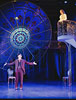
Robert Richmond’s wonderfully madcap production also represents a last hurrah. The director’s take is set in 1915 aboard  an opulent, sinking cruise ship (modeled on the famed Lusitania) with a massive, round stained glass window, keeling precipitously over the stage having lost some of its delicate panes.

Aboard their Illyrian pleasure boat, the brilliant ensemble cast pushes the party atmosphere to its limits. Everyone on stage is a lord or lady of misrule, seemingly governed by groin, spleen and/or heart.  Like the ship’s mast breaking in the storm that precedes the action, these characters all lost their heads long ago.

The songs, performed live on stage accompanied by a gorgeous grand piano with a transparent, curlicue body that would make Liberace happy, as well as assorted ukuleles, cellos, clarinets and accordions, are jubilant-lyrical odes to love. Balanced against this euphoria, though, is malice.

This nasty edge is most visible in the treatment of Malvolio (the superbly pompous yet lovable Richard Sheridan Willis, who steals the show.) When Sir Toby Belch and Feste goad the steward and accuse him of lunacy as he lies helpless inside the filigree body of that gorgeous piano, the prevailing atmosphere is sinister and sadistic. I only wished that the colorful lighting palette could have been muted in that scene to fit the ominous mood. Music, as symbolized by the piano-prison, at that moment becomes a source of torture. In this reality, Malvolio’s puritan way of life perversely starts to make sense.

The early 20th century seems to be looming large right now in the popular imagination, from Baz Luhmann’s Gatsby to Downton Abbey. The idea of a loss of innocence, of western society drunkenly staggering towards the chaos of World War I and the stock market crash, seems to echo an unease that people feel right now about our own culture, where the carefree excesses of the 1990s and early 2000s are perceived to be pushing us over a precipice.

This production of Twelfth Night bristles and dances with the same, intoxicating energy. Just as Viola (Emily Trask) — standing under the stained glass window on stage that also looks like a massive, looming clock — understands that only time can untangle the chaos of people’s affections, so the distance of a century provides us with a way of making sense of our present whirligig.

Nicholas Alexander Brown and the Library of Congress Chorale

photoWhen Nicholas Alexander Brown was walking down Pennsylvania Avenue in Washington DC yesterday afternoon following a lunchtime concert he had just conducted at The Library of Congress’s genteel Coolidge Theatre, two young women called out to him from outside a café to congratulate him on his success.

I wasn’t surprised: Brown is the sort of person who quite regularly gets accosted in public places around Capitol Hill. The twenty-something Library of Congress musicologist and administrator cuts an atypical figure at the Library. He’s about 40 years younger than the average employee, several inches taller and much better dressed. Yesterday he was sporting a charcoal-colored Hugo Boss suit that looked like it had been painted on him.

One of the things that Brown, a singer, French horn player and conductor, took on when he started working at the Library just over a year ago was the unglamorous job of conducting the Library of Congress Chorale.

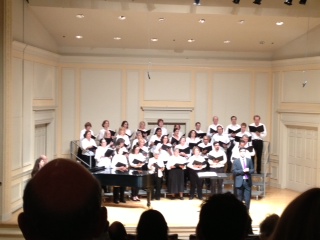
Composed entirely of volunteer singers from the ranks of the Library’s many departments, the SATB Chorale is a marvelous relic. It’s probably one of very few genuine workers’ choruses left in this country. The group rehearses once a week for an hour or so at lunchtime. The majority of its members are, at a guess, well over 50 and many of them don’t read music.

Despite the minimal time available to Brown to rehearse with his singers, the Chorale managed to pull off — with aplomb — an ambitious program of classic opera choruses yesterday that consisted of music in several different languages including English, German, French, Italian, Russian.

The ensemble’s intonation and articulation were fantastic throughout. I could make out almost every word that was sung. There were great dynamic contrasts and best of all was the variety of mood throughout the hour-long program. The group was suitably furious when they performed the “Chorus of the Furies” from Act II of Gluck’s Orphee et Eurydice, lyrical when it came to Verdi’s rousing “Va, pensiero” from Nabucco, full of pomp for “Gloire a Didon” from Les Troyens by Berlioz, rambunctious during Tchaikovsky’s “Chorus and Dance of the Peasants” from Act I of Eugene Onegin, and hushed for the “Humming Chorus” from Puccini’s Madama Butterfly.

Brown needs to encourage his forces to sing with a fuller, rounder tone. The overall sound was a little thin most of the time. But all in all, the Chorale gave the audience a fantastic lunchtime concert. The experience made me wish that workers’ chorales would come back in vogue.

An English Play, An Irish Play, And An American Musical

photoI hesitate to draw conclusions about the sensibilities of entire nations from seeing three plays over the course of a weekend, but it strikes me that the trio of productions I just experienced — a desperately dark Irish play, an English comedy with a hard-hitting underbelly, and a resolutely optimistic American musical — kind of sum up traditional views of these three contrasting yet related cultures. Here are a few further thoughts about each show:

Abigail’s Party at SF Playhouse: The English dramatist / filmmaker Mike Leigh’s dark 1977 satire revolving around an adult cocktail party as one of the guest’s teenage children (the titular Abigail) holds her own social gathering next door is subtly yet insistently infused with the inter-marital, class-conscious struggles of everyday life. The play is nearly 40 years old at this point and is set in a time and place — 1970s south-eastern England — which probably feels quite alien to most contemporary American audiences. At one point, the chatty, glamorous hostess Beverly (a sashaying, goading and irrepressible Susi Damilano) and her younger dowdier neighbor Angela (a frumpy yet endearing Allison Jean White) gaze at a shelf ornament that changes color and remark, excitedly, that the object reminds them of New York. Ah, these were innocent times. Yet despite the distance separating us from Leigh’s world, the core issues at stake are as prescient as ever. As Amy Glazer’s hilarious yet hard-hitting production careens on and the characters become more and more drunk and more and more disaffected with their lives, we are left with the feeling of dread not so much about the characters themselves, but about the sort of world that the obliviously partying teenagers next door will inherit from their unhappy forbears.

Terminus at the Magic Theatre: The last time I saw a play by the Irish playwright Mark O’Rowe was also at The Magic Theatre. That was about 12 years ago and Howie The Rookie has stayed with me ever since. I came away from that experience dumbfounded by the power of monologue and giddy from the beautiful violence of the dramatist’s lyrical use of language. This play, a three-hander instead of a duo, delvers similarly in terms of pith, poetry and punch. The tightly structured play takes place in a sort of holocaust-like nowhere land, realized by Robert Brill as a desolate sandbox packed with flinty dark grey shale upon which the three characters, uniformly dubbed A, B and C, stand, sit and lie down. A sepulchral light glimmers throughout Jon Tracy’s menacing-taut production and the characters are trapped in this space for the duration of the action. The drama weaves together narratives that balance extremes of kindness, destruction, love and hate and inhabits a liminal space throughout that perches on the precipice between life and deaf. In one story, for example, a young woman finds herself falling off a crane following a nasty surprise involving a boy she fancies; in another a woman describes being hit in the head repeatedly with a chair following an altercation with a psychopath about a violent abortion. Through nine monologues (alternating equally between each of the three characters) the tumbling locutions of the three characters’ monologues bring the cadences of Beckett, Shakespeare and rap music to mind. Stacy Ross, Marissa Keltie and Carl Lumbly make for a formidable cast. Their performances are focused, balancing mania with pathos. I staggered out of the theatre after close to two intermissionless hours feeling profoundly frightened and moved.

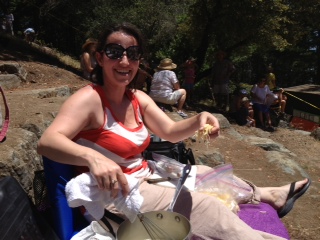
The Sound of Music at Mountain Play: It’s hard to imagine a more fitting production to celebrate the hundredth anniversary of the Mountain Play summer play producti0ns in a capacious amphitheatre near the summit of Marin County’s Mount Tamalpais than Rogers and Hammerstein’s classic musical ode to fresh mountain air and the healing power of song. I hiked up Mount Tam from Mill Valley for three steep, sunbaked  hours, schlepping a picnic with a friend, Christophe, in order to see the show. (See above for a picture of another friend, Mirit, making fondue on the mountaintop for our lunch. Never let it be said that my people do things by halves.) I’ve seen productions of this musical all over the gaff. But this time, uniquely, felt like I could join in with Mother Abbess Hope Briggs’ rich rendition of “Climb Every Mountain” and actually mean it. Mountain Play has assembled a lively and talented cast for the production helmed by an energetic and lovely Heather Buck in the central role of Maria. I was highly entertained, and, surprisingly for a boozy, sunny afternoon on top of a mountain among several thousand picnicking playgoers, also felt deeply moved by the drama’s serious political undercurrent.

lies like truth

These days, it's becoming increasingly difficult to distinguish between fact and fantasy. As Alan Bennett's doollally headmaster in Forty Years On astutely puts it, "What is truth and what is fable? Where is Ruth and where is Mabel?" It is one of the main tasks of this blog to celebrate the confusion through thinking about art and perhaps, on occasion, attempt to unpick the knot. [Read More...]

Archives

Blogroll

  • About Last Night
  • Artful Manager
  • Audience Wanted
  • Bitter Lemons
  • blog riley
  • Clyde Fitch Report
  • Cool As Hell Theatre
  • Cultural Weekly
  • Dewey 21C
  • diacritical
  • Did He Like It?
  • Engaging Matters
  • Guardian Theatre Blog
  • Independent Theater Bloggers Association
  • Josh Kornbluth
  • Jumper
  • Lies Like Truth
  • Life's a Pitch
  • Mind the Gap
  • New Beans
  • Oakland Theater Examiner
  • Producer's Perspective
  • Real Clear Arts
  • San Francisco Classical Voice
  • Speaker
  • State of the Art
  • Straight Up
  • Superfluities
  • Texas, a Concept
  • Theater Dogs
  • Theatre Bay Area's Chatterbox
  • Theatreforte
  • Thompson's Bank of Communicable Desire
Return to top of page

an ArtsJournal blog

This blog published under a Creative Commons license