
• Home
  • About
    • Chloe Veltman
    • lies like truth
    • Contact
  • AJBlogs
  • ArtsJournal

lies like truth

Chloe Veltman: how culture will save the world

Archives for 2010

Boo to Bureaucracy

bureaucracy.jpegSome irritating news from the San Francisco International Arts Festival in my in-box this morning. Two of the event’s companies have had to cancel opening night shows owing, according to the organization’s executive director Andrew wood, to local and national bureaucracy of one kind of another.

Al-Khareef Theatre Troupe from Damascus, Syria was scheduled to perform the U.S. premiere of their production, The Solitary, tomorrow, Friday night. According to Wood, SFIAF filed the petition for the company’s visas ahead of most of the other visa applications for this year’s festival. “Three months after USCIS received the application, whilst all of the other artists’ petitions that SFIAF filed later were eventually approved, the Al-Khareef petition remained in the system with USCIS officials saying nothing about the application’s progress,” said Wood. “After much imploring–including from the office of House Speaker Nancy Pelosi, the members of Al-Khareef finally received their visas on May 10. But then the Damascus Consulate refused to process them for over a week citing unspecified technical difficulties. The result was that the company was only able to fly out to San Francisco on Thursday May 20–the day they were supposed to be doing the technical load-in for their show. As a result the Festival producers had no choice but to do the technical rehearsals on Friday night and cancel the performance. Opening night will now be on Saturday.”

The festival was dealt a second blow as a result of red tape challenges closer to home when the Bay Area-based ensemble, The Foundry, had to move their new show, Please Love Me, from the newly refurbished Monaghan’s Bar on Pierce Street in the Marina District to the Dovre Club. “Monaghan’s was slated for reopening on May 1, but San Francisco’s Department of Building Inspections kept on putting off the bar’s scheduled inspections to approve the work causing nearly five weeks of delays,” said Wood. “The problem in getting a back-up bar was that most alternatives could do one date or the other, but not both, which would have required choreographer Alex Ketley and multimedia artist Les Stuck to completely reconfigure the show in 24 hours for a new venue.
In the end, the decision was made to cancel the Sunday matinee and keep the Tuesday performance at another Irish Bar, the Dovre Club.”

Hopefully these two hiccups will be the last facing the festival this year.
Sweet Pete

peter.jpegThere’s perhaps only one thing about the entertainment world that I dislike more than child actors, and that’s adult actors pretending to be children on stage and screen.

I was reminded of this antipathy yesterday evening when I finally made it out to catch a performance of Peter Pan — a 360-degree CGI-infused production from London adapted from the J. M. Barrie play by Tanya Ronder and directed by Ben Harrison. The show is on the first leg of a U.S. tour and is playing in a tent on the Embarcadero in San Francisco.

There’s very little else going on besides people in their 20s and 30s stomping about the round stage petulantly in pajamas, fondling teddy bears and speaking in squeaky voices. Only the few pirate scenes, where the adults get to act their own age, provide relief.

That being said, as the show unfolded with its engaging mixture of high- and low-tech effects, I found my annoyance with the acting fading and felt immersed in the story. There are some lovely moments, such as Captain Hook’s speech about how the only woman that ever felt anything for him is the crocodile that’s trying to eat him. And I enjoyed the simplicity and imagination of some of the staging, such as an underwater sequence in which Wendy’s brothers John and Michael flirt with two mermaids. The mermaids are aerial dancers and their tails are created by the unfurling sheets with which they slowly and gracefully move about the stage.

At two and a half hours, Peter Pan feels a little overly long. But I would definitely recommend the show for families — I think it’s a great treat for anyone aged eight and above.

Here‘s what The Chronicle’s Robert Hurwitt had to say about the show.

Salon City

cariwyl.jpg

Small cultural gatherings in private homes are all the rage right now in San Francisco. I’ve been involved in a theatre salon for several years; the Home Theatre Festival is happening right now in people’s living rooms across the city; the Mugwumpin performance troupe is producing a show in a motel room on June 7 and the San Francisco Parlor Opera is staging Don Giovanni in a private home through May.

I don’t think there’s anything particularly new about this phenomenon, though it seems more prevalent at the moment. In this age of increasing tech-driven isolation, perhaps people have been missing the intimacy of getting together with a few friends and new acquaintances to participate in artistic activities. Or maybe we’re all just tired of the same old formats and want to try something new. 

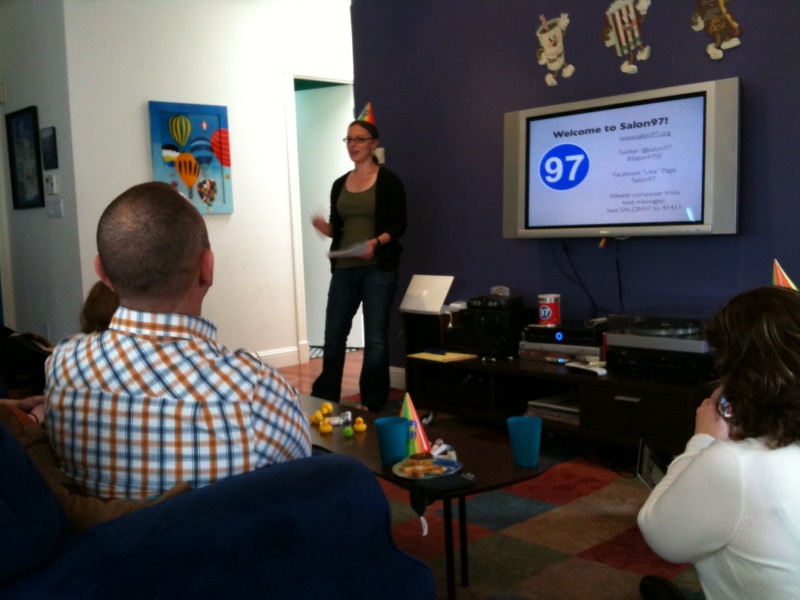
At the weekend, I attended an hour or so of a lively Salon97 music-appreciation salon. I wish I could have stayed longer at the gathering, organized by a local music lover, Cariwyl Hebert, but I had to be at a concert rehearsal. At any rate, from the short time I spent at Cariwyl’s home in the Upper Haight, I could tell that she and her friends are on to something. The event provides a wonderful high-engagement yet low-key format for listening and discussing music.

I asked Cariwyl (pictured) to tell us about the development of the salon and how it works. She sweetly obliged. Here is what she had to say about it:

In 2008, I visited the South by Southwest Music Festival. Excited to meet many new people and hear a lot of great music of varying varieties, I eagerly added my classical music affiliation to my conference badge thinking this would help pave the way to some great conversations. On the contrary, when fellow attendees saw that I wasn’t involved with indie rock somehow, they looked the other way. This all became rather frustrating after awhile and as the hours turned into days, it became downright depressing. I loved all the music I heard and overall had a great time, but the defeated feeling of the art form I loved the most being irrelevant to everyone else wouldn’t leave me alone. It was time to take matters into my own hands.

What was missing from classical music that made it seem so boring? Why was it that people were willing to stay up all night in crowded over-heated venues to hear indie rock, but not classical music? Was it a lack of intimacy? Community? Informality? Easy access to alcohol? Who wrote the rule that classical music listening couldn’t have all of this?

Two months later I hosted my first classical music listening party. Then another that summer. Every few months I’d pull together a playlist of music constructed around a theme such as American composers (with hot dogs and root beer floats), music in cinema (on Oscar night), living composers, parody in classical music for April Fool’s Day, and scary music for Halloween (with a costume contest). The principles I held to were: a. no experience necessary, b. no question is a dumb one, and c. we’re all here to learn and have fun together.

As time went on, the crowd grew bigger. I started a website, and I named our listening parties Salon97: Classical Music for the Other 97%. The parties were named for the style of event (a salon) and “97” is a tribute to conductor Benjamin Zander’s assertion that perhaps orchestras think three percent of the population likes classical music and that perhaps they strive for four percent. Instead, he says that everyone likes classical music but they just don’t know it yet. I’m after the other 97 percent.

Last Saturday, we celebrated two years of Salon97 with a birthday party that would be typical for any two year old. Balloons, party favors, and Betty Crocker Rainbow Chip cupcakes were everywhere. Our guests wore party hats. We listened to a three piece retrospective of some of audience favorites previously heard at our listening parties. The playlist included:

-William Grant Still’s The American Scene. We listened to the “Southwest” portion of the piece, and everyone was very intrigued by how much the work sounded like a film score to a 1960s western film.

-Arvo Pärt’s Annum per Annum. We discussed the silent portion of the piece and whether it correlated directly to the periods of contemplative silence the composer has taken professionally.

-John Adams’ Short Ride in a Fast Machine. We talked about Charles Ives’ influence on his life as a composer in addition to the energetic and innovative nature of the piece.

Two years ago, I never would have guessed that one small listening party would evolve into a growing community where people who were previously too intimidated to go to the concert hall or buy a classical album would have so much fun listening to classical music. Nor did I anticipate creating a new environment for people to make new friends and business relationships. All of these have happened.

I have big plans for Salon97. A podcast, concert field trips, a classical music 101 video series and more. But fundamentally, the idea behind Salon97 is a small and simple one. Classical music–in jeans or a tuxedo, sober or drunk–belongs to everyone.

Biodegradable Water Balloons

balloon.jpegOf all the cultural activities that make the Bay Area stand out as unique, the Bay to Breakers must be one of the most outstanding.

Now in its 99th year, the enormous footrace is a cultural phenomenon not just for the sheer numbers that participate in the 7.5-mile run from one end of the city to the other (there are around 60,000 participants) but also for the inventiveness of the costuming and assorted sideshow activities.

Actually, this year’s costumes were a bit of a letdown. The only truly inventive effort I saw while running in my cocktail dress yesterday morning was a group of synchronized swimmers with flowery swim-caps who kept formation by means of a blue tarp with holes in it which they collectively wore around their waists as they jogged along.

The prize for the event’s greatest inspiration, in my opinion, should go to someone who didn’t even participate in the race itself. My neighbor, Erica, performed an unlikely but welcome public service from her very own studio apartment in Hayes Valley all morning. For the second year running, Erica hosted a brunch geared towards deterring the many weak-bladdered Bay to Breakers participants from relieving themselves mid-race down the narrow back street over which her apartment looks. Every time Erica and her brunch guests saw someone taking a leak down Linden Alley, they threw a water balloon at the offending party. Most people took the onslaught from above well, Erica told me, soon after I turned up at her place post-run in my sweaty cocktail dress to catch the tail end of the party. Only one person, a man dressed up as a strand of bacon, threatened to throw rocks at her window.

Erica feels good about taking the law into her own hands and rightly so: For one thing, the Bay to Breakers organizers provide more than ample restroom facilities en route, making pissing down a back alley unjustifiable. For another, as Erica put it, the balloons she sourced for the proceedings were “of the biodegradable kind.”

Hold the Front Page

bay.jpegHere’s an update on what’s happening with regards to the New York Times‘ Bay Area culture coverage going forward:
Starting on June 1, The New York Times is handing over the editorial content of its Bay Area section (which was launched last fall and runs on Fridays and Sundays) to a new start-up media organization, The Bay Citizen.

The culture column which I have been writing will be tweaked slightly under the new regime. For now, I will be writing every other week for the Bay Citizen. All of the writing I do will appear on the Bay Citizen’s website. Sometimes, my pieces will also appear in the New York Times too. The column will be about the same length as in the past and the topics at least as broad in range. But it will probably have a more “insider-y” feel and “intimate” angle and tone.

The Bay Citizen just hired a wonderful culture editor, Reyhan Harmanci, who used to be an arts reporter for the San Francisco Chronicle among other media organizations.

Stay tuned for further developments.

In The Heights, The Elevator Pitch:

heights.jpegThink Rent meets West Side Story.

Shanghai Buddha

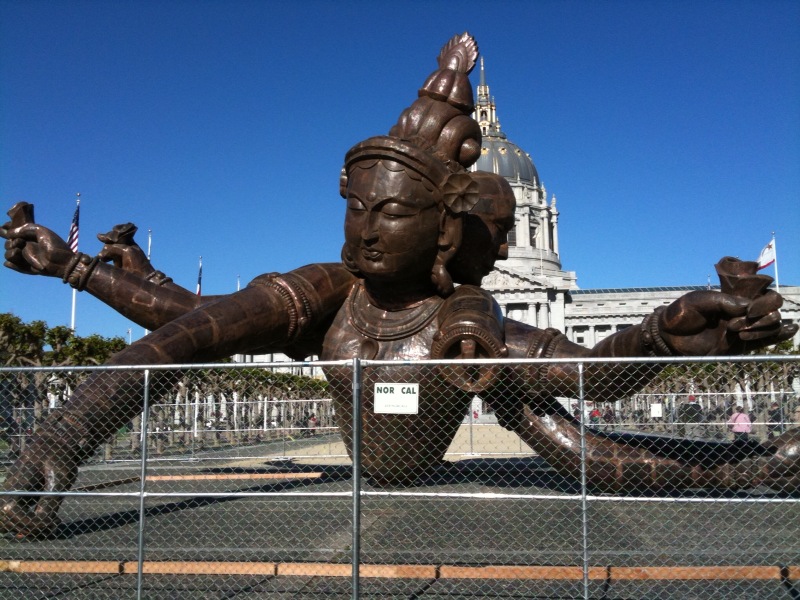
sculpture.jpgAs I write, a giant, three-headed, three armed bronze Buddha statue is being dedicated by Mayor Gavin Newsom at the Joseph L. Alioto Performing Arts Piazza, located across the street from San Francisco’s City Hall.
I went to look at the copper welded sculpture, which at that point was still encased behind a protective wire fence, yesterday morning. Against the blue sky, Chinese artist Zhang Huan’s Three Heads Six Arms (2008) makes for an awesome sight.

The piece weighs 15 tons and measures 26 feet tall by 60 feet long. One of the most impressive things about it is the way in which it appears to look at you and reach out to you from all directions. As a work of art installed to mark the spiritual and cultural ties between San Francisco and its sister city of Shanghai, the Buddha perfectly symbolizes a 360-degree world-view and far-reaching partnership between the two places.

The piece is on loan from the artist and Pace Gallery in New York through 2011 with the potential for an extension.

What A Lucky Gal I Am

volti and morten.jpgYesterday evening was one of those evenings which made me feel so joyful and blessed to be doing what I do in this great city.

The soiree started off with dinner for four at Mayes Oyster House on Polk Street with the formidable Los Angeles-based composer Morten Lauridsen, the poet, head of arts and culture programs for the Aspen Institute and former Chairman of the National Endowment for the Arts, Dana Gioia, and Tamsin Smith, the founder of Slipstream, an ethical business incubator based in San Francisco. The conversation grooved around such topics as poetry, music, architecture and whether oysters really taste like waves when you slurp them. The prize for the most memorable lines of the evening went hands down to Mr. Gioia: “Critics with musical backgrounds are best equipped to understand and write about my poetry” / “The BBC called about wanting to make a documentary about me. I declined because I thought it would give me just enough notoriety to receive more emails from strange people but not enough notoriety to be able to afford a secretary.”

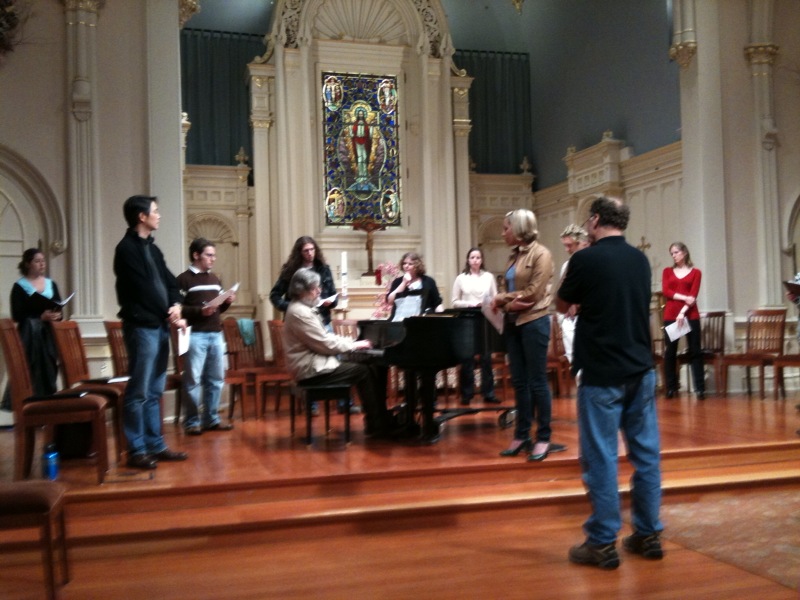
Dinner was followed by a trip to St. Mark’s Church where I was thrilled to catch the local choral ensemble Volti rehearsing some works by Morten for a pair of concerts this weekend. It was amazing to watch the singers’ body language change as they sang the gorgeous “O Magnum Mysterium,” perhaps the composer’s most well-known piece. Their bodies went from being rigid to supple. Their faces relaxed. It was like watching the musical equivalent of deep-tissue massage happening right before my eyes. Morten seemed so excited to be in the rehearsal room with the choir, a group with which he has collaborated on several occasions in the past. He leapt about like a sprite. It was wonderful to see him play the piano (see the snapshot I took, above) — the composer is accompanying the singers in a performance of his “Nocturnes” at this weekend’s concerts.

It was hard work tearing myself away from the church before the rehearsal was over, but I had to get to Davies Symphony Hall for the opening night of the Los Angeles Philharmonic’s national tour — the orchestra’s first national tour in nearly a decade and its inaugural tour with its rockstar music director, Gustavo Dudamel. I was assigned to cover the concert for the Los Angeles Times. The event distinctly lacked the glamor of the LA Phil’s opening night concert at the Walt Disney Concert Hall last October, though the program was the same — the orchestra performed John Adams’ “City Noir” and Mahler’s First Symphony. Unlike their counterparts down south, concertgoers in San Francisco don’t know how to dress and have no sense of occasion. But the music was mostly divine and Dudamel made a huge impression (as always) on the audience.

I got some good material for my story, including interviews with Adler Fellows Leah Crocetto and David Lomeli (who sang the Verdi Requiem with Dudamel in LA last November). Then I hot-footed it back to base to file an article and blog item to the LA Times to meet an overnight deadline. Staggered to bed at around 2 a.m., tired but blissfully happy. I feel like the luckiest gal alive.

Student Composers

conte.jpegIt’s no surprise that student composers often create music that sounds like the music of their teachers. As in most if not all fields of learning, students learn by emulating the techniques and principles that their teachers pass on to them. And creating music that’s in the mold of the teacher’s style is flattering and more likely to gain approval. It’s usually the case that students are not expected to create anything wildly original, but rather to follow the rules and build something that’s well-made. Creativity, if it comes at all, is a post-graduation right.
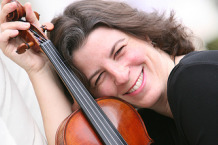
The 14 student pieces that constituted the San Francisco Conservatory of Music’s choral composition competition mostly perfectly met these expectations. The competition, which is run by composer and conservatory composition professor David Conte (pictured) and takes place every two years (this is the seventh iteration of the event) was full of pieces that were a) very similar in feel — most of them were ponderous, earnest and basically tonal — and b) written in a style approaching the teacher’s own compositional slant.

The choral ensemble with which I perform, The International Orange Chorale, was one of three choirs charged with performing the compositions. We were lucky enough to get to perform the winning piece — a ponderous, earnest and basically tonal work entitled Peace by Aaron Pike. The song was a setting of a poem by Louise N. Parter. Because this piece won, we ended up giving it a “lap of honor” by reprising it at the climax of the event.

The winning work was certainly well-crafted, but it wasn’t my personal first choice. I would have chosen one of the few works on the program which veered in a different direction from the rest. Performed by another local ensemble, the San Francisco Choral Artists, Carry, by Anthony Porter, juxtaposed a poem by e. e. cummings with the words of the Kyrie Eleison. Packed with jaunty rhythms, playful polyphony between the chorus and soloists and unexpected harmonies, the composer’s writing demonstrated some measure of originality. The pace and energy of the work made for a welcome break from the rest of the dreamy-serious pieces, as inoffensive to the ear as all of them were.

Originality clearly isn’t ranked high on the list of criteria for judging student compositions at the Conservatory. (The judges, by the way, were composer/conductor John Kendall Bailey, composer/organist Stephen Main, and singer/conductor Jeffrey Thomas.) The fact that veering away from the status quo seemingly isn’t foregrounded is a shame in a way, especially since the pieces are given a public performance. The compositions might reflect the different personalities of the composers in the eyes of their teacher. But to most audience members, I suspect it was hard to distinguish most of the works from one another.

Commuter-Friendly Music

Robin-Sharp_218x145.jpgIt was by accident that I heard about the San Francisco Chamber Orchestra‘s Rush Hour concert series. My composer friend, Gabriela Lena Frank, invited me to attend a performance by the group tonight, Friday. The orchestra is premiering a new work by Gabriela, her first violin concerto. Gabriela is the SFCO’s composer in residence.

When I said I sadly wasn’t available, she told me about a “quickie” series of late afternoon concerts run by the orchestra — occasional hour-long concerts at the Contemporary Jewish Museum which are free to members of the public and serve as a prelude to the orchestra’s main concert program.

I was so happy to meet my deadline for the day and walk over to the museum in downtown San Francisco in time to hear the music. The concert was well and diversely attended. There must have been about 60 people in the audience including a group of lively African-American elementary school kids (one of whom spent most of the concert energetically mimicking the conductor’s hand movements.)

This weekend, the orchestra is performing a series of concerts around the Bay. Works include Mozart’s Serenade in D Major, K. 239 (Serenata Notturno), Steve Reich’s Nagoya Marimbas (1994), Wayne Vitale’s Mbirama (2006), Gabriela Lena Frank’s Hailli Lírico violin concerto [2010: world premiere], and Béla Bartók’s Roumanian Folk Dances.

The Rush Hour program consisted of the Mozart, Reich and Frank pieces. This created a lovely mixture of periods and styles. If the Mozart was perfunctory and serviceable, the orchestra more than made up for this with the Frank premiere. The percussionists also did Reich proud with a mesmerizing rendition of the composer’s spiraling piece.

I enjoyed parts of Gabriela’s piece a great deal. The composer achieves a lyricism, warmth and intimacy with her work, all the while yo-yoing between radically different moods. Composed especially for violinist Robin Sharp (pictured), the SFCO’s concertmaster, the piece shows off the soloist’s ability to play with a Romantic weight and ardor as well as an angular, jaunty sprightliness. There are moments of great tenderness too.

The SFCO isn’t the only classical music organization around offering commuter-friendly concerts. The idea is a good one, as it entices into audience segments that might not otherwise attend evening concerts, such as elderly people and children. The fact that these programs, like all of the orchestra’s concerts, are free, is a wonderful bonus.

The SFCO’s remaining concerts this weekend are as follows:

8pm Friday, May 7, 2010 Herbst Theatre, 401 Van Ness Avenue, San Francisco
8pm Saturday, May 8, 2010 St. Mark’s Episcopal Church, 600 Colorado Avenue, Palo Alto
3pm Sunday, May 9, 2010 First Congregational Church, 2345 Channing Way, Berkeley
8pm Monday, May 10, 2010 Empress Theatre, 330 Virginia Street, Vallejo

New Jazz Center for SF

image003.jpgThe San Francisco Jazz Festival’s parent organization, SFJAZZ, is opening its first permanent home in the city in 2012. The building, which will be located in Hayes Valley near many of the city’s other key arts organizations such as the SF Ballet, SF Opera and SF Symphony, is touted as “the west coast’s first facility dedicated to jazz music and education” — a sort of Lincoln Center of the west, if you will.

The 35,000 square foot building is being designed by local architect Mark Cavagnero. It will include a state-of-the-art auditorium that will accommodate up to 700 audience members, rehearsal studios, a black-box theater, digital lab and sidewalk-level restaurant/café. The SFJAZZ Center will expand its education outreach to Bay Area children and adults through new lecture series, additional rehearsal spaces and opportunities to interact with world-class artists.

The funding for the project is anchored by an anonymous gift of $20 million, one of the largest donations ever given to a jazz institution. SFJAZZ is planning to raise an additional $60 million toward construction of the building and the expansion of the SFJAZZ endowment.

The news is particularly welcome at a time when San Francisco is suffering from great economic difficulties. And as a Hayes Valley resident, I am personally thrilled about welcoming another top-tier arts organization to the area.

Bibliohead

bibliohead_storefront.jpgI want to give a big shout-out today to my neighborhood bookstore, Bibliohead, in Hayes Valley, San Francisco.

I feel very lucky to live around the corner from this place. The Gough Street store is like Dr. Who’s time and space travel machine, the Tardis. The store is cramped and musty, with books wobbling on wooden shelves and plenty of dark corners to while away the hours in. The staff is helpful and the inventory surprisingly comprehensive. It’s the kind of place where you can buy a mottled 1950s edition of the J. S. Bach partitas to play on the piano and the latest Dan Brown. Bibliohead rarely lets me down.

I cannot think of any other place as convivial to get both new and used books, sheet music and whacky greetings cards at 9pm on a Saturday evening. Long may Bibliohead thrive.

« Previous Page
Next Page »

lies like truth

These days, it's becoming increasingly difficult to distinguish between fact and fantasy. As Alan Bennett's doollally headmaster in Forty Years On astutely puts it, "What is truth and what is fable? Where is Ruth and where is Mabel?" It is one of the main tasks of this blog to celebrate the confusion through thinking about art and perhaps, on occasion, attempt to unpick the knot. [Read More...]

Archives

Blogroll

  • About Last Night
  • Artful Manager
  • Audience Wanted
  • Bitter Lemons
  • blog riley
  • Clyde Fitch Report
  • Cool As Hell Theatre
  • Cultural Weekly
  • Dewey 21C
  • diacritical
  • Did He Like It?
  • Engaging Matters
  • Guardian Theatre Blog
  • Independent Theater Bloggers Association
  • Josh Kornbluth
  • Jumper
  • Lies Like Truth
  • Life's a Pitch
  • Mind the Gap
  • New Beans
  • Oakland Theater Examiner
  • Producer's Perspective
  • Real Clear Arts
  • San Francisco Classical Voice
  • Speaker
  • State of the Art
  • Straight Up
  • Superfluities
  • Texas, a Concept
  • Theater Dogs
  • Theatre Bay Area's Chatterbox
  • Theatreforte
  • Thompson's Bank of Communicable Desire
Return to top of page

an ArtsJournal blog

This blog published under a Creative Commons license