
• Home
  • About
    • About this Blog
    • About Andrew Taylor
    • Contact
  • Subscribe
  • Other AJBlogs
  • ArtsJournal

The Artful Manager

Andrew Taylor on the business of arts & culture

Turns out you never owned the recording anyway

June 20, 2007 by Andrew Taylor

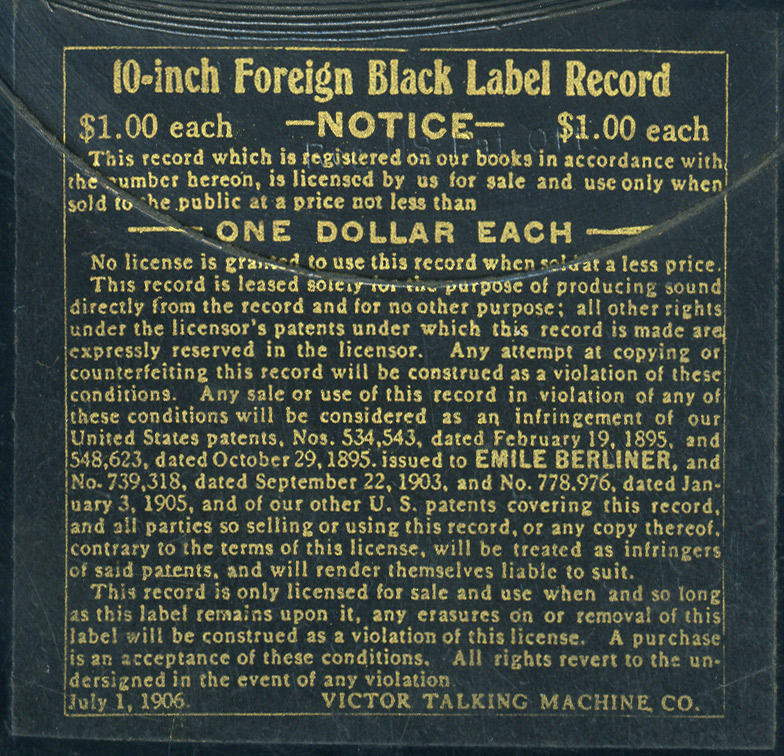
1906 Record LicenseThe digital age has thrown all sorts of complexity into media transactions — the purchase, license, transfer, or permission to experience recorded audio or video works. This fabulous label from an early recording shows that the issue is nothing new (found on this blog entry through BoingBoing).

Even back 1906, record companies were pushing the idea that you don’t buy a record, you buy the right to listen to the music encoded on the record. In fact, the label doesn’t call it a purchase at all, but a lease:


This record is leased solely for the purpose of producing sound directly from the record and for no other purpose; all other rights under the licensor’s patents under which this record is made are expressly reserved in the licensor.

It may sound like semantics, but the issue lies at the foundation of the many media industries (some of which I’ve touched on it before). We’re used to thinking of the contents and the container as the same thing (”I just bought a new CD,” ”I loved the film so much that I bought the DVD”). And with many cultural objects, the business model and the law support that assumption (books and records are covered under the first-sale doctrine within copyright law, allowing the purchaser of to sell or give away a ”particular, lawfully made copy of the copyrighted work without permission once it has been obtained”).

With digital technology, however, the only way to sell or give away a piece of music or a moving image (from your iPod or hard drive for example) is to make a copy of it. This gets copyright attorneys all a-quiver. The vagaries make media managers freaky, as well, since the rules and rights of commercial transactions define how most industries work (or don’t work).

In 1906, the Victor Talking Machine Company hoped to define the nature of the recorded audio transaction. In 1908, copyright law redefined it for them. Who knows how long it will take for the law and the marketplace to untangle the nature of cultural transactions in a digital world.

Filed Under: main

Comments

  1. Chad Wooters says

    June 22, 2007 at 10:42 am

    The essential difficulty with copyright protection is philosophical, not legal. It involves making subtle distinctions between a thing’s FORM and its SUBSTANCE. Since this has been one of the most central questions of philosophy for at least 2,600 years, I doubt that it will ever be resolved conclusively any time some.

About Andrew Taylor

Andrew Taylor is a faculty member in American University's Arts Management Program in Washington, DC. [Read More …]

ArtsManaged Field Notes

#ArtsManaged logoAndrew Taylor also publishes a weekly email newsletter, ArtsManaged Field Notes, on Arts Management practice. The most recent notes are listed below.

RSS ArtsManaged Field Notes

  • Sorting artists by social type January 20, 2026
    Clustering artists (and arts organizations) by their relationship to an "art world" can be both useful and terrible
  • Strategic outsourcing: when and why to DIY January 13, 2026
    Outsourcing can improve focus, amplify expertise, and reduce costs. But don't give away the farm.
  • Invitation to recalibration January 6, 2026
    In this new year, consider a next chapter in your Arts Management story
  • Top 10 Posts of 2025 December 30, 2025
    The most-read ArtsManaged Field Notes in a bumpy, grumpy year.
  • Pillars of a creative community December 23, 2025
    Six ways to make a place hospitable to artists

Artful Manager: The Book!

The Artful Manager BookFifty provocations, inquiries, and insights on the business of arts and culture, available in
paperback, Kindle, or Apple Books formats.

Recent Comments

  • Barry Hessenius on Business in service of beauty: “An enormous loss. Diane changed the discourse on culture – its aspirations, its modus operandi, its assumptions. A brilliant thought…” Jan 19, 18:58
  • Sunil Iyengar on Business in service of beauty: “Thank you, Andrew. The loss is immense. Back when Diane was teaching a course called “Approaching Beauty,” to business majors…” Jan 16, 18:36
  • Michael J Rushton on Business in service of beauty: “A wonderful person and a creative thinker, this is a terrible loss. – thank you for posting this.” Jan 16, 13:18
  • Andrew Taylor on Two goals to rule them all: “Absolutely, borrow and build to your heart’s content! The idea that cultural practice BOTH reduces and samples surprise is really…” Jun 2, 18:01
  • Heather Good on Two goals to rule them all: “To “actively sample novel experiences (in safe ways) to build more resilient perception and prediction” is about as useful a…” Jun 2, 15:05

Archives

Creative Commons License
The written content of this blog is licensed under a Creative Commons Attribution-ShareAlike 4.0 International License. Images are not covered under this license, but are linked (whenever possible) to their original author.

an ArtsJournal blog

Copyright © 2026 · Magazine Pro Theme on Genesis Framework · WordPress · Log in