A few minutes before 8 p.m., my heart beats faster. So many concerts start at this time -- after years in the business my body is trained!
The particular ritual of the concert brings a kind of order to living. Concert days culminate in a seventy- or eighty-minute period of time that begins at 8:05, or 8:13 (late ticket buyers still in line).
Of course, at Wigmore Hall, this "8 o'clock" is 7:30 (often 7:33), in Rome it's 9. Unlike the painter or the poet (one more revision?), the performer of live entertainments is on the spot/in the hot seat/in the limelight -- and then it's over.
Irretrievable. Done. One way or the other, gone to memory, or preserved "for posterity" in a "live recording." But not really. Really, it's not preserved, it's not saved -- we can't be saved. It's gone. Whatever it may have meant or signified, no matter how much it cost in dollars or sweat or blood -- it's over, gone, finito.
Until eight o'clock comes around again tomorrow...
Setting out to learn a piece of scripted classical music, a pianist usually looks at print. Some musicians listen to recordings.
A celebrated American violin pedagogue sent her young virtuosos to listen to five or six recordings of a new piece. The kids calculated the speed of each performance with a metronome, averaging the numbers together to determine the right tempo for their own performance -- a focus group for tempo!
Other teachers counsel strict avoidance of recordings. Is it better to read for ourselves? Erich Leinsdorf faulted young conductors who learned new repertory from recordings. Obvious sonic details (the triangle!) were prominent in their sense of a piece, but not basic structures or concepts, Leinsdorf maintained.
Embarking on research in science or the humanities, an initial stage is the discovery and reading of all the previous work. Lawyers study case law, as well as statutes. As he prepared to record Beethoven's "Hammerklavier," I discussed this with Russell Sherman. Would it make sense to find and listen to all the previous recordings of the sonata? Or can a pianist, in our period of relatively easy access to the legacy of recorded performing, dare not to listen to previous recordings of "his" piece? Can these recordings simply help in making sure there are not errors of text-reading? Or will they impede music making?
Perhaps listeners know the legacy. Jerome Lowenthal told me he was accosted backstage after playing Tchaikovsky's First Concerto. A woman
asked: "Do you play the Rubinstein or the Horowitz version?" Arturo Toscanini is reported to have said he couldn't compose because his head was too full of other people's compositions.
Is there middle ground? Is there some way to be aware of the recorded past, to draw information about style from it -- even inspiration and courage -- and yet not become a jukebox or encyclopedia?
My introduction of Alfred Brendel last night in Boston:
In classical music, there are those who believe that thinking about music can compromise feeling -- compromise our emotional response to music. Alfred Brendel's example vividly shows us that such notions are foolish. Mr. Brendel scrutinizes the canonic texts of the piano repertory. He examines the behaviors of piano playing and musical life, and he's shown that deep reflection can yield (not impede) a heightened emotional and even spiritual connection to the muses.
To a young pianist, it was a powerful example. From the high balcony at Carnegie Hall, I overheard Mr. Brendel grapple with Beethoven's music. I recall the thrill of anticipation I felt just buying the tickets for one of his Beethoven cycles. And then:
I had been, let us say, to hear
(From highest Carnegie incline)
The latest Fōld of the great garment of Beethoven's sonatas
Transmitted by Mr. Brendel through his hair and fingertips ...
(And for that, apologies to Mr. Brendel and to T. S. Eliot.)
From that high place -- from those cheap seats -- I witnessed probing and unforgettable performances: of Schubert's and Beethoven's music, of Liszt's Sonata, of the Two Saint Francis Legends, of Robert Schuman's C-Major Fantasy. On those occasions, control was "in league with chance," as Mr. Brendel has described an ideal.
Through Mr. Brendel's words, as well, provocative guidance has been offered. There are many well-worn copies of Musical Thoughts and Afterthoughts, and Music Sounded Out. Alfred Brendel has led generations of musicians "away from the piano, and to themselves."
Mr. Brendel has written of "the unseen hand" that can grip an audience and a player. I will paraphrase a passage from his essay, "On Recitals and Programmes":
There has been a spiritual link between Alfred Brendel and his public -- an intense physical experience, unique and unrepeatable, tied to a specific time in history, tied to the sounds of particular halls and instruments, to the sudden bursts of the athlete, and the peregrinations of the poet. All has been well, and Mr. Brendel's mastery has only been surpassed by the grip of an unseen hand, that has kept its hold over a player and his listeners alike for decades -- a few timeless moments... Through a long and magnificent career, he has brought us to an understanding, and a love, that we didn't know ourselves to be capable of.
Mr. Brendel, thank you.
I'm from Iowa. Born there. Grew up there. Studied music there.
I wasn't a prodigy. I took lessons from the lady down the street. (Her name was Joy Lord.) In high school, I played concertos with several Iowa orchestras. In a big city, I wouldn't have had the opportunity. I wasn't playing all of Chopin's etudes. Nothing like that. Being there gave me a chance, to dream bigger than I was.
What is musical talent? It is an ability to hear and coordinate, certainly. But also it is a capacity to experience. Talent can be a means to dream, unafraid.
We need adolescents(ce) to show us the future.
The "reception" of a piece of music becomes part of its identity. Our performances, recordings, reviews, reactions, lawsuits, teaching, reflection, arrangements, remixes, appropriation -- all of that is the piece, along with the text we started from. Famous music acquires a larger and larger, and more multiply-determined identity. Eventually, there are so many components that none of us can affect the whole very much.
When I give the first performance of new music (I'm playing a new piano piece by Nico Muhly in May), my performance functions to begin staking out an identity for that music in public. Actors are said to "create" new roles. Immediately things begin to shift as my playing is heard, as I play again, or record. Nothing ever gets taken back.
With canonic music, no matter how significant we believe our insights or approach to be, we don't make much of a difference. The music is large -- like a person who has lived a long time and for whom a few minutes represent only a small, small fraction of a life. In contrast, a few more minutes in a child's life significantly increase the whole.
Scripted music does continue to change, as it's played. Its identity is recentered, at an increasingly slow rate. How radically we depart from what has been done before in performing may be part of how far this recentering goes.
Does this explain Mannerism? As a style, or a particular piece of art becomes more and more familiar, an artist's assertion of personal voice (an attempt to recenter the piece, or school) may result in extremes. It is not exactly a wish to shock that drives Beethoven or Parmigianino -- but the desire to be heard.
Classical music culture is permeated with judgment making. Maybe it's necessary? Maybe it suits us? We audition musicians to discover who will play better in an orchestra, or to find out which students can develop best in a school. We're always grading and sorting. Critics and conductors announce what pieces are better than other pieces. (Recently, I read about Jean Sibelius's "best" symphony.)
It's dangerous. And not because we don't want superlative music. Artistic experience isn't one-size-fits-all. What plays well in Los Angeles reads differently in Paris, or Dubai. We know music is changing. Well, music itself is change!
Celebrity can sell. Orchestras bank on it -- Beethoven: The Complete Symphonies. But we know every single performance by Mr. Pollini is not better than every performance by Mr. Ponthus. And we should know that every scrap of paper touched by Beethoven's hand does not encode music that is "superior" to every note penned by Muzio Clementi.
The greatest risk is in the making of music itself. If, as we play, we judge everything we do, and respond harshly to "mistakes," or momentary lapses of taste, technique, or style, we may be so disappointed that we cannot be our "best." In order to be really present in the moment, a certain suspension of judgment serves better. Not about the facts particularly. "Is it quiet, or quick, or connected in sound?" Fine. But when it comes to drawing conclusions, it's better to wait, just to keep going where the lines and harmonies take us. Just to surrender at least some of our control, to the sound we perceive, to the breathing of the audience, to what Mr. Brendel called the "unseen hand."
There's a certain pride associated with rising melodic lines -- in much nineteenth-century music. Singing soars, and in soaring affirms something very positive about being human. As pitch rises, we might get louder, more tonally intense, more emotional.
In other music, high registers are thin. Earlier instruments and techniques may corroborate this thinness: no steel "E" strings on eighteenth-century violins, singing voices differently "supported." Eighteenth-century pianos and harpsichords are paler higher up; high notes sustain less well than notes in their lower registers. High notes are up there -- where God is? Where Heaven is? A place a human might aspire to, but not confidently occupy. In a lot of older European music, gestures that rise into high registers don't just go up -- they "ascend."
Last year, I played Messiaen's "Quartet for the End of Time" with several different groups of excellent musicians. As the cast of players changed around me, the music changed too.
The final movement, the slowly unfolding "Louange à l'Immortalité de Jésus" ("Praise to the Immortality of Jesus"), is a poem for violin and piano. It goes up very high on the fiddle. It's hard to play. It's hard to ascend ...
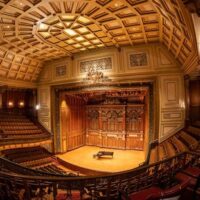
In a performance in Boston in Jordan Hall with James Buswell, I became overwhelmed. Was it the intensity of playing this very emotional music in a big room for a thousand people, built up through the whole hour-long piece? Was it Buswell's magnificent mastery? The physical sound of the sustained line rising higher and higher above the impossibly slow heartbeats (bum-baaaa, bum-baaaa) of the piano, repeating, and repeating, and repeating? Was it the recollection that Messiaen heard this music played in the hall decades before? Or thinking of the memorial event for a friend that took place on the same stage the day before our performance?
After we finished playing, after the last thin sounds entirely dissipated, after I rose from my seat, and as we bowed, my eyes filled with tears.
Mr. Buswell is a very accomplished collaborator and complimentary (when due), though not effusive. The next day when I ran into him, he asked a slightly oblique and rather plaintive question:
"Have you been in the chair again?"
I had not.
Near the beginning of T. S. Eliot's "Portrait of a Lady" there are these lines:
"We have been, let us say, to hear the latest Pole
Transmit the Preludes, through his hair and fingertips."
Were those the celebrated red locks of Paderewski? Like many Poles playing the piano,
he specialized in Chopin. There were so many Chopinists in the early years of the twentieth century -- just as sound recording really got going -- that, although we don't know how the players of the 1840s sounded when they played Chopin's music, we do have a lot of recorded evidence of the playing of the 1920s and 1930s. This forms a (somewhat anachronistic) performance-practice reference-collection for this repertory.
It can be intimidating. Before we play the Nocturne, opus 55, number 2, we might be thinking of Ignaz Friedman's 1936 recording. (And some players imitate it.) There are pianists who avoid the Fourth Ballade because of Josef Hofmann's overwhelming 1938 account.
Several years ago, in my essay "Exorcising Volodya," I described my efforts to remove, from my performances of Chopin's Polonaise-fantaisie, details from Vladimir Horowitz's 1966 recording -- details I imitated even though I didn't like them. Recently, as I have studied the Polonaise-fantaisie again, I've been thankful there are no early twentieth-century recordings of it. We can wonder how Friedman, Hofmann, or Alfred Cortot, may have played the piece. But, either because of technology -- it would have required several recorded "sides," like a concerto -- or perhaps because of this piece's reputation as discursive, none of the old players put it onto shellac.
Our sense of music is colored by when and how it entered the recorded repertoire -- even if we are not specifically aware of the first recordings. Do we have a more "modernist" view of the Polonaise-fantaisie than we might have of Chopin's First Ballade -- because the Polonaise-fantaisie was not recorded until after World War Two?
Walking across the campus of a big Midwestern university, I hear drumming. The drumline from the school's marching band is practicing outdoors, with a very loud metronome. Big speakers blast out the regular electric beats -- quite a lot louder than twenty drummers drumming. These beats sound like gunshots.
The music is intricate with a lot of syncopation, and these kids fit it all in, around the clicks. This kind of practicing is not so unusual in college and high school bands. Technology has allowed Maelzel's metronome to roar.
Previously, I've been aware of string quartets that practiced with amplified metronomes, souped-up clickers loud enough to be heard in a full-volume rehearsal. Old metronomes required quieter playing.
I don't believe we know just when musicians started to play whole passages, or whole pieces, with the metronome running. A few, like Arthur Schnabel, lined up the metronome's ticking with off-beats, or inner parts of beats, in the music being played.
In a 1948 essay, Arnold Schoenberg complains of the current style of performing "suppressing all ... unnotated changes of tempo." He writes: "Almost everywhere in Europe music is played in a stiff, inflexible metre -- not in a tempo, i.e. according to a yardstick of freely measured quantities."
Do we turn ourselves into machines: running on a treadmill at the gym, our hands gripping a game-controller, or practicing over and over with a metronome?
In an interview recently, I was asked the obvious question: "How many concerts have you played?" And I answered truthfully: "I don't know." I've thought about it before, even wishing I had kept track better. I might calculate the number by studying my old calendars and printed programs. (Could I have notched the leg of a piano bench?) It's got to be hundreds.
As I was speculating about this, I asked another question: "For the purpose of this count, what is a 'concert'?" Of course, evening-length performances with an audience in a theater. What about playing in somebody's living room? What about the performance of a
single short piece? Television? Open rehearsals? No wonder I haven't kept track.
There are artists who monitor and record bodily functions, or document the mundane or arcane physical details of life. Ok, I'm keeping a log now. I'll list each time I play the piano, for how long, and for whom...
About
Music is changing. Society's changing. Pianists, and piano music, and piano playing are changing too. That's Pianomorphosis. But we're not only reacting...
moreBruce Brubaker
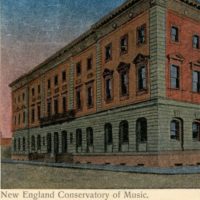
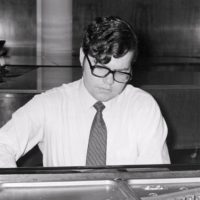
I'm Bruce Brubaker -- not Bruce Wayne! And yet, while I chair the piano department at America's oldest institution of professional musical training, New England Conservatory in Boston, increasingly technology turns my professional piano playing life into a kind of "caped crusade." Recordings such the new American piano music CDs I make for Arabesque reach a lot of different listeners, and seem to break through some old divisions of high culture/pop, or art/entertainment.
moreContact me Click here to send me an email... more
Blogroll
the other piano blog:
Stephen Hough at Telegraph.co.uk
AJ Blogs
AJBlogCentral | rssculture
Terry Teachout on the arts in New York City
Andrew Taylor on the business of arts & culture
rock culture approximately
Laura Collins-Hughes on arts, culture and coverage
Richard Kessler on arts education
Douglas McLennan's blog
Dalouge Smith advocates for the Arts
Art from the American Outback
For immediate release: the arts are marketable
No genre is the new genre
David Jays on theatre and dance
Paul Levy measures the Angles
Judith H. Dobrzynski on Culture
John Rockwell on the arts
Jan Herman - arts, media & culture with 'tude
dance
Apollinaire Scherr talks about dance
Tobi Tobias on dance et al...
jazz
Howard Mandel's freelance Urban Improvisation
Focus on New Orleans. Jazz and Other Sounds
Doug Ramsey on Jazz and other matters...
media
Jeff Weinstein's Cultural Mixology
Martha Bayles on Film...
classical music
Fresh ideas on building arts communities
Greg Sandow performs a book-in-progress
Exploring Orchestras w/ Henry Fogel
Harvey Sachs on music, and various digressions
Bruce Brubaker on all things Piano
Kyle Gann on music after the fact
Greg Sandow on the future of Classical Music
Norman Lebrecht on Shifting Sound Worlds
publishing
Jerome Weeks on Books
Scott McLemee on books, ideas & trash-culture ephemera
theatre
Wendy Rosenfield: covering drama, onstage and off
Chloe Veltman on how culture will save the world
visual
Public Art, Public Space
Regina Hackett takes her Art To Go
John Perreault's art diary
Lee Rosenbaum's Cultural Commentary
Tyler Green's modern & contemporary art blog

Recent Comments