
The Wyler Touch

Now that Hollywood's hype is fully upon us -- I'm talking about the Oscar nominations -- it's worth recalling what William Wyler, far and away the most Oscar-nominated director, once said:

Sitting here in this room, I can see a beautiful bridge -- the George Washington Bridge -- spanning the Hudson River. It is a great, majestic piece of work. But who was its builder? What's the fellow's name? I'll bet one person out of ten thousand couldn't tell me. Yet who in Hollywood has ever done anything to match it?

Just so we all know: Othmar Hermann Ammann designed the George Washington Bridge and was the chief engineer during its construction. Ammann also did New York's Triborough, Bronx-Whitestone, Throgs Neck, and Verrazano-Narrows bridges, and was a consulting engineer on the Golden Gate Bridge in San Francisco.

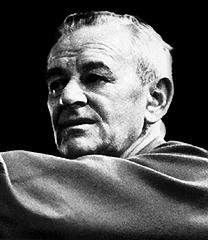
Wyler's Oscar nominations

Dodsworth -- 1936 (Directing, Best Picture)
Dead End -- 1937 (Best Picture)
Jezebel -- 1938 (Best Picture)
Wuthering Heights -- 1939 (Directing, Best Picture)
The Letter -- 1940 (Directing, Best Picture)
The Little Foxes -- 1941 (Directing, Best Picture)
Mrs. Miniver -- 1942 (Directing, Best Picture)
The Best Years of Our Lives -- 1946 (Directing, Best Picture)
The Heiress -- 1949 (Directing, Best Picture)
Detective Story -- 1951 (Directing)
Roman Holiday -- 1953 (Directing, Best Picture)
Friendly Persuasion -- 1956 (Directing, Best Picture)
Ben-Hur -- 1959 (Directing, Best Picture)
The Collector -- 1965 (Directing)
Funny Girl -- 1968 (Best Picture)

Best Picture nominations and awards actually go to the producers, but that's basically a sop to their egos. And just for the record, Wyler won the Oscar three times out of the 12 directing nominations. In all, his pictures won 38 Oscars on 127 nominations (half in best picture, directing and acting categories), which is roughly twice what any other director's pictures have earned.

January 26, 2011 8:36 AM | | Comments (0)

Leave a comment

Me Elsewhere

'WILD SIDE' STILL ROCKS 

Nelson Algren was one of the great American authors of the 20th century, it is no exaggeration to say, and among the most neglected. Consider his underrated classic, "A Walk on the Wild Side." The title -- popularized and co-opted as an idiomatic phrase by Hollywood and Madison Avenue (institutions Algren loathed) -- is familiar to most anyone who speaks English or knows Lou Reed's lyrics. But the novel itself? Hardly.

BUSTER KEATON REVISITED 
Buster Keaton: Tempest in a Flat Hat is not a biography. "This book is merely a fan's notes," Edward McPherson writes in the introduction, although his publisher ignores the disclaimer and calls it a biography on the cover. In fact, the book is a bit of both, a difficult combination to bring off unless you're David Thomson, who set the standard with Rosebud, his penetrating rumination on the life and career of Orson Welles, which was nothing if not a distillation of every obsessive thought he ever had about the myth and the man and all his movies.
LAUREN BACALL, STILL SALTY AT 80 
When Lauren Bacall writes that her singing voice ranges "somewhere between B minus sharp and outer space," she's being candid and funny. It's not every stage star with two Tony Awards for best actress in a musical whose vocal talent offers so little promise. (OK, Harvey Fierstein excepted.) Still less would one admit it.
THE STARS ACCORDING TO BOGDANOVICH 
Peter Bogdanovich's superb collection of movie-star profiles and interviews -- a sequel to Who the Devil Made It, his interviews of top film directors -- begins with an affectionate tale about Orson Welles that reminds us just how intimate the author's connection to Hollywood's greatest has been. But contrary to what we've come to expect from dime-a-dozen celebrities and celebrity interviews not worth two cents, the tale avoids bromidic egotism and journalistic platitudes.
SAMMY'S WHITE DREAMS 
Four decades ago Lenny Bruce sentenced Sammy Davis Jr. to "30 years in Biloxi," stripping him of "his Jewish star" and "his religious statue of Elizabeth Taylor." Now we have two new biographies of Davis that spring him from ridicule, if not from doubts about his legacy, and restore a measure of dignity to a black entertainer whose huge fame and success never overcame his devout wish -- indeed his lifelong effort -- to be white.
more picks

Sites to See

About this Entry

This page contains a single entry by Straight Up | published on January 26, 2011 8:36 AM.

They Died in Gaza was the previous entry in this blog.

From the Musical Comedy Dept. is the next entry in this blog.

Find recent content on the main index or look in the archives to find all content.

Creative Commons License
This weblog is licensed under a Creative Commons License.