
Lately I haven’t been paying much attention to “Countdown.” Non-stop, over-the-top bluster can get on anybody’s nerves, and Keith Olbermann has managed to get on mine — even though his rants take guts and even though I agree with them. But whenever he has Jonathan Turley on the show, as he did last night, I pay rapt attention.
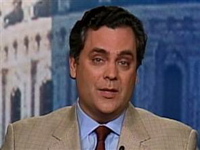 Olbermann began by asking Turley, a constitutional scholar and defense attorney, if he thought Cheney had confessed to a war crime on national television the other day in an interview with Jonathan Karl of ABC News. Here’s Turley’s reply and the rest of the exchange, which I’ve transcribed from the video segment (embedded below).
TURLEY: It’s an interesting question, isn’t it. It’s like a type of Zen question: If someone commits a crime and everyone’s around to see it and does nothing, is it still a crime? And I think that’s really the argument of this administration. It can’t be a crime because no one’s prosecuted us for it.
But it most certainly is a crime to participate, to create, to in many ways monitor a torture program. And indeed it’s one of the crimes that defines a nation committed to the rule of law. If you have to create a new nation one of the first things you do is to disavow this form of illegality. So you have the vice president sitting there saying, “Yeah, we talked about it. They came to me. I supported it, and I helped put it through.” The only problem is, what he is describing is most certainly, unambiguously, a war crime.
OLBERMANN: Except if, as you suggest, nobody prosecutes him for that. Which jumps ahead to the lasting legacy of what happens if the next administration does not press this. Do we let, you know, the international court at the Hague come in and take over all of our responsibilities for policing our own act here? Or where does this go domestically if he’s made such a statement?
TURLEY: Frankly, Keith, that’s what worries me the most, is that you can’t talk about change without having some moral component to it. It’s not just about creating jobs or lowering the price of gasoline. What occurred in the last eight years was an assault on who we are. And I think that president-elect Obama is going to have to decide whether he wants power without principle or whether he wants to start with a true change, to say that no matter where an investigation will take us, if there are crimes to be found, they will be prosecuted.
Now, right now, many leaders in Congress are trying to create a new commission that is designed to avoid any criminal prosecution. And those leaders happen to be Democratic leaders. But it will ultimately depend on citizens, and whether they will remain silent in the face of a crime that’s been committed in plain view.
OLBERMANN: A little less obvious perhaps, because there’s no confession up front. But what was in that Senate report that the person who authorized all the abuse and torture of the prisoners at Abu Ghraib, in Iraq, was President Bush. Could that be a war crime?
TURLEY: It most certainly can. That’s the amazing thing about all of this. It’s pretty much accepted by most legal experts. In fact, it’s pretty hard to find one who says that it’s not. Waterboarding goes back to the Spanish Inquistion. It wasn’t some invention of Dick Cheney’s mind. It’s something we prosecuted Japanese officers for when they did it against our soldiers. The English send people to death for it. We prosecuted people, again, even earlier than World War II, in the Philippines. It is a well-established war crime.
It’s not the law that’s in question here. The question is, most importantly, whether the citizens of this country will understand that they can’t simply treat Dick Cheney like some Darth Vader who controls their very thoughts and actions. It is equally immoral to stand silently in the face of a war crime and do nothing. And that is what the citizens are doing. There’s this gigantic yawn as we hear about a war crime on national television being discussed matter-of-factly by the vice president.
And by the way, Keith, there was a hearing not that long ago that was equally shocking, with an administration official sort of casually comparing different types of waterboarding, like the stuff that Pol Pot used as opposed to the Spanish Inquisition. And I stood there in disbelief that in Congress we were having this rather pleasant conversation about American-style waterboarding.
OLBERMANN: But is that, what you are referring in there, the collective yawn, is that the legal general principle on which Dick Cheney is resting his case? That waterboarding is not torture. It is not illegal, therefore it would not be a war crime?
TURLEY: Well, in my view there is no plausible legal theory because there is existing legal precedent establishing that this is a war crime. That’s why Attorney General Mukasey refused to answer the question. Because he could not answer the question at his confirmation: “Is waterboarding a crime, a war crime?” Because he knew that the cases establish that it is. If he answered that questioned, there would be serious repercussions.
OLBERMANN: All right. A hundred dollars to any Senator who asks Eric Holder that question.
Visit msnbc.com for Breaking News, World News, and News about the Economy


