
 Depending on who’s talking, the cult of Frida Kahlo has either been amplified or demystified by the centennial touring show that started out in Minneapolis, is now in Philadelphia, and is soon heading to San Francisco.
I second Peter Schjeldahl (“The world will have cults, and who better merits one?”), as well as Holland Carter (“…Kahlo enters your system, fast, with a jolt…”). Both of them can’t help gaping.
Neither can Sanford Schwartz. His remark is my favorite (“She is giving the world the finger …”). He cites her own frequently quoted final words, written in her diary not long before she died, “I hope the exit is joyful — and I hope never to come back.”
I’m a late convert to the cult.
On a trip to Mexico City last October, I went to Kahlo’s family home — La Casa Azul in the city’s Coyoacán suburb, where she was born and where she lived for much of her life and where she died. The place was crawling with diligent tourists like me.
More than a museum, it is a shrine to her memory. When I was there, the curators had mounted a touching exhibition of dozens of personal letters, photos, and artifacts. On display were some of the traditional Mexican dresses she famously wore. They had been tucked away in closets and were being exhibited for the first time. Many of the letters had also been secreted in the house, unseen for decades. Some, hidden behind a bathroom wall, were opened for the first time in 2004.
One in particular that struck me was a letter Kahlo wrote in 1939, defending her husband Diego Rivera against a complaint by Leon Trotsky, one of her former lovers. It is typewritten in English.
Dear Lev Davidovich: In your letter you say: ‘Diego should never accept a bureaucratic position in the organisation because he never writes, never answers letters, never comes to meetings on time …’ So your conclusion is that he is a lousy ‘secretary’. This position of yours I find rather unjust and childish. On several occasions in your house I observed that whenever there was a discussion of any kind, and Diego gave his opinion, you always took it with a certain irony and doubtfulness of its truthfulness. This kind of irony in time gets on one’s nerves.
I’m now a bona fide Kahlo cultist. That’s me in the tour-guide headphones, trying unsuccessfully to mimic the sad whimsy of a huge papier-mâché mask she made. It hangs on an exterior wall of the house adjacent to the garden, along with a handful of colorful papier-mâché skeletons strung up in a jolly kindergarten dance of death.
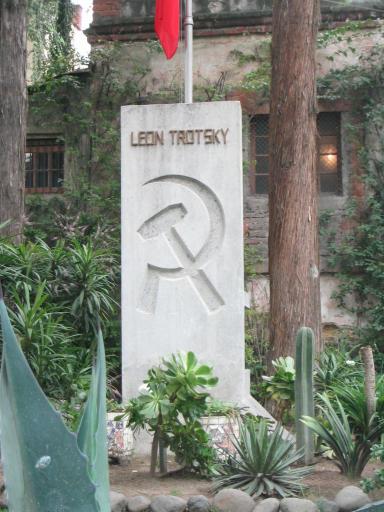
Not incidentally, the house where Trotsky was assassinated is only a few blocks away. That, too, was a revelation — though of a different sort. Unlike La Casa Azul, it is grim and ugly. You can still see bullet holes in a bedrooom wall from an assassination attempt that failed. His hammer-and-sickle gravestone — looking grand, in contrast to the house — is an ironic reminder that everything he worked for is buried with him, swallowed by what he himself used to call “the dustbin of history.”
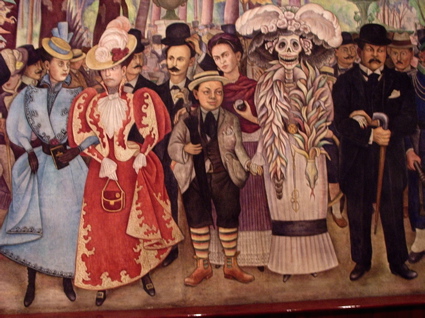
Postscript: Notice Frida Kahlo with her hand on Diego Rivera’s shoulder in this detail from Rivera’s 1947 fresco “Dream of a Sunday Afternoon in the Alameda,” on exhibit at the Museo Mural Diego Rivera. The museum is located at the west end of the Alameda in Mexico City. (Click the photo.)


When you visited Frida’s house, you were also about a mile away from Conlon Nancarrow’s wonderful house – not open to the public, unfortunately. He knew Frida and Diego, and his second wife was one of Diego’s models.
I’m a cultist too.
Sorry I missed it.
The PMA stop of the Kahlo show was a especially interesting one for Kahlophiles, as the PMA [Philadelphia Museum of Art] added several ex-voto paintings from their own collection which really showed Kahlo’s immense debt to traditional Mexican painting.
In the Kahlo painting “The Suicide of Dorothy Hale,” we see Dorothy Hale jumping to her suicide, first as a small figure jumping off her apartment building, surrounded by clouds echoing El Greco. We then see Hale’s body in a close up of her fall, and finally the broken and bloodied woman on the ground. A banner at the bottom of the painting tells the story in Spanish, and Kahlo has bloodied her signature and even the frame.
In the PMA’s ex-voto titled “Fall from a Balcony,” we see a Nanny and child falling through the floor of a balcony, which has given way under their weight. We also see them on the ground, having fallen and then having miraculously survived the fall. The banner at the bottom relates the story of the fall. It’s a brilliant juxtaposition of two unrelated works that cement the powerful influence of ex-voto upon Kahlo’s own work as no words can describe.
See the review at http://blogcritics.org/archives/2008/04/03/072958.php
And bienvenido to the cult!