

At Reuters, Peter Rudegeair writes: What’s a retailer to do with a widening gap between rich and poor customers? Starbucks is the latest chain to target America’s “hourglass economy.” By cutting 10% off its grocery-store coffee bags while keeping in place the price hikes it put in place in its cafés last year, Starbucks is simultaneously pushing both its discount and premium products. It’s a sensible strategy: low-wage occupations have dominated new jobs in the last few years, even as high-earners captured 121% of the income gains of the … [Read more...]
How dynamic pricing works
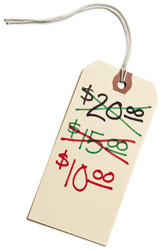
Let's begin with the basic analysis. It's Tuesday, and you have something on offer for Saturday night. You might be a hotel owner and you have vacancies for that night, your airline might have a scheduled flight from Tulsa to Kansas City with some seats still available, or you might be putting on a show that has not yet sold out. In each of these cases, you are certainly charging a current price well above marginal cost (the cost to you of putting a family in the otherwise empty hotel room, or getting a extra passenger on the flight, or … [Read more...]
Limiting the charitable deduction
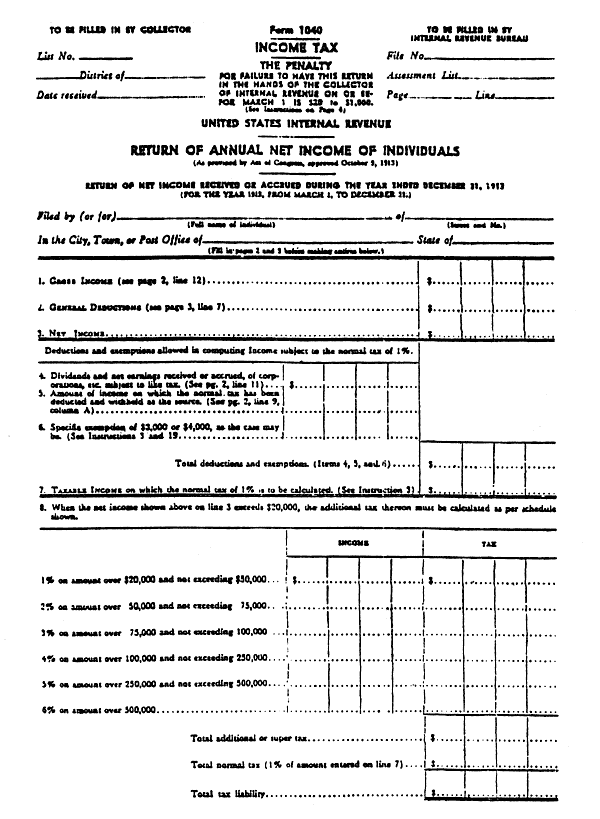
As my blog-neighbor Lee Rosenbaum reports, the proposed 2014 budget from the White House would cap the tax benefit for charitable donations at 28%. In the U.S., where donations are deducted from the income tax base, the actual rate at which your donation is subsidized is your marginal tax rate, i.e. the rate that applies to your last dollar of income earned. Marginal tax rates rise with income, with a top rate of 39.6%, and so a wealthy donor who gives $100 to the local museum gets an income tax reduction of $39.60. The budget proposal would … [Read more...]
Arts policy research is expensive

In an earlier post I talked about how firms with a large set of distinct items to sell - a cable television provider with many channels; a museum with many rooms - would find it most efficient to offer only a package deal to customers, with no a la carte offerings, even when customers complain that they really only want a very small sample of what is on offer. An example I did not give at the time was academic publishing. But publisher's strategies follow this same model. As an example, I will use Taylor & Francis, although I will note … [Read more...]
How quality differentials work
It is standard practice to offer to customers a range of quality levels. In clothing, electronics, and cars we see firms offer a range of products as a means of price discrimination: some customers are on a budget, or don't care so much about the luxury of the item, and are looking for something basic and low-price. Other customers really do care about distinctions of quality, and are willing to pay to get the best. It's not difficult then to see the logic in offering standard and premium goods. The rule of thumb is this: the quality … [Read more...]
Paywalls at Newspapers and Museums
Felix Salmon investigates how newspaper paywalls are evolving: In the early days of paywalls, some content was free, while other content you needed to pay for; the meter, in theory, replaced that system with one where the determination as to whether an article was free or not was a function of how many other articles the reader had read, rather than being a function of the content of the article itself. But this is a bit simplistic: [I]t’s a mistake — at least from a purely financial perspective — to treat all readers equally. Some readers … [Read more...]
How bundling works
LOVEtheatre of London will provide me with a special deal: I can get two tickets to Wicked, together with two "free" meals (drinks not included) to be chosen from a short list of participating restaurants. But if they want to attract me to Wicked, why not just lower the ticket price? Why give me the discount through a dinner for two? Delta airlines will save me money on a trip to Puerto Rico, but only if I stay at the Sheraton, and the trip is for three nights. If I buy gasoline from Shell, I can get a discount on a ski lift pass. But what do … [Read more...]
About those museum prices
My post staking a claim that $25 to visit the Metropolitan Museum of Art was not expensive generated some comments. There are two issues at play here, not entirely separable: first, that compared to other genres of art, high and low, $25 to see what is one of the world's greatest collections of art is not widely at odds with what one pays elsewhere, and in fact might even be somewhat less, and, second, regardless of the price compared to other genres, ought the Museum to charge a price as high as $25? The focus of my post was on the first … [Read more...]
Museums are not expensive
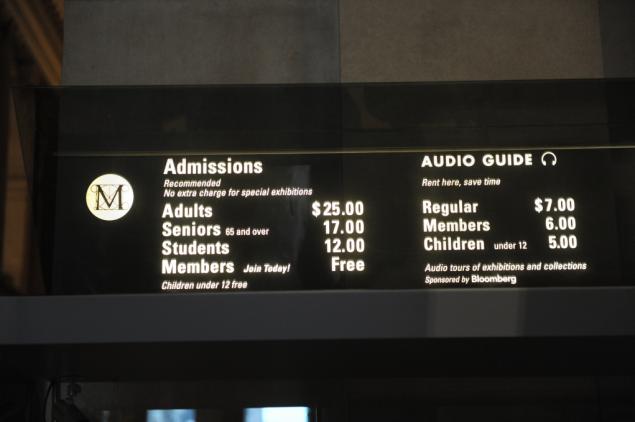
New York's Metropolitan Museum of Art is being sued for strongly suggesting that its "recommended" donation for entry is in fact required of visitors. Associated Press reports: 'The museum was designed to be open to everyone, without regard to their financial circumstances,' said Arnold Weiss, one of two attorneys who filed the lawsuit on behalf of three museum-goers, a New Yorker and two tourists from the Czech Republic. 'But instead, the museum has been converted into an elite tourist attraction.' In the New York Daily News, James Panero … [Read more...]
On Google, and why price discrimination is good for consumers
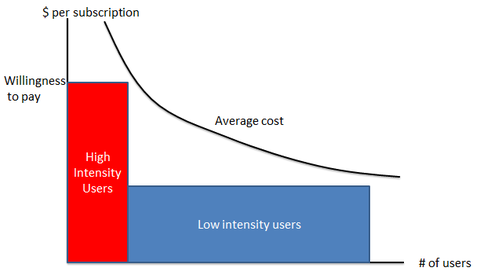
Paul Krugman writes about the decision by Google to shut down Google Reader. Whatever your thoughts on the good or evil nature of Google, he raises an important issue for thinking about price discrimination: there are cases where, if no price discrimination is possible, such that the seller can only charge one price to all, there does not exist a price that can possibly allow the firm to cover its costs. And this is true even if the total value consumers place on the good (as measured by their reservation prices - their willingness to pay for … [Read more...]