
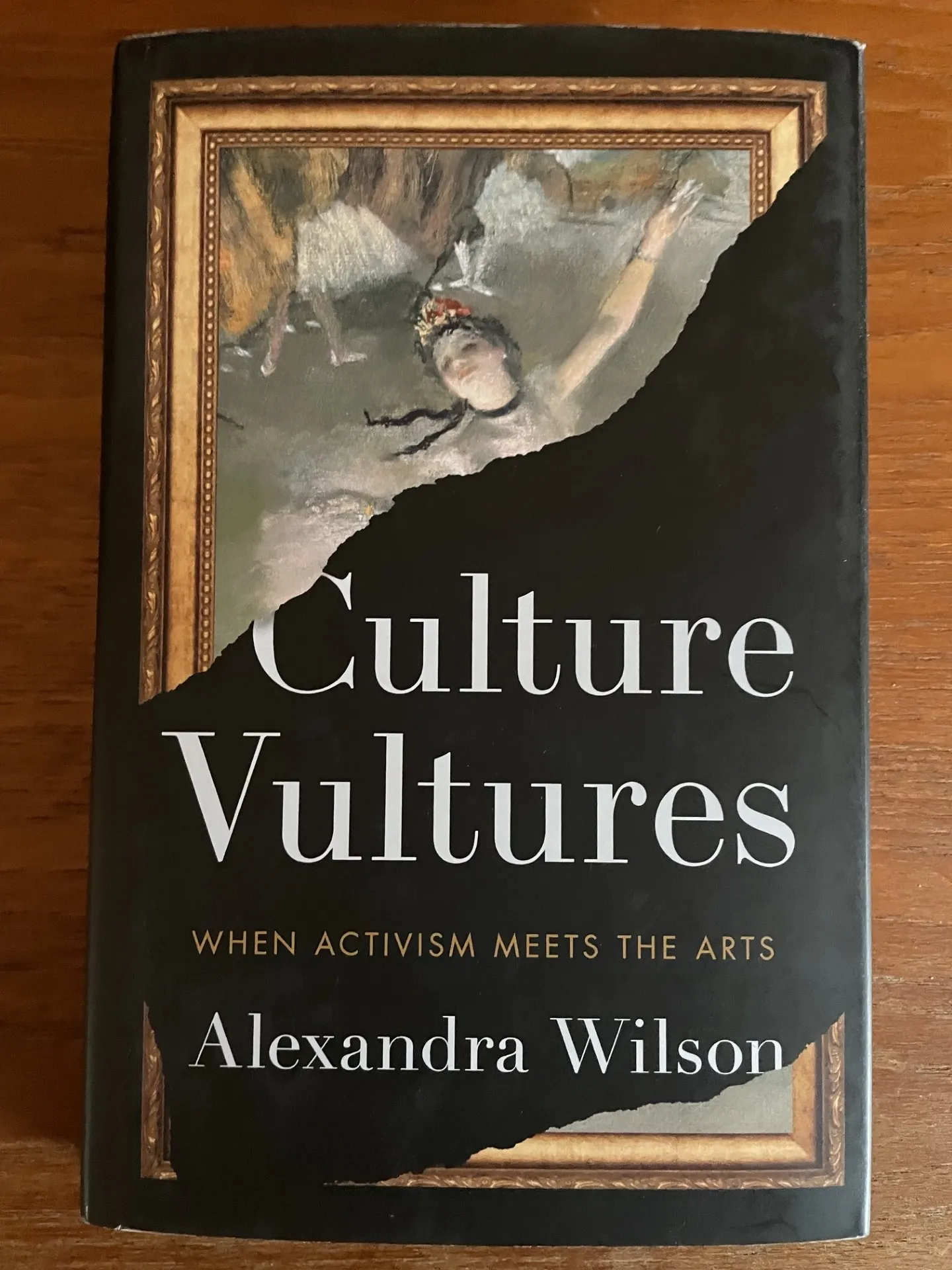
Alexandra Wilson thinks something has gone wrong in the art world. While there have been great works of art dealing with political subject matter since ancient times, and moving works that involve political advocacy and moral exhortation – “That Man to Man the warld o’er / Shall brithers be for a’ that” – we now have a situation where the arts have become “hyper-politicized”:
Most visibly, artistic spaces have become political battlegrounds, with theatres, concert halls and galleries now the go-to forum for protests about everything from distant war to climate change. What is going on?
Underpinning a now widespread insistence that the arts must constantly attend to politics is the notion that ‘everything is political’. This is an idea with its roots in academic theory, which has entered the mainstream conversation over the last decade. It is voiced not only by outspoken people with a drum to bang on social media or by journalists touting for clicks but also, in some cases, by the very people who run our arts institutions, as the arts find themselves at a strange intersection between managerial bureaucracy and progressive activism. There is no coordinated campaign, yet it is a way of thinking that has taken grip extremely widely in a short space of time.
As an arts consumer (and even occasionally as a performer) I have been sometimes frustrated by the very thing Wilson describes here. Whilst I was reading her book I saw a review of a “reimagined” (a word that immediately sets me on edge) production of Wagner’s The Flying Dutchman in Berlin, set during the post-Holocaust creation of the state of Israel, and it looks very, very bad on every level, serving neither the opera as a work of art in itself nor providing serious political and historical insight.
But can this frustration with ill-conceived productions and exhibitions sustain a book? What can I learn about how this happened: has it actually been “a short space of time” or something long in development, is it always for the bad, is this just a phase?
Although Wilson talks about the “hyper-politicization” of the arts as a new trend, with the words “often”, “frequently”, and “increasingly” used as if this were all obvious, was there not an awful lot of politicization of the arts in the 1980s? It was a widely debated issue in the 1930s, with journals like Scrutiny agonizing over whether they ought to adopt an explicit political position (A few years ago I wrote an essay on that time, here). In the US in the 1930s the Federal Theater Project was nothing if not political. In one of his last essays, from 1948, Orwell warned that “to yield subjectively, not merely to a party machine, but even to a group ideology, is to destroy yourself as a writer.” Is what we see now just the most recent wave of a centuries-old question?
She doesn’t lack examples: museum curators who cannot exhibit older works of art without explaining, as if their viewers were all little children, the monstrous ideas, by contemporary standards, hidden (or sometimes quite obvious) in the objects; film and television adaptations of literary classics that play fast and loose with historical accuracy, and that try to incorporate the edgy into works from Jane Austen to Agatha Christie where it just doesn’t fit (unlike in what is for her the golden age of prestige costume drama, the 1980s and 1990s, and the David Suchet Poirot’s); efforts to change, or eliminate entirely, the “canon”, in favor of greater diversity in the authors of works; and the search for “relevance” (a word which affects me the same way “reimagined” does) in the quest for finding new audiences (“Who are the Arts ‘For’ Today?” is the strongest chapter in the book). Wilson is willing to admit that some change can be for the good, in terms of making great art more accessible to modern audiences. But in each case she identifies the crux of the problem as arts administrators and artistic directors going too far.
As much I share some of her gripes about the ill-conceived political missions of some arts organizations and their exhibitions, and have said so occasionally on this blog, I found Culture Vultures1 something of a disappointment. There are different ways a writer could approach her concerns. One would be a deep dive into the theory and analysis of how the institutions of the art world have changed over the past few decades, what really drove these changes. An alternative would be a real effort at getting inside the organizations themselves: interviewing decision-makers, trying to get a sense of their goals and their constraints. But Wilson does neither. Instead, the scholarly research is thin, and there is very little on-the-ground reporting. Her sources are to a large part the very “outspoken people with a drum to bang on social media or by journalists touting for clicks” that she bemoans in her introduction. Consider this representative passage, on classical music (the genre with which she has the greatest depth of knowledge):
Some people in the arts would deny the fact that anyone is trying to get rid of the canon. [Kate] Molleson writes [in Sound Within Sound, 2023]: ‘Here is a myth I keep coming up against. It is an odd and spurious fear that The Great Works – the Passions of Bach, the symphonies of Beethoven and Brahms, the earth-shaking ballets of Igor Stravinsky – are somehow threatened if classical music becomes more inclusive. Nobody is mooting that we should ditch Mozart or Mahler. Nobody is suggesting that their music doesn’t speak for our times and for all time.’ But, in fact, one regularly stumbles across blog posts, opinion pieces and comments on social media that do endorse a dismantling of the canon, together with recommendations to outlaw previously greatly revered works that are now deemed to offend contemporary sensibilities.
But you can find anything and everything somewhere on social media and blog posts; it says nothing about actual influence. Casual observation of the programming of orchestras in my region suggests that the bloggers, whoever they are, wanting to dismantle the canon are not having much success. Many of her footnotes cite newspaper and magazine opinion pieces, blog posts, even tweets, but I can see those for myself if I want. Wilson, oddly for someone so keen to preserve high art, is far too online.2 Her explication of the “postmodern” (a word that carries a lot on its back in this book) theory she claims played a big role in what has happened to arts presenters in recent times is extremely thin – it is presented as a combination of garden variety wokeness and radical skepticism of scientific knowledge,3 with all of this gathered second-hand and without perspective. A lengthy passage on what is going on in the arts in universities is mostly based on anecdote, and, if we are trading in anecdotes, does not reflect what I see on my own campus.4
I am sympathetic to Wilson’s plea that there is nothing wrong with presenting classical music, opera, theatre and painting as they are, without trying to use the works to promote particular political views, or to achieve social goals beyond the enjoyment of the arts. But too often I felt I was reading a lengthy opinion article in The Times rather than something that aimed at depth, something that would tell the reader something they didn’t already know.
Cross-posted at https://michaelrushton.substack.com/
It’s a small point but her title is ill-chosen; “culture vultures”, at least in the United States, has a specific connotation that is not what her book is about.
I was recently notified of an article in a peer-reviewed (!) journal that tries to form a deep critique of my ideology based upon a reading of a single short blog post on which I spent an hour at most. I really hope this is not a trend.
On which, I would note that it was not the “postmodern” left who gave the lethally idiotic Robert F. Kennedy, Jr. a position of decision-making authority. In general, right-wing politicians who seek to use state-owned arts organizations or universities to promote their own political preferences get a pass in the book.
“Arts administrators” come in for a rough ride from Wilson, but my experience in two decades of teaching students wanting to go into that profession was of the vast majority being simply young people who enjoyed the arts as art and wanting to be a part of helping exhibitions and performances continue to thrive.
Leave a Reply