
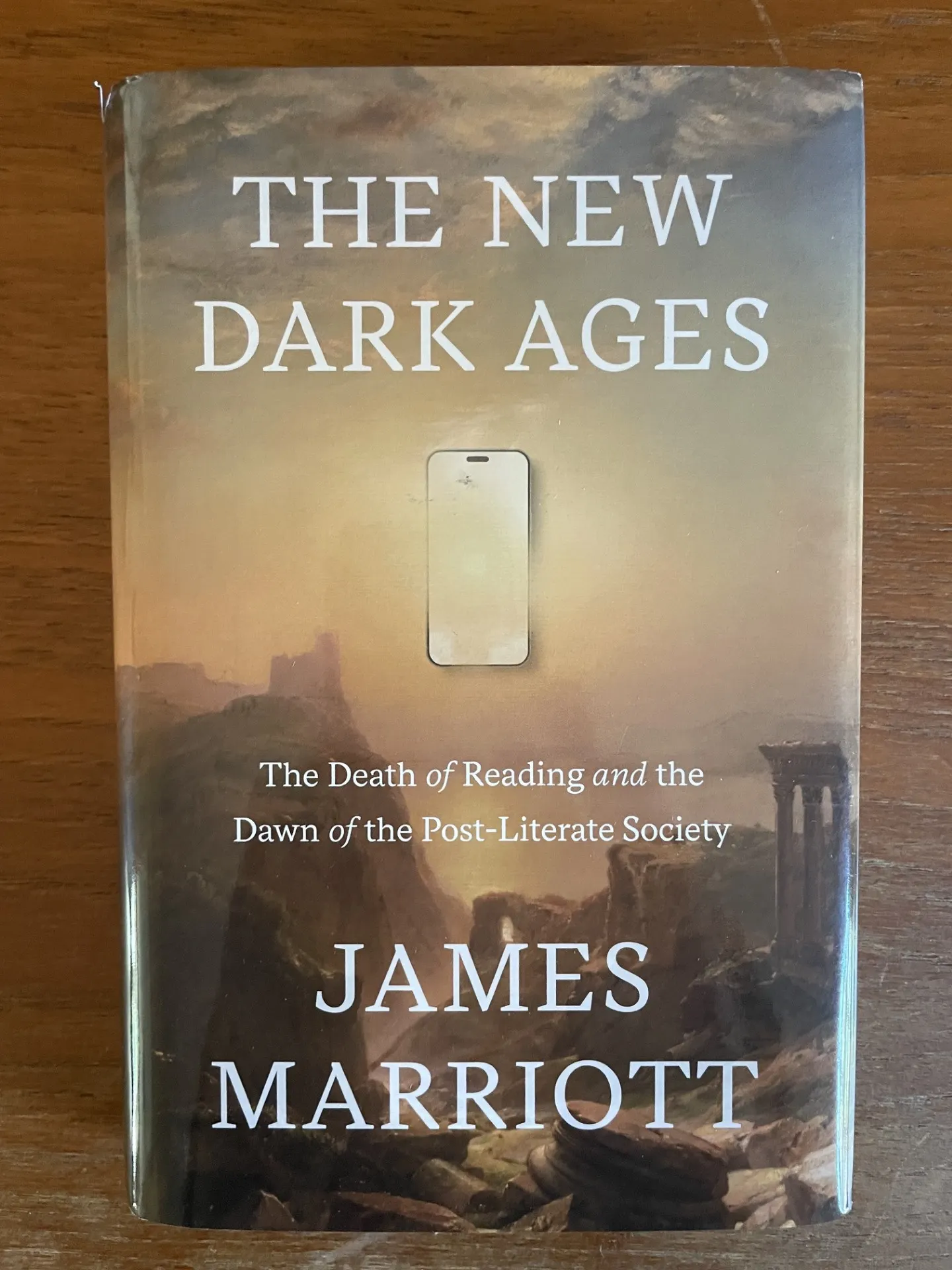
A year ago James Marriott had a Substack post on “the dawn of the post-literate society” that as I write has over 21,000 likes and 6,000 restacks: clearly something that struck a chord. And now we have a book length treatment of the issue, though a short book – put your phone away and you can read it in an afternoon.
As someone who recently retired from over forty years of university teaching, my own sense is that there has been a genuine decline in the ability of college students (and I only ever taught at non-elite public universities) to read relatively sophisticated, but non-specialist, essays and books – i.e. undergraduate-appropriate – and Marriott introduces the book with similar observations from his friends who teach in England. So I had to approach The New Dark Ages avoiding the trap of simply seeing the evidence that confirms my casual empiricism, and then clicking on the heart icon.
“New dark ages”, or, per the subtitle, “death of reading” and “post-literate society”: these are strong words. Is it all that bad? Even a documented recent decline in various degrees of literacy does not necessarily mean a trend headed towards rock bottom. Or does it?
Marriott, I think wisely, does not try to look too far into the future; there are enough worries in the here and now (I’m grateful for the break from vague speculation regarding the long-term impact of artificial intelligence, which is deeply in the range of diminishing returns right now). The book begins with the importance of the invention of reading and writing to the development of civilizations, then to the impact of the printing press, the ability to disseminate writings widely, and increasing literacy, all of which led to the great centuries, call them 1750 – 1950, of a culture of reading. It shaped science and the humanities, created the novel, and served as fuel for democratic political reform. Reading shaped how we think – with the written word we can process complex ideas that are beyond the capabilities of even the finest oral cultures. And reading encourages skepticism and critique, leading to the diminishment of superstition and unfounded claims. Even oral culture changes as we become used to more sophisticated writing (I’m currently reading Cheryl Misak’s wonderful biography of Frank Ramsey, and the culture of philosophical discussion at Cambridge in the 1920s (oh for time travel!) was only possible from their deep, sentence-by-sentence, parsing of each other’s written works). But it was not just all at this elevated level – reading was popular for middle-class folk, it was how to pass the time commuting or after work, and had been made very affordable (Marriott does not mention the establishment of Penguin Books in the 1930s, though I think this was also an important moment).
What went wrong?
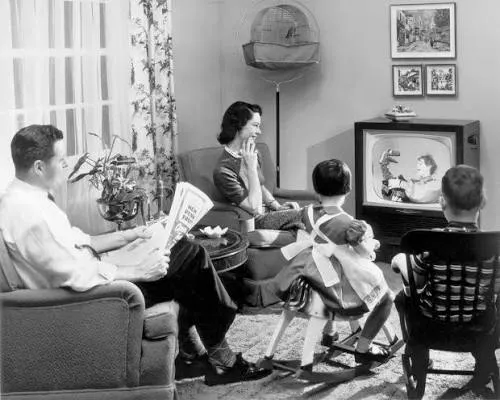
The beginning of the end was television. Smartphones are the obvious suspect in the decline of reading today, but Marriott says it was the introduction into our homes of a screen a family could passively watch that was the big change, with the smartphone in this century serving as the super-accelerant to something that had already begun. Reading takes more effort than watching a television screen or scrolling on a phone, it requires concentration, being free of distraction. Thus began the decline.
Now on average we read less, and, as noted above, on average people find it more of a challenge – college syllabi are shortened in the number of readings as well as their length and complexity, and ordinary tastes in literature decline. The New York Times Book Review has never been what you could call highbrow, but it now offers sections to cheerfully “Let us help you find your next book: romance” (they can also help you with fantasy). And this is for that segment of the population with at least the reading interest to browse the Times.
Marriott turns his focus at the end of the book to what the decline in literary culture has done to our politics. Contemporary politicians are not serious readers. They have adapted, self-selected, into our screen culture, focusing on what image they project in a fifteen-second video clip for CNN or Fox News, and spending more time on their social media posts than on speeches. Although Trump is the ne plus ultra of the end of literacy in politics, Marriott reminds us that this decline is across all political parties and persuasions. With a non-reading public, our politics takes place through sound-bites and slogans. We get an increase in the production of, and the belief in, nonsense claims – “vaccines cause autism”, “Our military needs more testosterone”, “the 2020 presidential election was stolen”, “tariffs will make us rich” – because bullshit claims are easy to make but require at least some analysis, reference to studies, and logic, to refute; the great long decline in superstitions that began two-and-a-half centuries ago begins to reverse. Talk is cheap for the demagogue but costly for the critic. In a shift that began in the 1960s, but well-entrenched now, voters tend to choose a political affiliation first, based on an intuition of who is their tribe, and then adopt the complete slate of official positions of that tribe, rather than independently thinking about issues and then voting for the party that, all things considered, offers a package on salient issues closest to their own. This reflects the decline in serious reading on current affairs, and also feeds it, in a vicious loop – politicians now just shout slogans at their followers, and toss insults at the opposition, as the crowd cheers and boos.
Marriott is a genial writer and avoids coming off as a scold (probably better than I do). He is careful to say that being well-read does not make for a more ethical individual, nor does being a non-reader make one less kind or generous. And this applies to whole societies as well: the twentieth century destroyed any hope that high culture protects a society from descent into barbarism and murder.
I’ll touch on two aspects of the decline of reading that Marriott does not pursue at length (this is not a criticism – I think it was a good choice to keep The New Dark Ages at 167 short pages of text).
One is that the decline in literacy in the young is not evenly distributed. And those who come out of high school simply unable to manage any complexity in text are going to have a rough go of it. Detailed documents from corporations outlining the terms of service, or from government agencies in the attempt to apply for benefits to which they are legally entitled, become a terrible struggle, typically ending in simply giving up. Jobs involving ordinary office or machine work that require the ability to quickly and accurately understand documents are out of reach. A world in which every fifteen-year old is a good reader will be a more equal world, a fairer one.
A second issue is at the other end of the scale. Any genre of art, if it is to flourish, needs a critical mass of audience who are active consumers of it, who through experience have developed the taste to be able to tell the valuable from the meretricious. Lose that critical mass, and the art goes into decline, whether it be film, music, theatre, dance, painting, or writing. We can do all we can to try to nurture and support talented young artists, but if the audience isn’t there, it will not bear fruit. An end to the culture of reading will cause a decline in the high art of literature as well.
There are people who could try to dismiss Marriott’s concerns with “well, there have always been culture pessimists telling us the sky is falling, haven’t there?”. Well, yes, there have been, but it doesn’t mean they were wrong, that something in our culture is not going terribly awry.
This is an important book and I recommend it.
Coda: Henry Oliver gives a thoughtful review of the book here, and interviews James Marriott here – these are both worth your time.
Cross-posted at https://michaelrushton.substack.com/
Leave a Reply