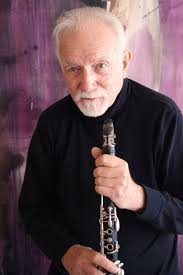
 James Moody told me that his Georgia-born grandmother said one morning while looking through the newspaper, “Folks is dyin’ what ain’t never died befo’.” The trend continues, as It always has and, if human suscsceptibility is a guide, always will. ” Recently, the parade of departures resumed when the jazz world lost two giants in their nineties, McCoy Tyner and William O. Smith. Smith (pictured left) a clarinetist, composer, teacher and formidable arranger, was 93.
Encouraged by the classical composer Darius Milhaud when he studied with Milhaud at Mills College, Smith formed an octet with Dave Brubeck in the early 1950s. In recent decades he was a professor of music at the University of Washington.
From late in their careers, here are Smith, Brubeck and the Montreal Festival Orchestra playing one of Brubeck’s most beloved compositions, “Blue Rondo ala Turk.”
For a thorough obituary of Bill Smith, see Paul de Barros in The Seattle Times.
McCoy Tyner attracted significant attention when he emerged from Philadelphia as the pianist in Art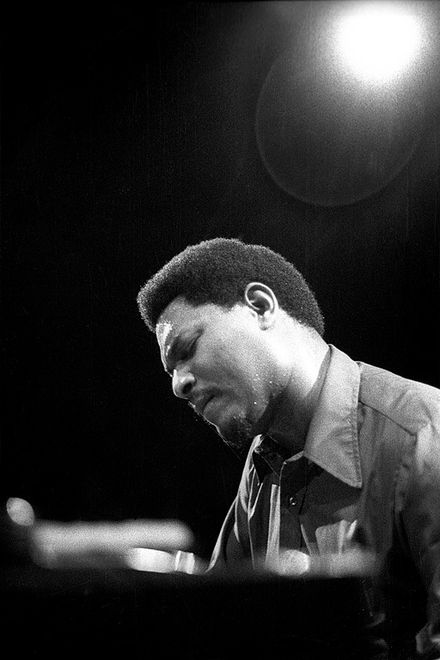 Farmer’s and Benny Golson’s Jazztet in 1959. He achieved widespread fame after he became a member of John Coltrane’s quartet the following year. ” His rich harmonies and mastery of demanding rhythms were at the core of what made Coltrane’s group one of the most successful in all of music during Tyner’s five years as a member.
Tyner died at 81 at his home in New Jersey. ” Here he is in concert on the British Broadcasting Corporation in 2002 with Bobby Hutcherson on vibes, Charnett Moffet on bass and Eric Harland playing drums. The composition is one of Tyner’s most famous, “Naima.”
McCoy Tyner, RIP.
Went to hear the McCoy Tyner Trio at the NYC Blue Note Club circa 1991. McCoy’s trio was the headliner but before they came on there was a quintet of young turks that came out smokin’. I thought “Uh-oh McCoy’s in trouble here. How could a trio outshine a red hot fivetet?” Turns out I needn’t have worried. McCoy along with Avery Sharpe on bass and Aaron Scott on drums played such an outstanding set that the members of the first act quintet peered around the corner of the stairsteps with mouths agape. As I write this, I am listening to “Walk Spirit, Talk Spirit” one of McCoy’s most scintillating compositions and one of my all time favorites. It’s as exciting today as when I first heard it many years ago. I’ll follow it up with “Ballad for Aisha” as I reminisce about that Blue Note show and all the great albums McCoy released over time. Rest in peace great master.
So, who was the quintet that preceded McCoy Tyner?
The late Roy Hargrove with Antonio Hart on alto. I don’t recall the other musicians, but it was circa Hargrove’s Diamond in the Rough and Public Eye albums.
I think you meant that Naima was one of Coltrane’s most famous compositions, not Tyner’s.
Correct. Thank you, Mr. Prout.
Nice presentation, Doug!
Both gentlemen had long lives, so that’s comforting. I like the quote by James Moody’s grandmother. But, if you believe in reincarnation and past lives, then we’ve all lived and died before.
That LP Bill Smith did of folk tunes with Jim Hall is a real gem. Thanks, Doug, for the appreciation.
Worked with Tyner Trio—Avery Sharpe and Aaron Scott in the early ‘90s at the jazz festival in Flint MI. I was the emcee and all three were gracious and wonderful to work with—and by the way—blew the crowd away with an incredible set!!! RIP to one of the true giants!!
Bill made some lovely contributions both on his own and with Brubeck. I’ve always loved the LP the two of them made together. RIP, Bill. And thank you.
Tyner heard the piano in its most percussive mode. Sometimes there was almost a bombastic approach until you realized, as you always did, that he felt those keys under his hands in a symphonic way and that he always returned to the piano’s melodic and harmonic modes whether it was a ballad or swinging.
Brubeck on the other hand used that percussive groove to play with rhythmic ideas gaining his swing (even as critics said he ‘lost’ time) to reach for his classical routes.
Nobody today plays like either one of them.