Milt Buckner: The Life and Music of a Unique Jazz Pianist and Organist (Woodward)
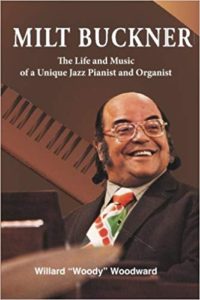 Willard “Woody†Woodward writes a straightforward account of the career of the keyboard artist who pioneered the Hammond B3 organ in jazz. Milt Buckner paved the way for later organ heroes including Jimmy Smith, Don Patterson and—more recently—Joey DeFrancesco. His legacy encompasses the parallel-chords or locked-hands technique that Buckner developed as a pianist and transferred to his organ playing. Woodward, a pianist and organist inspired by Buckner, is thorough as he traces Buckner’s development, including his breakthrough in the early 1940s with Lionel Hampton’s band. In addition to his solid story telling, Woodward discusses details of Buckner’s settings of the pullout stops that determine the B3’s variety of sounds. It’s fascinating stuff, not too technical for most readers. If you are unfamiliar with Buckner’s work (it’s possible), go here for a demonstration.
I had not seen that video of Milt Buckner. Always a joy to listen to and watch. How can that not put a smile on your face? Or this one that I ran across a few years back. He’s playing and singing “Shine on Harvest Moon” during the bridge of his first chorus of “On the Sunny Side of the Street” with Illinois Jacquet and Jo Jones. This is followed by a bass pedal solo on the next bridge. Besides being so damn good I am not sure I’ve ever seen a musician seem to have so much fun performing.
Thanks for the YouTube video. I wasn’t familiar with his work. There might be something wrong with the volume…could barely hear it, even turned all the way up. Good book recommendation.
Another source of significant support for Milt Buckner was drummer Sam Woodyard, later a Duke Ellington stalwart.
Woodyard told me that he started with Milt Buckner. He and I met when the Ellingtonians had come that week to San Francisco for a gig at Basin Street West. I spent my Christmas gift money over several nights at that club that week. Billy Strayhorn had just passed. They were recording “And His Mother Called Him Bill.” Duke announced, “Now we’ll play something by Billy Strayhorn.” A Trump-like character in the front row, with a bimbo on each arm, blurted: “He’s dead. Duke!” Duke zapped the guy with a laser-like glare, threw down his arm, and the band roared into “Take The ‘A’ Train.” (I think that was not the Strayhorn chart he had intended for that set).
Other recordings of the 1970s are examples of Milt Buckner’s seamless integration of the Hammond organ with Lionel Hampton “small big bands:†Salle Pleyel (1971, 10 piece band) and Lionel Hampton and His Jazz Giants 77 (1977, 8 piece band). Milt’s playing always showed a high level of taste and swing.