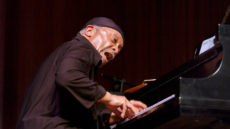
 Cecil Taylor, a pianist who fashioned his music from myriad styles and sources, died yesterday in New York. He was 89. From his earliest recordings in the mid-1950s with bassist Buell Nieidlinger, drummer Dennis Charles and soprano saxophonist Steve Lacy, Taylor pursued daring and swam upstream against jazz orthodoxy. This is how critic Ben Ratliff put it in an obituary in today’s New York Times.
At the center of his art was that dazzling physicality and the percussiveness of his playing — his deep, serene, Ellingtonian chords and hummingbird attacks above middle C — which held true well into his 80s.
Affirming that characterization and Taylor’s mastery of piano technique, here he is in a free improvisation in 1981, when he was 48. Close listening discloses those deep chords and a few bebop allusions that may have been whimsical; with Taylor, it was often hard to be sure.
To read all of Ben Ratliff’s comprehensive Taylor obituary—which is full of insights—go here.
Cecil Taylor, RIP.
I was very fortunate that my visit to New York from Sweden in 2004 coincided with the week of celebration of Cecil Taylor´s 75th Anniversary at the club Iridium. Of course, it was a very special occasion to see him as the leader of a big band. The house was full. So was the stage, though it was not big enough to store a big band. The trumpet players were seated dangerously near the trailing edge of the five-foot-high stage. Taylor stomped off his cohort roaring in full blast. Not all of the audience appreciated Taylor´s thundering, chaotic, key runs and the powerful high notes of the brass and the wild wailing saxes. A big chunk of the crowd seemed not to have the patience and strength and was scared of all the anarchical sound effects. They were leaving the premises long before Taylor´s grand finale. The evening´s only featured number was a composition of his lasting one hour and fifteen minutes. To me, the conception of big band music was not the same. Taylor showed me the possibilities in wide musical views. Mr. Cecil Taylor, thank you so much.
Doug – Thanks for this video, which I finally took the time to watch/listen to this morning. I haven’t ever felt engaged with CT’s music before, but this piece really grabs me. An aesthetic revelation: fascinating, exciting, cryptic, diffident, idiosyncratic, with moments of true beauty. The search for fitting description is itself an adventure. Didn’t catch any bebop allusions, but feel I have finally begun to appreciate why CT deserves acclaim.
At the very beginning of the Taylor video, you may hear a hint of “Salt Peanuts,” and hear it in another guise at 4:44. Taylor being Taylor, in the latter case he takes the octave leap from an altered E-flat chord up to an altered (of course) E major chord. If you hear the harmonies differently, I understand. For those unfamiliar with “Salt Peanuts” (it is possible), here is its most famous recording, by Dizzy Gillespie and His All-Stars on May 11, 1945 in New York City for Guild Records. The lineup was Gillespie, trumpet; Charlie Parker, alto saxophone; Al Haig, piano; Curley Russell, bass; and Sid Catlett, drums.