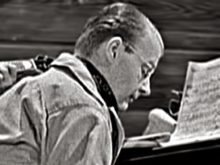
Chummy MacGregor was born on this day in 1903 and died on March 9, 1973. It’s the rare listener to modern jazz who doesn’t know of the MacGregor composition “Moon Dreams,†which he wrote when he was a pianist and arranger with his longtime boss Glenn Miller. “Moon Dreams†is one of the most familiar pieces from Miles Davis’s Birth Of The Cool sessions of 1957. Gil Evans’ arrangement of MacGregor’s song had much to do with Evans’ early recognition as a central figure in the music. In case you can’t bring the performance to mind, here it is:
During World War Two, Major Glenn Miller recorded “Moon Dreams†with his Army Air Force Orchestra. The vocal was by Johnny Desmond And The Crew Chiefs.
In the early 1940s Martha Tilton’s version of â€Moon Dreams†was one of the first releases from Capitol Records, a company founded by Johnny Mercer, who wrote the song with MacGregor. These days, few listeners—indeed, few muscians—are aware that “Moon Dreams†began not with Miles Davis and Gil Evans, but with a 1940s pop hit.
And he was played by Harry Morgan in the Miller biopic!
As Johnny Carson used to say “I did NOT know that”. Now I miss Carson.
Is it a coincidence that I have been playing “Birth of the Cool” a lot lately? Doug is not only a great writer/reviewer, he’s a mind reader.
Thanks for remembering Chummy McGregor. Well, he was not exactly swingin’, but he could do the boogie woogie quite credibly
Glenn Miller’s Army Air Force Band was one of the first (jazz) big bands featuring a french horn; this would also establish a connection to Miles Davis, Gerry Mulligan, Gil Evans and their kind of cool orchestral jazz sounds.
One of the very first versions of Dizzy Gillespie’s great hit “A Night In Tunisia” was broadcast by Mel Powell’s Uptown Hall Gang, featuring Addison Collins on french horn.
Bernie Previn (tp) Nat Peck (tb) Addison Collins (fhr) Peanuts Hucko (cl, as) Mannie Thaler (bar, b-cl, as) Mel Powell (p) Trigger Alpert (b) Ray McKinley (d) – Co-Partners Hall, Bedford, England, December 3, 1944. It’s unfortunately not on YouTube.
Here’s a link to “Moon Dreams” with Martha Tilton:
Gil Evans first arranged “Moon Dreams” for the Claude Thornhill band as part of a medley with “Easy Living” and “Everything Happens To Me”, but they never recorded it. That arrangement, which was clearly the basis for the nonet arrangement, has now been recorded by both Ryan Truesdell’s Gil Evans Project and the Dutch Jazz Orchestra. You can hear the latter recording at this link.
Thanks for all you do. Just to set the record straight, “Moon Dreams,” the Miles’version, was recorded in 1950, not 1957. Keep swinging !
Correct: March 13, 1950, according to the Jepsen discography.
I remember very well an assignment to compile a Johnny Mercer Songbook back in my Warner Bros. Publication days. I insisted that we include the sheet music to “Moon Dreams,” and was surprised that no one could locate a copy. Eventually a manuscript of a piano/vocal arrangement was sent to me, and it had slightly different lyrics than what was recorded. Of course finding the original score and parts to Gil Evans’ treatment for Miles Davis was another wonderful event.
…from which the performing public profits in form of the Ejazzlines publication of said score & parts.
To elaborate on that, normally the arranger does not get an additional dime; he has arranged something he does not own, and he was paid (or not paid as in the case of the Nonet). Jazz Lines has an agreement with the Evans estate, and Anita and Gil’s sons get monies from sales of all Evans’ publications, whether he composed the pieces or not. Rob wants to do right by the writers, one of the reasons I am proud to work with them.
Excellent post re: “Moondreams” and MacGregor. March 28th is also Paul Whiteman’s birthday. He did a lot for jazz, especially in the Bix/Bing/Bill Challis era of his orchestra.
A lovely song indeed, but it depends how you define the word “hit”. Hits are, and were, the runaway best sellers of all records currently produced. I don’t believe that any version of Moon Dreams ever became a pop hit, or that it appeared on any hit charts of the day. To my mind it became one of those many good pop songs that, as far as the general public was concerned, vanished into obscurity. Today, it is known and remembered only by jazz enthusiasts.
I left a link to another Gil Evans arrangement on Facebook. It was a tune written by John Benson Brooks called “The Happy Stranger.” Gil wrote the arrangement in 1947 and the Thornhill instrumental version was released in 1950. Very interesting use of passing lines and superimposed harmonies. You can find it on YouTube>.