Continuing to roam through Jeff Sultanof’s new book on big band jazz I am appreciating, almost as if for the first time, pieces of music that I’ve listened to for years. For instance, Sultanof’s narrative road map to Claude 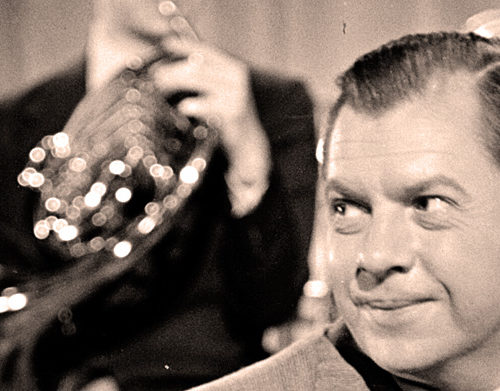 Thornill’s “Robbins’ Nest†emphasizes the uncanny empathy of the band members and the genius (no other word for it) of arranger Gil Evans. (Thornhill is pictured right). The version Sultanof chose is a 1947 radio transcription available on YouTube. After a setup paragraph describing the instrumentation, the orchestration and a few solo moments, he writes this:
What happens next is one of the most striking instances of melodic paraphrasing during the late big band era. The entire ensemble plays a harmonized improvisational line that sounds like one big instrument, perfectly balanced and relaxed. Again note the dynamic range from very soft to very loud (2:05).
Here is the entire recording.
Following the “Robbins’ Nest†analysis in his book, Sultanof takes on ” the Evans arrangement for Thornhill of Charlie Parker’s “Yardbird Suite.†He includes observations on solos by Red Rodney, Lee Konitz and Barry Galbraith. The book really is—as billed—a listener’s companion.
I agree that Jeff’s book is a gem.
The Thornhill band always relied on dynamics. I once spoke to a former member of his early band, and he mentioned that the band was never properly recorded. Whenever they hit a crescendo, the engineers would decrease the sound level, and when they played a diminuendo, they would push up the sound level, thus making the charts sound flat and bland on the recordings. When they would play the charts on a gig, people would be excited and tell them that they should record the chart. Often it was a chart that had already been recorded, and spoiled by the recording engineers.
Yes, a hearty thank you to Jeff for this wonderful book. I find it very demanding of the reader/listener’s time, and that I need to experience it in “chunks” of time, do something else for a while, and then return to it.
A sad footnote — in the first few chapters, I’ve run into several links that have fallen victim to copyright issues. The irony is that if the music were still there, it could cause listeners to chase it down and buy it! I often do that with stuff that is referenced here, on the Mosaic Jazz Gazette, and on other jazz blogs.
Jim,
Absolutely this book was meant to be taken in chunks. It was originally written for the reader who had little background in listening to big band music, and listening to a lot of tracks at one time is overwhelming anyway. There are so many different styles and sounds. The whole point of the book is active listening: I point out what to listen for so that the reader becomes an experienced listener.
I am well aware that links may no longer be active. I had to think long and hard about the use of YouTube for any number of reasons. The sad fact is that the inclusion of a CD set with the book is not workable—labels charge a lot for licensing tracks and sometimes will not license at all if you want tracks from different labels. And the set itself would be cost-prohibitive. I wanted to create a volume that would have a lot of bands so that the experience of reading it would take weeks, months and years; if I am not mistaken, there are over 300 different recordings cited. I wanted the reader to get a lot for his/her money.
I will periodically go over the tracks and substitute ones that work; in fact, I am currently in the middle of doing that. These will be forwarded to the publisher, who has promised to regularly update them in future printings. For those who have already purchased the book, if you send me an e-mail (address found at the end of the book), I will happily put you on a list for future updates. If you are on Facebook, they will be posted on the group page.
Thank you for your kind words.
Jeff
The wide dynamic range was particularly problematic on live broadcasts. The other problem with recording these arrangements was the problem of needle tracking. Believe it or not, some purchasers still had acoustic windup machines, and those heavy pickups would reduce the loud grooves to white dust. Come to think of it, the ‘modern’ record players of that time had heavy pickups too.
This aspect of Thornhill’s band could only be experienced live. I am also reminded of the Miller bands, which also featured wide dynamic ranges. In England, the BBC complained that some musical passages played by the AEF band were so quiet that listeners thought the station had gone off the air temporarily. There were other bands that had similar problems, and if they happened to record for a label that used poor shellac……
It is one of my pleasures to indicate the proper dynamics on the Thornhill and Evans music I’ve edited and Jazz Lines has published. If anyone records these things now, wide dynamic ranges are not an issue.
Thanks for this entry. Whenever I hear or even contemplate music of this time and style, I am reminded of something Paul Desmond said in a Down Beat interview published in about August of 1965. He was discussing the then-current social scene where normal conversations were all but impossible due to the volume of the ubiquitous rock music. Referring to the 1940s, he said something like, “We didn’t realize it then, but kids were dancing to the twilight years of the greatest popular music that ever had been played.” So true.
Frank,
Popular music reached a number of high points during those years. While I always remind students of the many terrible songs that were written and performed during that era (every era has had its share of bad pop songs that were popular), the fact that we had such incredible writers as Rodgers and Hart, the Gershwins, Harry Warren, Jimmy Van Heusen, James Monaco and many more who could create harmonically sophisticated works of art is miraculous, but logical in retrospect. Today most performers write their own songs, which can be good or bad depending on who we are talking about.
There are still new wonderful songs being written and performed, but the modern listener is interested in something else, obviously. The nice thing is that there will always be room for new arrangements of the old ones and I, for one, love writing them.
Jeff
Jeff,
Thanks for the reply. Almost as a rejoinder to me, yesterday I had to stop and think for a few seconds at an Olive Garden Restaurant, as I thought I heard “Israel” coming from the sound system. And it was, the original—there was Miles, then the ensemble, then Lee Konitz. I don’t know how it got there, but this music will live.
I am continually surprised by what I hear at restaurants and malls. Some weeks ago, I was walking in a mall and heard a Robert Farnon composition from the 1950s. The trailer to a new movie entitled “Isle of Dogs” has the Sauter-Finegan recording of “Sleigh Ride.” I wonder who is choosing this music.
What a beautiful arrangement. Those are fascinating comments on the difficulty of recording the band in the time it existed. It’s always interesting, and at times frustrating, to realize that the recordings sometimes don’t do justice to a band’s full impact and repertoire. I have Mr. Sultanof’s book on order.
(One of my first intros to jazz was a friend’s cassette recording of a variety of big bands from the swing era. He was a heavy metal drummer who worshipped people like Dave Tough. I will always be in his debt for tweaking my young ear to musical possibilities other than radio rock.)
“Robbins Nest” is a great tune, one that I have played many times. Written by Illinois Jacquet and Sir Charles Thompson, Jacquet & Milt Buckner’s arrangement of it is heard on Lionel Hampton’s Salle Pleyel CD, March 9, 1971, Buckner played a great version on his Play Chords and Rockin’ Again recordings, and he teams up with Jacquet and Alan Dawson on Jacquet’s Go Power CD with Milt on organ. All of these are great performances of this interesting tune.
Do you know who the clarinet soloist was — gorgeous tone and great improvisation!
The clarinetist is Danny Polo, identified by Jeff Sultanof on page 86 of the book.
Polo was to be in the Miles Davis Nonet (there is a clarinet part for “Moondreams” but he passed away and was replaced by Konitz.
Thanks for the information. Now that I have “discovered” Danny Polo,, thanks to you and Doug, I’ve been checking out his recordings from the ’30s on YouTube. The guy was fantastic; another clarinet hero.
Thanks for pointing out this brilliant arrangement. I heard it for the very first time when the Hindsight LP series of hitherto unissued radio transcriptions came out as The Uncollected, in 1977. It’s on the LP Claude Thornhill & His Orchestra, 1947, HSR-108.
I can’t tell you how often I have spun this particular LP. OK, there is one problem with this series: Some of their releases, if not most of them, run too fast, sometimes even a half-tone; and so—wrong keys throughout.
I don’t know how that could have happened, and I wish they had hired some expert like Mr Sultanof (*all* of those companies should have done that!), to clear those matters. A tuning fork can be of great help. When tracks are in the wrong pitches, it can make it very hard for musicians to figure out the correct keys.
When I talked to Glenn Miller’s bassist Trigger Alpert on the phone on March 1, 2004 (Major Miller’s centennial), I asked him if the key of this very modern arrangement by Jerry Gray was really A-major. Alas, since he played so many charts in his long career, he couldn’t remember. Anyway, it is actually “I Got Rhythm” changes in A-major, and Bobby Nichols managed to execute a very expressive, very hip solo in this key (B-natural for trumpet), er, five sharps = five enemies). It modulates to Bb for the clarinet solo, though. Peanuts, so to speak 🙂
Brew,
Most record labels never bother to check pitch when recordings are reissued, and in many cases, one doesn’t know what the original key is. In addition, the original equipment may not have been operating properly. Back in the 78 days, many labels in fact did not record 78 RPM; some may have been 76, others may have been close to 80. There are several books on how these recordings were made back then, and you no doubt can find them. When Columbia recorded “Robbins’ Nest,” they recorded the master on a 16″ lacquer disc, which was then transferred to a 78 master. In this case, we have the original score, which Jazzlines has published.
This is another reason I am passionate about getting this music out properly, cleaned up and easy to read – so that we know what the original keys to these arrangements are and can be pitched properly when reissued.
Thanks for this information. Yes, the eternal pitch-/ key-problem. One of my colleagues wanted a clean copy of “Cornet Chop Suey.” OK, I was quite certain that it’s *not* in the key of E; but to be sure, I did a web search and found this fantastic site with a thorough, if not scientific analysis of the entire Hot-Five-session which took place in Chicago on February 26, 1926.
It’s quite crazy that each of those six tracks has more or less its own speed/pitch, but when I’m spinning my old Parlophone LP, I have simply to speed it up one half-tone, and it sounds OK.
In most cases, proper keys can be derived based on the instruments that play the music. I wouldn’t have imagined that Cornet Chop Suey is in the key of E. In that case, sheet music of the Hot Five repertoire was published at the time – every trumpet player was studying Louis, and that tune entered the repertoire of trad groups, so it would have been easy to find out.
But I well remember transcribing “Come Fly With Me” that Sinatra recorded in 1957, and both my boss at Warners and I couldn’t believe that the key was B, particularly since he re-recorded it for Reprise and it was clearly in Bb. Years later, I was able to examine the original score, and it WAS in the key of B originally, with a note at the top stating that new parts were to be copied out in Bb, so both keys were right.
When we’re talking about doubtful keys, how about Fletcher Henderson’s arrangement of “Stardust?”
Hoagy Carmichael’s original from 1927 is in Db, some did it in C or Bb, not so Fletcher: His famous chart from 1936 is in D (probably also his own version from 1931?). — I studied the Benny Goodman papers when they were still available online. Fletcher did another one for BG 10 years later, but in Ab (BG recorded it for Columbia in 1951); Gordon Jenkins penned one for Benny in 1976 in Eb. Added to this comes the confusion about how to spell it correctly: “Star Dust” or “Stardust?” 🙂
Fletcher was known to be especially fond of keys with sharps; his musicians spoke about this (I don’t know if you’ve seen it, but there was a fabulous book by Walter Allen called “Hendersonia” which was the first book to comment on the keys of these arrangements; subsequently there was a listing of Henderson arrangements for B.G. in Jeffrey Magee’s book). As far as the title of Carmichael’s song, it was first copyrighted as “Star Dust” but ASCAP now lists the song as “Stardust.”
I’ll bet you weren’t thrilled to play in the key of D concert, but if that is the key that the singer is comfortable with…..you know the drill. By all means go to ejazzlines and look at the score to “Come Fly with Me.” The trumpet parts originally had no key signature and the requisite sharps were added. We engraved them in Db.
P.S. — We played Sinatra’s, er, Don Costa’s “New York, New York” once. It modulates from D to Eb in the out-chorus, if I recall it correctly. Man, we trumpeters were relieved at that key change.
Yep, make ’em flats, that’s been a very gracious deed, instead of what Billy May originally wrote. You can see in his original score how he thought/worked. In the 1980s was a little portrait on TV, just a very short film, showing Billy at home and in the studio and how he used to arrange. He always had a little e-keyboard with him and wrote practically directly into the score without sketching it in concert before.
That’s what I read about Smack: He gave the sharps to the brass, and the flats to the saxes. Duke preferred the flats.
As for Cornet Chop Suey, or West End Blues, or many other off-pitch releases: Can you imagine young trumpeters in the 1920’s trying to finger those partly quite abstract solos in E, F# or other, er, *exotic* keys?
It may be that Ornette Coleman’s style was rooted in the simple technical flaw of poorly adjusted phonographs. Could it be that he tried to play along with Yardbird’s Koko (Cherokee) in B-natural? We will never know.
Regarding how Billy May worked, and changing the subject slightly, Mel Torme, in his book My Singing Teachers (1994), related the following interesting story:
May was indeed that talented, although at around that time, he needed help. Walter Sheets is one name I know, besides that of Heinie Beau, who worked with May; Sheets was an arranger on the Bing Crosby radio show. Many of these arrangers took on a lot of work and then needed someone to help them finish. I remember the story of an arranger in New York who called a colleague, needing one of his arrangements completed. The writer went to the man’s apartment, saw two copyists there and was told what was needed. Then, Arranger A went into the shower to get ready to conduct a live TV show. As Arranger B wrote what was needed, the music was handed to the two copyists who were working on different parts at the same time.
I recently saw a set of parts for a Nat Cole arrangement in which there were two distinct hands on one part, indicating that the score was being written out and two or three copyists were working on multiple parts. That was how work got done in those days; everything seemed to be last-minute. Neal Hefti told me he stopped doing albums as an arranger because he was never given enough time, and didn’t want to rush.
Regarding “exotic” keys, I read a book about great standard songs and recall a line that described a tune in C# minor as one in “sharp infested waters”. Can’t remember the book title or author but loved that line!