Bob Dietsche, Tatum’s Town (Bobson Press)
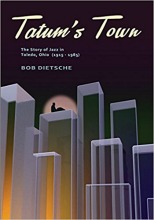 Most Art Tatum devotees know that Toledo, Ohio, was his hometown. It was where his genius became evident when he was a teenaged Fats Waller disciple. Many Tatum fans may not know that Toledo’s active jazz community in the 1920s and ‘30s included a number of musicians destined to become important jazz artists. Among them were trombonist Jimmy Harrison, guitarist Arv Garrison, Count Basie saxophonist Candy Johnson and, later, younger musicians like vocalist Jon Hendricks and pianist Stanley Cowell. Dietsche traces the development of jazz in his hometown and does for Toledo what he did for Portland, Oregon, in his 2005 book Jumptown. Tatum’s Town” is slightly marred by indexing confusion and lax copy editing, but it is packed with anecdotes and information about a jazz scene that thrived before, during and after the swing-to-bop transition and produced Tatum, one of the music’s pivotal figures.
I’m from Toledo, Ohio, and this just made my evening. Even lifelong Toledoans often don’t know the depth of the jazz heritage the town has. Jon Hendricks (who just turned 96) has been a great advocate for raising Tatum’s profile in the city.
Back in the day, Toledo attracted big names, including Duke Ellington, and Stan Kenton. Rusty’s Jazz Cafe was a mecca for decades (I regret missing Maynard Ferguson there in the late ’90s), as was Murphy’s downtown. Plenty of great musicians have fought the good fight to keep jazz going there, including at the University of Toledo and Bowling Green State University.
The decline of manufacturing hit Toledo hard, like much of the Great Lakes region, into the early ’90s. It’s come a long way since then, and I hope that has the city reinvents itself, the revitalization will extend to the arts. It’s a good little big city, (And go Mud Hens!)
Thanks for featuring this book. I grew up not far from Toledo and know something of its rich jazz history.
There was only one Art Tatum, but before television became an ubiquitous form of entertainment and expressways and “urban renewal” gutted inner-city neighborhoods, many other cities had thriving local jazz scenes.
This outstanding book chronicles the scene in Detroit in those days. A jazz lover who does not know this history will be astounded to learn of all the musicians who came from that city and its environs. To mention just three: brothers Hank, Thad, and Elvin Jones.
Another great musician to come from Toledo is bassist Tom Warrington.
I’ve known Tom, and heard him many times, since he arrived in Los Angeles in the early 80s. I can’t list all of Tom’s credits without referring to his bio, but I do know he was with Buddy Rich’s Big Band, played with Stan Getz and Freddie Hubbard, and has been a regular member of the Joe LaBarbera Quintet for many years. He has a few recordings under his own name on Jazz Compass Records, a label he co-founded with Joe, guitarist Larry Koonse and trumpeter Clay Jenkins.
Tom is also on several of the Fresh Sound CDs produced by Dick Bank, including recordings by Hod O’Brien, Lanny Morgan, Frank Collett and a wonderful album called Will You Still Be Mine – celebrating the music of Matt Dennis, which also features Jan Lundgren and Joe LaBarbera.
Listening to that collection of Matt Dennis songs again was a nice way to spend part of yesterday afternoon.