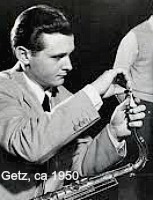
Thanks to Steven Cerra of Jazz Profiles for including, in his recent profile of Stan Getz, notes that I wrote for the box set reissue of Getz’s recordings for the Roost label. As Steve mentions in his introduction, Getz’s elegant work toward the end of his life tends to obscure what he achieved with his Roost sessions in the early 1950s. His recordings with groups featuring guitarist Jimmy Raney and pianist Horace Silver are from an important early period in his success. The collection has a cross-section of dates from that era that also features as sidemen Al Haig, Duke Jordan, Tiny Kahn, Johnny Smith and Bill Crow, among others.
To tease you into reading Steve’s post, here’s Getz in 1951 with Raney, pianist Haig, bassist Teddy Kotick and drummer Kahn playing Johnny Mandel’s “Hershey Bar.â€
For the Cerra post, go here.
To tease is the exact word here, as the video is unfortunately unavailable to me in Moscow.
Great thanks to Doug Ramsey and Steven Cerra for a very interesting feature on Getz.
Getz is a great example that the only thing universally reviled by musicians is another more successful musician. I never understood the anger about him (well about his playing, anyway). I understand that Getz the man was a piece of work. I met him the late 1970s. He was, indeed, a great bunch of guys. Anyone who has ever played the saxophone can only tip his cap to Getz the musician. The sound was unique, as compelling as Hodges’. The technique was flawless. The ability to fit into and dominate any musical situation was scary. And yes, he seemed to have an innate ability to capitalize on financial trends in music, which I suppose is one reason for the gnashing of teeth. That, and every time he capitalized on something, the finger waggers would also point to someone else they felt should be making the money instead of Getz. Fortunately, his music persists.
I became a member of Stan’s quintet just as he was moving from Roost to Norman Granz’s labels. But Roost was recording “Lullaby of Birdland” by all its artists, and Stan hadn’t done his yet. So we went into the Roost studio and they backdated the session date to a week or so before Stan’s contract with Granz began.
Bill Crow plays bass with Getz, Raney, Duke Jordan and Frank Isola on six tracks of the Getz Roost collection.
Bill,
Please share more on this session.
Thanks!
I don’t have much else to tell you about this session, Andreas. I was just getting comfortable with the quintet after working in clubs with them for a few weeks. Raney was an old friend, and a great help in getting me to play the changes Stan liked. I was very impressed with Duke Jordan’s elegant playing, and Frank Isola was a drummer I had played with at a lot of jam sessions when I was just learning the bass, so I really liked being in that band. Stan and Jimmy had a musical connection that was almost supernatural. When they played unison lines together it sounded like a single instrument, and Jimmy’s accompaniment was always sparse, tasteful and centered in the music. I thought Stan’s tone at the time was the purest saxophone sound I had ever heard. Unfortunately, the group fell apart when Jimmy, incensed about Stan’s drug use, left to join Jimmy Lyon at the Blue Angel. Stan replaced Frank with Kenny Clarke, who I also loved playing with, and we were a quartet for a while until Duke and Klook left to do something else. Then Stan started a new group with Bob Brookmeyer.
Thanks for sharing, Bill. Even a few words can communicate a lot.