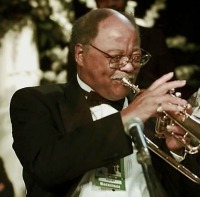
 Clark Terry and Bob Brookmeyer co-led one of the great small bands of the last half of the twentieth century. In the group Terry (1920-2015) concentrated on the flugelhorn, which he played—as he did the trumpet—with fluency, feeling, technique and humor that make him to this day a model and inspiration for brass players. Brookmeyer (1929-2011) had equal
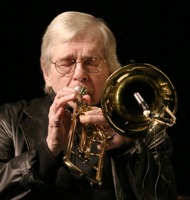 eminence as a valve trombonist, beginning as he rose to prominence in the early 1950s with Woody Herman, Stan Getz, Gerry Mulligan and Jimmy Giuffre, among others.
In a departure from its standard practice, in the 1960s the British Broadcasting Corporation flew Terry and Brookmeyer from New York to London for an appearance on the popular BBC program Jazz 625, hosted by Humphey Lyttleton. The rhythm section of eminent British jazzmen was Laurie Holloway, piano; Rick Laird, bass; and Allan Ganley, drums.
As for departures, let’s depart from the standard Rifftides practice of presenting relatively short video clips.” We’ll go long. Here is a half-hour segment of Terry and Brookmeyer.
We hope that launches you into the weekend in a pleasant frame of mind.
What a lovely video! This was one of my favorite gigs. We played with Bob and Clark at the Half Note in NYC several times a year for several years. Started out as Hank Jones’s gig on piano, but he was so busy recording in those days that he always sent in a sub. So we got to play with Herbie Hancock, Tommy Flanagan, Barry Harris, etc. Finally Roger Kellaway became the steady pianist, and was a constant delight. Bob and Clark were always brilliant, and my old pal Dave Bailey from the Mulligan quartet held it all together. We played well, laughed a lot, and enjoyed each others’ company so very much. The Canterino family made it all possible in their wonderful little jazz club. There were always many friends and colleagues at the bar. Golden memories.
That was f’ing great! Loved it. Share share….
Well, we encourage sharing, Ty. Forward the link to your friends and colleagues.
Thanks for posting this beautiful video. I first caught Bob and Clark at Boston’s Jazz Workshop and later in The Apple. These two cats were always swinging, and very funny. Seeing this video was invigorating and sad, knowing that they are no longer with us.
This beautiful video made me wanting more! Each tune was a delight, wish that they could have played for another hour. I loved the lovely tonality they got while playing the head on “Hum”- just gorgeous, just absolutely gorgeous. Especially enchanting was Mr. Brookmeyer’s half valve squeezes which he worked into the solo.
My first recollection of the two of them playing somewhat together back in the day when I was growing up was on a Gerry Mulligan At The Village Vanguard Concert Jazz Band vinyl album, on which CT took several solos as well as Bob Brookmeyer, my favorite being the piano blues “Let My People Be” where Brookmeyer leads off with a solo, again replete with half valve squeezes and some growling as well. CT let loose with a couple of his trademark plunger-work choruses and the band started riffing behind him, with a head arrangement that kept going for a couple of choruses. I know that Bill Crow was on bass for that recording and I am going to guess that Mel Lewis was on drums.
That led to another big band session under the leadership of Mr. Brookmeyer with the title of Gloomy Sunday and other Bright Moments. CT had several solos on that session as well. Sounds like Gary McFarland had a vibes solo or two on the album in addition. I know that he wrote at least one of the tunes that featured CT on flugel and BB with the title of “Why Are You Blue?” There was a tune with the title of “Ho Hum”—by Brookmeyer—which does not sound (to my ears) like his composition “Hum”.
Going to have to dig out the several Brookmeyer-Terry Quintet vinyl albums out of the basement and find a way to save them to my iTunes on the computer.
Thank you very, very much for posting this video and the memories it led to.
Hi Tony,
The vibes solo you referred to in your post was played by Eddie Costa. “Hum,” recorded by Clark and Bob for Bob Shad’s Mainstream label, came after “Ho Hum,” from the brilliant Gloomy Sunday album. Almost the same big band recorded another album shortly thereafter under Gary McFarland’s name, called The Jazz Version Of How To Succeed In Business Without Really Trying. Both albums appeared on the Verve label and were reissued as one CD years later, also by Verve. Probably available on Amazon.
As John Bolger mentioned on an earlier Rifftides blog post, Stan Getz-Bob Brookmeyer Recorded Fall 1961 (Verve) is truly a jazz recording for the ages. The playing is absolutely beautiful throughout. Bob and Stan had reached a level of lyrical maturity at that time that was awe-inspiring and memorable. Every solo—including those by pianist Steve Kuhn, bassist John Neves, and the ageless drummer Roy Haynes—is a masterpiece of form, lyricism, grace, and gentle humor. Also still available on Amazon.
The bit about flying them both in especially for the gig was a bit of a BBC exaggeration. They were already here to record with John Dankworth!
The adaptable Rick Laird also played bass for Brian Auger and The Trinity and The Mahavishnu Orchestra.
Well, I’m showing up a little late to the fair, after reading all of the wonderful commentary and reminisces re: Bob’s memorial in April, 2012. Suffice it to say, the evening was indeed magical and heartwarming, and the participants were a Who’s Who of great jazz artists, writers, and friends. For me to be able to contribute as both a speaker (in the company of so many other, far more eminent folks than I) and as a player with John Mosca, Bill Kirchner, Steve Kuhn, and Bill Crow, was truly an honor!
Bob’s influence on me as both a musician and as a human being was (and is) incalculable. He was mentor and friend; musical partner and big brother. He and his lovely wife Janet were Best Man and Woman at Kathleen’s and my wedding.
Ours was a deep and abiding relationship and I count myself blessed to be in the company of so many others who feel the same way. Bob taught me the importance of the sanctity of silence between notes and the blank spaces between words on a page. Bob was largely responsible for my ongoing love affair with music—jazz, most notably. And when the stars and planets were in alignment, Bob owned “wry and funny”! We laughed a lot and when playing together if I played something that Bob liked, he would turn around and give me that Cheshire cat grin that was the greatest compliment in the world.
Sometime shortly after Bob’s passing, Kathleen and I visited Janet at the home she and Bob shared in New Hampshire. At first, being there without Bob felt strange, but in a way, Bob WAS there and we could feel his presence in some unexplainable way. As the sun was setting shortly before dusk, I walked out into the stand of trees where Bob’s memorial marker was placed. It was in that quiet moment that I stood motionless for a few moments, after which I sang one of Bob’s solos note for note, start to finish. Then I said goodnight to him and walked back to the house, hoping that somehow we’d meet again.