Miles Davis At Newport 1955-1975:The Bootleg Series, Vol. 4 (Columbia/Legacy)
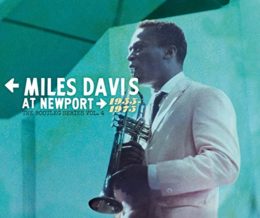 Miles Davis’s importance and recognition grew dramatically in the decades covered by the recordings on these four volumes. When he played in an all-star group at the 1955 Newport Jazz Festival, the trumpeter was barely known to the general public. By the end of the 1950s, Davis had recorded Kind Of Blue, an album that sold in the millions and helped to make him that rarity, a modern jazz musician with a household name.
The music in this set not only presents Davis playing, for the most part, at the top of his game; it also traces the course of mainstream jazz as it made its way out of the bebop era, embraced aspects of rock and soul music and simultaneously expanded its harmonic complexity. As the music changed, Davis and his groups both absorbed and influenced trends. These Newport performances through the 1960s and 1970s trace much of that change. Davis, Bill Evans, John Coltrane and—to an extent—Cannonball Adderley, expanded sensibilities, rhythm section practices and applications of modal theory that grow out of developments in the Kind Of Blue band. Coltrane’s progress toward his Giant Steps period is one manifestation of the change. Another is the rhythmic subtlety and harmonic intricacies in the Bill Evans trio after Evans found that bassist Scott LaFaro and drummer Paul Motian made it possible to achieve the music he had conceived. Coltrane’s and Evans’s approaches helped change the course of jazz. Nearly six decades later, they continue as primary influences.
Davis, noted for his refusal to look back or let his style calcify, remained one of the great melodic improvisers. His playing with Zoot Sims, Gerry Mulligan, Thelonious Monk, Percy Heath and Connie Kay at the ’55 Newport Festival—notably his solo on Monk’s “’Round Midnight‗resulted in a contract with Columbia Records that soon led to his increased fame. Three years later, what was to become known as his Kind Of Blue sextet appeared at Newport. They recorded Kind Of Blue the following spring. Aside from an “Ah-Leu-Cha†taken at a tempo so frantic as to be nearly unmanageable, the 1958 set has relaxed, comfortable playing, with Davis muted and notably relaxed on “Bye Bye Blackbird†and “Fran Dance.†His open horn takes on greater urgency in the Monk blues “Straight No Chaser.†Throughout the six pieces, Coltrane pushes the bop envelope about as far as it can go. He had recorded “Giant Steps†ten months later, profoundly affecting a generation of jazz musicians.
What is sometimes described as the second great Davis quintet performed at Newport’s 1966 and 1967 festivals, with Wayne Shorter in the tenor chair, and the cohesive, adventurous rhythm section of pianist Herbie Hancock, bassist Ron Carter and drummer Tony Williams driving Davis to renewed aggressiveness that Shorter matched. Shorter’s “Footprints,†Davis’s “All Blues†and a 1967 “Gingerbread Boy†of relentless vigor are highlights of these sets.
By July of 1969, Davis had begun his transition into electronics, adding Chick Corea’s Fender-Rhodes keyboard. With bassist Dave Holland and drummer Jack DeJohnette, the quartet’s music was still firmly within the jazz tradition, however wild their departures might be within it. “Miles Runs The Voodoo Down,†Sanctuary†and “It’s About That Time†amount to a suite that tends toward Davis’s coming merger with rock. At Newport’s 1973 festival in Berlin, the transition was nearing fruition. Davis electrified his trumpet, complete with wah-wah effects. The rhythm section featured two thoroughly amplified guitars played by Pete Cosey and Reggie Lucas, with Michael Henderson on electric bass, Al Foster on drums and percussion by Mtume. Davis’s front-line partner is soprano saxophonist Dave Liebman. Their music is mostly a study in volume and various degrees of density. It includes voice-like or animal-like sounds from the trumpet that Davis may have intended to be ironic and amusing. Liebman has an intriguing and rather restrained flute solo on the Davis composition called “Ife,†which leads into exchanges among the trumpet and the guitars that feature a frequently fascinating series of musical statements that simulate speech.
The Newport New York festival in 1975 retains Cosey and Lucas on guitars, adds tenor saxophonist Sam Morrison, with Foster on drums and percussionist Mtume. The solos by all hands are relatively subdued soliloquies signifying little. A final disc in the four-CD set reverts to October of 1971 and a Newport Jazz Festival In Europe concert in Switzerland. Saxophonist Gary Bartz joins Davis in the front line, with Keith Jarrett attending to electric piano and organ and Michael Henderson is again on electric bass, Ndugu Leon Chancler drums, and Mtume percussion. Joe Zawinul’s “Directions†opens a concert that about halfway through gets to music that seems to be where Davis was heading all along in his electronic explorations. It is a 12-minute exploration of “Bitches Brew,†the piece he had recorded two years earlier which heralded one of his most effective and enthusiastically welcome periods of electrified music. His own work on the piece has moments of lyricism that listeners subject to nostaligia may find comforting.
For the 2017 Newport Jazz Festival, impresario George Wein plans several events in tribute to Davis and to Wein’s Storyville club in Boston, where the young Davis often played in the 1950s.
Thanks for the excellent rundown. I post now to interject the name George Russell into the proceedings as a guy whose influence on MIles’ path is not acknowledged. He hung at Gil Evans’ pad with the guys who came up with the Birth of the Cool and his Lydian Chromatic/modal concept was a part of the mix. Note his work with Bill Evans before Kind of Blue and Coltrane was also in that mix. Then, in the 60’s, he went full bore into the use of electronic instruments and synths; getting there before Miles.
Somewhere in the mid 70’s I think, Miles Davis and company stopped by a now defunct jazz club on M Street in Washington DC. I remember Pete Cosey on guitar and another guitarist who might have been Reggie Lucas, I definitely remember cigar smoking Michael Henderson on electric bass, Sonny Fortune on alto and flute, Al Foster on drums and Mtume on percussion. Miles was on his amplified trumpet and occasionally, an electronic keyboard. Mtume did some kind of fingernails on the rim of the congas during one song that elicited an audible “what in the world was that?” comment from Miles, that he later kind of replicated by pantomiming his hands over the keyboard.
It was the only time in my life that I had seen Miles live and I am not sure that I understood all of what was going on then – and maybe not even now. All of Sonny Fortune’s solos were very well executed as memory serves and rather well received by the audience, although it was a little tough going with his flute being amplified over the sound system’s microphone. Miles had at least one very lyrical muted solo that was reminiscent of his earlier work that brought cheers from the audience as well.
The Miles’ set from Newport of 1958 was part of a “Miles & Monk at Newport” vinyl on Columbia that I remember owning back in the late 60’s or early 70’s. “Fran Dance” was my favorite Mikes’ piece from that set.
Thank you very much for the excellent description of the music. It has brought back some memories for sure.