Sixty-three years ago—almost to the day—Shorty Rogers included “Infinity Promenade†in his classic Short Stops album. Let’s hear it again. The introductory cymbals magic is by Shelly Manne. Soloists are alto saxophonist Art Pepper, Rogers on trumpet, and pianist Marty Paich. However, what blows minds all this time later is the double trumpet lead near the end by Conrad Gozzo and Maynard Ferguson. I once wrote that together these two created for lead trumpeters a gold standard. It remains in effect” today. In this Ray Avery photo from the following year, we see (L to R) John Best, Gozzo and Ferguson.
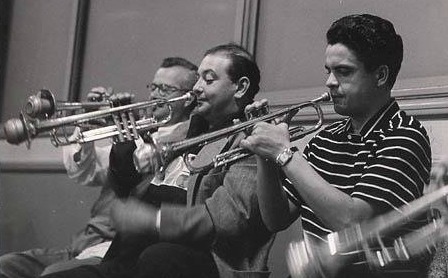
Complete personnel on “Infinity Promenade†was: Rogers (comp, arr, cond, flugel); Conrad Gozzo Maynard Ferguson, Pete Candoli, John Howell (tps); Milt Bernhart, John Haliburton, Harrt Betts (tbs); John Graas (fh), Gene Englund (tuba), Art Pepper Bud Shank (as); Jimmy Giuffre (ts),Bob Cooper (bs) Marty Paich (p), Curtis Counce (b), Shelly Manne (d).
Thirty years later at the 1983 Aurex Festival in Japan. Rogers brought together a galaxy of his west coast colleagues in a new arrangement of “Infinity Promenade:†Rogers, flugelhorn; Bud Shank, alto sax; Jimmy Giuffre and Bob Cooper, tenor sax;; Bill Perkins, baritone sax; Pete Jolly, piano; Monty Budwig, bass; Shelly Manne, drums.
Have an infinitely good” weekend.
All of the big band Rogers tracks are worth hearing. All have not just excellent musicians, but INCREDIBLE musicians, and his trumpet sections have mostly lead players in every seat.
“Infinity Promenade” is “Good Bait” in disguise.
The thing that makes this arrangement work so well-especially in the first version-is the sense of power being held in check and periodically erupting full force. BTW, Shorty has one of those “wrong” embouchures that work so well.
That original recording of “Infinity Promenade” still thrills me more than 60 years later, as does much of the sessions by that band. I consider it one of the high water marks of big band jazz writing and playing. And yes, that out chorus is something else!
It’s typical that the sound on the 1953 recording was far superior to that of the 1983 video. RCA did a great job recording the original session, whereas the video crew seemed careless