 After jazz emerged—or coalesced—as a distinct form of music in New Orleans in the early twentieth century, it quickly took hold throughout the world. Jazz musicians developed on every continent, even in countries where the spirit of jazz goes against the grain of politics and culture; a jazz community is emerging in China, not an eventuality that Mao Tse Tung is likely to have envisioned.
But for all the music’s wide acceptance abroad, the United States was where jazz flourished. During a decade or more in the 1930s and ‘40s swing and big bands constituted the foundation of American popular music. Several generations still cherish it as a cultural touchstone. Bebop came, stayed, subdivided and left several influential offshoots. In the l950s and ‘60s, rock enveloped popular music and still dominates it. Jazz remains artistically vital, even though in terms of popular acceptance it is tied, more or less, with chamber music.
Four recent books give valuable insights into the development of jazz in widespread regions of the country.
Gary Chen, They Call Me Stein On Vine (Independent)
Gary Chen moved to the United States from his native Taiwan, attended the Berklee School of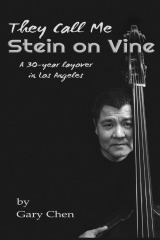 Music, and met Maury Stein, the owner of the music store Stein On Vine. Stein’s was, and is, a magnet for musicians in Los Angeles. Based on an interview that consisted of nine words between them, Stein hired Chen to work in the store. That was evidently in the early 1970s; the book is hazy on chronology. The first day on the job Chen met Freddie Hubbard, Ray Brown and Lou Levy and was hooked. When Stein died in 1987, Chen took over the store. The book is his life story, casually written in the first person and laced with anecdotes about the eccentric Stein and about the dozens of musicians for whom Stein’s was a virtual headquarters. A few of his stories are good-natured exercises in convolution, but some of the quotes from musicians are priceless.
“You should listen to Stravinsky more,†Wayne Shorter told a young saxophonist visiting from Europe. She played for Shorter and wanted advice.
Arranger Nelson Riddle: “I stole everything from Mozart and Debussy.â€
Horace Silver on playing with Stan Getz before Silver left Connecticut: “He would play every tune in all 12 keys. Every chorus he would raise a half step until we came back to the original key. Man, I can’t tell you what a challenge that was for a piano player. But I got my shit together.â€
Lou Levy on fellow pianist Cedar Walton: “I can outswing a lot of people, but guys like Cedar, they just got it.â€
Gerry Mulligan, upon receiving a compliment from Chen: “Gary, you are a fine gentleman with great taste.â€
Chen’s book is an easy, relaxed read that evokes the L.A. jazz milieu during a vital time.
Benjamin Franklin V, An Encyclopedia Of South Carolina Jazz & Blues Musicians (U. of South Carolina Press)
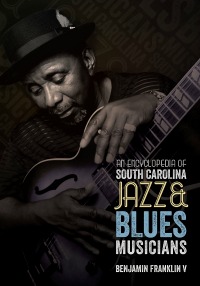 Franklin, an English professor at the University of South Carolina, compiles an encyclopedia with biographies of famous and obscure South Carolina musicians. Leading the parade of the famous is Dizzy Gillespie, followed by Bubber Miley, Eartha Kitt, Lucky Thompson, James Blood Ulmer, Jabbo Smith; bandleader Buddy Johnson and his sister Ella. Franklin’s thorough research also led him to the bassist, singer and composer Jim Ferguson; avant-garde saxophonist Robin Kenyatta; singers Etta Jones and Bertha “Chippie†Hill; Taft Jordan, who played trumpet with Chick Webb and Duke Ellington; and trombonist Fred Wesley, longtime music director for James Brown.
Illuminating an aspect of South Carolina jazz history little known outside the state, several of Franklin’s entries concern boys who were wards of the orphanage founded by Lena and Daniel Jenkins in 1891. Bands of the orphanage gained national recognition in the early 1900s, playing in the inaugural parades of presidents Theodore Roosevelt and William Taft and performing in several European cities. Among alumni of the Jenkins orphanage were trumpeters Cat Anderson and Jabbo Smith. The institution’s impact on music in Charleston parallels that of the New Orleans Colored Waifs Home, where Louis Armstrong learned to play the cornet.
Franklin is meticulous in his research, leaving no stone unturned when it comes to places and dates. This biographical heading is about clarinetist Jimmy Hamilton’s place and date of birth: Possibly 25 May 1917, though possibly ca. 1911 (Dillon, S.C.) S.C. residence: Dillon (probably 1917, but possibly ca. 1911 – possibly ca. 1922 when an encylopedist is that thorough with details of the small stuff, we can trust the accuracy of his major information.
You will find an interview with Professor Franklin here.
Lyn Darroch, Rhythm In The Rain (Ooligan Press)
Full Disclosure: I wrote a blurb for Lynn Darroch’s book. This is it.
Lynn Darroch illuminates the rich history of jazz in the Pacific Northwest from the
early twentieth century to the present. Interweaving factors of culture, economics, politics, landscape and weather, he helps us to understand how the Northwest grew so many fine jazz artists and why the region continues to attract musicians from New Orleans, New York, California, Europe and South America. He concentrates on the traditions of the big port cities, Seattle and Portland, and underlines the importance of musicians from places like Wenatchee, Spokane, Eugene and Bend. Darroch has the curiosity of a journalist, the investigative skills of a historian and the language of a poet. His writing about music makes you want to hear it.
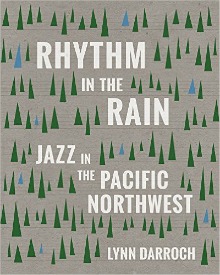
The book covers Quincy Jones, Leroy Vinnegar, Bud Shank, Don Lanphere, Thara Memory, John Stowell and dozens of musicians you may not have known about. Darroch makes you want to head for your CD shelves or YouTube. A choice collection of black and white photographs illustrates the book.
John McKee And Mike Metheny, Old Friends Are The Best Friends (Independent)
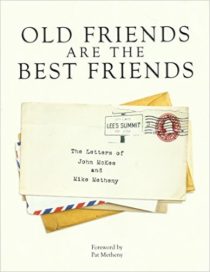 Mike Metheny is a trumpet player. Pianist John McKee ” (1945-1989) ran a lumber business. They grew up together in Lees Summit, Missouri. Their book consists of letters, McKee writing from Lees Summit, Metheny from Boston when he was forging his career in music and from lots of places after it was underway. The foreword is by Mike Metheny’s guitarist brother Pat. The book is not primarily about jazz, although music inevitably is an important aspect of it. Metheny writes to McKee about witnessing the singer Eddie Fisher trying to bolster the ego that is sagging along with his career. The friends have a sometimes lighthearted, sometimes earnest, exchange of letters. They write to one another about the conditions of Christianity, the Republic, about literature, about the television evangelists Jim and Tammy Fae Bakker and sometimes, about music.
Metheny on a jazz club:
Fat Tuesdays is exactly as The New Yorker describes it: a dark and soulful New York jazz room that is so intimate, we trumpet players must be careful not to empty our spit valves onto a customer’s knees. Surprisingly, the crowds were polite and encouraging and the whole experience would have to be considered positive.
McKee on a movie, Martin Scorcese’s The Last Temptation of Christ:
The way I see it, Scorcese has been making this personal-hell, cleansing-fire, final-redemption flick for at least 15 years. The Last Temptation… is merely an unconscious rehash of themes he has been pursuing (or have they been pursuing him?) for years. Scorcese’s Jesus no more resembles the Christ of the historical gospels than Harvey Keitel looks like Judas. (I’ve seen Judas’s high school picture, and you can tell the guy’s a jerk because he’s got that duck tail and he’s givin’ everybody the finger.
It’s not a jazz book. It’s a life book, suitable either for browsing or a long, steady read.
Check out Music at the Crossroads: Lives and Legacies of Baltimore Jazz, 2010, Apprentice House/Loyola University Maryland. I wrote the chapters on Ellis Larkins and Hank Levy.
Perhaps due to its humble origins, jazz long had a wider geographic distribution than genres like classical music. One thinks of great, historical centers of jazz like New Orleans, St. Louis, and Kansas City. As jazz’s popularity fell and it became a rarified interest of aficionados, the centers of jazz moved to the coastal cities associated with classical music.
I hope the USA will eventually develop a public funding system for the arts like the Europeans have used for decades. This form of funding is more democratic and creates a more geographically egalitarian distribution of arts support. This would allow regional America to strengthen, if not re-discover, its cultural voice. Urban areas like St. Louis, Kansas City, and others might regain their historical significance in jazz.
I think this would create a healthier country on many levels. One can’t help but notice that the states likely to vote for Trump cut across the heartland of our country. To my partisan mind, it seems like a manifestation of ignorance created in part by cultural neglect. For whatever reasons, cities with well supported cultural lives, including jazz, are as a rule wiser and more tolerant than much of what we see in America today. Public funding’s more egalitarian effects could create a country with a more robust democracy.
Anyway, thanks for the reports about jazz in four regions of America.
Many Thanks for some worthy additions to my winter reading list!
Your most welcome post on “Books About Jazz In Four US Regions” reminded me about a few from Texas. Dave Oliphant is the author of a number of excellent reads, including a couple on the rich history and heritage of Texas jazz. You might want to check out Texan Jazz (1996) and Jazz Mavericks of the Lone Star State (2007) or his latest, KD, (2012) an engaging and comprehensive verse biography of Texas trumpeter Kenny Dorham.
Although it only deals with a specific portion of the OKC music scene One O’clock Jump: The Unforgettable History of the Oklahoma City Blue Devils by Douglas Henry Daniels is a nifty little read.
John McKee and I used to talk about making our letters into a book someday, and when he passed in 1989 I decided to follow through with that goal. Just didn’t think it would take 27 years!
p.s. Fans of Pat might also recall that he wrote a song called “John McKee†in honor of our departed friend. It can be found on Jack DeJohnette’s Parallel Realities.
It can also be found on YouTube in a performance at the 1990 Antibes Jazz Festival. DeJohnette is the drummer with Pat Metheny, guitar; Herbie Hancock, piano and synthesizer; and Dave Holland, bass.
Dear Mike —
I’m so glad you got this done. Jazz in context, your context, and “beyond the Missouri sky…” Invaluable!