This is how co-host Renee Montagne of National Public Radio’s Morning Edition opened one of the program’s hours this morning.
We’re kind of blue. Miles Davis died 25 years ago today.
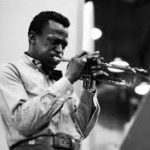 It came as a shock to realize how quickly that sizeable amount of time has passed; and a comfort to know that a major creative musician, recognized in a casual comment, is a part of the fabric of the nation’s, and the world’s, culture. Ms. Montagne’s reference to Davis’s best-known album suggests that listening to it again is always a good idea. Whether you are about to have lunch in Shanghai or get out of bed in Copenhagen, here is the complete 1959 Kind Of Blue with Miles Davis, John Coltrane, Cannonball Adderley, Bill Evans, Wynton Kellly, Paul Chambers and Jimmy Cobb.
No doubt if you searched the internet, you would find thousands of Miles Davis anecdotes. I have only one from first-hand experience. It’s from my 1989 book Jazz Matters. I’m not sure that I have posted it on Rifftides.
My first opportunity to hear Miles Davis Live came when I as in New York for a week in 1962 and he was playing the Jazz Gallery in Greenwich Village. In the interim he had, to quote Colman Adrews, “sent his demons roundly back to hell; recorded the milestone “Walkin'” session; formed the quintet with John Coltrane, Red Garland, Paul Chambers and Philly Joe Jones; been “rediscovered” at the 1955 Newport Jazz Festival; reorganized his combo into the mind-blowing sextet with Coltrane, Cannonball Adderley, Bill Evans, Wynton Kelly, Chambers and Jones; collaborated triumphantly with Gil Evans; masterminded the Kind of Blue date, possibly the most influential record session of the past twenty years; and become a household name.
At the Gallery, Chambers and Jones were still aboard. Wynton Kelly was the pianist. Tenor saxophonist Hank Mobley and trombonist J.J. Johnson were the other horns. Teddy Wilson’s trio was appearing opposite the Davis band.
Aside from the distinct recollection that Miles, Philly Joe and J.J. played superbly that night, two memories of the evening survive. Between sets, Miles sat at a table in front of and slightly to the right of the piano and listened to Wilson intently and with great enjoyment. During a later break, he came to the bar and took a stool next to mine. I had heard all those stories about Davis’s surliness and wasn’t about to get him riled up by coming on like the hick fan I was. But he initiated a conversation and for maybe twenty minutes we made small talk, little of it about music. The freezing weather came up, as I recall, the New York newspaper strike, foreign cars, and Teddy Wilson. There was no handshake, no exchange of names. Then, as Miles got up to return to the stand, he asked where I was from. No place he’d ever heard of, I said, Wenatchee, Washington. He paused a moment, then said:
“Say hello to Don Lanphere.”
D o n w a s p l e a s e d .
What a great remembrance. Always have loved that album.
I loved your story about meeting Miles Davis.
Thanks for sharing your ‘moment’ with Miles. Reminded me of my own moment with Miles. He was my neighbor on W 77th St for close to 25 years, was anything but surly. Used to sit on the wall in front of his brownstone greeting and chatting with neighbors passing by. One morning I was running to the subway when he pulled up at the corner in his Jaguar and asked where I was going! My reply, “to work.” He asked, “where’s work?” to which I answered ‘Broadway and 40th.” To my surprise Miles replied,” “Get in. I’m going that way, I’ll drop you.” And he did!
Wow! That’s neat!
I like what Quincy Jones said about Kind of Blue, that it
is his “daily music, his daily orange juice.” Always
fresh, at just the right refrigerator temperature.
Had you identified yourself as a writer or jazz critic, I suspect that Miles would have said something more provocative. Here’s what he told Stephen David in a 1973 interview:
“Are you afraid to die?â€
“No. [laughs out loud] All these lectures, ‘Protecting Your Inner Karma,’ and all that sh- – -. How many people even know they have one? I mean, think of all the guys that go to Vietnam. They go for no reason and kill somebody that they don’t even know, and then you come back and a guy calls you a black mother- – – -er or something, and you have a reason to smash his head in and you do it and you’re a criminal and you have to go to court, but you don’t have to go to court for going in the army and killing fifty people that you don’ know. It’s easy to do, kill somebody. I mean the police do it all the time and nobody says a fu- – in’ thing. They don’t go to church and say, ‘I’m sorry I killed that guy.’â€
I never got to hear Miles in person, let alone talk with him, but I remember Orrin Keepnews’ hilarious recollection of their first meeting. Orrin said something like, “The day before I was to meet Miles, I was on a television quiz show. I was terrible and didn’t win any money. When I met Miles the next day, he didn’t introduce himself or greet me by name, instead saying in his hoarse voice, “What’s the matter? Didn’t you know the answers to the questions?'”
My name is Mel Mason from Seaside, California. I am trying to connect with other former kids who sat in the Kiddie Corner behind the chicken wire at the Blackhawk. I went there from 1959 (my junior year in high school) through spring of 1961 (my freshman year in college). Could we have some kind of Reunion? Or at least communicate with each other? we were all part of something real historic.
Thanks, Doug and others, for the memories and anecdotes. Great stuff. It’s a nice surprise to read that Miles could be just a regular guy sometimes. And what’s this about an underage section behind chicken wire at the Blackhawk?? Tell us more!
Blackhawk owner Guido Cacienti was the hero. He put the practice into effect in 1950. Here’s a passage from chapter 19 of The Public and Private Lives of Paul Desmond.