…just because it has been too long since you’ve heard it, even if you heard it a 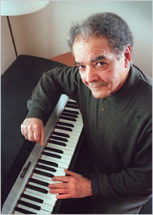 few minutes ago. It is a B-flat blues called “Honesty,†composed by trombonist Dave Baker and played by a sextet led by George Russell (pictured). We hear seven musicians thoroughly experienced in the post-bop mainstream who were also immersed in the freedom that in 1961 was introducing new colors into jazz. Indeed, Russell had been an encourager and trailblazer of that freedom since he wrote for Dizzy Gillespie in the late 1940s. His 1950s and ‘60s work featuring pianist Bill Evans, trumpeter Art Farmer and tenor saxophonist John Coltrane, among others, is some of the best of the music of those decades, written with the soloists’ characteristics and personalities in mind.
What, you say you’ve never heard “Honesty?†This is your lucky day.
Don Ellis, trumpet; Dave Baker, trombone; Eric Dolphy, alto saxophone; George Russell, piano; Steve Swallow, bass; Joe Hunt, drums. It’s from the album Ezz-thetics, recorded in New York in May, 1961.
I’ve got this album on LP and after I sign off today I’m going to re-visit it. There’s such great stuff lying dormant in my listening room. “Honesty” is a great piece by a magnificent composer.
Thanks for turning me on to a great recording. The soloists are very dynamic! The rhythm section is very flexible, but swinging.
George Russell was a great composer. band leader and author of the most demanding theoretical study musicians can undertake.
I studied his Lydian Concept in the early 50’s at his NYC Bank street apartment when his theory was in manuscript form. He had to read the written pages aloud and demonstrate at the piano for each lesson what the Lydian Concept meant to me as a player. I had a total of 6 lessons but I had to separate the lessons at 3 month intervals. It took me that long to absorb and integrate the Lydian Concept into my playing and improvising. It was not an easy task!
To this day, I rework and apply the Lydian Concept mainly to my solo piano playing. My album Tributes is a good example of Russell’s influence. I have been applying his principals of tonal gravity ever since. That’s over 60 years ago.
After George heard the Tributes album, he asked me to join his Living Time band. We toured Europe and returned to play at the Village Vanguard for one full week. The entire experience of performing his compositions gave a tremendous boost to my confidence as a player.
Thank you, George Russell.
I was working with Art Farmer while he was studying George’s concepts, and asked George if I could buy a copy. He sold it to me, but said, “I don’t know how much good this is gong to do you. We’re taking the other instruments into a higher atmosphere, but we sort of expect the bass to hang around the roots. After working on it for a while, I came to agree with him, but it did open up my ears a lot.
Guitarist Eric Skye recalls a gig when “a lot of serious jazz players and instructors were in town checking us out. In the middle of my solo, I was getting pretty angular and ‘out’ and somehow I just got totally lost – like falling-off-a-train-in-India lost. It went on like this for four choruses and it was just so awful trying to get back onboard. Somehow, I was able to get back to the head and out. When it came time for the break, I had to exit by passing through the audience—the ultimate walk of shame. But two different jazz instructors stopped to say things like, ‘Those are some incredible Lydian dominant ideas you have!’”