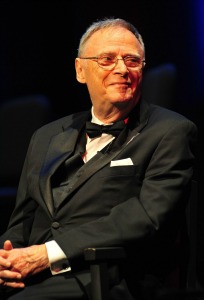
 Rudy Van Gelder, who recorded thousands of albums by musicians including some of the most important in jazz, died today at 91. As a young man, Van Gelder began recording in a room in his parents’ house in Hackensack, New Jersey. Among his recordings were early albums by Miles Davis and Thelonious Monk. He was a practicing optometrist, but he said in recent years that when he first found himself in a recording studio, he had a feeling that “this is what I should be doing.” He went on to acquire the most sophisticated equipment and learned to use it to create what was sometimes labeled the Van Gelder sound. There was widespread speculation about how he achieved that sound, but he never disclosed his recording secrets. He ultimately left optometry and established his own studio in nearby Englewood Cliffs. Over the years he engineered classic sessions by Gil Mellé, John Coltrane, Cannonball Adderley, Art Blakey, Sonny Rollins, Horace Silver and dozens of others. Van Gelder’s work made up substantial portions of the output of the record companies Savoy, Prestige and—especially—Blue Note.
As an example of the Van Gelder sound, from pianist, composer and arranger Duke Pearson’s 1966 album Sweet Honeybee” here is a nifty blues in F. The soloists are Freddie Hubbard, trumpet; Joe Henderson, tenor sax; James Spaulding, alto sax; Duke Pearson, piano; and Ron Carter, bass. The drummer is Mickey Roker. Pearson named the piece, “Ready Rudy?â€
For an appreciation of Van Gelder from a New Jersey news organization, go here. Embedded in the obituary is video of an interview with Van Gelder about his life and work.
Rudy Van Gelder, RIP.
Just for the record, Rudy started recording in his parent’s house in Hackensack, New Jersey not Teaneck. Then he moved to his new studio at Englewood Cliffs, NJ.
The post is corrected. A tune by Thelonious Monk, recorded in Van Gelder’s home studio in 1954, is titled “Hackensack.”
As an optometrist & jazz fan myself, Dr. RVG has a special place in my heart. By far, THE COOLEST O.D. there ever was, which I can only hope to aspire to. Thanks & Rest in Peace, Dr. Van Gelder.
Rudy inspired me to get a paper route and save my money to buy a Telefunken U-47 microphone and a Webcor reel to reel tape recorder. I think I paid $600 for that mic. I just looked on the Sweetwater website and that mic, today, runs $8,495. Rudy was the best. Some of his digital remastering of old, analog recordings are works of art. I’ll bet Bucky Pizzarelli has some interesting Rudy Van Gelder stories.
I went by the studio once but couldn’t bring myself to possibly knock on the door. I was just too intimidated by the very idea of being so bold. So I just parked for a while on the street and dreamed in my head of all the sessions that went down there over the years. Sessions that became the “soundtrack of my life” in a way that pop music never was for me. After a bit, I started to feel like the proverbial creepy stalker type and drove back to Canada. Maybe I should have knocked, if only to say thank you to Rudy. I’ve read some accounts where he actually talked to someone over the intercom once he realized he was talking to yet another fan.
We are losing giants on a daily basis it seems. RIP.
Hi Doug, Thanks for posting this. Long ago I aspired to become an engineer recording jazz music, but when I learned about Rudy Van Gelder I knew that there was no hope for me. I never would have been able to equal what he was doing.
Few engineers would put the drums in jazz as high in the mix as Rudy would, and I really like the way he did that. His recordings of Elvin Jones are like no other, still a sonic delight. I would go so far as to say that Rudy was a factor in Elvin’s career.
I wonder what’s going to become of all of his equipment, and his studio? There’s probably too much there for the Smithsonian, but that’s where it should be.
Further to what Kenny Harris posted, Rudy Van Gelder was earning his living as an optometrist at his office in Teaneck, New Jersey.
As a scientist, recording engineer, ham radio operator, and human being, I come from a tradition of sharing what I have learned, giving back to younger people, just as older guys helped me out when I was young, passing it on just as one musician passes it on to others. Bird, Dizzy, Clark, and Barry Harris are examples — I’ve read a bunch of jazz bios, and many of them cite these musicians and others as being totally selfless in sharing what they have learned. We all know of the dozens of musicians who have graduated from the Art Blakey and Betty Carter universities. I’ve watched Billy Hart interacting with his students, fresh off a plane from gigs in EU, but remembering each one’s story and complimenting them on what he just heard them do. They are among my heroes. I try to do the same — my expertise is audio, recording, live sound, and a few other techie things. I’ve shared everything I’ve learned.
Rudy has a reputation for never having done that — indeed, he always held his cards VERY close to his vest. That bothers me. What I do like about his story is his personal dedication to quality, to investing in the best equiment he could find, and his serious study to learn his craft. And certainly his making the best of his available resources — recording all those great sessions in his parents home!
And while his recordings have always been quite decent, I’ve been more impressed over the years with the work of guys like Roy DuNann for Contemporary, Val Valentin, and Wally Heider (especially his early live recordings), which I think sound a lot better. And the guys recording Miles, Brubeck, and Mingus for Columbia were no slouches—their work stands up quite well 60 years later! I think a big reason Rudy got so much important work was that he was across the river from NYC and he got connected early.
For a 2007 Rifftides appreciation of Roy DuNann, go here.