

Are awards the staff of life? Of course not. But they certainly seem like food for the hungry.
More Resonant Than Ever
Heathcote Williams’s ‘The United States of Porn’
![Heathcote Williams [photo: JH]](https://www.artsjournal.com/herman/wp/wp-content/uploads/2015/06/heathcote-williams-photo-280-200x200.jpg)
Heathcote was always prescient. But it is still astonishing to realize how relevant — and resonant — his dissident voice remains more than a dozen years after he recorded “The United States of Porn.”
Poetry & Prose
‘Wortlaut’ Saint Gallen Festival Salutes the Word

UPDATED: Jan Heller Levi & Jan Herman will appear on March 30, 2025 at the festival, where they will read and discuss their latest poems with Giovanna Caggiano and Julia Mülli from the Kantonsschule am Burggraben. Florian Vetsch will also read with Jan & Jan at the Palace on April 1.
I’m With Amélie Cardy and Cézanne on This
Cold Turkey Press is publishing an illustrated, four-page folio of “Frankly Speaking” with a drawing by the young British artist Amélie Cardy in an edition limited to 36 copies. And a poster of the poem with a drawing by Cézanne is seeking a publisher.
‘American Porn’ for the Orange Man’s Inauguration Day
!['American Porn' by Heathcote Williams [Thin Man Press, 2017]](https://www.artsjournal.com/herman/wp/wp-content/uploads/2017/01/American-Porn-by-Heathcote-Williams-Thin-Man-Press-2017400-200x200.jpg)
Here we go again. To mark the resumption of our long nightmare, my staff of thousands thought it apt to repost this from 2017:
On the day he is sworn in as the preening el presidente of a tin-pot United States of Trumpistan, enabling him to run the country like a division of his family-held company, Thin Man Press will release American Porn, a collection of “investigative poems about American history, culture and politics” by Heathcote Williams.
New in French Translation
Sinclair Beiles’s Selected Catastrophies & Other Poems
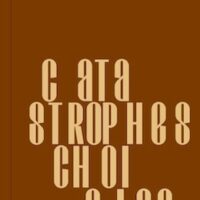
As part of the Beat Hotel crowd in Paris during the late-1950s and early ’60s, Sinclair Beiles collaborated on the first book of avant-garde cut-ups, “Minutes to Go,” with Brion Gysin, William Burroughs, and Gregory Corso. While working at Maurice Girodias’s Paris-based Olympia Press, he was a key editor who helped shepherd Burroughs’s “Naked Lunch” into print. It is his incandescent poetry, however, for which he should be most remembered. But despite praise for his poetry from such luminaries as Burroughs and Leonard Cohen, his writing has rarely surfaced outside the small-press literary world. “Catastrophes Choisies” is not Beiles’s first poetry collection to appear in French, but it is the most elaborate..
The Late Brion Gysin (1916-1986) Is Having a Moment
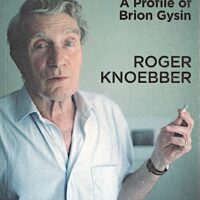
Over the years he had many, in fact, although few of them lived up to his expectations. But never mind. An updated model of his and Ian Sommerville’s Dreamachine was recently featured in a symposium on art, AI, and the humanities here in New York; and another will be installed in London at the Tate Modern, in the exhibition “Electric Dreams: Art and Technology Before the Internet,”which will run from the end of this month (Nov. 28) to June 1, 2025. Meanwhile, Roger Knoebber has brought Gysin back to life in a shaggy, unconventional book-length profile, “Hysteresis.”
Buckminster Fuller’s Versified Prose
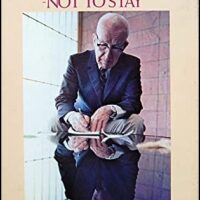
By my philosophy
The finite, but imponderable
Metaphysical Universe
Embraces the definite,
Ponderable, physical Universe.
‘Finite’ is not unitarily conceptual.
‘Definite’ is unitarily conceptual.
I have mathematical proof …
Does the Dreamachine Elude AI? Yes It Does.

Scholars and specialists addressed ethical and political considerations surrounding AI in collaborations with human creators. Topics ranged from AI aesthetics to the early history of machine learning, from multimedia art to computational research experiments with artificial intelligence, including AI biases and applications.
‘The Hanging’ and ‘Wheel of Fortune’
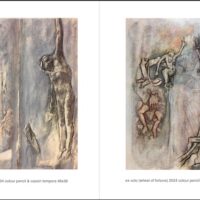
These drawings, which appear in “di Umbris,” a dossier of Gerard Bellaart drawings just published by Moloko, were not intended as commentary on current events. But I can’t shake the sensation that they are.
A Second Look
Touched by a Documentary Ode to Nelson Algren

Some years ago I criticized Michael Caplan’s documentary ode to Nelson Algren as the cinematic equivalent of a pop tart. Now that I’ve had another look I see that I was very wrong.
Human Figuration as an Expression of Ideas

These drawings move across centuries, from the Middle Ages to our blighted times in an unflinching rawness that gives no comfort. Nothing is omitted. You will find the sexual inscribed like watermarks of passion and anguish. The demonic appears in equal measure with the angelic. Most of all, not unlike cave drawings of prehistoric times, they are an existential record of a particular creature, Bellaart by name.
Lionel Ziprin: ‘One of the Secret Heroes of Our Time’
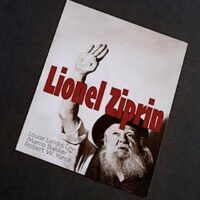
“I am not an artist. I am not an
outsider. I am a citizen of the
republic and I have remained
anonymous all the time by choice.”
I Guess It Had to Happen
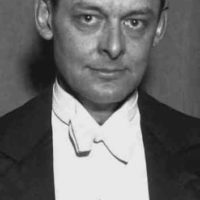
Julian Peters has done Poe, Rimbaud, Frost, Keats, Dylan Thomas, Wordsworth, Oscar Wilde, Villon, Yeats, Sassoon, and plenty of others — and they’re all damn well done — so why not T.S. Eliot?
‘Dear Willy’ Tells a War Tale of Love and Hope
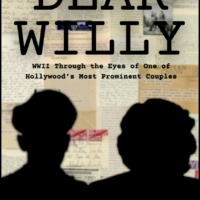
The letters that Hollywood director William Wyler and his wife Talli wrote to each other during World War II are the basis of a new documentary directed by Taylor Alexander.
Underground Railroad: Walt Whitman Bears Witness
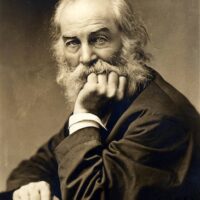
… to “the runaway slave” in his most famous poem, “Song of Myself,” which first appeared untitled in his self-published collection Leaves of Grass, in 1855.
One More Missive from the Department of Letters
By popular demand, here’s another letter from Nelson Algren, this time a big fat gossipy one apparently in reply to questions that Roger Groening must have posed.