
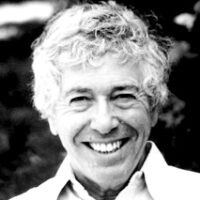
The indie filmmaker was one of many notable speakers at “Kenneth Koch at 100: A Celebration,” held last month at The New School’s Auditorium in Greenwich Village. Kenneth Koch was Jarmusch’s teacher at Columbia, “a kind of godfather to me, aesthetically,” he said, noting further that the “so-called New York School of poets in general remain as my godparents in almost anything I create.” Among the more interesting tributes were Maxine Groffsky’s and, via video, Alex Katz’s. I found Jarmusch’s the most amusing.
Thinking of Gregory Corso’s ‘Happy Birthday of Death’
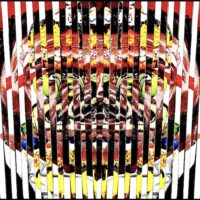
Not ready for his closeup.
Musk and His Chainsaw Are Still Coming for You
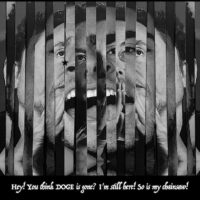
You think DOGE is gone? He’s still here! And so is his chainsaw!
Proposal for a Billboard
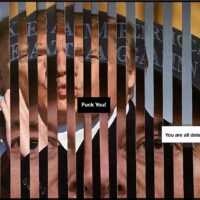
The tag team of Elon Musk and Donald Trump were cheered ringside by MAGA Republicans during el presidente’s speech to the joint session of Congress.
Awards Mean Little Beyond Publicity

Are awards the staff of life? Of course not. But they certainly seem like food for the hungry.
You Are All Deleted. You Are Deleted Forever.
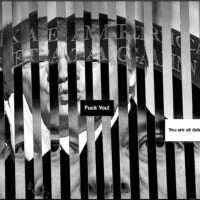
AGITPROP PROPOSAL FOR A BILLBOARD: To be deleted is not a matter of the Internet. It’s a matter of reality.
Double Trouble: Bacon Sometimes Meets Picasso
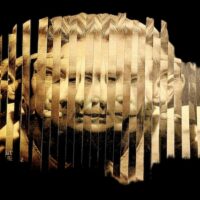
This is what happens when you take a razor to a pair of images cutting them up in vertical strips. And this is what happens when the procedure is applied to a single image, then doubling the result upon itself. Jiří Kolář gave the name “rollage” to this kind of minimalist collage technique.
My Books
Several books of poems are published by Moloko Print and Stadtlichter Presse in bilingual (American-German) editions, and by Cold Turkey Press in handmade chapbooks. “The Z Collection” appeared in three editions, by AC Books, Blue Wind Press, and Moloko Print.”
The Ugly Spirit … with commentary
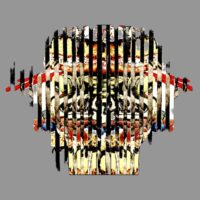
I know where this image came from. It began with the random association of two photos that I sliced up longitudinally with a razor, then laid the resulting strips side by side. I subsequently photographed it, dropped out the background and very slightly manipulated the color and sharpness. The result seemed to me utterly surprising, just as confounding, and very disturbing. In a word, scary.
A Kiss Is Still a Kiss
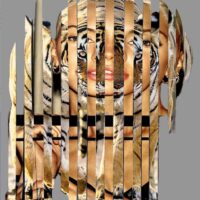
Which the Beauty? Which the Beast?
I’m With Amélie Cardy and Cézanne on This
Cold Turkey Press is publishing an illustrated, four-page folio of “Frankly Speaking” with a drawing by the young British artist Amélie Cardy in an edition limited to 36 copies. And a poster of the poem with a drawing by Cézanne is seeking a publisher.
Bringing It All Back Home
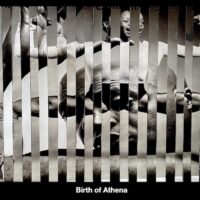
She gave Zeus a headache … which he deserved.
When Words Fail, a Cut-Up Will Do
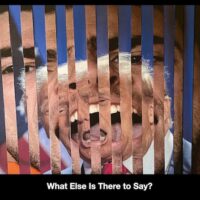
What else is there to say?
The Once and Future Prez
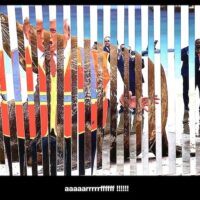
aaaaarrrrrffffff !!!!!!
Once Again, What Would Daumier Make of Trump?
![Lithograph by Honoré Daumier [1831]](https://www.artsjournal.com/herman/wp/wp-content/uploads/2018/04/daumier_honore_1-200x200.jpg)
Honoré Daumier went to prison for six months for his 1831 lithograph after its publication in a satirical illustrated periodical that appeared weekly in Paris, “La Caricature morale, politique et littéraire.”.
American Sphinx
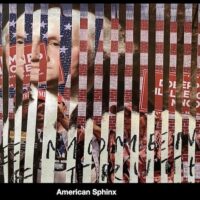
No words needed.
The Late Brion Gysin (1916-1986) Is Having a Moment
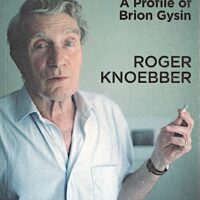
Over the years he had many, in fact, although few of them lived up to his expectations. But never mind. An updated model of his and Ian Sommerville’s Dreamachine was recently featured in a symposium on art, AI, and the humanities here in New York; and another will be installed in London at the Tate Modern, in the exhibition “Electric Dreams: Art and Technology Before the Internet,”which will run from the end of this month (Nov. 28) to June 1, 2025. Meanwhile, Roger Knoebber has brought Gysin back to life in a shaggy, unconventional book-length profile, “Hysteresis.”