an blog | AJBlog Central | Contact me | Advertise | Follow me:

Rachmaninoff in Texas

In Twentieth Century Music, an admirable and much-used survey written in 1974, Eric Salzman devotes 13 pages to Stravinsky, 11 to Schoenberg, and 6 to Berg versus 2 for Ravel, 2 for Shostakovich, 1 for Sibelius, and 1 for Richard Strauss. To Sergei Rachmaninoff, he allots a single sentence, consigning him to the "older Romantic tradition" of Russian music. Today, 37 years later, Rachmaninoff is an expanding twenty-first century presence. Shunned by modernists for deficits in originality and influence, he is newly admired alongside other … [Read more...]

Mahler in Texas

For last Saturday's performance of Mahler's Ninth Symphony at the Round Top Music Festival, an orchestra of 88 gifted young musicians rehearsed for 22 hours over the course of six days; there were also more than four hours of sectional rehearsals. A splendid young Austrian conductor, Christoph Campestrini, used every minute of his allotted time, correcting and exhorting with precision and enthusiasm. The result was formidable: an impassioned and idiomatic account, honed to honor Mahler's kaleidoscopic textures. The previous week, Round Top … [Read more...]

Improvising Stravinsky

One of my standard rants - typically inflicted on young pianists - is called "The Piano in the 21st Century."I begin by asking if anyone can name an important pianist before 1900 who was not also a composer and/or conductor. It's supposed to be a trick question - all the names that come to mind (Liszt, Thalberg, Rubinstein, Pabst, von Bulow, Busoni, etc.) support my point that the "performance specialist" - the pianist who only plays the piano - is a 20th century anomaly. (I had given this talk dozens of times before someone said "Vladimir de … [Read more...]

Something New and Necessary for Orchestras

With the fate of American orchestras in the news, the National Endowment of the Humanities has recently awarded $300,000 for a symphonic project -- "Music Unwound" -- that dramatically explores new templates for concerts and new missions for institutions of performance. The NEH public programs division funds orchestras once every decade or two. That the Humanities Endowment is not accustomed to dealing with orchestras, and that orchestras are not prone to apply for NEH funding, identifies in a nutshell the challenges and opportunities the new … [Read more...]

Schubert on the Trombone

Among his colleagues, the unclassifiable bass trombonist David Taylor is both famous and notorious. I happen to have known him for something like 25 years. We occasionally play together in my living room. David sight-reads Beethoven cello sonatas and German Lieder. One day, I introduced him to the harrowing late songs of Franz Schubert. I though they might be a fit for the Taylor temperament. They were. He has since made Schubert's "Der Doppelgänger" a signature piece, performing it on home turf in cities like Vienna, Linz, Zurich, Innsbruck, … [Read more...]

Interpreting Stravinsky (continued)

Igor Stravinsky, in his polemics, preached "against interpretation." He insisted that his music be performed as written, and as he himself had performed and recorded it. He idealized mechanical instruments. But in 1978 -- seven years after his father's death -- Soulima Stravinsky created an edition of the Stravinsky Piano Sonata (1935) adding pedallings, dynamics, and expression marks. At the recent Stravinsky Project presented by Post-Classical Ensemble and Strathmore, George Vatchnadze took Soulima's edition and ran with it. The result was a … [Read more...]

Lou Harrison and the Great American Piano Concerto

The music of Lou Harrison represents a rare opportunity for advocacy. To begin with, he is unquestionably a major late 20th century composer, and yet little-known. Also, he is both highly accessible and stupendously original. And he is the composer of a Piano Concerto as formidable as any ever composed by an American. The Harrison Piano Concerto (1985) was the centerpiece of Post-Classical Ensemble's sequence of three Harrison events over the past two weeks in DC. Why this American masterpiece is so little performed is a good question. There … [Read more...]

Bruckner and Religion

For the second time in two weeks, I've heard an unforgettable symphonic performance fortified by intense religious conviction. In Pittsburgh, Manfred Honeck delivered Tchaikovsky's Fifth Symphony as a profession of faith in God and mankind (see my blog of Feb. 13). Never before had I heard this work's problematic finale so infused with liturgical resonance, so distant from trumpets and drums. Last weekend, Carl St. Clair - like Honeck, a devout Roman Catholic - led his Pacific Symphony in performances of Bruckner's Ninth Symphony buoyed by a … [Read more...]

Nixon in China at the Met

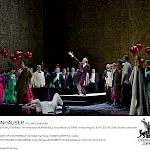
I first saw John Adams' Nixon in China at BAM in 1987, weeks after my son was born. The opera was as brand-new as Bernie. I connected with its breathless exhilaration - the Nixons' discovery of a new world, of new realms of feeling, of new purpose and possibility. I was not alone. At that New York premiere, you didn't have to be a first-time father to know that something important was happening: of all things, an American opera that gripped and held. I really didn't know what to expect, re-encountering Nixon at the Metropolitan Opera this … [Read more...]

What the embattled NEH does for education: a case in point

The National Endowment for the Arts and the National Endowment for the Humanities are endangered by impending Congressional budget cuts. Few people know what these agencies do - which is to say, it's little appreciated how vitally they contribute to American lives, and how disproportionate their contributions are in relation to their very modest budgets. A pair of events in eastern Pennsylvania earlier this week are a case in point. For Black History Month, two elementary schools in semi-rural communities not far from Philadelphia - North … [Read more...]

an ArtsJournal blog