


The Forsythe Company / BAM Howard Gilman Opera House / Brooklyn, NY / October 7-10, 2009
William Forsythe made his name creating ballets with an eye to pushing the art conspicuously forward, as Balanchine had done. Nowadays he makes concoctions that are so hard to appreciate, detractors find them empty, showy, foolish, inexplicable, or all of the above. It’s not that I think he should retrace his early steps.
Artists must not – cannot, actually–imitate their past. They need to move ahead to find their own future. I just wish I understood and liked Forsythe’s recent work better.

Members of the Forsythe Company in Forsythe’s Decreation
Photo: Julieta Cervantes
Decreation, which Forsythe and his devoted troupe brought to BAM’S Howard Gilman Opera House for an October 7-10 run, is not so much a dance as a dance cum postmodern drama cum installation cum performance art cum . . . well, you get the idea.
Forsythe’s idea is that the world is in pretty hopeless shape. While its inhabitants obsess about communication, connection, empathy, and even love, he tells us, their actions invariably disintegrate into the cruel and bizarre. Though he keeps his stage tidier than the colossal-mess-loving Pina Bausch–even the dancers’ clothes, shmatas you could clean the garage in, are fastidiously keyed to a subtle sky-and-earth palette–Decreation recalls the themes of her angst-driven earlier works.
The piece opens with a narrator standing behind a translucent box (also used as a projection screen, part of the media mix the choreographer favors), playing the dual role of defense attorney and accused. Her lines, delivered in a voice cracked with rage, alternate so swiftly between the two characters, they’re barely intelligible.
The effect is like that of a particularly hostile Punch and Judy show.
In general, the sound is unbearably raucous, with overlapping verbal provocations accompanied by intermittent music played onstage and crackling static. The static may be there to remind us that everything we say nowadays is being recorded as info in the public domain, to be received by unsympathetic listeners. Occasional silences fail to bring relief; they only make one woman’s low moaning audible.
As for the movement in the piece, it’s usually violent and grotesque (angular, spasmodic, writhing)–and endlessly repetitive. The groupings, though, are so handsomely arranged, it’s hard to believe that the anatomical incoherence represents authentic feeling.
Images suggesting sexual abuse abound. One pathetic figure often reappears, clutching one of her breasts with her right hand and her crotch with her left. She is the Eternal Female Victim, until she slips out of a contorted confrontation with two men, leaving them to undo each other.
Ten minutes into the one-hour show, you feel as if you’ve stumbled into a loony bin, albeit one that boasts high-end design and a façade of braininess. The latter comes across in exchanges like this one: He says, “Everything is beautiful and nothing hurt.” But she says (he reports), “Everything hurt, everything that was beautiful.”
And then there’s the persistent variation on this theme: “I might prefer to love another more than I love you. What would you do?” Only the libretto of one of the gayer Mozart operas could make such business viable, and then it would bubble with fun. Here it’s rendered with pensive solemnity, reiterated so often you wonder why the guy at the receiving end doesn’t counter with “Gimme a break already!”
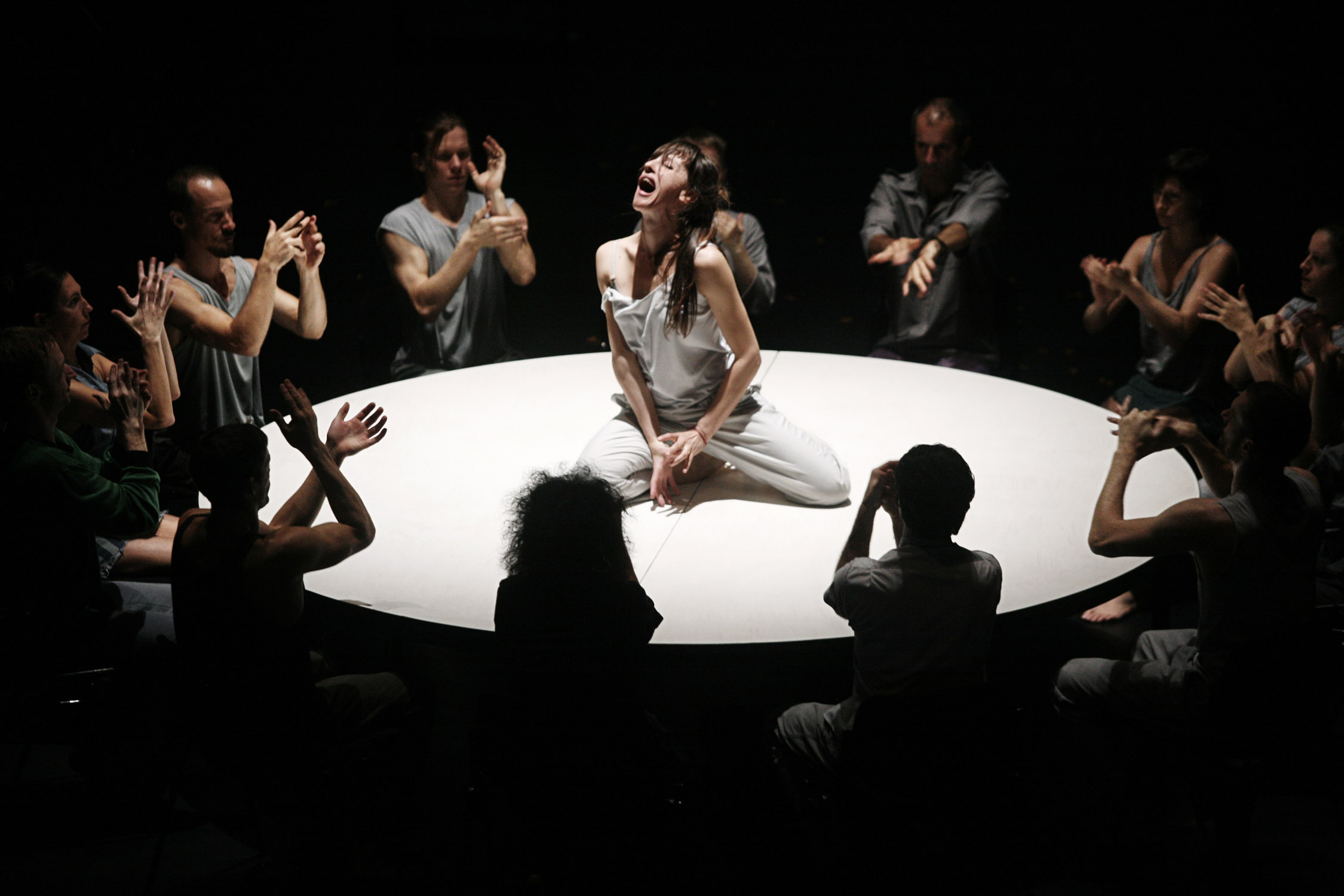
The Forsythe Company in Forsythe’s Decreation
Photo: Julieta Cervantes
In the final segment, the huge round table that loomed in the background is stripped of its formal dinner paraphernalia (crystal, china, sumptuous white cloth) and dragged forward, folding chairs placed to rim its periphery. The whole overwrought cast congregates, seated, for one last blast. Of course a distraught woman mounts the table (remember the Béjart Boléro?) and–oh, never mind. We’ve all been there before.
© 2009 Tobi Tobias
Hm, different strokes for different folks, I guess. I came back to New York almost a year ago from a spell in Europe, where it seemed I could see great works by the likes of Romeo Castellucci and Christophe Marthaler and Mathilde Monnier and Jerome Bel at will, and have struggled to find just two performances in New York that rocked my world like they did. Decreation was one of them. Seen the distraught woman climbing the table before? Well, if this is indeed a conscious reference, then as T.S. Eliot said, immature poets imitate, mature poets steal. And I have no doubt that the import of the woman climbing the table in Forsythe is utterly, utterly different than whatever Bejart came up with.
Forsythe called ‘Decreation’ his opera. So, for anyone reading who is trying to decide whether to go, my suggestion is that you check your expectations of conventional dance or conventional narrative or conventional anything at the door, be up for an uncategorizable challenge, and make up your own mind on whether you’ve seen it all before. This is important work.
If Forsythe’s work is indeed “empty” and “inexplicable,” I would say that it’s not art. Though you might not go so far as to conclude that, in remarking that “Decreation” “is not so much a dance as a dance cum postmodern drama cum installation cum performance art cum . . .” (your ellipsis), you at least seem to be saying that it can’t be categorized and is certainly not dance. In any case, your remarks are refreshingly candid and most welcome.
Louis Torres, Co-Editor, Aristos (An Online Review of the Arts)
While I agree that the piece is rather inaccessible (I saw it twice last week), it becomes much more cogent when considered in very direct dialogue with the text (by Anne Carson, bearing the same title–here: http://commonknowledge.dukejournals.org/cgi/pdf_extract/8/1/188) that inspired it. During his talk after Thursday night’s performance, Forsythe was quite articulate in explaining the relationship–which made my Saturday viewing a much different experience.
Case in point: the final table seen refers to Marguerite Porete’s immolation. (Porete was a 14th-century French mystic, from whose writing the “love” variations are taken.)
BAM had credited Carson in its promotional material in the spring but dropped any reference to her essay in subsequent materials. Given how closely linked the two are, such omission seems irresponsible. This information has been cited in other reviews of the piece, so such omission on the part of a critic (in your position) seems equally–perhaps even more–irresponsible.
Thank you for writing, Paul. We have some differences of opinion about responding to a dance and a critic’s responsibilities.
I think a dance has to make its case without the help of the choreographer’s explaining its relationship to material that is not immediately available to the average viewer. (In other words, I believe that a dance has to stand on its own feet.)
As for a critic’s picking up clues from his/her colleagues’ reviews, I try not to read them before I’ve posted my own take on the show.
tt
Love your writing, Tobi. Please put me on your list for e-alerts. Risa Jaroslow, whom I dance for, recommended your blog.
Alas (or should it be a sigh of relief?), I did not get to see William Forsythe’s “Decreation,” which I assume was his collaboration with the poet Ann Carson. Or perhaps this was a different piece. In any case, it seems that more and more artists have to explain their work, which is not the way it used to be. Of course there are dance pieces that benefit from several viewings, but that is a luxury most critics with deadlines and even most audience members cannot afford. Time is a precious commodity nowadays. Unless Mr. Forsythe and other “inscrutables” who resist easy interpretation are willing to engage in “talk backs” at every performance, it sounds as if this particular piece was too just too obscure. Of course, I can’t judge, as I didn’t see it, but there has to be some kind of visceral or intellectual connection between the artist and the viewer–either immediately or upon reflection; otherwise, what’s the point? Julieta Cervantes’s photos are excellent and the second image recalls a long-ago production of Peter Brooks’s “Carmen” at Lincoln Center, which was very effective in its minimalist staging. I have liked Forsythe’s work in the past, so will have to await another opportunity.