Caution, Slow Listener

That my readers' defenses of Dvorak are falling on deaf ears says something about my own compositional technique which has been on my mind lately. It's not that I don't find Dvorak's music well crafted, but that his unit of craft is too often the one- or two-measure phrase, bounded by bar-lines. In my own music, I am obsessed with making the bar-line disappear. I don't have a lot of particular things I pick on students about, but a passage like the one I quoted from the New World Symphony, if a student had brought it to me, would drive me nuts. When I see a kid composing in units of measure, measure, measure, with a new impetus, new phrase, new harmony on every downbeat, I start in with my wheedling tone (every experienced composition student will recognize the sound): "How about a triple upbeat to start that melody off a little more gracefully?" "How about we vary the harmonic rhythm here?" "You think the audience can't hear where your bar-lines are if you don't accent every one?" 

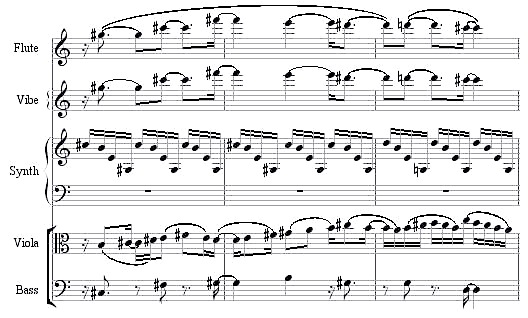
Perhaps because it deals with floating bodies, The Planets is, even more than most of my music, about obliterating the bar-line:

  Venusfives.jpg
I don't think it's often in my music that the listener can feel sure what meter is being used, and I appreciated Daniel Webster's reference in the Inquirer to my "intricate metrical joining." I like nothing better, in fact, than to start off in clear 2/4 or 3/4, and then start throwing in five-beat phrases, or change harmony on odd 8th-notes, or to simply omit rests in the melody that a regular phrasing would imply. In rehearsal last week Douglas Mapp, Relache's bassist, started pointing out "groove-inhibiting factors" in my music, and I picked up the nickname "The Groovebuster." It's not really at all that I don't like regular rhythms, but that I think written music should aim to efface the page, to sound so fluid that the listener forgets that the music is written down, and especially that it springs from obvious formulas like 1 + 2 + 3 + 4-ee-and-a. Of course, Elliott Carter's Double Concerto obliterates the bar-line too, but I do prefer in my music (and this is the essence of Totalism) to have recognizable metrical patterns for the ear to grab onto and follow - I just don't want them slavishly dictated by a recurring bar-line. 

Plenty of great 19th-century music satisfies me in this regard. It's not so much about contradicting the groove as having a meta-metrical sense on a larger level than the measure. The opening of Brahms's First Piano Concerto projects an open-ended hyper-measure, grouping phrases through its descending drone bass-line into a striking accelerando; and then the quiet second theme sustains a dazzling tightrope-walk of metric ambuiguity. The soaring, minute-long opening theme of Bruckner's Seventh lifts you to a meta-metrical height that makes the measure look like a petty unit indeed. In a grad-school Rhythmic Analysis course I chose the Adagio of the Bruckner Seventh to analyze because its rhythm fascinated me; and sure enough, I found its key in phrases that would begin a new tonality in mid-measure, delaying the resolution of rhythmic tension for minutes at a time until, at that big cymbal crash (added later and controversial), the harmonic rhythm and the phrase rhythm finally match up, resolving a subliminal but long-standing metric dissonance. Even in Mozart, I feel, however unconsciously, a satisfaction in the 15- or 17-measure sections he creates by overlapping the last measure of one phrase with the first measure of another, sounding perfectly normal but never quite letting you anticipate. 

I hear these things without trying. I have a long attention span, and I listen to music in slow, spacious units. First time I heard The Well-Tuned Piano live, La Monte ended after six hours and I looked up and thought, "What? Over already?" Music that keeps reminding me of its bar-lines and meters strikes me as fussy, like the composer couldn't stand back far enough from his music to hear it on a multiplicity of levels. I've known all nine Dvorak symphonies since I was a teenager, and they've made all the impression on me they're going to. His scherzos are sometimes rhythmically interesting; I'm fond of that in the Eighth, which falls effortlessly into ten-measure phrases, and exhibits more than his usual variety of large-scale phrasing. As with Tchaikovsky, I think he's freer, more graceful, when he's not struggling with sonata-allegro form. The world will not be altered in any respect by my finding Dvorak fussy, and meanwhile I have Bruckner, Brahms, and Mahler to remind me what glorious arcs of sound can be made by an orchestra playing in common meters. Dvorak will have his revenge, too, for the flip side is that a lot of folks probably can't hear the larger rhythmic level into which I pour the cream of my creativity.

By the way, you want to know the secret to voluminous blogging? Insomnia. I'm up at 4 AM probably because I took some Benadryl, which is supposed to make one sleep, and things that make most people sleep tend to induce insomnia in me. I'm just built different.

June 4, 2009 6:04 AM | | Comments (9) |

Categories:

9 Comments

I usually think of Dvorak's music as being "nice", not earth-shaking, but also not gag inducing. On the other had, I can't abide
Tchaikovsky. Hearing him makes think "what a waste of decent tunes."

"Paradoxical response" is the general term used when someone has the opposite to the expected reaction to a pharmaceutical, like you and the Benadryl. Looks like that might be a useful term for your responses to the Nutcracker and Dvorak as well. At any rate, this last series of posts has been great. Congratulations on the Planets. Looking forward to the CD.

KG replies: Clever juxtaposition. Perhaps my entire life has been a series of paradoxical responses.

"In my own music, I am obsessed with making the bar-line disappear."

Reminds me of Satie's approach. I've heard too many works where phrasing is limited to bar lines.

Keep on the voluminous blogging... though of course I wish all the best for your health and good sleeeping is part of that.

The other day when you wrote about Dvorák I remembered the ten-measure-phrases of the third movement of the 8th Symphony. That's very pretty and a favourite of mine. Is it derived from folk style or am I mistaken?

KG replies: Dunno. Those Slavs have all the interesting rhythms, though.

Being unfamiliar with the term "Totalism", went to Wikipedia. Are you OK with this sentence?

>>The term totalist refers to the aims of the music, in trying to have enough surface rhythmic energy (often emulating pop) to attract unsophisticated listeners, but also to contain enough background complexity to satisfy connoisseurs.

KG replies: Heck, I may have written it.

If there's something strange
In your polymeter
Who you gonna call
(Groovebusters)
If the rhythm's weird
And it sounds real good
Who you gonna call
(Groovebusters)

I ain't afraid of isorhythms
I ain't afraid of isorhtyhms

If you're seeing tuplets
Running through your score
Who can you call
(Groovebusters)
An invisible beat
Leaking through the bar
Oh, who you gonna call
(Groovebusters)

I ain't afraid of isorhythms

Interestingly Balinese music might be a counter example. The more developed music is in the simplest meters and phrase lengths. the odd meters/lengths are more common in the smaller ensembles. I think other world music examples bare this out.

One might argue it takes a good composer to make such regularity work. But i won't in this case

I am not convinced the endless meandering of the late romantics is the result of imagination any more than one would look at urban sprawl as imaginative city planning. (One might compare musical forms to the history of cities designs to in which they are created).
It basically has lead to a collapse of long forms as having much musical meaning. Perhaps the minimalist brought these back. but more often as monotheist enterprises.


Dear kraig Grady,

Early U.S. blues and country recordings -- Robert Johnson, Lightning Hopkins, Carter Family, Woody Guthrie -- frequently depart from 4/4 time from 4-bar phrases; later stuff is much more regulated/regular.

Poet/translator/essayist and theorist of ethnopoetics Jerome Rothenberg has an axiom: Primitive means complex.

I'm easy -- I tend not to mind neat 4-bar phrases as long as there's not a drummer in the group whacking out every damn beat.

Not that I'd necessarily want to play such a piece, though.

Leave a comment

Sites To See

Postclassic Radio! - Kyle Gann's internet radio station that accompanies the blog; see the playlist at kylegann.com

American Mavericks - the Minnesota Public radio program about American music (scripted by Kyle Gann with Tom Voegeli)

Kalvos & Damian's New Music Bazaar - a cornucopia of music, interviews, information by, with, and on hundreds of intriguing composers who are not the Usual Suspects

Iridian Radio - an intelligently mellow new-music station

New Music Box - the premiere site for keeping up with what American composers are doing and thinking

The Rest Is Noise - The fine blog of critic Alex Ross

William Duckworth's Cathedral - the first interactive web composition and home page of a great postminimalist composer

Mikel Rouse's Home Page - the greatest opera composer of my generation

Eve Beglarian's Home Page - great Downtown composer

Just Intonation Network - a meeting place for people interested in alternative tunings

Erling Wold's Web Site - a fine San Francisco composer of deceptively simple-seeming music, and a model web site

The Dane Rudhyar Archive - the complete site for the music, poetry, painting, and ideas of a greatly underrated composer who became America's greatest astrologer

Utopian Turtletop, John Shaw's thoughtful blog about new music and other issues

About this Entry

This page contains a single entry by PostClassic published on June 4, 2009 6:04 AM.

Sic 'omm! was the previous entry in this blog.

When Morty Met Stefan is the next entry in this blog.

Find recent content on the main index or look in the archives to find all content.

AJ Ads

Introducing
AJ Arts Blog Ads

Now you can reach the most discerning arts blog readers on the internet. Target individual blogs or topics in the ArtsJournal ad network.

Advertise Here

AJ Blogs

AJBlogCentral | rss

culture
About Last Night
Terry Teachout on the arts in New York City
Artful Manager
Andrew Taylor on the business of arts & culture
blog riley
rock culture approximately
critical difference
Laura Collins-Hughes on arts, culture and coverage
Dewey21C
Richard Kessler on arts education
diacritical
Douglas McLennan's blog
Dog Days
Dalouge Smith advocates for the Arts
Flyover
Art from the American Outback
Life's a Pitch
For immediate release: the arts are marketable
Mind the Gap
No genre is the new genre
Performance Monkey
David Jays on theatre and dance
Plain English
Paul Levy measures the Angles
Real Clear Arts
Judith H. Dobrzynski on Culture
Rockwell Matters
John Rockwell on the arts
Straight Up |
Jan Herman - arts, media & culture with 'tude

dance
Foot in Mouth
Apollinaire Scherr talks about dance
Seeing Things
Tobi Tobias on dance et al...

jazz
Jazz Beyond Jazz
Howard Mandel's freelance Urban Improvisation
ListenGood
Focus on New Orleans. Jazz and Other Sounds
Rifftides
Doug Ramsey on Jazz and other matters...

media
Out There
Jeff Weinstein's Cultural Mixology
Serious Popcorn
Martha Bayles on Film...

classical music
Creative Destruction
Fresh ideas on building arts communities
The Future of Classical Music?
Greg Sandow performs a book-in-progress
On the Record
Exploring Orchestras w/ Henry Fogel
Overflow
Harvey Sachs on music, and various digressions
PianoMorphosis
Bruce Brubaker on all things Piano
PostClassic
Kyle Gann on music after the fact
Sandow
Greg Sandow on the future of Classical Music
Slipped Disc
Norman Lebrecht on Shifting Sound Worlds

publishing
book/daddy
Jerome Weeks on Books
Quick Study
Scott McLemee on books, ideas & trash-culture ephemera

theatre
Drama Queen
Wendy Rosenfield: covering drama, onstage and off
lies like truth
Chloe Veltman on how culture will save the world

visual
Aesthetic Grounds
Public Art, Public Space
Another Bouncing Ball
Regina Hackett takes her Art To Go
Artopia
John Perreault's art diary
CultureGrrl
Lee Rosenbaum's Cultural Commentary
Modern Art Notes
Tyler Green's modern & contemporary art blog
Creative Commons License
This weblog is licensed under a Creative Commons License.