
I don’t care what the airline authorities say, Joe Biden is right. I walked onto the plane in Albany feeling fine, and walked off in Chicago two hours later with a cold. And I heard the guy sneeze behind me, big. Second cold this month, and I always get one when I fly. The dean’s office is waiting for my final grades, but it’s a beautiful summer day out on my screened-in porch. Which raises the question, how do people without blogs get out of doing the work people are expecting from them? Poor excuse-less schmucks must have to keep their noses to the grindstone, even while sneezing their heads off.
Procrastinating with Percy
Meanwhile, there’s an old, frail copy of an “Analytic Symphony Score” piano reduction of Dvorak’s New World Symphony, which I found at a wonderful little used book store in Great Barrington, sitting on my piano, edited by Percy Goetschius, Mus. Doc. I’m a big fan of Percy Goetschius, Mus. Doc. – I’ve even got the same degree. I collect his theory books, published in the late 19th century (I first found one years ago in Trimpin’s library), and love reading them. They’re bracingly, menacingly hard-core. The fourth scale degree always resolves to the third, the seventh must rise to the octave, a iii6-4 chord can only follow I, and if you brazenly start a modulation with the I (one) chord of the new key as your pivot – well, may God have mercy on your soul, that’s all Percy has to say. In my dreams I imagine teaching a beginning theory class with Percy’s The Theory and Practice of Tone-Relations (1892), but the students would feel like they were on a chain gang. Every piece of music they look at would break Percy’s iron-clad rules, and I’d have a hell of a time finding suitably strict musical examples. And yet, reading him, the reasons music is the way it is fall into place, and random-looking conventions come to seem inescapably logical. There is a reason, generally, to avoid the I chord as a pivot. Probably 98 percent of iii6-4 chords follow I with passing motion in the bass. The essence of music shines forth, isolated in the tight little net of Percy’s mandates. This is a real man’s theory, with none of your current-day liberal mollycoddling.
New World Symphony makes me wish I had taught the piece in the 19th-century course I just completed (the one whose papers I have yet to grade). I’ve never taught Dvorak, not having much use for him (I prefer the 5th, 6th, and 8th symphonies to the 9th, at least), but playing through it, I realize that the first movement of the New World is the most pedantically clear Romantic sonata-allegro I know of. Every melodic phrase is four measures. (Percy says every melody is four measures at heart: maybe two if it’s slow, or eight if it’s fast, and other lengths have to be accounted for by extensions or elisions. It’s easy to see why he liked the New World.) Every four-, two- or one-measure unit gets repeated. Sometimes the tune is the same and the harmony changes, sometimes the notes change but the rhythm is repeated, sometimes the rhythm changes but the pitches are retained, but there’s a fanatical insistence on leading the ear from measure to measure. No measure comes as a surprise, or almost even a contrast.
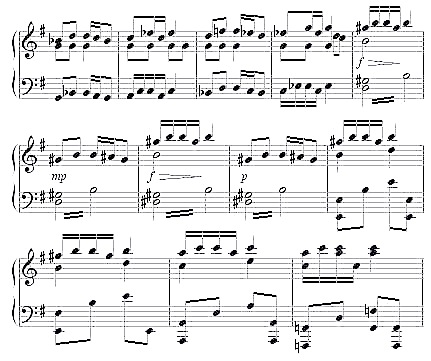
Really not so far from early minimalist practice, only less gradual and with conventional chord teleology. It’s a smooth, smooth piece, didactically so; a child could make sense of it on first hearing. Its popularity with audiences couldn’t be more explainable. Infinitely inferior to Brahms: one would almost wonder why Brahms so promoted Dvorak’s career, except that it is the immemorial habit of composers to champion other composers whose works are in the same general style as their own but not as good. (An entire history of music could be written elucidating that one principle, especially in the post-WWII era when composers came to run the new-music performance scene.) But the New World – little more than a harmonic progression articulated by repetitious motives – would make a wonderful teaching piece, a template for composing large-scale forms by monotonous formula. The subtle continuities of Brahms, Bruckner, and Mahler are a little too creative and elevated for undergrads to understand, but the New World is right at their level, and assimilating it would make those other composers shine even more brightly. – Kyle Gann, Mus. Doc.
AAAAAAACHHOOOOO!