
I finished my magnum opus today: The Planets, for flute, oboe, alto sax, bassoon, percussion, synthesizer, viola, and contrabass, commissioned in stages by the wonderful Relache ensemble in Philadelphia. It’s just over 70 minutes long, a 346-page score, in ten movements, my own personal Turangalila. I started writing it in January of 1994, sitting on a plane en route to Seattle next to Laurel Wyckoff, the ensemble’s former flutist. They commissioned the first four movements as part of the Music in Motion project, by which ensembles and composers flew to distant cities to collaborate. The concept was that I would compose every morning and in the afternoons the ensemble would run through what I’d written. I used to be a fairly slow composer, and the plan terrified me. But, under pressure, I wrote the first movement, “Venus,” in a week, and, realizing I could write as fast as someone told me to, I’ve been a fast composer ever since. In fact, I date the coalescence of my mature style from that trip. I was 38.Â
I had always planned to write more movements than the initial four I wrote then, and in 2001 Relache came up with another commission. Their instrumentation was so odd (so difficult to keep that viola audible) that I was reluctant to write a major work for them without assurance that they would play the whole thing, and for years they were in such financial straits that I was afraid to proceed. Also, their instrumentation had changed before, and I feared it might change again before I could finish. But last fall they called and said they were ready to record the work for CD, and told me to get my ass in gear and get those other movements in. So I have, and we start recording next month. Of course, the obvious question is, had my compositional habits so changed over 14 years that the end of the piece would come out very different from the beginning? But I had formed a firm idea back in the ’90s of what each movement would do, and I stuck to my original conception. It’s pretty consistent. “Venus” remains, I think, one of the best movements.
This is my big astrological piece, and of course, there are always people disappointed or horrifed by an admission of any interest in astrology, because most people know next to nothing about it, and have a caricatural view of it associated with newspaper sun-sign columns. I came to the subject via a respectable route. Reading Cage as a teenager interested me in the I Ching and the idea of synchronicity. That led to an interest in several other forms of mysticism, and, eventually, a close devotion to the music of Dane Rudhyar (a far more important and fascinating composer than all but a few of us cult fans will ever admit) led me to embark on reading some of Rudhyar’s 30-odd books on astrology, beginning – as one must – with The Astrology of Personality. Add to that an addiction to the writings of Jung in grad school, and I got caught up in a Jungian conception of the field, based on synchronicity rather than causation. The most important recent writer on the subject is Liz Greene, a brilliant Jungian psychoanalyst.Â
There were other, more personal influences as well. I once worked for an arts organization whose entire staff were clients of the excellent astrologer Doris Hebel. Arts-world interest in the subject is vaster than people talk about. Almost any composer on the New York scene can tell you, if asked, their sun, moon, and rising signs. It’s a social thing. Cage himself was a long-time client of the New York astrologer Julie Winter. I’ve collected music based on astrology, including Holst’s eponymous work (one of my favorite orchestral warhorses), Constant Lambert’s Horoscope, George Crumb’s pieces, and the Interstellar Space recording of John Coltrane, with pieces entitled Mars, Leo, Venus, Jupiter Variation, and Saturn. I took courses in astrology at (apparently defunct) Isis Rising bookstore in Chicago, and, like Holst, I’ve done readings for many a fellow composer. In fact, in 1986 my income as a freelance critic was dwindling, and, having failed (I thought) in that field, I was looking into how to get started as an astrologer when from out of the blue Doug Simmons called me from the Village Voice and offered me a job. (If you know something about astrology, it may interest you to hear that on that very day, Saturn crossed my ascendant and Uranus transited the ruler of my house of employment. Very significant.)Â
I used to fantasize about reviewing concerts astrologically, in advance, like: “Don’t bother attending Nic Collins’s Roulette concert this Friday, Mercury is retrograding over his midheaven, and it’s a sure bet his equipment will malfunction.”
I have to add, too, that with 12 zodiac signs divided into 30 degrees each, with a wealth of experimental aspects like quintiles and septiles calculated within certain degrees of orb, astrology offers a number of delicious parallels with the 12 fluidly-defined pitch areas and continuum of consonances in microtonality. I’ve long savored the feeling of moving smoothly from one to the other without seeming to change the kinds of geometry I’m dealing with. And then, my fascination with rhythmic cycles going out of phase with each other, much manifested in The Planets, was always partly driven by a “music of the spheres” paradigm. Whatever mathematical way my brain is hardwired that drew me to Henry Cowell’s rhythms and Ben Johnston’s scales made me a sucker for astrology as well. Jupiter circles the sun every 12 years and Saturn every 29 years, with a conjunction approximately every 20 years? Now that’s a rhythm, cut me off a piece of that! It’s not all just, “Oh, you’re a Libra, so you have trouble making up your mind.” There’s as much math as you want.
So comments challenging me to defend astrology will be ignored. I never defend astrology, nor proselytize for it, nor say I “believe” in it. I have no idea why astrological transits sometimes seem startlingly relevant, but, like the I Ching, it is an ancient worldview containing a wealth of psychological insight that greatly widened my understanding of human behavior. There are even astrologers who consider it no more than a kind of elaborate Rorschach test, which is certainly one way to understand it. Like anyone who knows anything about the field, I never read newspaper sun-sign columns except for amusement. If you want to bash me for taking an interest in it, go ahead and blast Cage and Coltrane, and feel free to throw me into their camp. I’ll be honored.Â
My mother likes to say, “I don’t believe in astrology; Aquarians never do.”
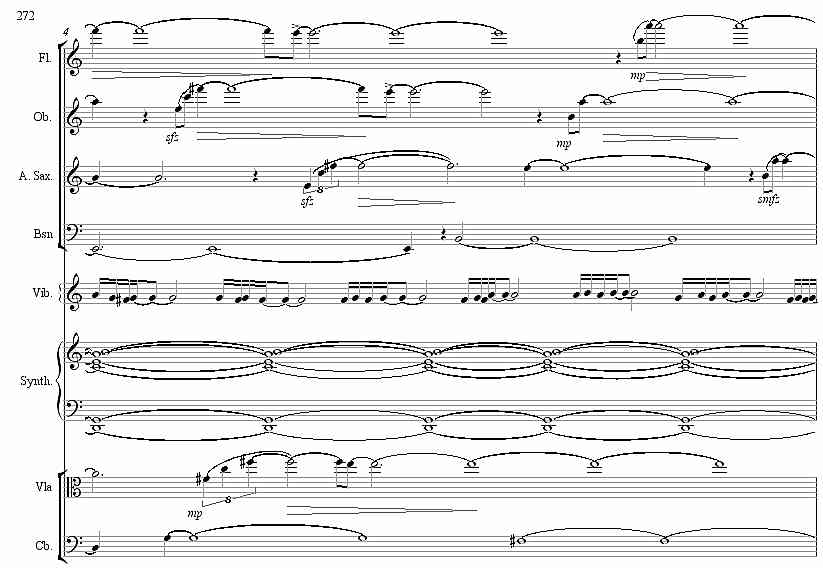
In any case, as I say in the program notes to the piece, music may not have progressed since Holst wrote his Planets, but astrology has. Rudhyar ushered in an era of “free will” astrology, according to which transits are psychological forces which, if understood, can become channels to new understanding, by which otherwise fated-seeming actions can be avoided. As astrology is now understood as process rather than fate, and minimalism created a new musical paradigm of process-oriented composition, it was time for a new set of Planets to fuse musical processes with planetary ones, rather than the more conventional melodies and atmospheres of Holst’s grand work. I have three more movements than Holst: I include the Sun and Moon, which astrology refers to as “planets,” and also Pluto, which wasn’t discovered until 13 years after Holst finished. (The demotion of Pluto by astronomers has had no effect on astrology.) Each movement follows a process that expresses the idea of its planet. “Sun” is an additive process in the shape of a sunrise. “Moon” is full of melodies and rhythms going out of phase. “Saturn” is a chaconne in which harsh, immobile dissonances are gradually replaced with gorgeous lines of counterpoint. “Uranus” is a jolting collage of constant surprises. The fog of “Neptune” (pictured) has the performers in eight unsynchronized tempos. And so on. John Luther Adams and I agreed that he’ll write music about the earth, and I’ll handle the rest of the solar system.
So after 14 years (half a Saturn cycle), I’ve finally completed the longest instrumental work I have any thought of writing. You can hear the movements that Relache has already performed here. They premiere the entire work in Philadelphia and possibly New York September 26 and 27, by which time we’re hoping to have the CD available as well. It’s a weight off my shoulders. I have dreams of orchestrating the work, but what would I do with a 70-minute orchestral score? Make a nice MIDI realization?