
A Truly Loopy Idea

The idea of different-length loops running at the same time and going out of phase with each other, which I wrote about in the Totalistically Tenney post, is one I've been working with for more than three decades. It would be, if anyone knew much about my music, the idea with which I am most associated. I first used it in 1975 in Satie, my Opus 1, so to speak (here the loops are 11 against 19 against 6, as measured in 8th-notes, and the upper lines use a note-permutation technique that I later learned Jon Gibson and Barbara Benary were using as well):
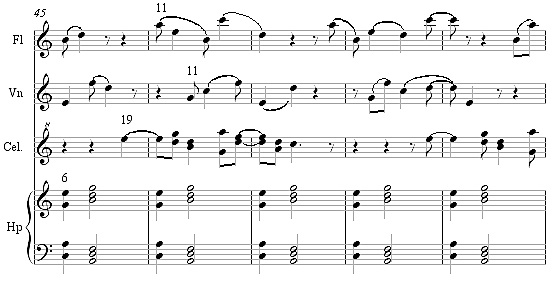
Satie1.jpg

and most recently in Sunken City, the piano concerto I just completed (with indicated loops of 7, 5, 13, 11, 9, and 21 quarter-notes):
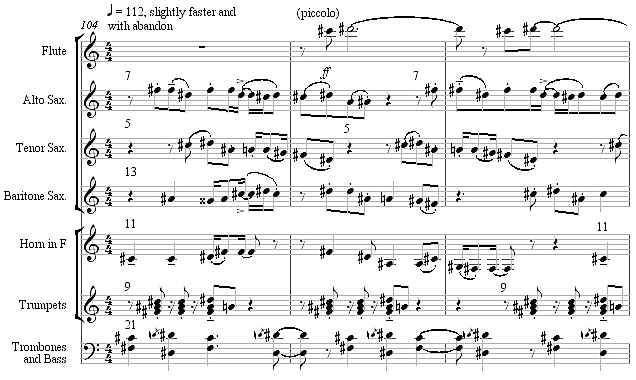
SunkenCityexample.jpg

In between it's been the basis of perhaps half the pieces I've written, and the most characteristic half at that. Most people I mention my piano concerto to ask me if I retuned the piano. I guess everyone associates me with microtonality, but only about a third of my music is microtonal, including almost none of the acoustic music, and rhythm has always been more crucial to my music than pitch. I became electrified by microtones in 1984, but my fascination with polytempo goes back to 1969, the year I discovered Three Places in New England, and I have rarely written a piece in which the primary interest wasn't rhythmic.

And so much of my music uses repeated phrases of different lengths, played at the same time. The question is, what does it do for me? And even before that, what do I call the idea? I sometimes refer to my "nonsynchronous simultaneous loops," which is a horrific phrase; no antibiotic has so off-putting a moniker. I wish someone would come up with a name for my particular -ism, but I am reluctant to do so myself, even though I am far from being the only person to widely explore the idea. In any case, out-of-sync-loopism is not an inherently rewarding device. Unlike the gradual phase-shifting Reich discovered, it does not immediately arrest the ear. Unlike the 12-tone row, it does not offer any theoretical guarantee of deep underlying unity. In fact, it's a difficult idea to make work. As you can see from the first example, Satie, it's pretty easy to do if you want to float around in an unresolving, unchanging, pandiatonic cloud, which was the first solution I came up with. That much is easy, but it didn't satisfy me for long.

The idea of out-of-sync loops has many roots, all of them (so far as I know), American, although it would probably be possible to cherry-pick examples from The Rite of Spring. Henry Cowell implies the device in New Musical Resources, and momentary examples are common in Ives. Nancarrow's early music bristles with the device, especially Studies Nos. 3, 5, and 9; but I was already using it in 1975, and heard none of Nancarrow's music until the New World recording came out in 1976. The other root for the technique is easy to overlook: it is John Cage, for if you start a couple of loops repeating against each other, and agree in advance to accept whatever unforeseen clashes and unisons arithmetically result, that's much like accepting the results of a chance process. And it was originally a strong interest in Cage that made me willing to repeat a 31-beat melody against a 43-beat melody and be willing to accept whatever dissonances and consonances would eventually arise from their relatively unforeseeable combinations.

And so I've worked with the idea, and worked with it, and worked with it, and some of the attempts have been disastrous, others merely dull, and a few glorious. Blake's inspiring line, "If the fool would persist in his folly, he would become wise," has always been my motto, and I have exhibited a stubborn Scorpio persistance in my faith in this device that the consequences alone would never have justified. Set a bunch of repeating loops going, and certain uninteresting eventualities are virtually guaranteed. Take a loop of 11 beats against one of 13: in 143 beats they will have cycled through every possible combination, and unless you've calculated shrewdly, some of the results are bound to be awkward or redundant. In addition, the music is guaranteed to remain fairly static: the device generates ever-new combinations for awhile, especially if you have enough lines going, but the component materials themselves never change. A lot of the effect depends on what numbers you pick. Back in the '80s, I leaned on the Cagean aspect of the idea, with loops of 103 beats against 173 against 211 (all prime, of course), so that truly unplanned combinations would result. More recently, I use smaller numbers to create a more audibly pulsing texture, and play free and loose with harmonic alterations to ensure more surface interest.

Still, between the Scylla of unpredictable collisions and the Charybdis of predictably unvarying content, the out-of-sync loop device would seem to harbor more pitfalls than advantages. I have to ask myself, from time to time, why I keep trying to make it work; and I answer myself here, not only in the quest for self-knowledge, but because I'm giving a paper on this subject at a minimalism conference at the end of August, and I need to be able to explain not only why I but why other composers have been so fascinated by this problematic paradigm.

Number 1: it relates to some vague idea we all have of the medieval Music of the Spheres. Watching the 19-year cycle of the moon's orbit go out of phase with our revolution around the sun is a primordial human experience: too slow to observe on a weekly basis, but crucial for agriculture and calendar-making. The visible planets Mars, Saturn, and Jupiter also exhibit phasing relationships against the background of the stars, and the cycles of those planets (along with the invisible orbits of Uranus, Neptune, and Pluto) connect the nonsynchronous-looping idea with astrology. So looping at different rates has a deep philosophical connection with our experience of the moon and other planets. Certainly some of my interest in the idea was encouraged by all the grad-school work I did in medieval music, in which the Music of the Spheres was a potent theoretical paradigm.

Number 2: Looping segments of different lengths is one way to create a static musical texture without allowing any literal repetition. A couple of my pieces, like Windows to Infinity (1988) and Cosmic Boogie-Woogie (2000-1) employ the idea mechanically, and thus would eventually begin repeating literally if played for thousands of years. I am not much interested in literal repetition, but I am very partial to pieces that never stray from their opening premises. In some pieces I have learned how to use lines that inflect the harmony chromatically, so that the confluence of loops doesn't limit me to a static pandiatonicism. My favorite such passage is one in plain quarter-notes from Time Does Not Exist (2001) (with loops of 13 against 19 against 23):
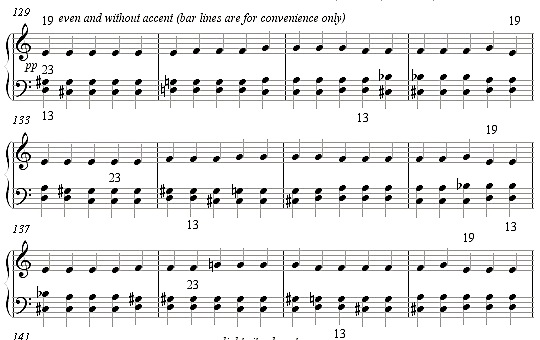
Timeexample.jpg

Number 3: It's a way to suggest the idea of different tempos at the same time in an ensemble context without actually asking people to play at different tempos. In the early '80s I was writing pieces (Long Night being about the only successful one) in which performers watched silent, blinking metronomes to play repeating phrases at different tempos. And of course, several of my Disklavier pieces, most notably Unquiet Night, use the idea with actual polytempos.

Number 4: It allows for a feeling of pulse, but destroys any overriding sense of regular meter. There is a vague sense of melodies, high notes, rhythmic motives, recurring; but since each line recurs at a different place with respect to the others at every repetition, there is a non-metric wash to the sound that, when it really works, I find rather ecstatically trancelike.

Number 5: Morton Feldman was inspired by the mobiles of Alexander Calder to write pieces in which various repeating motives float by one another in continually changing temporal relationships. Why Patterns? is a particularly clear example. As far as I know, all such instances in Feldman's music allow the players to play at their own rate, unsynchronized, so that exact relationships among the repeating figures are, in a detailed sense, unpredictable. Using repeating loops in a synchronized, metric context allows one greater control over the resulting relationships. There is, of course, no strong reason to maintain a mechanical rate of repetition, and in recent years I have sometimes only approximated the effect, conveniently avoiding unwanted clashes.

For me, these are potent philosophical, psychological, practical, and perceptual reasons to continue trying to make the idea work. It has often not worked, and (like Cage with his chance processes) I have often had to revise and revise until I liked the results. One of my best successes, I think, is in the last movement of Transcendental Sonnets, in which the entire orchestral texture (except for the climax about 3/4 of the way through) is pervaded by nonsynchronous loops, filtered through periodic changes in harmony; you can hear the result here. Every few years I seem to make some breakthrough to a more effective use of the idea. Out-of-phase loops can also be heard in Mikel Rouse's songs of the 1990s, and in Michael Gordon's pieces of the same period, like Yo Shakespeare (1993) and Trance (1995); and one can, of course, find similar ideas - usually with only the rhythms looped, and not the pitches - in the musics of John Luther Adams, Art Jarvinen, Joshua Fried, Diana Meckley, Larry Polansky, Evan Ziporyn, Eve Beglarian, Rhys Chatham, Glenn Branca, and others. I'm afraid I'm probably fated to keep working with the technique. It's like the speck of dirt that gets into an oyster, irritating him until he builds a pearl around it.

June 23, 2007 12:05 AM | | Comments (28)

Categories:

28 Comments

I don't know how seriously he's taken here but Frank Zappa has a number called "Toads of the Short Forest" (from Weasels Ripped My Flesh), the midsection of which has three loops going simultaneously in 3/4, 5/8 and 7/8. There may be more musically compelling examples elsewhere in his work but I think this instance is most significant because he tells the audience what is going on.

KG replies: I have heard that, a long time ago. Frank Zappa is taken very seriously everywhere.

I was in an art rock band in the early 80s where a few of the tunes had multiple riffs of different, usually relatively prime, lengths played by different instruments. In fact, one number consisted only of a set of ostinati, one per part, and was titled 4.7 x 10^6 (pronounced 4.7 million), which referred to the approximate overall period of the whole mess in beats. I didn't use the technique that much in my own music, even though I may have wanted to, mostly - and I'm a little embarrassed to admit this - because I had read the annotation of example 35 in Messiaen's Technique de mon language musical where he describes "Our first essay in polyrhythm, the simplest, the most childish, will be the superposition of two rhythms of unequal length, repeated until the return of the combination of departure." The added emphasis is my own. There was something about that 'childish' comment that put me off the whole thing. One more example of my musical education hindering rather than helping me.

KG replies: Great post on your web site, Erling, very moving.

Nice article, Kyle.

Like you and everybody else, I am fascinated by this rhythmic issue, and it does go back to medieval technique. It's a very Appolonian approach for sure.

For what it's worth, I've been straying away from such blatantly algorithmic approaches; although I still find them interesting, I usually find the results far less interesting than the non-algorithmic use of my ear/mind to tell me what is really interesting, and I guess for me, I need the unpredictible twists and turns and surprises of broken rules and patterns to keep things interesting. I hear you say: "but it is unpredictable to set these lines up and not know what you're going to get"....in that case, I would respond that I mean meta-unpredictibility.

In a phrase: I want to avoid, as much as possible, being lazy in writing my music.

My sense is that my best, most moving, most interesting music doesn't rely on such 'tricks', but allows for subversion. I truly believe that, speaking for myself, I can hear the laziness when I do write this way, and I end up *not* liking it in the long run.

OTOH, the alloy of such tricks with an ever active creative flow has proven itself to be quite potent.

KG replies: Well, me too. There's a lot of intuitive mystery you can get out of the technique by tweaking it and using it for momentary texture. I don't write music mechanically.

I am happy to hear I am in good company, as this very style of composition is something I have almost entirely settled on working with (at least pre-dominantly) throughout the near future (as well as other minimalist/music-following-minimal musical techniques).


My question, as of late, with this methodology, is how to take it from essentially saying "look at this that i set up" to actually dragging some sort of structural significance out of this idea. I feel like I am currently stuck in the "look at this..." realm, setting up cross-rhythms and assymetrical loops and essentially letting them go, which is exactly what a number of you have mentioned struggling with. Unfortunately, I can offer no advice, or some manner I have come up with that seems to bring more out of said methodology.


Perhaps it is only me, but I frequently find myself a little disappointed with this technique after it has been performed for the first time, sitting at my desk/piano with the score and the recording, and wondering why such moves I was quite happy with while composing seem to lead to false-promises in the piece (i.e. significant events that never seem to actually happen). I suppose that is the name of the game, though. Not that there is anything wrong with the Reich-ian (or Cage-ian, etc.) manner of setting it up and letting it go, but I cannot help but feel that I should be able to get more out of such attempts (though this is the style I wish to compose in). This will probably just take time...


Regardless, I am happy to hear that this is not a problem only I am running into with such methodologies.


Kyle, did you find transcribing parts of Eno's ambient series beneficial at all? I have considered it a number of times (mainly in regards to "Discrete Music"), but eventually convinced myself that I would not get a lot in return for my efforts.

KG replies: I'll date myself, but I was analyzing Eno back in the vinyl days, and I never made it past the psychological barrier of flipping the record to side two. I guess I got something out of figuring out that the melody of 1/1 never changed appreciably. Listening to it lately, I wish I had taken a stab at 2/2.

Not Prince, but noted 80s pop band King Crimson did this kind of thing in, eg, "Discipline" from the album of that name.

KG replies: *That* I can believe.

While Henry Cowell only got a brief mention in Kyle's article, for those Rhythmicon fans out there, this Spring Cowell's Rhythmicana was performed for only the second time (I believe) by the Stanford Symphony Orchestra with Max Mathews performing the looping Rhythmicon part on his Radio Baton. The work was then recorded at the Skywalker Studios in San Francisco and hopefully will make its way out on cd sometime in the near future.
link: http://ccrma.stanford.edu/concerts/c_schedule.html#madeatstanford

I feel like gannons have an odd cognitive resonance with this:

http://en.wikipedia.org/wiki/Rotor_machine

The idea isn't really the same at all, of course. First of all, the cryptographic device has an input and an output - the musical device, not so much. And the musical equivalent of the two-rotor machine described in the article would be one 4 note loop in quarter notes and another four note loop in whole notes, which is deadly dull by metametric standards. But it would be extremely easy to make a rotor machine that did work like a gannon (or a polyphonic isorhythm, or whatever you want to call it).

"music can be made with any weirdo ideaas long as the composer is willing to step back and apply some self-criticism as to whether it's working or not."

Ain't it the truth. As Persichetti used to say, "There are many ways to write bad music," by which he meant that the answer was not in the methodology, but rather in how closely the composer is paying attention to the results.

RE your point 1: I think our generation was the first to seriously study Medieval Music in school, which raises a chicken-and-egg question - did this generation find inspiration in the multiple isorhythms of the ars nova, or did we find ars nova fascinating because it was dealing in principles similar to ours?

Your dissection of the limitations of this approach is excellent: those are the problems that led me to stop composing this way after the 1980s. But I can definitely relate to your desire to keep plugging away at it, trying to find a way to make it work, because of the attractions you've listed.

KG replies: Thanks, Lawrence. I think music can be made with any weirdo idea as long as the composer is willing to step back and apply some self-criticism as to whether it's working or not. And I think what went wrong with 12-tone music, and later with free improv in the '80s, was that people had too much blind faith in the idea, and assumed it would carry them through by itself. I never had that kind of faith in out-of-sync loops.

Point of clarification?

falikilunj brings up Brian Eno, and its unclear in your response whether you're saying "Eno doesn't do this" or "Eno does it but in the same ways I've already described, so bringing him up doesn't really give us new information." You mean the second, right? Something like "Music for Airports" seems to me like a pretty clear example of what we're talking about, unless I'm seriously missing some critical point. . .

KG replies: Well, maybe both. I listened to Music for Airports round the clock in the late '70s, and even transcribed some of it, but it wasn't until much later that I read something Eno wrote about the looping in it. I still can't hear most of it: the first track plays the same melody over and over, and the second and fourth, beiing uni-timbral, make any such form impossible to hear. So I never experienced it as part of that movement, and certainly never connected it with the New York rhythmic complexity movement of the '80s and '90s, in which you can clearly hear multitempo things going on. Maybe some people I knew were influenced by that, but no one ever mentioned it. I was certainly influenced by other aspects of Eno.

I've used multipulses since 1975. But I use pulses that are every close to eachother. I also like the prime numbers also: 53 59 61 67. I have used these prime numbers over and over again. My pieces start with a simultaneity and the parts spread out to form an arpeggio-like sound. The listener can actually hear the different parts expanding-compressing with eachother at the end of each sections. I finish with what I call the Grand Conjunction. Also planetary in scope.

KG replies: Sounds fascinating. I'd love to hear it.

mclaren says "Mozart's internally symmetric themes amplified into large-scale regular phrases..."

mclaren has the wrong classical composer. If anything is characteristic of Mozart it is his assymmetical phrasing. Take the catalogue aria from Don Giovanni for example. (Or even better Michael Nyman's parody of the first 13 measures, In Re Don Giovanni).

KG replies: It *is* rather amazing how often Mozart's regular-sounding phrase groups add up to 15 or 17 or 19 measures.

Polyphonic isorhythms. As Lou Harrison once told me, "It's terribly hard to actually invent anything." Some guy in Paris in 1100 A.D. usually did it before we did, and often better, with more sophistication. At best, we usually only manage to do riffs on their innovations. It is of the new we tire, of fashions and superficialities. - Vitruvius

Rouse and Gordon and others not only use mututally prime length polyrhythms, they use polyphonic isorhythms that exhibit internal asymmetry as well as overlapping irregularity. A pattern of 7 might be broken up into 4 in the time of three, for example, followed by 4; or a pattern of 19 might contain internal triplets or 5-tuplets. The irregularity is fractal, extending down to the level of the sub-phrase as well as upward across the barlines.

To use a visual analogy, the difference twixt classic common practice music and modern music is similar to what you observe between the regular tilings (squares, triangles, hexagons: there are only 3) often used in classical architecture, and Penrose tilings, a modern innovation. The three regular tilings produce the same pattern wherever you look no matter how far you go. A Penrose tiling keeps producing different patterns as you go farther and farther away from your starting point. Compare with Elliot Carter's description of his music as "projecting time on a curved screen."

http://www.uwgb.edu/DutchS/symmetry/penrose.htm

Ivor Darreg pointed out that from the Renaissance up to the end of the 19th century, Europeans viewed the universe as a cosmic clockwork operating with Newtonian regularity. Pierre Simon de Laplace once exclaimed, "Give me the positions and velocities of all the particles in the universe, and I will work out the future for you." [Laplace, Pierre Simon de, A Philosophical Essay on Probabilities, transl. by F. L. Simon, New Dover Books, New York, 1998]
We now know this is not the case, as even the simplest dynamical systems exhibit non-linear properties and can (depending on initial conditions) become impossible to predict.

This offers a useful analogy for the metrical regularity and regular musical phrasing of common practice period music, as opposed to the more complex and unpredictable metrical structure of modern music -- particularly post-Nancarrow music.

Accordingly, we would expect the music of the common practice period to celebrate regularity and symmetry -- Mozart's internally symmetric themes amplified into large-scale regular phrases mirror the periodic recurrence of cycles of the moon, tides, the orbits of the planets, and the precession of the fixed stars that made up their Newtonian worldview. Starting with special relativity in 1905 and soon afterward with the eruption of quantum mechanics and general relatively, however, people began to realize that we live in a highly non-linear universe full of black holes and supernovae and wave/particles which diffract through solid crystals (Bragg diffraction). 20th century art (cubism) and music (Rite Of Spring, Nancarrow's Studies, Cage's Three Constructions) and space-time-fractured drama (from Luigi Pirandello's Six Characters In Search Of An Author and Dos Passos' New York trilogy to Quentin Tarantino's Pulp Fiction) reflect this change in worldview.

Perotinus and Longinus used regular isorhythms because they saw time and space as static and measured against a fixed reference frame, as Aristotle decreed. We use irregular overlapping polyphonic isorhythms because in our century time and space distend and warp fluidly and can collapse into singularities, as Einstein's general theory of relativity requires. In such a worldview, irregularity and asymmetry are naturally celebrated as the rule rather than the exception.

During one of our conversations, Ivor Darreg noted that steam-powered factories were constructed vertically around the central steam engine, with all the floors feeding out drive belts which ran at the same rate as the master driveshaft, so everything in the 19th and early 20th century factories was hierarchical and uniform and centralized.

As electrical power replaced steam power in the 20th century (Ivor remarked), factories became decentralized, collapsed from multi-storey vertical brick buildings into a single storey and exploded outward into sprawling multiple corrugated-metal prefab buildings, and allowed each worker to run separate machine tools at varying speeds.

Ivor pointed out that this seemed to mirror the change in compositional methods from the 19th century (hierarchical, centralized, uniform structures and regular key-changes and regular tempi) as opposed to the post-1920s 20th century compositional techniques (irregular, multiple simultaneous tempi, asymmetrical, polytonal, broken up into wildly contrasting sections, and favoring bricolage over ignano or sonata-allegro methods of musical development).

Ivor used to say that someone could write quite a revealing history of 20th century composition by tracing the changes in the organization of the workplace caused by technology and relating them to the changes in methods of musical organization -- sort a musical version of Future Shock. I really wish I had a tape recorder running when I used to go over to Ivor's place and talk with him. He used to throw off casual insights like this all the time: deep connections that other people would expand into entire journal articles, he'd just mention as casual asides.

Sorry to disappoint you authentic types but the Purple Midget, Prince, was doing this with pop hits in the 80's and doing it so well you can barely tell.

Brian Eno: Repetition takes on its own form.
Also, check out, if you can find them: Neurotec, Kung Fu Junkies, Cigarettes.

KG replies: Hey, here at Postclassic we don't make blanket dismissive comments without offering specific evidence. Some relevant Prince song titles, please, and we'll be the judges. Brian Eno's entire output, for instance, I'm thoroughly familiar with, and I wouldn't change a word I've written based on the information. If you think Eno changes the argument here, you may be similarly mistaken with Prince, so let's hear some examples.

There are "microtonal" ways to create a kind of field of cohesion in a tuning, which I find very effective for all kinds of heterophonic/accidental counterpoint and "process" stuff. The most effective may be too effective- after creating stuff with these tunings that looks like hell on paper but sounds "like church music" to listeners, I'll have to try more brutal techniques like your asynchronous loops to getting anything resembling a nasty dissonance.

AFAIK Kraig Grady of "Anaphoria Island" has been doing (consciously) this kind of thing the longest; I just stumbled across it as a byproduct of working on different ways to create cohesions in a tuning, and maybe something rubbed off while drinking beer in in Tartini Square in Piran.

Anyway, if you tune rationally like this, for example: 13(+n)/13 to 26/13 (the octave), you get a "differentially cohesive" tuning, the Tartini tones (difference tones) of which, when octave-reduced, return the tuning itself (there are other properties which you'll notice immediately). Having stumbled across this through working with what I call "shadow" tunings, ie a contrapuntal voice tuned to the potential Tartini tones of another voice etc., I call it "shadowless" tuning.
Maybe it's worth a try.

As far as the rythmic approach you're writing about being African, I would disagree, if "African Polyphony and Polyrhythm" (the sturdy one with the Ligeti forward) and all the African music I've ever heard have any say in the matter. But this opinion is based on the admittedly hickoid and ignorant view that what's (not) percieved is more important than what's on paper. "If it sounds different, it is different", to paraphrase Ellington.

The ergot in the rye of the whole Minimalism story, ergo the wryness of Mr. Gann's writings, is the Americaness of it all. Since the first step of grasping what "American" even means requires dumping about 500 years worth of education, Mr. Gann your whole enterprise is pretty much fucked from the git-go and I love you for it. :-)

the multi-loop thing, when I first heard and was aware of it in Beefheart's music, was for me - dance music. I think of it as something like difference tones. When the organ player plays the lowest C/G available on the pedals, and what you hear is a non-existent C, off the pedals. I could never dance very well to regular pop tunes, but the different meters and tempos going on in Beefheart tunes would seem to get a knee going at one speed, and an arm going at another, and it always felt right and felt good. I can dance to Lick My Decals Off, Baby - and you're not supposed to be able to.

"I can't help but think that in a *healthy* musical climate, when you started out you would have been as familiar with Rouse's and Gordon's and Jarvinen's use of the technique as I was with Reich's phase-shifting in 1974."


No kidding. Not that I didn't learn lots of other stuff when I was starting out, but the minimalism family is seriously underserved. I've learned a tremendous amount from your blog and your earlier essays at New Music Box back in the day. This seems like a good opportunity to say thanks :)

KG replies: You're welcome!

Also Robert Erickson's LOOPS (see this http://www.ex-tempore.org/Loops/Loops.htm ), a different approach, starting from the sum of the loops and working backward to the individual lines. Erickson was Terry Riley's teacher and later Paul Dresher, who both use loops.

What? I didn't invent this?


I like it because it's a way to extend material by repeating without repeating. I just like repition. I just like repition.


I did a piece once for hammer dulcimer player that I knew. She was complaining that all the pieces in the standard repitoire were too easy. So I had her re-tune her strings for a 7-limit JI tuning and then had her play two lines against each other. I think instead of prime numbers, I did phrase of the fibbonacci series.


So the challenge for her was both that it didn't repeat exactly, and not all of the string were usable because of the retuning.


She only played it once and said she more wanted to split the difference between that standard repitoire and what I would write.


(And people ask why I mostly write computer programs . . .)

Do we really need a new term for "nonsynchronous simultaneous loops?" We're basically just talking about isorhythmic overlap.

KG replies: Well, isorhythmic overlap is a new term to *me*. I find ten references on the web, some of which have to do with medieval music, where it means something a little different. But we can run it up the flagpole and see if anyone salutes.

Lalo Schifrin's Mission Impossible scores in the '60s (not his famous theme, but the incidental music) used this idea to great effect: sets of 4 or 5 different-length sparse loops (2-5 attacks in 8-12 beats) at slowish tempos, especially during scenes of guys fiddling with wires in air-conditioning ducts.

Great post. I frequently use loops of different lengths in my music and it's wonderful to read one composer's views on the meaningfulness and usefulness of the technique. Like you, I have a fascination with it and seem to gravitate toward it naturally. Your reasons 2, 3 and 4 are the ones I generally have in mind when I write in this way. For me, the effects of this type of rhythm are a metaphor for our existence and our perception of time: When you look at world around you, people and objects seem solid, fixed--unchanging (like the rhythmically identical repeating phrases). There is your wife sitting beside you, there is your coffee cup, your computer--they aren't going anywhere. But in reality, of course, everything is in a state of constant flux, unceasing change (like the relationships among the various out-of-phase loops). I know that all sounds a bit awkward, but it's the best way I can explain it. The pieces heard here all use the technique in one way or another, which, for lack of a better term, I simply call "multicyclic."

Kyle, have you ever used the technique in microtonal music? It seems like you could partition available pitches in a large-enough scale among the loops in way that avoid unisons, at least.

KG replies: Only in Custer and Sitting Bull, and there it's mostly pitches versus drums. I have trouble bringing full rhythmic intensity to a piece in which I'm trying to think microtonally. Reaching that point has been my aim all along.

Kyle, I associate your nr. 4 reason with the term 'metametric': a higher sense of meter that is 'beyond meter' and that can, indeed, produce a peculiar kind of ecstacy - one that I associate again with a sense of the panoramic. It seems to be what I was after when I started using related techniques in my work.

Does this view make sense to you?

KG replies: Absolutely. Every now and then I try to write an explanation without using any special terminology, to disarm all the readers who reflexively dismiss any music that someone's applied an "-ism" to.

I've been working with different-length loops for some years, applying the principle (Polyloopism?) to rhythm and pitch, sometimes independently, sometimes interdependently, as in isorhythms. I started by interleaving patterns of different lengths, as Reich did to get the Piano Phase pattern. Most often I have used lengths that were prime to one another (I'm currently working on the second of two pieces to use the title Prime Times) though this is only necessary if one insists on having all possible juxtapositions in the cycle. I came to realize that I like the notion that there is a rigorous process going on but that the pattern can't be readily heard. That is, on a local level predictability is low, yet there is (should be, at least) a sense of rightness. And while the full cycle may take hours to complete itself, there is often repetition of small segments that then become motivic. In some cases the motives are strictly rhythms or pitches, in some cases both. I identify most strongly with Kyle's Reasons 1 and 2, and I feel very much as he does that there's still good reason to continue working with loops.

KG replies: Paul, I almost added yours and Bill Duckworth's names to the list, but I could only think of pieces in which you cycled loops of the same length (like the first movement of Interleavings). There's clearly a lot more of your music I need to analyze.

New Dictionary entry:

Gannon: music [that] uses repeated phrases of different lengths, played at the same time

KG replies: I got a very good laugh out of that one. Thanks.

The great American loop composer is Alan Hovhaness.

KG replies: Interesting. I've never had one of his scores to look at. Will check it out.

Repeated cells of different lengths going in and out of phase with each other is one of my standard techniques too, and of course it's one of those things that I think I invented myself but obviously I can't possibly have actually done so.

My main reason for using the technique is your Number 2. I'm very interested in establishing relentless grooves that evolve over time and feel static without actually being repetetive. One thing that I actually don't care much about at all is whether the listener know's what's going on. Whereas some composers want the audience to know that a phasing process is underway and to listen specifically for the artifacts of that process, I'm only interested in that general feeling of non-repetetive stasis.

I actually tend to approach Number 3 from a slightly different angle. I definitely like having a steady pulse, but I also like the way in which changing some loops while leaving others the same allows for metric modulation. In a given set of loops I sometimes set up one of them to be dominant and establish a feel of a meter, but then later on I'll leave that loop going and bring in a new loop in a different meter that becomes the dominant loop. So the 4/4 goes for a while, and then even though the 4/4 still exists the dominant metrical feel will be, say, 7/8.

The best example of the technique in my music is probably my two-piano piece "Systems of Preference or Restraint" (which was played by Hugh Sung on the S21 concert). Almost the whole construction of the piece is sets of different length cells which start at the same time and go out of phase with each other. Then, when they're about to sync back up again one or both of the cells changes. That procedure isn't always followed strictly, but it's the underlying premise. You can hear an MP3 here and view the score here

I was a little surprised to see you say "The idea of out-of-sync loops has many roots, all of them (so far as I know), American." It seems to me that the polymeters in a variety of non-western musics, such as West African drumming, are pretty clearly the same idea. Each repeated cell establishes its own "meter," and in fact I believe that in many cases cellular repetition is part of what establishes the polymeters in those non-western traditions. The polymetric looping strategy relies heavily on an additive rather than divisive concept of meter, and I suspect that conception was imported from these other cultures as well. The Americans have certainly taken the idea out to extremes, but loops of 11 and 13 beats against each other is conceptually the same as loops of 3 and 4 beats against each other--it just takes a lot longer to come back into phase, and is harder to count :)

KG replies: Well, I should probably have said, "many roots, none of them (so far as I know) European."

I can't help but think that in a *healthy* musical climate, when you started out you would have been as familiar with Rouse's and Gordon's and Jarvinen's use of the technique as I was with Reich's phase-shifting in 1974. We all work in ridiculous ignorance of each other's methods, which I try to counteract by getting so technical in this blog.

Leave a comment

Sites To See

Postclassic Radio! - Kyle Gann's internet radio station that accompanies the blog; see the playlist at kylegann.com

American Mavericks - the Minnesota Public radio program about American music (scripted by Kyle Gann with Tom Voegeli)

Kalvos & Damian's New Music Bazaar - a cornucopia of music, interviews, information by, with, and on hundreds of intriguing composers who are not the Usual Suspects

Iridian Radio - an intelligently mellow new-music station

New Music Box - the premiere site for keeping up with what American composers are doing and thinking

The Rest Is Noise - The fine blog of critic Alex Ross

William Duckworth's Cathedral - the first interactive web composition and home page of a great postminimalist composer

Mikel Rouse's Home Page - the greatest opera composer of my generation

Eve Beglarian's Home Page - great Downtown composer

Just Intonation Network - a meeting place for people interested in alternative tunings

Erling Wold's Web Site - a fine San Francisco composer of deceptively simple-seeming music, and a model web site

The Dane Rudhyar Archive - the complete site for the music, poetry, painting, and ideas of a greatly underrated composer who became America's greatest astrologer

Utopian Turtletop, John Shaw's thoughtful blog about new music and other issues

About this Entry

This page contains a single entry by PostClassic published on June 23, 2007 12:05 AM.

New Music for the Hyperactive was the previous entry in this blog.

The Alt. Route to Metametrics is the next entry in this blog.

Find recent content on the main index or look in the archives to find all content.

AJ Ads

Introducing
AJ Arts Blog Ads

Now you can reach the most discerning arts blog readers on the internet. Target individual blogs or topics in the ArtsJournal ad network.

Advertise Here

AJ Blogs

AJBlogCentral | rss

special
Program Notes
the blog of the National Performing Arts Convention
culture
About Last Night
Terry Teachout on the arts in New York City
Artful Manager
Andrew Taylor on the business of arts & culture
blog riley
rock culture approximately
CultureGulf
Rebuilding Gulf Culture after Katrina
diacritical
Douglas McLennan's blog
Flyover
Art from the American Outback
Life's a Pitch
For immediate release: the arts are marketable
Mind the Gap
No genre is the new genre
Rockwell Matters
John Rockwell on the arts
Straight Up |
Jan Herman - arts, media & culture with 'tude

dance
Foot in Mouth
Apollinaire Scherr talks about dance
Seeing Things
Tobi Tobias on dance et al...

jazz
Jazz Beyond Jazz
Howard Mandel's freelance Urban Improvisation
ListenGood
Focus on New Orleans. Jazz and Other Sounds
Rifftides
Doug Ramsey on Jazz and other matters...

media
Out There
Jeff Weinstein's Cultural Mixology
Serious Popcorn
Martha Bayles on Film...

classical music
The Future of Classical Music?
Greg Sandow performs a book-in-progress
On the Record
Exploring Orchestras w/ Henry Fogel
Overflow
Harvey Sachs on music, and various digressions
PostClassic
Kyle Gann on music after the fact
Sandow
Greg Sandow on the future of Classical Music
Slipped Disc
Norman Lebrecht on Shifting Sound Worlds

publishing
book/daddy
Jerome Weeks on Books
Quick Study
Scott McLemee on books, ideas & trash-culture ephemera

theatre
Drama Queen
Wendy Rosenfield: covering drama, onstage and off
lies like truth
Chloe Veltman on how culture will save the world
Stage Write
Elizabeth Zimmer on time-based art forms

visual
Aesthetic Grounds
Public Art, Public Space
Artopia
John Perreault's art diary
CultureGrrl
Lee Rosenbaum's Cultural Commentary
Modern Art Notes
Tyler Green's modern & contemporary art blog
Creative Commons License
This weblog is licensed under a Creative Commons License.