
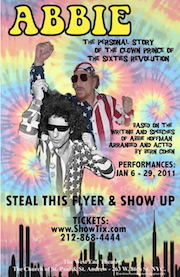
 I see there’s a new one-man show on the boards, “Abbie,” about Abbie Hoffman, starring a lookalike. According to the NYT review, it is “framed as a 1987 talk by Hoffman” covering his upbringing, influences, student activism, and Yippie days, as well as his underground life on the lam. He jumped bail after an arrest for selling cocaine, had plastic surgery to alter his appearance, and made an amazing comeback in plain sight as “Barry Freed,” the alias he took in his battles for the environment in upstate New York and Pennsylvania.
It reminded me of a Los Angeles Times interview I did with him in May of 1988, less than a year before he died. His rap by telephone from Solebury, Pa., where he was living at the time, was the real one-man show. He sounded like an avid sports announcer whose enthusiasm for the game has curdled. Think Bill Murray satirizing Howard Cosell.
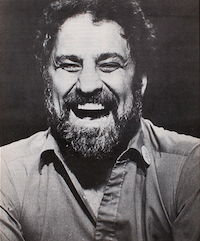 “Look!” Abbie chortled. He was watching the news on his television. “There’s Lech Walesa! Wow! Union solidarity in Poland! Ha! Ha! No way does this TV ever relate to a rebel union leader over here the way it does to Lech! Big dissident! Is he getting his arms broken? His legs? My God! He’s got 50 reporters around him! Wow! He’s in terrible shape! He has a $2-million book contract! Try getting that as an American dissident!”
Abbie was just warming up. It could have been a rehearsal for one of the gleefully outrageous speech/lecture/stand-up routines that he’d been delivering on college campuses around the country.
Here’s the rest of the interview, slightly edited, mainly to put the narrative into the past tense.
He had lectured at Holy Cross on student activism, at Princeton on the CIA, at Tulane on ethics, at Duke on the history of the civil rights movement. The month previous he had appeared in Paris at the Sorbonne and at the University of Puerto Rico in San Juan.
“I have enough frequent-flyer points to leave Earth for a month,” he said.
After nine books, including a couple of best sellers, 53 arrests and a total of 2 1/2 years in jail, he was as embattled as ever. His causes were legion, his tongue-lashings bitterly funny, his arguments with the Establishment unrelenting. He was fighting developers, nuclear power, the rape of the Delaware River, the pollution of the Great Lakes, acid rain.
“I cross the Rockies and I’m a ’60s legend,” he said. “Here I’m still a pain in the neck.”
Hoffman explained that Pennsylvania’s Bucks County authorities had taken away his right to vote on a residency challenge. “That was a naughty thing to do, because even homeless people can vote,” he said. “They didn’t say I had no address. They said I had too many.” He reminded me that the pre-Revolution pamphleteer Thomas Paine used to live in Solebury.
Hoffman’s home was “a former turkey coop,” costing him $400 a month in rent. But he regarded himself as “a nomad. A Jewish road warrior. I do not have a concept of home. I wish I did. But I live with the idea that we have to get out of town before dawn.”
He was proud to tell me that he owned no property, no stocks, no bonds, no insurance, and that he was the father of three grown children (“No yuppies in the litter; make note of that”). He said he earned between $60,000 and $100,000 a year (“Nothing sticks”). For the previous 14 years he had lived with Johanna Lawrenson (“My running mate, we run around”).
His detractors liked to deride him as the court jester of the counterculture and, in fact, humor was always one of the hallmarks of his career. But beneath his wisecracks, Hoffman was a serious grass-roots organizer. He started out with the civil rights movement in 1960, traveled to the South with the Freedom Riders in 1964 and 1965, and founded the Youth International Party, better known as the Yippies, with Jerry Rubin in 1968.
A year later Hoffman achieved his greatest fame as one of the defendants in the “Chicago Seven” conspiracy trial. The trial lasted for 20 weeks and became an unparalleled form of guerrilla theater. Though convicted of riot and contempt charges, Hoffman was exonerated of the original charges by a federal appeals court, in 1972.
By then, however, the Vietnam anti-war movement of the ’60s had dwindled, and in 1973 he was charged with participating in the sale of three pounds of cocaine. Faced with a mandatory life sentence, he jumped bail and went into hiding for the next six years. He had plastic surgery to alter his appearance, lived under many aliases, suffered a brief mental breakdown.
But Hoffman was nothing if not resilient. He staged an astonishing comeback, surfacing as the environmentalist Barry Freed. Under this alias, he organized a Save the River Committee in upstate New York and took on the U.S. Army Corps of Engineers, which wanted a $20-million project to clear the St. Lawrence Seaway for winter navigation.
He became so respected as Freed, who fought the project as a threat not only to the environment but also to the financial health of the Port of New York and other ports on the Eastern Seaboard, that he was singled out for praise by Sen. Patrick Moynihan and invited to testify before a U.S. Senate panel. He was even appointed to a federal water resource commission.
Hoffman finally revealed Freed’s true identity in 1980 and turned himself in to face prosecution. He was convicted of bail jumping and a reduced drug charge and served a year of a three-year prison term. As a graying rebel he continued to make headlines, getting arrested, for instance, at the University of Massachusetts in Amherst, in 1987, with Amy Carter and 58 others who occupied a building to protest CIA recruiting on campus. He also achieved victory in that case with what he called “the necessity defense,” by exploiting a Massachusetts law that made it legal to commit a crime to prevent a greater crime.
“The jury declared us innocent because we proved the CIA was committing a greater crime,” Hoffman said. “Our trial defense is now being imitated by 20 others across the country.” Particularly noteworthy, he believed, was that “the jury of six consisted of four people who voted for Reagan, two of whom didn’t vote, and all of whom described themselves as conservative Americans.”
The summer before my interview with him, he had been arrested three times in an environmental battle with the Philadelphia Electric Co. in Bucks County, Pa. Given his continuing involvement with social causes, I asked why had he shifted gears and “gone showbiz” with a standup comedy routine?
“Am I showbiz?” he said. “I’m an American. I render unto Caesars Palace that which is Caesars Palace in order to get a few simple points across.”
“Funny isn’t the opposite of serious,” he continued. “Silly is the opposite. If I tell racist or sexist jokes or just ethnic jokes, that would be funny for funny’s sake — just like art for art’s sake. I don’t believe in that at all. There is a political impact I’m trying to make. I’m funnier than [Edward] Meese, funnier than [Oliver] North, funnier than [George H.W.] Bush and [Michael] Dukakis combined. I’m not funnier than Ronnie and Nancy. No way. They’ve got astrologers running the country.”
Long before that other ’60s radical-turned-comedian, Timothy Leary, ever took his “standup philosophy routine” on the road, Lenny Bruce had shown how provocative and dangerous comedy could be. It was no coincidence that Hoffman dedicated his second book, Woodstock Nation, to him. He believed that Bruce was the most subversive comic ever. In the late 1950s, he recalled, he used to memorize Bruce’s records.
Some of the points Hoffman wanted to make were not so simple. When I asked about his relationship with former ’60s radicals such as Tom Hayden, who was also a defendant in the Chicago Seven trial, he replied, “I only get asked that question in the West,” implying that Hayden had lost his clout as a national figure.
“I used to refer to him as ‘Mr. Warmth,'” Hoffman went on, “because he was hard-edged, very calculating, theoretician-oriented, not very warm. But if you’re asking how I feel about him, I have to say I have ambivalent feelings.”
After a pause, he said, “The myth is that our generation made all those changes in the ’60s, when it was really just a minority of people who were taking risks with their lives, their careers, their marriages, and he was one of them. I’m not going to deny his historical contribution. But if you’re asking would I rather see him inside the movement for social change instead of outside, as I view him now, of course I’d rather see him inside.”
Hayden and Jane Fonda made “a nice couple,” Hoffman added sardonically, noting that he tended to see Fonda in those years more as a movement activist than as a movie star. “She went beyond the celebrity appearance thing. Plenty of celebrities made appearances and they could speak about three minutes on an issue — maximum. But Fonda could go an hour or two.”
But he had begun to have his doubts. “Look at her,” he said, veering into comedy. “Jumping Jane. Wow! Does she take things serious! I once proposed the idea that Jerry Rubin and Jane Fonda merge. You could have taut strong bodies with shallow minds. You’d have the perfect Yuppie prototype. The Jerry Janes.”
Hoffman maintained that in the post-McLuhan age of television you have to communicate in punch lines because the public’s attention span is so short. That is why even his “serious” campus speeches frequently resorted to comedy, sometimes with surprising results.
He recalled giving a speech at Washington University several months earlier during the Gary Hart fiasco. It was supposed to be broadcast on C-SPAN. “They said they never take a line out of anyone’s mouth. With me they took out the whole speech.” And what did he say that was so terrible that it couldn’t be broadcast? Just a few quips about the Reagans, Barbara Walters, Roy Cohn, Donna Rice and Hart that might have sent them all into cardiac arrest.
But not everybody wanted to censor Hoffman. In 1987 the mayor of Worcester, Mass., Hoffman’s hometown, gave him the key to the city. “I said the right thing to the mayor,” he recalled. “I asked him, ‘Is it the key to get in or out?’ They laughed. They said, ‘He hasn’t changed.’ People don’t want me to change. Would you want me to change?”
The answer to that question was “no.” Not then and not now. I’m sure the new show means well, but I don’t intend to see it.


Hi
Based om what you wrote, all of which I liked, I think you would have liked my one-man show, ABBIE.
Bern