
May I add an annex to The Original Copy: Photography of Sculpture, 1839 to Today, which is now on in New York at The Museum of Modern Art? The MoMA show features works by lotsa biggies — Atget, Bellmer, Brancusi, Brassaï, Duchamp, Frank, Friedlander, Gaillard, Höch, Kertész, Man Ray, Nauman, and too many others to cite. Straight Up features Stephen Deutch (1908-1997), who is little known.
 A longtime friend of Nelson Algren‘s, Deutch was born in Budapest, Hungary. He studied sculpture there at the Royal Academy of Fine Arts.
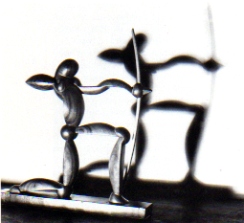
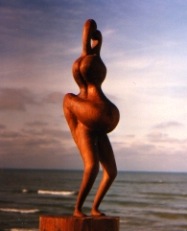
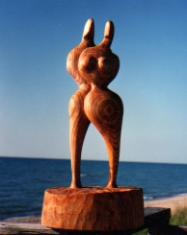
In the ’80s, when Steve and I became best of friends, in Chicago, he was always carving wood pieces. They were invariably sensual abstractions of the human form, as you can see from the photos. But while he kept his hand in as a sculptor, he made his living as a commercial photographer.
Archer, 1933-34, Wood sculpture, Paris
Steve and his wife Helene arrived in Chicago in 1936, from Paris, where she had been working as a fashion photographer. Helene taught him her trade. “I was a pretty good photographer,” she recalled in an interview for a retrospective essay by Abigail Foerstner in Stephen Deutch, Photographer. “With his sense of lighting, Steve brought everything alive.” Foerstner writes:
Lovers, ca. 1989, Wood carving
They opened their first studio in Chicago within weeks of their move to the city. They had arrived during a remarkable era of American photography. In 1935, a corps of photographers began roaming the country in what would become an eight-year odyssey to record the ravages of the depression for the Farm Security Administration. …
Most photographers signed up for a career in the arts, the studio or on the streets as photojournalists. But Deutch straddled all three camps with his magazine photo essays about Lena Horne, Joe Louis and Duke Ellington and his maverick studio style that gave commercial shots an unstaged spontaneity. Most poignant of all was his work as an artist on self-assigned projects that captured the life of a city from its blustering politicians to its mentally wounded. From start to finish, from Paris to Chicago, he sculpted with light in photographs that tell a story of the connectedness of all things.
Kama Sutra #2, ca. 1989
 Compassion was perhaps an even greater touchstone of his work than sensuality. This is especially clear in his photojournalism, whether it was his “Twilight World” series of 1964-65 about the Dixon School for the Mentally Retarded, which was published by the Chicago Daily News and nominated for a Pulitzer Prize, or his “Bench Sitter” series of the mid-1950s, about which Studs Terkel wrote:
Aside from Edward Hopper and his use of light in accentuating loneliness, I know of no one else who has so poignantly captured that feeling as Deutch does in his bench people. We see two elderly ones sharing a park bench, yet they are at a distance from one another: far apart and back to back. In the background, casually dominant, is a sports-car dealership; “JAGUAR” is the only word we see. It is enough. At the school for retarded children, we see one: she has bedecked herself with assorted dolls as elegantly as a young society matron in sable furs. She, too, is someone to reckon with.
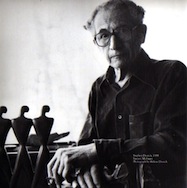
Stephen Deutch [Photo: Helene Deutch]
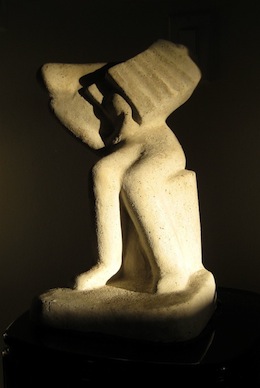 There could have been no warmer friend than Steve. But his warmth was available to anyone. This is evident not just in his work as a photojournalist. Consider “Clochard,” a concrete casting from the early 1930s, which portrays a blind accordion player he saw in the Paris metro. Steve captured the humanity of the figure, it seems to me, while avoiding the least hint of sentimentality. Not too shabby.
Clochard, ca. early 1930s, Paris [Photo: JH]
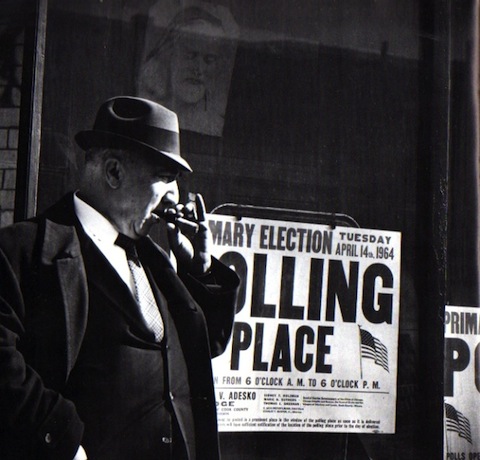
And just for the record, Steve was no pushover. See this:
The Boss, South Side polling station, Chicago, 1964 [Photo: Stephen Deutch]
(Crossposted at HuffPo)
To add to Jan’s lovely and fitting tribute to my father, for those who’d like to learn more about him, I’d like to mention my 1979 documentary, “Pista: The Many Faces of Stephen Deutch.” Part of his extensive collection at the Chicago Historical Museum, “Pista” (meaning Stevie in Hungarian) features both his sculptures and photographs, with appearances by his gifted wife, Helene and his dear friends, Nelson Algren and Studs Terkel, with music by the noted Fine Arts Quartet, who perform live in the film. If you search a bit, you can also find stray copies of his book, “Stephen Deutch, Photographer — From Paris to Chicago, 1932-1989,” by Abigail Foerstner, with a foreword by Studs (TriQuarterly Books 1989). As Jan, Nelson, and Studs would agree, Steve Deutch should indeed be counted among the greats!
Thanks, Kat. The museum has put the inventory of the Stephen Deutch Photograph Collection online in two parts. Part 1 is here: http://chsmedia.org/media/fa/fa/1980/58.htm . Part 2 is here: http://chsmedia.org/media/fa/fa/1989/152.htm . — Jan
to still be relevant and loved. to inspire the heart of youth and stir the mind to create. still, so many years passed. yet the work captures a moment of time. his understanding and use of that found wisdom in his work, shown through the non-static areas of the positive, negative space. splendid. much to learn from this artist, this man.
thanks to the family and the museum. you are doing what i wish was done more often, sharing great works of art, that can teach, well beyond their time.
Shray
http://www.shraybronze.com/
Steve and Helen Deutch were treasured friends with whom my wife, Diana, and I spent many rewarding hours. His friendship enriched my life and his dedication to his work was an inspiration for me in my own.
For all his artistic achievements Steve remained a fervent opponent of pretence or hypocrisy. During his last days of life when I visited him in the hospital and stood beside his bed, finding speech difficult he motioned me closer. Thinking he would offer me some poignant final words of farewell, I bent closer only to hear Steve whisper, “Sit down.”
A poet has written that life without a friend is death without a witness. I am grateful that Steve and I were witnesses for one another.
— Harry Mark Petrakis
See: http://www.harrymarkpetrakis.com/bio.html — JH