
J.G. Ballard, R.I.P.

In London The Guardian posted its obit Sunday at 9 p.m., which means it went live in New York at 4 p.m. But this morning's print edition of The New York Times makes no mention of Ballard's death.

OK, print is slow -- but not that slow. And how come there's no obit on the NYT Web site either? Not even a link as of 8:50 a.m. ET this morning on its obit page, which looked like this. (Screen grab, right).

It's not as if the news was The Guardian's alone. Or that Ballard was unimportant. Here's the lede from the obit in The Times of London:

Pinteresque, Dickensian, Shakespearean. Not many writers are so distinctive and influential that their name becomes an adjective in its own right. J. G. Ballard, who died yesterday morning after a long battle with cancer at the age of 78, was one of them.

It goes on to cite the dictionary definition of "Ballardian" as especially suggestive of "dystopian modernity, bleak man-made landscapes and the psychological effects of technological, social or environmental developments."

I heard about Ballard's death from a friend via email at 7:10 p.m. ET on Sunday. And another friend at realitystudio.org let me know at 8:29 pm ET: "There's already a thread on the RS forum."

The Telegraph's obit was posted Sunday at the equivalent of 4:53 p.m. ET. The BBC had an obit posted at the equivalent of 5:19 p.m. ET. And Yahoo posted the AP obit at 11:40 pm ET.

There were other postings, too, like Michael Moorcock's, which was probably the earliest, or the blogpost at REsearch and the one at Ballardian. Even the Los Angeles Times has posted an obit and, what's more, an appreciation. So somebody was asleep at my paper of record.

(Crossposted at Huffpo)
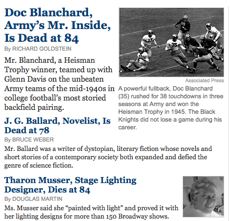
Postscript: April 21 -- This morning's NY Times carried a well-made Ballard obit, describing him as "a writer of dystopian, literary fiction whose novels and short stories of a contemporary society in insidious thrall to technology, the media and relentless progress both expanded and defied the genre of science fiction."

Bravo for that. It's nice to know the editors were not too busy celebrating the paper's five Pulitzer Prizes to overlook the news of his death. It would have been nicer, though, had they acknowledged his importance by playing it on the Web site's obit page above Doc Blanchard's. Ballard is likely to be remembered in the historical record long after "a Heisman Trophy winner [who] teamed up with Glenn Davis on the unbeaten Army teams of the mid-1940s," no matter how "storied [that] backfield pairing" was.

Meanwhile, Michael Moorcock has posted a striking tribute to Ballard, who was a close friend of his for 50 years. It is heartfelt and revealing, and offers personal history as well as literary context.

April 20, 2009 9:08 AM | | Comments (0)

Leave a comment

Me Elsewhere

'WILD SIDE' STILL ROCKS 

Nelson Algren was one of the great American authors of the 20th century, it is no exaggeration to say, and among the most neglected. Consider his underrated classic, "A Walk on the Wild Side." The title -- popularized and co-opted as an idiomatic phrase by Hollywood and Madison Avenue (institutions Algren loathed) -- is familiar to most anyone who speaks English or knows Lou Reed's lyrics. But the novel itself? Hardly.

BUSTER KEATON REVISITED 
Buster Keaton: Tempest in a Flat Hat is not a biography. "This book is merely a fan's notes," Edward McPherson writes in the introduction, although his publisher ignores the disclaimer and calls it a biography on the cover. In fact, the book is a bit of both, a difficult combination to bring off unless you're David Thomson, who set the standard with Rosebud, his penetrating rumination on the life and career of Orson Welles, which was nothing if not a distillation of every obsessive thought he ever had about the myth and the man and all his movies.
LAUREN BACALL, STILL SALTY AT 80 
When Lauren Bacall writes that her singing voice ranges "somewhere between B minus sharp and outer space," she's being candid and funny. It's not every stage star with two Tony Awards for best actress in a musical whose vocal talent offers so little promise. (OK, Harvey Fierstein excepted.) Still less would one admit it.
THE STARS ACCORDING TO BOGDANOVICH 
Peter Bogdanovich's superb collection of movie-star profiles and interviews -- a sequel to Who the Devil Made It, his interviews of top film directors -- begins with an affectionate tale about Orson Welles that reminds us just how intimate the author's connection to Hollywood's greatest has been. But contrary to what we've come to expect from dime-a-dozen celebrities and celebrity interviews not worth two cents, the tale avoids bromidic egotism and journalistic platitudes.
HERMAN WOUK'S LATEST 
It's hard to say which comes off worse in Herman Wouk's latest novel, his first in a decade: the U.S. Congress or the American press. "A Hole in Texas" offers the choice between two emblematic stereotypes: a red-faced opportunist who heads the House Armed Services Committee and a mustachioed investigative reporter for the Washington Post.
more picks

Sites to See

About this Entry

This page contains a single entry by Straight Up | published on April 20, 2009 9:08 AM.

Emily SmartPhones was the previous entry in this blog.

More Notes From Nowhere is the next entry in this blog.

Find recent content on the main index or look in the archives to find all content.

AJ Ads

Introducing
AJ Arts Blog Ads

Now you can reach the most discerning arts blog readers on the internet. Target individual blogs or topics in the ArtsJournal ad network.

Advertise Here

AJ Blogs

AJBlogCentral | rss

culture
About Last Night
Terry Teachout on the arts in New York City
Artful Manager
Andrew Taylor on the business of arts & culture
blog riley
rock culture approximately
critical difference
Laura Collins-Hughes on arts, culture and coverage
Dewey21C
Richard Kessler on arts education
diacritical
Douglas McLennan's blog
Dog Days
Dalouge Smith advocates for the Arts
Flyover
Art from the American Outback
Life's a Pitch
For immediate release: the arts are marketable
Mind the Gap
No genre is the new genre
Performance Monkey
David Jays on theatre and dance
Plain English
Paul Levy measures the Angles
Real Clear Arts
Judith H. Dobrzynski on Culture
Rockwell Matters
John Rockwell on the arts
Straight Up |
Jan Herman - arts, media & culture with 'tude

dance
Foot in Mouth
Apollinaire Scherr talks about dance
Seeing Things
Tobi Tobias on dance et al...

jazz
Jazz Beyond Jazz
Howard Mandel's freelance Urban Improvisation
ListenGood
Focus on New Orleans. Jazz and Other Sounds
Rifftides
Doug Ramsey on Jazz and other matters...

media
Out There
Jeff Weinstein's Cultural Mixology
Serious Popcorn
Martha Bayles on Film...

classical music
Creative Destruction
Fresh ideas on building arts communities
The Future of Classical Music?
Greg Sandow performs a book-in-progress
On the Record
Exploring Orchestras w/ Henry Fogel
Overflow
Harvey Sachs on music, and various digressions
PianoMorphosis
Bruce Brubaker on all things Piano
PostClassic
Kyle Gann on music after the fact
Sandow
Greg Sandow on the future of Classical Music
Slipped Disc
Norman Lebrecht on Shifting Sound Worlds

publishing
book/daddy
Jerome Weeks on Books
Quick Study
Scott McLemee on books, ideas & trash-culture ephemera

theatre
Drama Queen
Wendy Rosenfield: covering drama, onstage and off
lies like truth
Chloe Veltman on how culture will save the world

visual
Aesthetic Grounds
Public Art, Public Space
Another Bouncing Ball
Regina Hackett takes her Art To Go
Artopia
John Perreault's art diary
CultureGrrl
Lee Rosenbaum's Cultural Commentary
Modern Art Notes
Tyler Green's modern & contemporary art blog
Creative Commons License
This weblog is licensed under a Creative Commons License.