
Now that America has elected a black fist bumper to the presidency, take a look at the newspaper he has in his hand. Take a close look. The photo, shot during the election campaign, shows him carrying The Wall Street Journal.
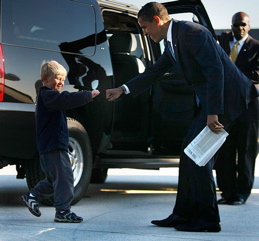 As everybody knows, the Journal’s editorial page falls somewhere between Barry Goldwater and Attila the Hun. It is even further to the right than Bill Kristol, the doofus whose unreadable, once-a-week column was added to the opinion pages of The New York Times to “balance” its so-called liberals.
Nevertheless, it is the Journal in a column this morning by the eminently readable Thomas Frank — a once-a-week addition to the Journal’s opinion pages to balance all the resident rightwingers — that puts Barack Obama’s election victory in the proper perspective.
What grabs Frank’s attention is not so much the new tactics that Obama brought to the campaign — all that Internet reach, for instance, which made possible his humongous fund-raising in small donations. It’s what he and the Democrats did that was old. Frank writes that “2008 made retro politics cool again.” And he’s not talking about the old-style “ground game” of get-out-the-vote volunteers, either.
In place of a showdown between a folksy “middle America” and a snobbish “liberal elite,” Democrats needed to offer the real deal — the conflict between a public that craves fairness and an economic system that enables the predatory. …
Watching the Dow get hacked down, seeing the investment banking industry collapse, hearing about the lavish rewards won by the corporate officers who brought this ruin down on us — all these things combined to make a certain Depressionesque fury the unavoidable flavor of the year. When your mortgage is under water and your neighbors are being laid off, the need to take up the sword against arrogant stem-cell scientists becomes considerably less urgent.
Equally important, it’s also what the BananaRepublicans did that was old, which led to their massive defeat. “The Republican response, of course, was to double down on the righteous rhetoric of red-state grievance and spin the wheel one more time,” Frank notes.
So make no mistake: Despite a peculiar headline doubtless written by a diehard rightwing opinion-page editor — “Conservatism Isn’t Finished” — which distorts the column’s essential point, Frank attributes the Gasbag‘s loss to his BananaRepublican themes, out-of-touch arrogance, and over-the-top contradictions.
(Crossposted at HuffPo)
For those who can’t access Frank’s column, here’s an excerpt:
John McCain’s campaign was not just another culture-war offensive; it was a flamboyant pantomime, grotesquely exaggerated in each of its parts, and, ultimately, separated from the life of the everyday Americans it claimed so extravagantly to revere. It was “overripe,” to borrow the term Johan Huizinga used to describe late Medieval culture. The campaign’s vision of America was like a Norman Rockwell painting in which all the figures wear flag pins and weep swollen, steaming tears for their betrayed homeland.
What previous Republican campaigns had whispered, this one screamed. What had been contained to the movement’s feverish fringes moved to center stage.
Traditional Republican talk about the heartland became Sarah Palin’s “real America,” with other campaign officials speculating about precisely where the realness started and stopped. Conventional appeals to the working class became “Joe the Plumber” and a cast of supporting hardhat caricatures. An unremarkable Obama reference to progressive taxation became “socialism,” there was conjecture by Rep. Michele Bachmann, Republican of Minnesota, about his “anti-American views,” and one almost longed for the naïve stages of the campaign, when the Democrat’s elitism would be established by sly references to arugula.
Media bias has been a favorite theme of the right for decades, of course. But apart from Spiro Agnew, this aspect of conservatism was mainly the province of the movement, not the leadership. The McCain campaign, which owed more to the media than any Republican effort in years, brought it back into the mainstream with relish. The amazing Mrs. Palin even persuaded herself that the press was violating her First Amendment rights when it criticized her, and Republican audiences rediscovered the joy of booing the media.
Full disclosure. I voted for Ralph. And I don’t mind booing the corporate media myself, but for its rightwing bias.
Postscript: Nov. 7 — Because of something Ralph Nader said on Election Day — he asked whether Barack Obama was going to be an Uncle Sam or an Uncle Tom — I feel obliged to take note of it here.


